

An elite boutique investment bank is an independent advisory firm that works on mergers, acquisitions, and restructurings as large as the ones the biggest banks handle, often worth more than $1 billion, but does not lend money or run a large trading business. In 2026 the term covers a core group of seven firms: Evercore, Lazard, Centerview Partners, PJT Partners, Moelis & Company, Perella Weinberg, and Qatalyst Partners. Five of them are listed in the United States. Their 2025 annual reports show revenue of $751 million to $3.86 billion each, and the four that report advisory pay separately spent $718,000 to $973,000 on compensation per employee, support staff included.
For someone planning a career in private equity, the category matters for two reasons. Elite boutiques advise on many of the largest buyouts and take-privates, usually as the adviser to the company being sold or to its board. And a few of them, Evercore above all, place analysts into the largest buyout firms at rates close to Goldman Sachs and Morgan Stanley, while others in the group place very few.
What an elite boutique is
An elite boutique sells advice. Its bankers tell a company's board whether to sell, how to run the sale, what price to accept, how to defend against an unwanted bid, or how to restructure debt the company cannot pay. The firm earns a fee, most of it paid only if the deal closes. It does not commit loans to fund the deal, it does not underwrite bond issues on its own balance sheet, and it has no large sales and trading floor. Evercore's 2025 annual report states the consequence: "the fact that we do not provide financing or otherwise commit capital to clients" can hurt its mergers and acquisitions (M&A) business when credit markets are tight.
What makes a boutique "elite" is the size of its deals. Thousands of small advisory firms, also called boutiques, sell companies worth tens of millions of dollars in one region or industry. The elite group advises on transactions that would otherwise go to bulge bracket banks such as Goldman Sachs and JPMorgan, and it often advises alongside them. Among its recent mandates, Centerview's website lists adviser to Kenvue on its $48.7 billion sale to Kimberly-Clark (November 2025) and exclusive financial adviser to Walgreens Boots Alliance on its take-private by Sycamore Partners (March 2025).
The firms do not use the label themselves. In their filings and in interviews they call themselves independent investment banks or independent advisers. Evercore describes itself as a firm "free of the potential conflicts of interest created within large, multi-product, capital intensive financial institutions." Students say "elite boutique" or "EB"; bankers and clients usually say "the independents."
Elite boutiques are not all advice-only. Evercore runs an equities business, Evercore ISI, that publishes research and trades stocks. Lazard runs a large asset management business. Perella Weinberg owns Tudor, Pickering, Holt & Co., an energy investment bank with research and trading. PJT Partners has PJT Park Hill, which raises money for private equity and other private funds. What none of them does is lend.
Why they grew after 2008
The modern group mostly dates from the decade around the 2008 financial crisis. Lazard was founded in 1848 and is the old exception. Evercore was formed in 1995 by Roger Altman, a former deputy secretary of the U.S. Treasury, according to the firm's leadership page. Perella Weinberg opened offices in New York and London in June 2006 with ten senior partners. Centerview was founded in 2006, Moelis & Company in 2007, and Qatalyst, led by the technology banker Frank Quattrone, in 2008. PJT Partners began trading on October 1, 2015, after Blackstone combined its own advisory business with PJT Capital, the firm Paul J. Taubman founded in 2013, and distributed the result to Blackstone's shareholders.
The crisis helped them in two ways. Senior bankers left the large banks, some of which had failed or been rescued, for firms they could own. And boards became warier of advisers whose parent banks also lent to, traded with, or invested in the other side of a deal. By 2014 the Financial Times, The New York Times, and The Economist had all written about companies moving M&A mandates to independent firms for that reason.
The elite boutiques in 2026
Most current lists agree on the core seven. They differ on whether to add Allen & Company, Guggenheim Securities, Rothschild & Co, LionTree, and a few younger firms. Centerview and Qatalyst are private partnerships and publish no financial results.
| Firm | Founded | Headquarters | 2025 revenue | People, end of 2025 | Known for |
|---|---|---|---|---|---|
| Evercore | 1995 | New York | $3.86bn net revenue ($3.77bn Investment Banking & Equities) | about 2,570, with 2,100 in investment banking and equities | Largest elite boutique; M&A, restructuring, Evercore ISI research |
| Lazard | 1848 | New York | $1.83bn financial advisory ($3.10bn firm, with asset management) | 216 managing directors and 1,358 other staff in financial advisory | Oldest firm; M&A, restructuring, sovereign advice, Europe |
| PJT Partners | 2015 | New York | $1.71bn | 1,224, including 133 partners | Restructuring and Special Situations; Park Hill fundraising |
| Moelis & Company | 2007 | New York | $1.52bn | 1,416, including 178 managing directors | M&A and restructuring; generalist analyst pool |
| Perella Weinberg | 2006 | New York | $751m | 736 | M&A, restructuring; energy through Tudor, Pickering, Holt |
| Centerview Partners | 2006 | New York | Private | Not published | Large-company M&A, special committees, activism defense |
| Qatalyst Partners | 2008 | San Francisco | Private | Not published | Technology M&A only |
Sources: 2025 Form 10-K filings of Evercore, Lazard, PJT Partners, Moelis & Company (headcount as of February 4, 2026), and Perella Weinberg; Centerview and Qatalyst websites.
Evercore is the largest by a wide margin, with more than twice the advisory revenue of Lazard. Its revenue rose 29 percent in 2025 as completed M&A recovered. Moelis grew 27 percent and PJT 15 percent. Perella Weinberg's revenue fell 14 percent, from $878 million in 2024. Moelis also changed leaders: Navid Mahmoodzadegan, a co-founder, became chief executive on October 1, 2025, and Ken Moelis became executive chairman.
Borderline firms
Allen & Company is a private, low-profile media and technology adviser that appears on many lists and is left off others because its deal volume swings from year to year. When it does lead a deal, the deal is large. Activision Blizzard's 2022 merger proxy shows Allen & Company as its financial adviser on the $95-a-share sale to Microsoft, for an aggregate fee of $65 million, $10 million on delivery of its opinion and $55 million on closing.
Guggenheim Securities, part of Guggenheim Partners, advises on large healthcare and media deals and is sometimes classed as an elite boutique and sometimes as a middle-market bank. Rothschild & Co is one of Europe's leading M&A and restructuring advisers and is less prominent in the United States. LionTree (founded in 2012) and The Raine Group are media and technology advisers with small teams and some very large deals. Younger firms such as Zaoui & Co. and Dyal Co. are usually treated as too new to judge.
Firms that have been absorbed
Two firms still found on 2026 lists are no longer independent. Mizuho Financial Group completed its acquisition of Greenhill on December 1, 2023, and Greenhill now operates inside a lending bank. Evercore acquired Robey Warshaw, a small London adviser known for very large British deals, in 2025; its 10-K counts five Robey Warshaw senior managing directors among the 18 investment banking senior managing directors who joined that year. Lists that show Greenhill or Robey Warshaw as stand-alone elite boutiques predate those deals.
Banks that are not elite boutiques
Jefferies, Houlihan Lokey, Piper Sandler, Baird, William Blair, and Harris Williams appear on some boutique lists but are not elite boutiques by the usual test. Jefferies is a full-service bank that trades, publishes research, and lends through a joint venture. The others are middle-market banks that mostly advise on smaller companies, though Houlihan Lokey's restructuring group competes with the elite boutiques for large bankruptcy and creditor mandates. Specialist firms such as FT Partners (financial technology), Leerink Partners (healthcare), and Ducera Partners (restructuring) are strong in their sectors and usually classed as industry boutiques.
How the elite boutiques compare with each other
Rankings of elite boutiques move more than rankings of the large banks, because each firm advises on fewer deals and one large mandate can lift it many places in a league table. League tables also add up every deal a bank touched, including stock and bond offerings, which favors banks that underwrite. A review of league tables by Mergers & Inquisitions, a banking career site, found Evercore, Lazard, and Centerview the elite boutiques most consistently in the global top ten by M&A volume, with Rothschild consistent mainly because of its European business. Moelis and Qatalyst have ranked above some bulge brackets in some years and outside the top 20 in others, and Perella Weinberg rarely ranks high by total volume even when it advises on very large deals.
There is no official ranking, and the informal ones disagree. A widely cited 2018 Wall Street Oasis thread put PJT, Centerview, Evercore, and Qatalyst in its top tier and Lazard, Moelis, and Perella Weinberg in the second. A 2025 ranking by the YouTube creator rareliquid, a former JPMorgan analyst, put Evercore, Centerview, Qatalyst, and PJT at the top, Lazard, Moelis, and Perella Weinberg next, and Rothschild, Guggenheim, LionTree, Raine, and Allen & Company below. What the lists agree on is short. Evercore and Centerview are in the top group on almost every list, and Perella Weinberg and Greenhill are usually lower.
The more useful comparison is by group, because each elite boutique is known for one or two teams. PJT's Restructuring and Special Situations group, which advises companies and creditors in Chapter 11 cases and out-of-court restructurings, says it ranked first in both global and U.S. announced restructurings in three of the last four years. Qatalyst does nothing but technology. Moelis is known for restructuring and, according to Career Principles and rareliquid, for staffing analysts as generalists across M&A and restructuring work. Lazard is known for restructuring and runs a Sovereign Advisory Group that advises countries on their debt. Group strength at a firm is not the same as placement at a particular fund.
Elite boutiques vs bulge brackets and middle-market banks
Three differences separate elite boutiques from the bulge brackets and from middle-market banks.
The first is lending. A bulge bracket can advise a buyer and also commit billions of dollars of debt to pay for the purchase. An elite boutique can only advise, so on a large buyout the private equity buyer hires lending banks for its financing and the target's board often hires an elite boutique for advice.
The second is conflicts, and a merger proxy shows them in numbers. When Sycamore Partners agreed in March 2025 to take Walgreens Boots Alliance private for $11.45 a share in cash plus a right to future asset-sale proceeds, the Walgreens board had two financial advisers. The June 2025 proxy says Centerview had not worked for Sycamore in the previous two years and had received nothing from it. Morgan Stanley, the second adviser, disclosed that in the same two years it had earned $5 million to $15 million from financing services for Sycamore and its affiliates, was a lender to Sycamore affiliates under revolving credit facilities, and with its affiliates held 2 percent to 3 percent of Walgreens' stock. Sycamore's debt came from a group of lenders that included Wells Fargo, JPMorgan, Goldman Sachs, UBS, and Citigroup. The proxy describes Centerview advising Walgreens through the negotiations with Sycamore, for an aggregate fee of about $60 million; Morgan Stanley, which delivered a second fairness opinion, was due $10 million.
The third is size. Elite boutiques work on larger deals than middle-market banks, but they are much smaller firms than the bulge brackets. Goldman Sachs reported headcount of 47,400 at the end of 2025 in its 2025 Form 10-K. Evercore, the largest elite boutique, had about 2,570.
Smaller boutiques
Below the elite group sit three other kinds of boutique. Industry boutiques such as FT Partners, Leerink Partners, and Seabury cover one sector in depth. Regional boutiques, usually 5 to 50 people in one or two offices, advise on sales of companies worth less than about $50 million. Firms founded recently by star bankers, such as Zaoui & Co. and Dyal Co., can work on very large deals with very small teams. Analysts at all three can reach private equity, mostly at middle-market and lower-middle-market firms, but the path to the largest funds usually runs through a larger bank first.
What an elite boutique does on a buyout
Private equity firms meet elite boutiques at three points. When a buyout firm bids for a public company, the target's board often hires an elite boutique to run the process and issue a fairness opinion, the letter saying the price is fair to shareholders from a financial point of view. When the buyer is affiliated with management or a large shareholder, a special committee of independent directors usually hires its own adviser, and elite boutiques take many of those mandates; Centerview's site lists its work for the special committee of Endeavor on its 2024 sale to Silver Lake. And when a portfolio company runs into trouble, a restructuring group at PJT, Lazard, Evercore, Moelis, or Houlihan Lokey advises the company or its creditors.
Elite boutiques also advise private equity firms directly, mostly on sales of portfolio companies and on large acquisitions where the buyer wants independent advice separate from its lenders. Several have built private-capital businesses for the same clients. PJT Park Hill raises money for private funds and advises on secondary transactions that give fund investors liquidity, Evercore's Private Capital Advisory and Private Funds Group teams do similar work, and Perella Weinberg bought Devon Park, a secondaries adviser founded in 2021.
The fee pattern on large public deals is consistent. Most of the fee is paid at closing, a smaller part when the opinion is delivered, and large deals can pay a single adviser more than $50 million: Allen & Company's $65 million on Activision Blizzard and Centerview's about $60 million on Walgreens both appear in the proxies.
Pay at elite boutiques
Elite boutiques have a reputation for paying more than the large banks, and the public filings support the claim at the firm level. Compensation is the largest cost at every advisory firm, and the listed elite boutiques spend about two-thirds of their revenue on it.
| Firm, 2025 | Compensation and benefits | Share of revenue | Employees | Compensation per employee | Revenue per employee |
|---|---|---|---|---|---|
| Evercore | $2.50bn | 64.9% | about 2,570 | about $973,000 | about $1.50m |
| PJT Partners | $1.16bn | 67.6% | 1,224 | about $946,000 | about $1.40m |
| Perella Weinberg | $535m | 71.3% | 736 | about $727,000 | about $1.02m |
| Moelis & Company | $1.02bn | 67.1% | 1,416 | about $718,000 | about $1.07m |
Calculated from each firm's 2025 Form 10-K: total compensation and benefits expense (including equity-based pay) divided by year-end headcount and by net revenue. Lazard is left out because its filing reports firm-wide compensation with asset management included.
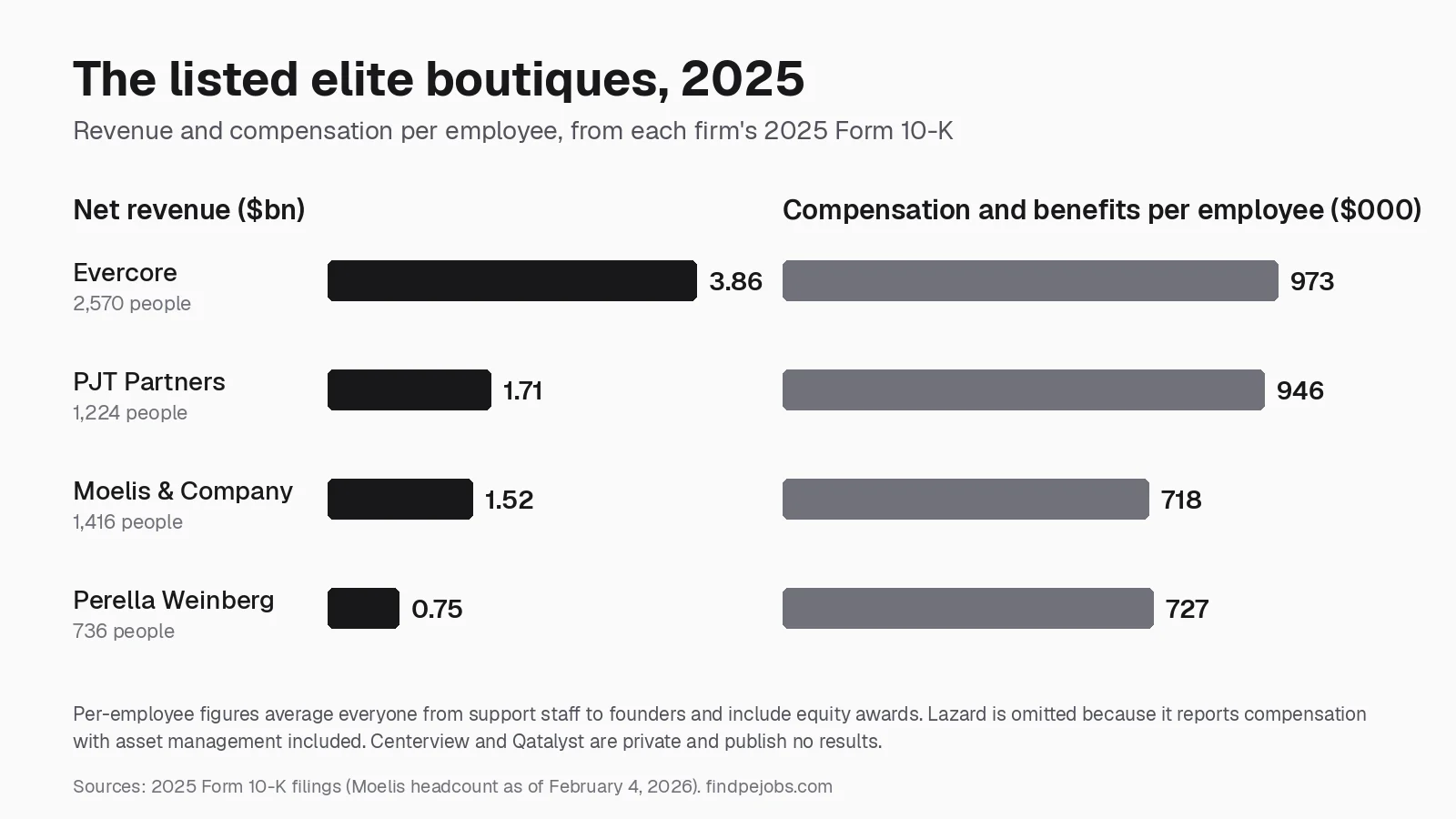
These are averages over everyone, from receptionists to the founders, and include stock awards, so they say little about what a first-year analyst earns. No elite boutique publishes analyst pay. Recruiting firms and training companies publish estimates. Career Principles, a finance training company, puts first-year total pay at Centerview around $220,000 and at Evercore and Qatalyst around $210,000, without a source. The clearer gap is at mid-level. Travillian, a finance recruiting firm, posted in May 2026 that vice presidents earned $820,000 or more at elite boutiques against $545,000 to $580,000 at bulge brackets, and directors about $970,000 against about $725,000.
Senior pay is not all cash. Evercore pays part of its bonuses in deferred cash and restricted stock units, and the other listed firms grant equity that vests over several years. Career Principles and rareliquid both put Centerview and Qatalyst at or near the top of the industry for pay, but as private partnerships the two firms disclose nothing.
Working at an elite boutique
The case for an elite boutique offer rests on the work. Deal teams are smaller, so an analyst does more of the analysis, sees senior bankers and clients sooner, and spends less time on formatting and internal approvals. The work is concentrated in M&A and restructuring, which is closer to the work of a private equity associate than most capital markets jobs are. Pay is high at every level, and the firms suit people who want to stay in banking and become senior advisers, because the partnership culture rewards client relationships.
The case against starts with the brand. Outside finance, few people have heard of Centerview or PJT, which matters for anyone who might later leave for a company, a startup, or business school. The alumni networks are smaller than those of the large banks, because the firms are younger and hire fewer people each year. Experience varies more than at a large bank. Evercore's M&A group in New York and a small industry team in a regional office of a smaller firm are very different jobs, and firms built around a few senior bankers can lose deal flow when those bankers leave. Hours are long everywhere. In rareliquid's ranking, the former JPMorgan analyst describes Moelis's Los Angeles office as one of the hardest-working teams in banking, with exits to match.
Some firms also expect analysts to stay longer. Career Principles and rareliquid both describe Centerview's analyst program as three years rather than the usual two, with leaving early for private equity frowned upon, and the firm pays in a way that makes staying attractive. That norm is not written in any public document, so candidates should ask current analysts how it works in their group.
Getting hired at an elite boutique
Elite boutiques hire small analyst classes. Mergers & Inquisitions estimates that together they make only a few hundred entry-level front-office hires worldwide each year, against thousands at the bulge brackets. Most of those hires come through summer internships offered about 18 months before the internship starts.
Several elite boutiques now open applications before the large banks. Extern, a career-training company that checks bank career sites weekly, shows in its tracker updated October 9, 2026 that Evercore opened its summer 2028 program on September 9, 2026, closes it on November 15, and does not review applications on a rolling basis. Moelis posted its Houston summer analyst role on October 5, with its other U.S. offices expected in late December. Perella Weinberg's Tudor, Pickering, Holt energy program in Houston closes on November 10, with its main U.S. advisory program expected in mid-November. Lazard, Rothschild, and Qatalyst are expected in December, and PJT and Centerview in January 2027, around the same time as Goldman Sachs and Morgan Stanley. Sophomore programs that feed those classes, including Moelis's (October 22) and Perella Weinberg's (October 25), close earlier.
The firms screen hard on technical skill and on a specific reason for wanting independent advisory work. Candidates should be able to discuss a recent deal the firm advised on, explain why a board would hire an independent adviser, and handle accounting, valuation, and merger-model questions. In Extern's analysis of the LinkedIn profiles of 756 summer analysts at 16 banks in the classes of 2025 and 2026, students from non-target schools made up 4 percent of the class at PJT Partners, against 35 percent at JPMorgan. A candidate from a school where the firms do not recruit has better odds through networking with alumni and through middle-market banks first.
From an elite boutique to private equity
The strongest data on placement comes from a March 2026 study by 10X EBITDA, a recruiting-training firm, of about 300 LinkedIn profiles of investment banking analysts who became associates at Apollo, Blackstone, Carlyle, CD&R, KKR, Thoma Bravo, and TPG in the classes of 2020 through 2025. Its findings on elite boutiques:
- Evercore was one of three banks, with Goldman Sachs and Morgan Stanley, that together supplied about half of the associates.
- The funds hired "overwhelmingly" from Evercore's M&A group and only occasionally from Evercore restructuring.
- Allen & Company, Perella Weinberg, Greenhill, and Qatalyst, along with Deutsche Bank, together supplied less than 1 percent.
- The New York office mattered more than the group: only about 5 percent of New York associate seats went to analysts in regional offices.
- Elite boutiques are a strong feeder only in the United States. Outside it, the study says, they "are uncompetitive for buyside recruiting."
The gap between a firm's reputation and its placement at a given fund can be large. Qatalyst sits at the top of most practitioner rankings for technology banking yet barely appears in the megafund data. The study covers only seven buyout firms, so it says nothing about placement at technology growth investors or venture capital firms. A user on X who counted the associates Hellman & Friedman lists on its website in March 2026 found none from Qatalyst, one from PJT restructuring, and five from Goldman Sachs.
The mechanism behind the numbers is the headhunter. For the largest funds, on-cycle recruiting runs through a few search firms that build their lists from the analyst classes of the banks their clients hire from. Mergers & Inquisitions notes that headhunters contact elite boutique analysts directly, which is part of why the New York offices of the larger elite boutiques place well. Analysts at the lower-placing firms and in regional offices more often move into middle-market private equity, growth equity, or a second banking job first. Firms that post associate roles are listed on Private Equity Jobs.
Common questions
Is Lazard an elite boutique?
Yes. Lazard is the oldest firm in the group, founded in 1848, and its financial advisory business earned $1.83 billion in 2025. It also runs a large asset management business, which the other elite boutiques do not.
Is Jefferies an elite boutique?
No. Jefferies is a full-service bank with trading, research, and lending, usually described as a middle-market or challenger bank. Its investment banking revenue for the year to November 2025, $3.79 billion, was about the same as Evercore's, but it does not fit the advice-only model.
Is Houlihan Lokey an elite boutique?
No, by most definitions. Houlihan Lokey is an advisory firm that does not lend, but most of its M&A work is for middle-market companies. Its restructuring group competes directly with the elite boutiques for large cases.
Is Rothschild an elite boutique?
In Europe, Rothschild & Co is one of the leading independent advisers and is often counted. In the United States it is less prominent, and many U.S. lists leave it out or place it lower.
What happened to Greenhill?
Mizuho Financial Group bought Greenhill and completed the deal on December 1, 2023. Greenhill now operates as part of a Japanese lending bank and is no longer independent.
Which elite boutique pays the most?
Among the listed firms, Evercore and PJT Partners had the highest compensation per employee in 2025, about $973,000 and $946,000. Centerview and Qatalyst are private; recruiting guides put their pay at or above that level, but the firms publish no figures.
Do elite boutiques lend money?
No. None of the elite boutiques commits loans to clients. Some underwrite or trade stocks (Evercore ISI) or raise money for private funds (PJT Park Hill), but a buyer that needs debt financing hires a lending bank.
Sources
Form 10-K annual reports for 2025 of The Goldman Sachs Group, Evercore, Lazard, PJT Partners, Moelis & Company, and Perella Weinberg (SEC EDGAR, filed February and March 2026); Walgreens Boots Alliance definitive proxy statement (DEFM14A), June 6, 2025; Activision Blizzard definitive proxy statement (DEFM14A), March 21, 2022; Mizuho Financial Group, Greenhill acquisition release, December 1, 2023; Centerview Partners, Qatalyst Partners, and LionTree websites (accessed October 11, 2026); 10X EBITDA, "Which Investment Banks Do Top PE Megafunds Hire From?", March 2026; Extern, "Investment Banking Internships 2028," updated October 9, 2026; Travillian Group post on X, May 29, 2026.
Related posts

Bulge bracket banks are the largest global investment banks: JPMorgan Chase, Goldman Sachs, Morgan Stanley, Bank of America, Citigroup, and Barclays, with Deutsche Bank and UBS on the border. The 2026 list with filed revenue, how they compare with elite boutiques and middle-market banks, what each does for private equity firms, and which banks place analysts at the largest buyout funds.

Buy-side firms such as private equity funds invest capital for a return, and sell-side banks are paid fees and commissions to arrange the deals and trades. Which firms sit on each side, how each is paid, how research and licensing differ, and how careers move from banking into private equity.

When a private equity fund buys a company, the company takes on the acquisition debt, the fund takes the board, and a plan to raise earnings starts on day one. What changes for managers and staff, what the research says about jobs and failure, and how the ownership ends.