

A bulge bracket bank is one of the largest global investment banks: a firm that advises companies on mergers, underwrites their stock and bond issues, lends to them and to the buyers who acquire them, and trades securities with investors in every major region. In 2026 the term usually covers six banks, JPMorgan Chase, Goldman Sachs, Morgan Stanley, Bank of America, Citigroup, and Barclays, with Deutsche Bank and UBS on the border. The five American members reported $38.4 billion of investment banking fees for 2025 in their annual reports, about four times the combined revenue of the five listed advisory firms usually called elite boutiques.
The label is informal, and bankers rarely say it out loud, but it shapes two things a future private equity investor cares about. On large buyouts, a bulge bracket bank is the kind of firm that can advise on a deal and also commit the debt that pays for it. In recruiting, the analyst classes of a short list of bulge bracket banks and elite boutiques supply most of the associates hired by the largest private equity firms. Where a bank sits among bulge brackets, elite boutiques, and middle-market banks decides which deals its analysts work on and which buy-side firms call them two years later.
What a bulge bracket bank is
A bulge bracket bank sells every product in investment banking, in every region, to the largest clients. Its investment banking division advises on mergers and acquisitions (M&A) and restructurings. Its capital markets groups underwrite stock offerings, investment-grade bonds, high-yield bonds, and leveraged loans. The same firm runs sales and trading desks that sell those securities to institutions and make markets in them, sells interest-rate, currency, and commodity hedges to companies, publishes equity and credit research, and usually runs a large wealth management business. Goldman Sachs's 2025 annual report counts 47,400 employees in offices in more than 35 countries, with 50 percent of headcount in the Americas, 20 percent in Europe, the Middle East and Africa, and 30 percent in Asia.
The feature that separates these banks from almost everyone else in the industry is the balance sheet. A bulge bracket bank lends. It can commit to fund a multibillion-dollar acquisition loan before a deal is announced, hold part of that loan itself, and sell the rest to investors. A firm that only gives advice cannot make that commitment, so a buyer that needs financing on the day it signs a deal hires at least one bank that can. The largest mandates in the market, such as a merger between public companies, a multibillion-dollar initial public offering (IPO), or the financing of a large take-private, usually go to banks that can carry part of the risk.
Most of the group are parts of larger banking companies. JPMorgan Chase, Bank of America, Citigroup, Barclays, and Deutsche Bank sit inside groups with large commercial and consumer banks. Goldman Sachs and Morgan Stanley grew up as securities firms and became bank holding companies during the 2008 financial crisis. UBS has made global wealth management its main business since a change of strategy in 2011, and its investment bank is smaller than those of the American banks.
The term has no legal definition, and no regulator keeps a list. Some descriptions say bulge bracket banks are the primary dealers that bid in every U.S. Treasury auction. All eight are on the Federal Reserve Bank of New York's list of primary dealers, but so are 18 other firms, including Jefferies, Wells Fargo, RBC Capital Markets, Cantor Fitzgerald, and the securities arms of the large Japanese and Canadian banks. Primary-dealer status describes a bank's role in the government bond market. It does not decide whether a bank belongs in the bracket.
The words themselves are used more in recruiting guides, on internet forums, and in the financial press than inside banks. Bankers tend to say "the large banks," and the elite boutiques call themselves independent firms. Evercore's annual report describes the firm as "the leading independent investment banking firm in the world" by the dollar volume of announced M&A it has advised on over five years. Some writers rank banks in tiers instead, with JPMorgan alone in a first tier. Those tiers are informal too.
The label also belongs to investment banking. People who work in sales and trading or on quantitative research desks rank the same banks differently, desk by desk: a bank that is strong in rates trading can be weak in equity derivatives, and those rankings move more than the investment banking pecking order does.
Where the name comes from
When a company sells new shares or bonds, a group of banks called an underwriting syndicate buys the securities from the issuer and resells them to investors. Each bank takes a share of the offering and of the fee. The banks are listed by rank, first on the cover of the prospectus and historically in "tombstone" advertisements in newspapers, plain notices that named the issuer, the security, and the underwriters and nothing else. The Securities and Exchange Commission's Rule 134 still lists what such a notice may say without counting as a prospectus, and paragraph (a)(10) allows "the names of underwriters participating in the offering of the securities, and their additional roles, if any, within the underwriting syndicate."
Underwriters of equal rank were grouped together in a bracket, and the top bracket appeared first and in larger type. That top group was the bulge bracket. In Ron Chernow's history of J.P. Morgan & Co., The House of Morgan (1990), the bracket of the late 1960s and early 1970s was Morgan Stanley, First Boston, Kuhn Loeb, and Dillon Read. In 1975 Morgan Stanley, which managed the syndicates and decided their order, replaced Kuhn Loeb and Dillon Read with Merrill Lynch, Salomon Brothers, and Goldman Sachs. Four years later IBM insisted that Salomon Brothers co-manage a $1 billion debt issue with Morgan Stanley. Morgan Stanley refused to share the role, IBM gave the lead to Salomon, and the order of the bracket was never as fixed again. In October 1987 a New York Times article on tombstone rankings named six firms in the bulge bracket: First Boston, Goldman Sachs, Merrill Lynch, Morgan Stanley, Salomon Brothers, and Shearson Lehman Brothers. Only Goldman Sachs and Morgan Stanley still operate under their own names. Salomon became part of Citigroup, whose broker-dealer was renamed from Salomon Smith Barney to Citigroup Global Markets in 2003, and First Boston became part of Credit Suisse.
The modern version is easy to see in a prospectus. Medline, the medical supplies company in which Blackstone, Carlyle, and Hellman & Friedman bought a majority stake in October 2021, priced its IPO on December 16, 2025, selling 216 million shares at $29 each, or $6.3 billion. Its prospectus lists 47 underwriters in three brackets. The first line, "Global Coordinators and Joint Bookrunning Managers," names Goldman Sachs, Morgan Stanley, BofA Securities, and J.P. Morgan. The underwriting table shows how much of the deal each bank took:
| Underwriter | Shares | Share of the IPO |
|---|---|---|
| Goldman Sachs | 38,780,347 | 18.0% |
| Morgan Stanley | 38,780,347 | 18.0% |
| BofA Securities | 22,517,173 | 10.4% |
| J.P. Morgan | 22,517,173 | 10.4% |
| Barclays, Citigroup, Deutsche Bank, Jefferies, UBS (each) | 6,928,772 | 3.2% |
| Evercore | 4,751,158 | 2.2% |
| Blackstone Securities Partners and TCG Capital Markets (each) | 3,959,299 | 1.8% |
| BMO, BNP Paribas, MUFG, RBC, Santander, SG, TD, Wells Fargo (each) | 2,375,579 | 1.1% |
| Smallest allocations, including Blaylock Van and Loop Capital (each) | 395,930 | 0.2% |
The four lead banks took 56.7 percent of the shares, and the eight banks usually called bulge brackets took 69.6 percent. The underwriters shared a discount of about $0.63 a share, $136.5 million in total, or 2.2 percent of the money raised. Two of the underwriters were broker-dealers owned by Blackstone and Carlyle, Medline's private equity owners. Because their affiliates owned more than 10 percent of the company and would receive more than 5 percent of the proceeds, the prospectus discloses a conflict of interest under Rule 5121 of the Financial Industry Regulatory Authority. The rule did not require a separate independent underwriter here, because the bank primarily responsible for managing the offering had no conflict of its own.
The bulge bracket banks in 2026
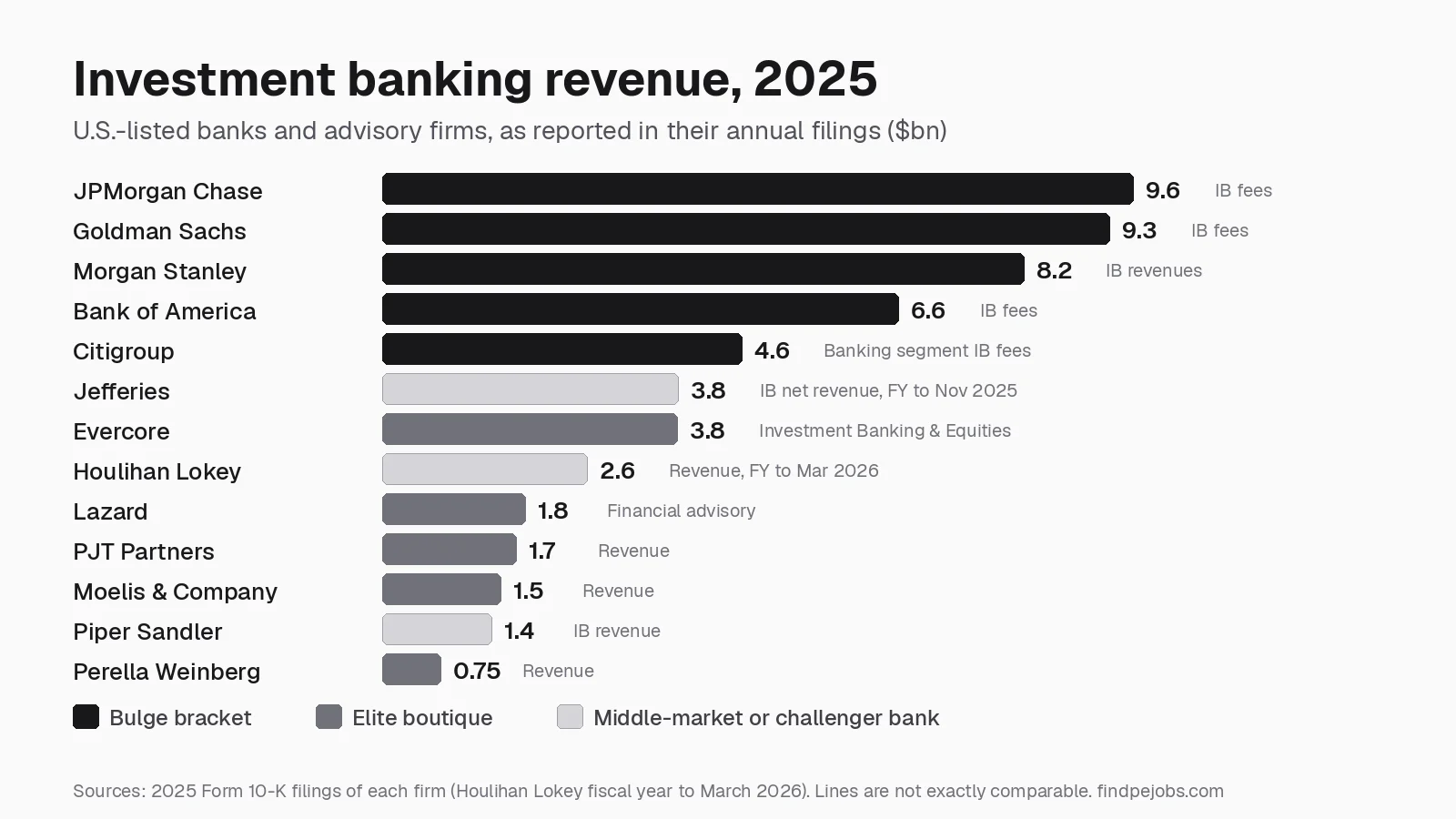
Most current lists agree on six banks and disagree about two more, Deutsche Bank and UBS. The table shows each bank's investment banking revenue for 2025 as the bank reported it. The lines are not exactly comparable: some banks report fees net of deals they led for themselves, Citigroup reports its Banking segment, and the European banks report in their own currencies and segments.
| Bank | Headquarters | Investment banking revenue, 2025 (as reported) | Status |
|---|---|---|---|
| JPMorgan Chase | New York | $9.6bn investment banking fees | Core |
| Goldman Sachs | New York | $9.3bn investment banking fees | Core |
| Morgan Stanley | New York | $8.2bn investment banking revenues | Core |
| Bank of America | Charlotte | $6.6bn investment banking fees | Core |
| Citigroup | New York | $4.6bn investment banking fees (Banking segment) | Core |
| Barclays | London | £2.5bn banking fees and underwriting | Core |
| UBS | Zurich | $3.2bn Global Banking revenues ($2.6bn underlying) | Borderline |
| Deutsche Bank | Frankfurt | €1.9bn Investment Banking & Capital Markets | Borderline |
Sources: JPMorgan Chase, Goldman Sachs, Morgan Stanley, Bank of America, and Citigroup Form 10-K filings for 2025; Barclays, UBS, and Deutsche Bank Form 20-F filings for 2025.
The American five are the clearest members. JPMorgan, Goldman Sachs, and Morgan Stanley each reported more than $8 billion of investment banking revenue, and Goldman's fees rose 21 percent from 2024 on higher completed M&A. Bank of America bought Merrill Lynch in early 2009. Its investment bank has traded as BofA Securities since 2019, and Merrill is now the name of its wealth management business. Barclays is the only European bank most lists treat as a full member. It bought Lehman Brothers' North American business after Lehman's bankruptcy in September 2008, which gave it a large U.S. investment bank, and in 2025 it earned £676 million from advisory, £278 million from equity capital markets, and £1.5 billion from debt capital markets.
Deutsche Bank and UBS
Deutsche Bank and UBS still run global investment banks, take part in most large financings, and each underwrote 3.2 percent of the Medline IPO. They sit on the border because their advisory businesses are smaller than the core six's and their strategies have moved. Deutsche Bank's advisory revenue was €536 million in 2025, and most of its investment banking revenue came from debt origination, €1.1 billion. UBS reported $1.0 billion of advisory revenue in 2025 and has put wealth management first in its strategy since 2011. Older bankers often still count both as bulge brackets, and many students list them that way. In a 2026 study of associate hiring at seven large U.S. buyout firms, Deutsche Bank was one of five banks that together supplied less than 1 percent of the associates.
Banks that left the bracket
The list shrinks when banks fail or are bought. Bear Stearns was sold to JPMorgan in 2008, Lehman Brothers filed for bankruptcy that September, and Merrill Lynch became part of Bank of America. Credit Suisse, which owned the old First Boston, was the most recent to go. UBS completed its acquisition of Credit Suisse on June 12, 2023, and the New York Fed removed Credit Suisse from its primary dealer list at the end of that month. Lists that still show nine banks with Credit Suisse among them predate that deal.
Challengers: Jefferies, Wells Fargo, RBC, BNP Paribas, and Mizuho
A handful of banks earn fees close to the smaller bulge brackets but are not usually counted. Jefferies reported investment banking net revenue of $3.79 billion for the year to November 2025, including a record $2.15 billion from advisory, more than Deutsche Bank or UBS earned from investment banking. It took the same 3.2 percent of the Medline IPO as Barclays and Citigroup. It lends through Jefferies Finance, a joint venture with MassMutual that underwrites senior secured loans, and has had a strategic alliance with Japan's Sumitomo Mitsui group since 2021. Most lists still leave it out because it works on smaller deals on average and has a smaller presence outside the U.S. and Europe.
Wells Fargo is a large lender and a large underwriter of corporate debt but is weaker in M&A and equity and does most of its business in North America. RBC Capital Markets has the same profile in Canada and the U.S. BNP Paribas is a large European bank with a strong financing business. Mizuho completed its acquisition of Greenhill, an independent M&A and restructuring adviser, on December 1, 2023, to add advisory to its lending. None of these banks is regularly called a bulge bracket, and all of them were in the Medline syndicate.
Outside the United States
The term is used worldwide, but the banks that lead deals differ by country. In Canada, the capital markets arms of the five largest banks (RBC, TD, BMO, Scotiabank, and CIBC) compete with the global banks for domestic mandates. In Japan, the securities firms owned by the three megabanks and Nomura do the same. Chinese securities firms such as CITIC Securities earn large fee totals, almost entirely at home. A student in Toronto, Tokyo, or São Paulo who wants a local private equity job should look at which banks lead deals in that market, not only at the global list.
How many, which is biggest, which is oldest
There are six core bulge bracket banks, or eight if Deutsche Bank and UBS are included. By investment banking revenue, JPMorgan was the largest in 2025, with Goldman Sachs close behind. JPMorgan is also the largest by total assets, $4.4 trillion at the end of 2025. The oldest is Barclays, which traces its ancestry to two goldsmith bankers on Lombard Street in London in 1690. JPMorgan Chase dates its founding to the Manhattan Company of 1799, a water company chartered by Alexander Hamilton and Aaron Burr, and J. Pierpont Morgan's own firm, Drexel, Morgan & Co., to 1871. The 1799 date belongs to the Manhattan Company, and the Morgan name enters the firm's history in 1871. Blackstone, which sometimes appears on lists of bulge bracket banks, is a private equity and alternative asset manager, a buyer of companies rather than a bank.
Bulge bracket vs elite boutique vs middle-market banks
Investment banks are usually sorted into four groups. The groups differ in what they sell and in the size of the deals they work on, and the most important difference for a private equity reader is whether the bank lends.
| Bulge bracket | Elite boutique | Middle-market bank | Regional or industry boutique | |
|---|---|---|---|---|
| What it sells | Advisory, underwriting, lending, trading, research | M&A and restructuring advice; some add equity capital markets, research, or wealth management | Advisory and some underwriting, usually for smaller companies | Advice on sales of private companies in one region or industry |
| Lends to clients | Yes | No | Rarely, sometimes through a partner | No |
| Typical clients | Large public companies, the largest private equity firms, governments | Large public companies and their boards, private equity firms | Private and mid-sized public companies, middle-market private equity firms | Founder-owned and smaller companies |
| Examples | JPMorgan, Goldman Sachs, Morgan Stanley, Bank of America, Citigroup, Barclays | Evercore, Lazard, Centerview, PJT Partners, Moelis, Perella Weinberg | Houlihan Lokey, Jefferies, William Blair, Harris Williams, Piper Sandler, Baird | Firms with one or a few offices or a single sector |
| Size, from 2025 filings | $4.6bn to $9.6bn of investment banking revenue each (U.S. five) | $0.75bn to $3.8bn of revenue each (listed five) | $1.4bn (Piper Sandler) to $3.8bn (Jefferies) | Mostly private |
Elite boutiques
An elite boutique is an independent advisory firm that works on deals as large as the ones bulge bracket banks work on, often above $1 billion, without lending money. The listed elite boutiques say so in their annual reports. Evercore's 2025 10-K warns that "the fact that we do not provide financing or otherwise commit capital to clients" can hurt its M&A business when credit markets are tight. Evercore reported $3.77 billion of net revenue in Investment Banking & Equities for 2025 with about 2,100 people in that business. Lazard, founded in 1848, earned $1.83 billion in financial advisory. PJT Partners, spun off from Blackstone, had $1.71 billion of revenue and 1,224 employees. Moelis & Company, founded in 2007, had $1.52 billion and 1,416 employees. Perella Weinberg, founded in 2006, had $751 million and 736 employees. Centerview Partners is a private partnership and does not publish its results.
Elite boutiques are not strictly advice-only. Evercore underwrites and trades equities through Evercore ISI and took 2.2 percent of the Medline IPO. What none of them does is commit loans. When a credit market closes, as it did in 2007 and 2008, an elite boutique's M&A pipeline depends entirely on clients finding money somewhere else.
An elite boutique's team is also smaller. Goldman Sachs alone had 47,400 employees at the end of 2025. Lazard's financial advisory business had 216 managing directors and 1,358 other professionals and staff. Fewer bankers per deal means a junior banker at an elite boutique usually does more of the analysis on each deal, and the elite boutiques together hire far fewer analysts each year than the large banks do.
Middle-market banks
A middle-market bank advises smaller companies, many of them private, and the private equity firms that buy and sell them. Houlihan Lokey, the largest by revenue among the advisory-focused firms, reported $2.62 billion for the year to March 2026 and more than 1,900 financial professionals in more than 30 offices. Its annual report says the firm does "not engage in any lending, securities sales and trading, or investment research," and it markets its services through a dedicated financial sponsors group. Piper Sandler reported $1.40 billion of investment banking revenue in 2025 and says it focuses primarily on middle-market clients. Harris Williams, William Blair, and Baird are among the banks that advise on sales of companies owned by middle-market private equity firms.
Jefferies sits between the groups. It is a full-service bank with trading, research, and lending through its joint venture, which puts it closer to a bulge bracket in what it sells and closer to a middle-market bank in the average size of its deals.
Regional and industry boutiques
Below the middle-market banks are thousands of small firms that advise on the sale of private companies in a single region or a single industry, such as healthcare services, software, or energy. Their deals are smaller, their teams are a few people, and their analysts do a wide range of work. Some industry boutiques are highly regarded in their sector and place analysts into private equity firms that invest in that sector.
What each kind of bank does for a private equity firm
Private equity firms are among the largest clients of every kind of investment bank, and each kind earns its fees at a different point in a fund's life. A buyout firm hires banks to sell companies it owns, borrows from banks to buy companies, pays banks to take portfolio companies public, and buys companies that banks are selling for other owners.
The 2025 take-private of Electronic Arts shows how the work divides on a large deal. The buyers were Saudi Arabia's Public Investment Fund, Silver Lake, and Affinity Partners. Electronic Arts hired Goldman Sachs as its financial adviser, and the merger proxy says it agreed to pay Goldman a transaction fee of about $110 million, $10 million at announcement and the rest only if the deal closed. To fund part of the price, the buyers signed a debt commitment letter with JPMorgan Chase Bank for $20 billion, later amended to add other lenders. A take-private of that size needs at least one bank willing to commit to the whole loan on the day the deal is signed, and only the largest balance sheets can do it.
The same proxy shows the relationship between a bulge bracket bank and a private equity client over time. Because Goldman was advising the seller, it had to disclose its work for the buyers. In the two years to September 28, 2025, Goldman had earned about $154.7 million from Silver Lake and its related entities. The listed work included acting as a bookrunner on the term loans for Silver Lake's acquisition of Endeavor, advising Silver Lake on that acquisition, and acting as a bookrunner on the IPO of Klarna, a Silver Lake portfolio company. Large banks organize this coverage through financial sponsors groups, teams whose clients are private equity firms. A single buyout firm can pay one bank for advice, loans, and IPOs across dozens of portfolio companies, which is why the banks compete for sponsor relationships year after year.
Exits run through banks as well. When a private equity firm sells a portfolio company, a bank runs the auction, writes the confidential information memorandum, and collects bids. When the firm takes a company public, as Blackstone, Carlyle, and Hellman & Friedman did with Medline, the bulge bracket banks usually lead the IPO, and the private equity firms' own broker-dealers can join the syndicate.
The kind of bank depends on the size of the deal. Elite boutiques advise on large sales and take-privates, often as the target's adviser or as a second adviser alongside a lending bank, and they never commit financing. Middle-market banks run most sale processes for companies worth tens or hundreds of millions of dollars, where the buyer is often another private equity firm and the debt comes from a private credit fund or a regional bank rather than a bulge bracket. The work an analyst sees at each kind of bank follows from that split: lending and capital markets work on the largest buyouts at a bulge bracket, sell-side M&A for large companies at an elite boutique, and many sale processes for private companies at a middle-market bank.
Working at a bulge bracket bank
The main advantages of a bulge bracket job are the brand, the range of products, and the size of the deals. Almost everyone in business recognizes the names, which helps with jobs outside finance as well as in it. Analysts work on large public-company transactions and see how financing, capital markets, and advice fit together on one deal, which is useful preparation for a leveraged buyout, where the debt package matters as much as the price. The banks run long formal training programs for incoming analysts and keep large alumni networks across private equity, hedge funds, and corporate finance.
The disadvantages come from size. Deal teams are larger, so the most interesting analysis often goes to associates and vice presidents, and junior bankers spend more time on formatting, process, and internal approvals. Experience varies widely by group: a strong industry or M&A group at a bulge bracket and a weak product group at the same bank can lead to very different careers. Hours are long at every kind of bank. At senior levels, the large banks pay more of each bonus in deferred stock. The listed elite boutiques defer pay too (Evercore runs a deferred cash program and grants restricted stock units, and Lazard awards managing directors deferred equity), so the difference is one of degree.
Bulge bracket offers are also harder to win. The banks recruit mostly from a set of target universities, start the process early in university, and hire in large classes that fill a year or more before the start date. Because the large banks hire far bigger classes, many more people start their careers at a bulge bracket than at an elite boutique.
Which banks place analysts into private equity
The largest private equity firms hire most of their pre-MBA associates from a short list of banks. A March 2026 analysis by 10X EBITDA, a recruiting-training firm run by former bankers and private equity investors, looked at about 300 LinkedIn profiles of people who moved from investment banking analyst to private equity associate at seven U.S. firms (Apollo, Blackstone, Carlyle, CD&R, KKR, Thoma Bravo, and TPG) in the associate classes of 2020 through 2025. It found:
- About half of the associates came from three banks: Goldman Sachs, Morgan Stanley, and Evercore. At Apollo, Blackstone, and KKR the share was about 60 percent.
- About 40 percent came from 15 other bulge bracket banks and elite boutiques, with JPMorgan the largest at about 10 percent of all hires. Allen & Co., Deutsche Bank, Perella Weinberg, Greenhill, and Qatalyst together supplied less than 1 percent.
- About 7 percent came from all other banks, including Houlihan Lokey and Jefferies, with no single bank supplying hires every year.
- Less than 3 percent came from the three large strategy consulting firms.
- Only about 5 percent of New York associate seats went to analysts from regional offices such as Houston, Los Angeles, and San Francisco, and many of those were energy hires from Houston.
The study covers U.S. megafund associate classes only. The firms that recruit through it are a small part of private equity, and its authors note that elite boutiques are a much weaker feeder outside the United States.
The channel behind those numbers is the headhunter. For the largest funds, on-cycle recruiting runs through a small number of search firms, and those firms build their lists from the analyst classes of the banks their clients hire from. "If you're an analyst at a BB/EB, they WILL find your email and reach out to you before the recruiting cycle," wrote the pseudonymous account @BowTiedSizeLord in a 2021 thread after that year's on-cycle round. A former banker posting as @BoringBiz_ wrote in December 2025 that at a bank that sends many analysts to the buy side, the author probably received more than 20 headhunter emails a week, and that analysts at other banks have to get onto the headhunters' lists themselves, usually through former analysts from their group. Several large banks now require analysts to disclose future-dated private equity offers, and JPMorgan has said it will fire analysts who accept one within their first 18 months; the bank policies differ and change.
Analysts at middle-market banks and boutiques do move into private equity, mostly into middle-market and lower-middle-market firms, which are far more numerous than megafunds and hire throughout the year. Middle-market banks see many private equity sale processes up close, and the firms on the other side of those deals often hire from the bankers who ran them.
How to choose between bank offers
The bank's category is one input among several. In the 10X EBITDA data, the specific bank and the office predicted placement at the largest funds more than the category did, and the group within Goldman Sachs or Morgan Stanley mattered less than candidates tend to assume.
- The bank's own placement record. Within the bulge brackets, Goldman Sachs and Morgan Stanley placed several times as many analysts at the seven megafunds as Deutsche Bank. Within the elite boutiques, Evercore placed far more than Perella Weinberg or Greenhill. Former analysts' LinkedIn profiles show where a specific class went.
- The office. For U.S. megafunds, the New York office matters more than the bank's tier. A strong group in a regional office places mainly into regional and sector funds.
- The group's deal flow. M&A, financial sponsors, and leveraged finance groups do work closest to a buyout. Groups that mostly execute equity or investment-grade bond deals give less practice with valuation and financing structure, which private equity interviews and modeling tests examine. A busy group at a smaller bank can give more deal experience than a quiet group at a large one.
- The goal after private equity. A bulge bracket name travels further outside finance, into corporate roles and business school applications. An elite boutique offers a smaller team and a longer advisory career if banking turns out to be the job.
- Realistic odds. Bulge bracket and elite boutique classes are small relative to the number of applicants. A strong offer from a middle-market bank that leads to a middle-market private equity seat is a common path, and the private equity analyst programs at some firms hire straight from university.
Private equity firms that post associate and analyst roles are listed on Private Equity Jobs, and the companies directory profiles the firms that hire from each kind of bank.
Common questions
How many bulge bracket banks are there?
Six by the usual 2026 definition: JPMorgan Chase, Goldman Sachs, Morgan Stanley, Bank of America, Citigroup, and Barclays. Eight if Deutsche Bank and UBS are counted. Nine-bank lists that include Credit Suisse date from before UBS bought it in June 2023.
Is Jefferies a bulge bracket bank?
Not by most definitions. Jefferies earned more from investment banking in 2025 than Deutsche Bank or UBS and offers trading, research, and lending, but it works on smaller deals on average and has a smaller global footprint. It is usually described as a challenger or an upper-middle-market bank.
Is Evercore a bulge bracket bank?
No. Evercore is an elite boutique, an independent firm that advises on large deals without lending. It competes with the bulge brackets for M&A mandates and is one of the three firms that supplied about half of the associates at seven U.S. megafunds in the 10X EBITDA study.
Which bulge bracket bank is the biggest?
JPMorgan Chase, which reported $9.6 billion of investment banking fees in 2025, slightly more than Goldman Sachs's $9.3 billion. It is also the largest by total assets.
Which bulge bracket bank is the oldest?
Barclays, whose history begins with goldsmith bankers in London in 1690. JPMorgan Chase traces its founding to 1799 and J. Pierpont Morgan's firm to 1871.
Do bankers say "bulge bracket"?
Rarely. The term is common in recruiting guides, forums, and the press. In interviews and at work, people usually say "large banks" for the bulge brackets and "independent banks" or "independent advisers" for the elite boutiques.
Sources
Annual reports on Form 10-K for 2025 (fiscal year to March 2026 for Houlihan Lokey and to November 2025 for Jefferies) from Jefferies, Evercore, Lazard, PJT Partners, Moelis & Company, Perella Weinberg, Houlihan Lokey, and Piper Sandler, and the bank filings listed under the table above; Medline Inc. prospectus (Form 424B4), December 16, 2025; Electronic Arts definitive proxy statement (DEFM14A), November 20, 2025; Securities and Exchange Commission Rule 134, 17 CFR 230.134; Kenneth N. Gilpin, "Split in 'Tombstone' Ranks," The New York Times, October 5, 1987; Ron Chernow, The House of Morgan (1990); Federal Reserve Bank of New York, Primary Dealers list and its history of revisions; UBS, "UBS completes Credit Suisse acquisition," June 12, 2023; Mizuho Financial Group, Greenhill acquisition release, December 1, 2023; Barclays and JPMorgan Chase corporate history pages; 10X EBITDA, "Which Investment Banks Do Top PE Megafunds Hire From?", March 2026.
Related posts

Buy-side firms such as private equity funds invest capital for a return, and sell-side banks are paid fees and commissions to arrange the deals and trades. Which firms sit on each side, how each is paid, how research and licensing differ, and how careers move from banking into private equity.

When a private equity fund buys a company, the company takes on the acquisition debt, the fund takes the board, and a plan to raise earnings starts on day one. What changes for managers and staff, what the research says about jobs and failure, and how the ownership ends.