
Private equity and venture capital are both ways to buy companies that are not listed. A firm raises a fund from limited partners (LPs), invests in those companies, and has to return cash before the fund ends.
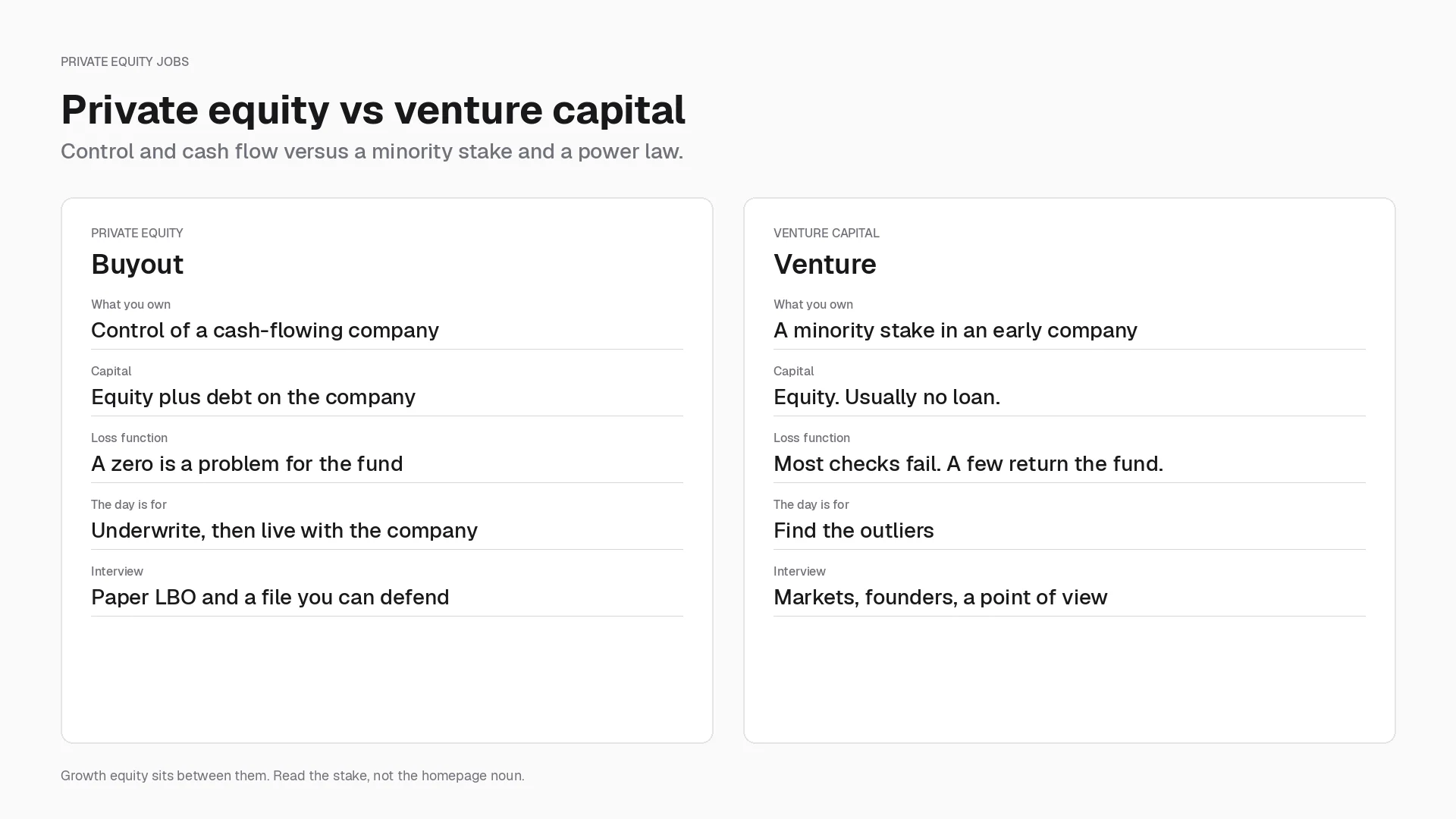
A buyout fund, which is what most people mean when they say private equity (PE), takes control of a business that already produces cash. It often puts a loan on that company's balance sheet, then has to grow earnings, pay down that loan, and sell the company so the limited partners get cash back. A venture capital (VC) fund buys a minority stake in an earlier company. Most of those investments will not return the money. A few have to return the whole fund. Growth equity sits between them: a large minority check into a company that already has customers, usually without a buyout-sized loan.
What is private equity vs venture capital
Limited partners and textbooks often use private equity as a name for the whole private-market bucket. Venture capital, growth equity, and buyouts sit inside that bucket. In each case a general partner (GP) calls committed capital from limited partners (pensions, endowments, sovereigns, insurers, family offices), charges a management fee, and takes carried interest if the vintage works.
People who work in the industry use the words more narrowly. If someone says they work in private equity, they usually mean a buyout fund: a fund that buys control of a company that already produces cash, often with debt. If they work in venture, they say venture.
A buyout is often a leveraged buyout (LBO). The fund has to believe the company can pay interest on the loan, grow earnings, and later be sold to a strategic buyer, another fund, or the public market. The checks are large and the portfolio is small, so one failed deal can damage the vintage.
A venture fund is built on the opposite assumption. Most financings will not return the money. A few have to return the fund. The check is usually smaller, the stake is a minority, and there is usually no loan on the company, because there is not yet enough cash flow to pay interest.
Growth equity sits between those two. The company already has a product and customers. The fund usually takes a minority stake, uses little or no leverage, and is betting on growth rather than a full take-private.
Key differences
| Buyout private equity | Growth equity | Venture capital | |
|---|---|---|---|
| What you own | Control of a company, often 100% | A minority (or shared-control) stake | A minority stake, often well under 50% |
| Company | Established, usually profitable, with cash flow the fund can underwrite | Proven product and customers; still growing fast | Early company; may have little revenue and no profit |
| Capital structure | Equity plus debt on the company's balance sheet | Mostly equity; little or no leverage | Equity (sometimes a convertible note or a simple agreement for future equity at the earliest stage) |
| When a deal fails | Most deals are supposed to return capital. A zero is a problem for the fund. | Downside is usually slower growth, not a shutdown | Most financings will not return 1x. A few must return the fund. |
| How returns are made | Earnings growth, debt paydown, and sometimes a higher sale multiple | Growth in revenue and earnings, then an exit | A higher valuation at exit. The fund needs a small number of very large outcomes. |
| Hold | About five to seven years on the company inside a fund of about ten years | Several years; shorter than early venture | Until an acquisition, a later-round sale, or a listing, if one arrives |
| The work | Read teasers, build models, sit through diligence, then follow the company after close | Source companies and judge whether growth will continue | Find companies that can return the fund, mostly through meetings and market work |
| Interview | A paper LBO, deal experience, and a file that can survive an investment committee | A mix of growth math and commercial judgment | Markets, founders, and a point of view. A paper LBO will not help. |
Check size is a poor way to tell these strategies apart. Middle-market buyouts close well below $100 million. Later venture rounds close well above $10 million. In the first half of 2026, most US venture dollars sat in financings of $100 million or more. Ownership, and what happens when a deal fails, travel better than a round-number check.
How they make returns
A simple buyout shows the shape. The fund buys a $100 million company with $40 million of equity and $60 million of debt. The $60 million is borrowed in the company's name. The portfolio company owes it. Limited partners put up the $40 million, plus fees. If the equity later sells for $80 million after the debt is refinanced or repaid, the fund made money on $40 million, not on $100 million. If cash flow cannot service the $60 million, the company is the one in distress.
A venture round is priced differently. The company has a pre-money valuation and a post-money valuation, and the fund owns a percent of the equity. A buyout is priced as enterprise value and a sources-and-uses table.
Bain's 17th Global Private Equity Report (23 February 2026) set out the 2026 buyout numbers. 2025 global buyout deal value, excluding add-ons, rose 44 percent to $904 billion. Buyout-backed exit value rose 47 percent to $717 billion. Buyout dry powder sat at $1.3 trillion. Holding periods at exit hovered around seven years. In the 2010s, roughly 5 percent annual growth in earnings before interest, tax, depreciation and amortization (EBITDA) could underwrite a 2.5x multiple on invested capital (MOIC) over five years. With higher borrowing costs, less leverage, and stagnant multiples, Bain says typical deals now need something closer to 10 to 12 percent annual EBITDA growth for the same return. That earnings path has to be found on companies the fund already owns. The model does not assume that most of the portfolio will go to zero.
Venture is a different distribution. Correlation Ventures, a data-driven co-investor, looked at more than 21,000 US venture financings from 2004 through 2013. Seth Levine, then a managing director at Foundry Group, published the distribution in August 2014 with Correlation's permission: 65 percent of those financings failed to return 1x capital, 10 percent returned 5x or more, and 4 percent returned 10x or more. David Coats, co-founder of Correlation, updated the point in September 2019 on a later decade of exits: about 51 percent of the capital invested lost money, and less than 4 percent generated a 10x or greater multiple. Counted as financings rather than dollars, almost two thirds lost money. The fund can lose money on most financings if a small number of companies return enough to pay for the rest.
The 2026 venture market has the same shape, with more of the dollars in fewer rounds. The Q2 2026 PitchBook-NVCA Venture Monitor (8 July 2026) put US venture deal value at $412.7 billion in the first half of 2026, already above every previous full-year total in that series. Financings of $100 million or more captured 87.5 percent of the dollars. Artificial intelligence accounted for 86 percent. Three firms took in about 48 percent of the capital raised. Ordinary seed and Series A checks still make up most deals by count, and a much smaller share of the money.
Growth equity
Growth equity is a large minority investment in a company that already has a product, customers, and a market that is no longer a guess. The fund sometimes takes a board seat and protective provisions. It rarely puts a buyout-sized loan on the business. There is still an ownership job after the check is written, but less of the work is a classic leveraged-buyout model and more of it is commercial diligence and founder dynamics.
The lines between the strategies have moved. Traditional venture firms raise growth funds and write $50 million to $100 million-plus checks into companies that would have gone public a decade earlier. Traditional buyout firms raise technology and growth vehicles that look like late-stage venture. Buyout funds also buy companies that venture already funded. Those deals can be software businesses with real revenue. They are still control purchases, often with debt, not another minority round.
A job titled private equity does not tell you which of these you are walking into. If the interview is a paper LBO, it is a buyout seat. If the interview is a market map and a founder reference, it is venture or growth. The companies directory lists the actual strategy.
Work, recruiting, and pay
On a buyout fund, associates spend most of their time on companies the fund might buy or already owns. They read teasers and drop the ones with a customer book that is too concentrated. They build the model, sit through quality-of-earnings, and write the memo the committee will use. After the purchase closes, they keep the monthly numbers honest when revenue misses or working capital eats cash. They do not decide whether to buy. The investment committee does.
On a venture fund, associates spend most of their time finding companies. They take founder meetings, write market maps, and sit on a board or two if the fund wins the round. The spreadsheet is usually simpler because there is less history. The hard part is judging whether this team, in this market, can become one of the few companies that return the fund. Both seats pass on almost every company they see. A buyout passes because the cash flow or the price is wrong. A venture fund passes because the company cannot become large enough to matter to the fund.
Large US buyout associate hiring still runs through a compressed on-cycle process for bankers in the right groups, plus off-cycle hiring at smaller funds. The test is a paper LBO and a deal you can defend. Most venture hiring is off-cycle and built on relationships. The test is whether you have a point of view on a market and can talk to a founder. A buyout case does not help in a venture interview. A market-size slide without returns math does not help in a buyout interview.
Junior cash is high-finance money in both seats. Buyout associates usually earn more cash than venture associates at the same seniority, because the funds are larger and the fee pool is larger. Carry exists in both, and in both it is delayed, vested, and lumpy. A megafund buyout associate and a seed-stage venture associate are not in the same pay market.
People leave buyout seats for other buyout funds or for a portfolio company. People leave venture seats for other venture funds, a startup, or an operating role in tech. Moving from venture into a classic US buyout associate seat is hard, because those funds are hiring people who have already sat in live auctions. Moving from buyout into venture is possible if you can show you know markets and founders, not only the model. Counting on that reverse move is a weak plan.
Which to choose
Neither seat is better in the abstract. A buyout associate is graded on an underwrite the fund may have to live with for years: cash flow, a capital structure, and a company that already exists. The interview looks like a banking file that has to survive an investment committee. Hours still run long when a process is live.
A venture associate is graded on whether the fund can find companies that become outliers: markets, founders, and a thesis that may look wrong for years if it is early. The interview rewards a point of view and treats a paper LBO as the wrong test. Cash is usually lower at the same seniority. Carry is still delayed and lumpy.
A growth seat is a later-stage company without a full leveraged buyout. The fund documents and the interview tell you more than the firm's About page.
If you are raising money rather than looking for a seat, the same split applies. A buyout check usually means you are selling control of a cash-flowing business. A venture check usually means you are selling a minority stake and giving up some board and financing rights in exchange for capital and help raising the next round. A growth check is the later version of that minority deal. None of those is a bank mandate. Banks sell a process for a fee. Funds buy ownership.
Open roles sit on Private Equity Jobs. Research the firm on the companies directory.
Common questions
Is venture capital the same as private equity?
No. A venture fund buys a minority stake in an early company, and most of those investments will not return the money. When people in the industry say private equity, they usually mean a buyout: control of a company that already produces cash, often with debt. Growth equity sits between them.
Which is riskier?
For a single company, venture is riskier. Most financings in Correlation's long sample did not return 1x. A buyout of a cash-flowing business is less likely to go to zero, and more likely to be damaged by the loan if the earnings path was wrong. A buyout fund can fail to return capital if too many deals miss that path or the debt goes wrong. A venture fund can fail to return capital if it does not own one of the few companies that pay for the rest.
Which pays more?
Junior cash is usually higher in buyout, because the funds are larger. The ceiling in both is carry, and carry is delayed. A partner at a huge buyout firm and a partner at a seed fund are not in the same market. If you need a number for a negotiation, use a current recruiter and a dated survey, not an average copied from a career blog.
Do you need investment banking first?
Usually, for a classic US buyout associate seat. Banking is the default feeder. Venture hires a wider mix: operators, product people, consultants, some bankers, some founders. Direct-from-undergrad buyout exists and is still a minority product.
Can you move from private equity to venture capital, or the other way?
Buyout to venture is possible if you can show markets and founders, not only models. Venture to classic buyout is harder, because the buyout fund is hiring someone who has already sat in a live process. People do make that move into technology or growth vehicles when the story is coherent. It is still a weak thing to count on.
How do you invest versus how do you get hired?
Investing as an LP is a commitment of capital, usually reserved for institutions and qualified purchasers. Getting hired is a seat on the GP. Open roles sit on the board.
Sources
Bain & Company, 17th Global Private Equity Report and 17th Global Private Equity Report, 23 February 2026. PitchBook and the National Venture Capital Association, Q2 2026 PitchBook-NVCA Venture Monitor, 8 July 2026 (US H1 deal value $412.7 billion; megadeal and AI shares as reported there). Seth Levine, Venture Outcomes are Even More Skewed Than You Think, August 2014, sharing Correlation Ventures' distribution across more than 21,000 financings from 2004 through 2013. David Coats, Correlation Ventures, Venture Capital: No, We're Not Normal, 11 September 2019.
Related posts

Buy-side firms such as private equity funds invest capital for a return, and sell-side banks are paid fees and commissions to arrange the deals and trades. Which firms sit on each side, how each is paid, how research and licensing differ, and how careers move from banking into private equity.

When a private equity fund buys a company, the company takes on the acquisition debt, the fund takes the board, and a plan to raise earnings starts on day one. What changes for managers and staff, what the research says about jobs and failure, and how the ownership ends.