Private Equity Hold Period: How Long Funds Own Companies
A private equity hold period is how long a fund owns a company before exit. Here is how average and median holds differ, why clocks stretched toward seven years, and what that does to IRR, DPI, and continuation vehicles.
A private equity hold period is the time between buying a portfolio company and exiting it. Models often assume three to five years. Buyout assets that actually sold in 2025 had been held for about seven years on average, according to Bain & Company's Global Private Equity Report 2026.
That gap is not a trivia update. The same Multiple on invested capital (MOIC) produces a lower Internal rate of return (IRR) when the cash comes later. Limited partners waiting on Distributed to paid-in capital (DPI) feel the delay as missing cash, not as a prettier mark. The hold period is the company clock. The fund life is a different clock. Confusing the two is how people misread both returns and fundraising pressure.
What a private equity holding period is
Start with the company. The hold period runs from the day the fund closes the acquisition (or first control investment) to the day it sells, lists, or otherwise realizes the position. Trade sales, secondary buyouts, and IPOs all end a hold. A dividend recapitalization returns cash without ending ownership, so it is not an exit hold.
Three measurements get mixed in market commentary:
- 1. Hold at exit. How long companies that sold this year had been owned. Bain's roughly seven-year average for 2025 buyout exits is this measure. Private Equity Info's median of 6.0 years for PE-backed exits through 2025 is also this measure, on a different database.
- 2. Age of still-held companies. How old the unsold inventory is. PitchBook and McKinsey series on still-held assets answer a different question. A falling median among exits can coexist with an aging backlog.
- 3. Fund age. Years since the fund's first close or first investment. A ten-year limited partnership can hold a company bought in year four for six years and still be inside the fund term.
A "target hold" in an investment committee memo is an underwriting assumption, usually in the three-to-seven-year band for classic buyouts. It is not a covenant. Strategy changes the band: infrastructure and some real assets run longer; some growth equity seats underwrite shorter paths to a strategic sale. None of those ranges replaces the fund's legal life.
How long holds are now
For most of 2010 to 2021, average buyout holds at exit sat closer to five to six years. Bain's 2026 report puts the average hold at exit for buyout assets sold in 2025 at around seven years. Almost 40 percent of buyout-backed companies had been held more than five years in Bain's 2025 data, up from 29 percent in 2019.
Private Equity Info, using its own M&A research database of exits from 2000 through 2025, puts the median holding period for PE-backed exits at 6.0 years, the longest in that series. Average and median are not interchangeable. An average near seven years with a median near six is consistent with a right tail of older exits pulling the mean up.
The inventory behind those exits is large. Bain counts roughly 32,000 unsold buyout-backed companies and about $3.8 trillion of unrealized value (value as of the second quarter of 2025 in the annual report). That stock is why a strong year of exit value does not automatically reset the clock for every file.
Why holds lengthened
Holds stretched because exits got harder to clear at prices sellers would accept, not because funds forgot how to sell.
Financing costs rose after 2022. Buyers who need leverage cannot pay the same entry multiples sellers marked in a cheap-debt vintage. Bid-ask gaps keep processes open. Bain's midyear and annual work in 2025 to 2026 keeps returning to the same wedge: seller expectations versus what a financed buyer can underwrite.
Exit value and exit count diverged in 2025. Global buyout-backed exit value rose 47 percent to $717 billion, while exit count fell 2 percent to 1,570 transactions. Seven exits above $10 billion contributed $155 billion, or 22 percent of the total. Large gems moved. Mid-file inventory did not clear at the same pace.
The 2021 to 2022 acquisition cohort makes the math worse. Those companies were often bought at elevated multiples. They need more earnings growth to justify an acceptable sale price. Bain notes that almost 40 percent of companies now sit past five years of ownership. Waiting for EBITDA to catch the entry price is a deliberate choice. It is also how seven-year averages get printed.
What a longer hold does to returns
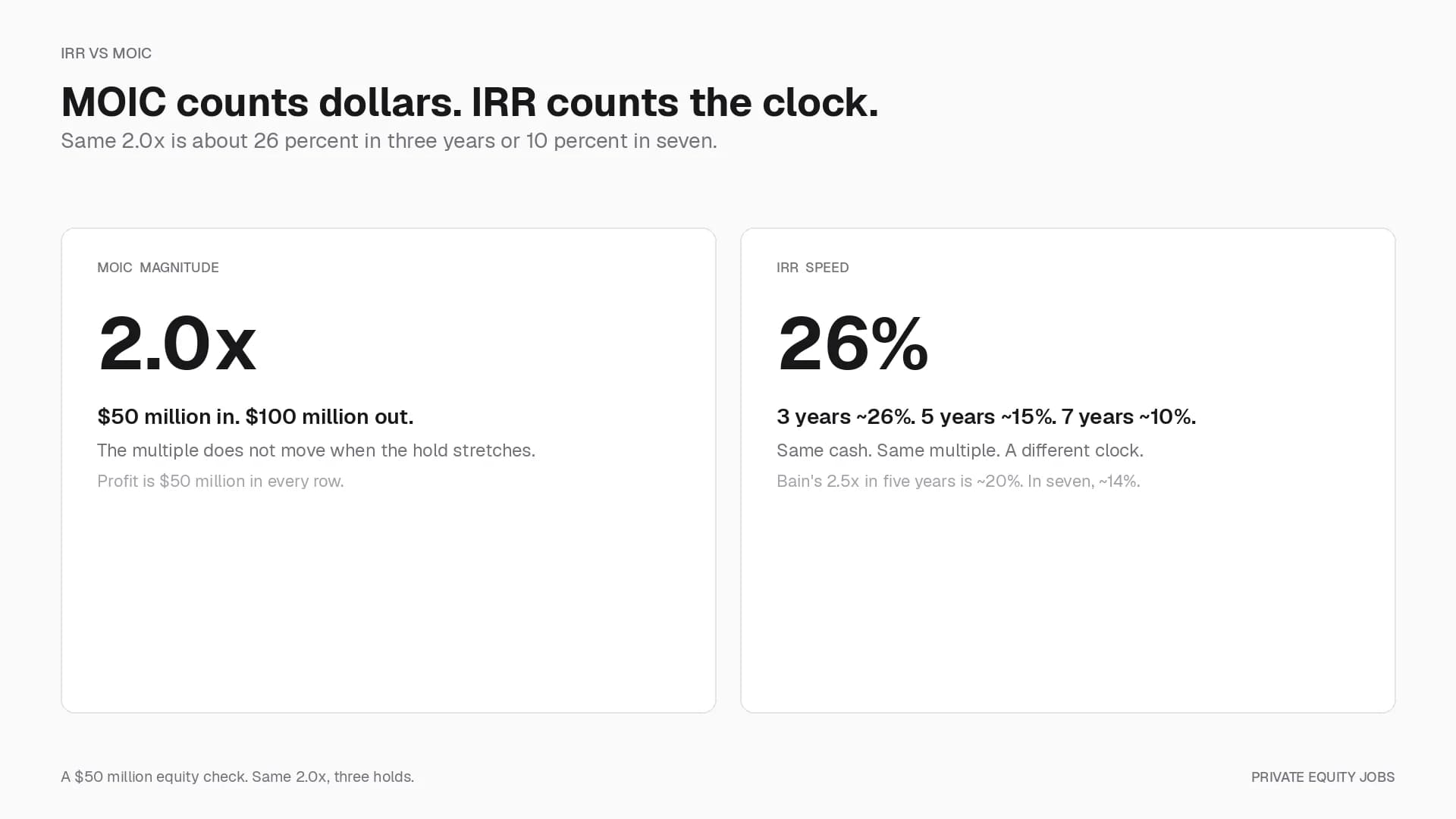
MOIC counts dollars. IRR counts the clock. A deal that turns $1 of equity into $2 is a 2.0x MOIC whether the exit lands in year four or year eight. The annualized rate is not the same. On a single investment and a single exit payment, 2.0x is about 19 percent IRR over four years and about 9 percent over eight years (before fees). The profit is identical. The rate is not.
That is why a slipped sale hurts even when the multiple still looks fine. Bain's analysis of buyout fund vintages from 2000 to 2015 finds that fund-level IRR begins to stagnate around year seven and declines afterward, while median Total value to paid-in capital (TVPI) flattens after year eight. More time can still raise MOIC if operations keep compounding. It does not automatically raise IRR.
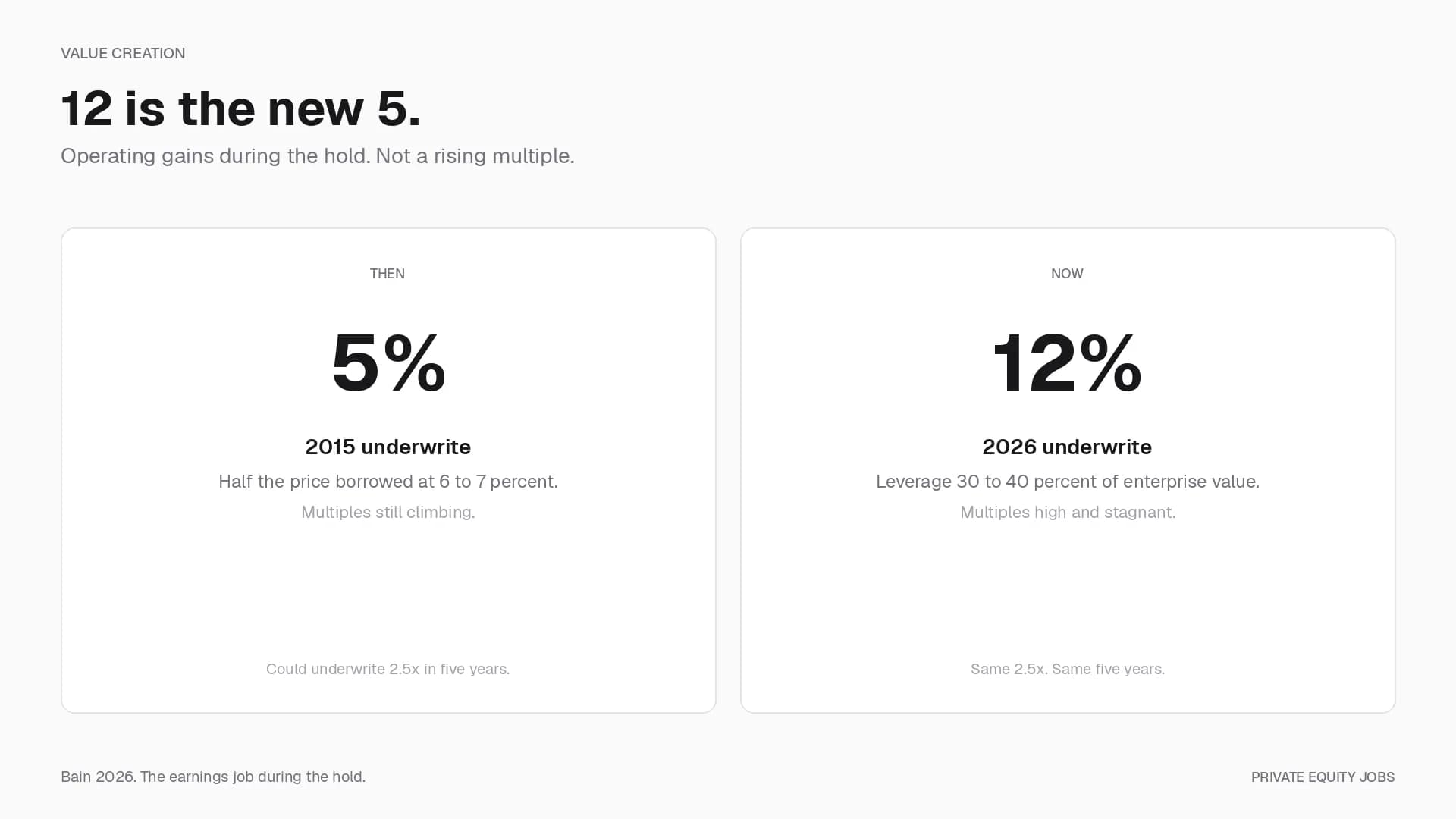
Underwriting has to match the clock you actually expect. Bain's midyear illustration in 2026 makes the operating ask explicit: a deal that once cleared a 2.5x path over five years with mid-single-digit EBITDA growth may now need roughly 12 percent growth when rates, entry prices, and exit timing are less friendly. The private equity value creation plan is what has to carry that load when multiple expansion will not.
For the interview and modeling version of the same tension, use IRR versus MOIC. This page will not reprint that full table.
Distributions, DPI, and the backlog
Limited partners experience long holds as slow cash. Distributions as a share of net asset value (NAV) stayed below 15 percent for four consecutive years through 2025, about 14 percent on Bain's reading for the twelve months through the third quarter of 2025. That is the liquidity drought next to the seven-year hold print.
DPI is the cash scoreboard. TVPI can look healthy while DPI lags if marks stay high and exits do not. The DPI versus TVPI page is the metric walkthrough. Here the point is simpler: a hold period that slips a year is a DPI problem for the LP and a fundraising problem for the GP, because new commitments compete with undrawn old ones.
The J-curve is the fund-level cash shape of the same delay. Early years are negative for structural reasons. A harvest that arrives two years late keeps the trough from becoming the stick.
ILPA's LP sentiment work, as cited in Bain's 2026 outlook, finds that most limited partners will trade some near-term liquidity for a better eventual MOIC when they believe the GP still has a plan. Patience is conditional. It is not a blank check to sit on a stale mark.
Fund life, extensions, and continuation vehicles
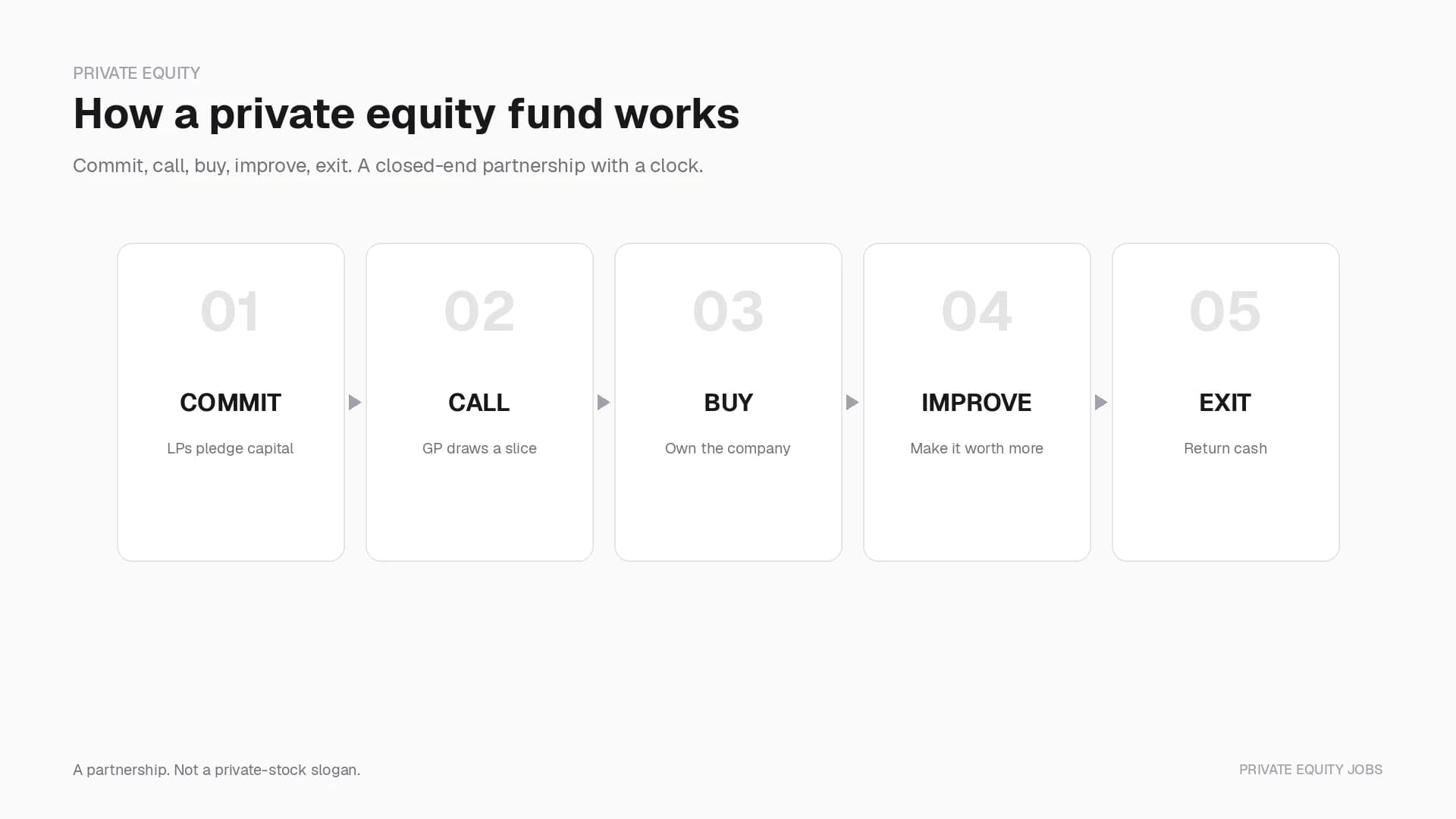
A typical buyout fund is a closed-end limited partnership with a life on the order of ten years, plus negotiated extensions. Capital is called and invested early. Companies bought late in the investment period have less runway before the fund needs to wind down. The company hold and the fund calendar meet in that corner of the portfolio.
When the fund clock runs out before the company is ready, general partners increasingly use continuation vehicles. The asset moves into a new vehicle the GP still manages. Existing LPs can cash out or roll. New capital comes in. For the LP who cashes out, the hold ends. For the sponsor, ownership continues under new terms. Bain finds GP-led continuation-vehicle volume up 62 percent year on year in 2025, still below 10 percent of total private equity exit value. The private equity exits and private equity secondaries pages cover the mechanics. The hold-period point is narrower: a continuation fund can fix an LP's liquidity without resetting the industry's inventory clock to zero.
Extensions and continuation funds also raise governance questions. Foley & Lardner's July 2026 note on aging assets frames long holds as a fiduciary and conflicts problem when the GP sits on both sides of a continuation or affiliate transaction. Process quality matters because the alternative reading is fee preservation, not value creation.
Common questions
How long do private equity firms hold companies?
Traditional underwriting often used three to five years. Realized buyout holds at exit in 2025 averaged about seven years on Bain's global series, with a Private Equity Info median of 6.0 years. Individual deals still exit earlier or later depending on performance, financing, and buyers.
Is the holding period the same as the fund life?
No. The holding period is company ownership length. The fund life is the partnership term. One fund holds many companies with different entry dates and different exit dates.
Why did holding periods get longer?
Higher financing costs, valuation gaps between buyers and sellers, and a large cohort of expensive 2021 to 2022 deals reduced exit velocity. Exit value recovered faster than exit count in 2025, so headline dollars moved without clearing the full backlog.
Do longer holds always mean better returns?
No. Longer holds can raise MOIC if the business keeps growing. They usually lower IRR for the same multiple. Bain's vintage analysis shows fund-level IRR pressure around year seven even when TVPI is still supported by marks.
Do continuation funds end the holding period?
They can end it for an LP who sells. They often extend sponsor ownership of the same company in a new vehicle. Treat them as a liquidity tool, not as proof the industry's average hold has reset.
Sources
Figures on average hold at exit near seven years, the share of companies held more than five years, the roughly 32,000 unsold buyout-backed companies and $3.8 trillion of unrealized value, distributions below 15 percent of NAV for four years, 2025 exit value and count, continuation-vehicle growth, and IRR/TVPI aging patterns are from Bain & Company's Global Private Equity Report 2026 outlook chapter, Private Equity Outlook 2026: Gaining Traction (published 22 February 2026; report dated 23 February 2026 in PEJ house citations). The 6.0-year median hold at exit is from Private Equity Info's February 2026 holding-period update, Private equity holding periods continue to climb. Aging-asset inventory commentary and fiduciary framing draw on Foley & Lardner's Aging Assets and the Patience Test for Private Equity (16 July 2026), citing PitchBook's midyear US inventory figures. StepStone's three-to-five-year traditional range appears in industry guides and is treated here as the familiar underwriting band, not as a 2025 census.