
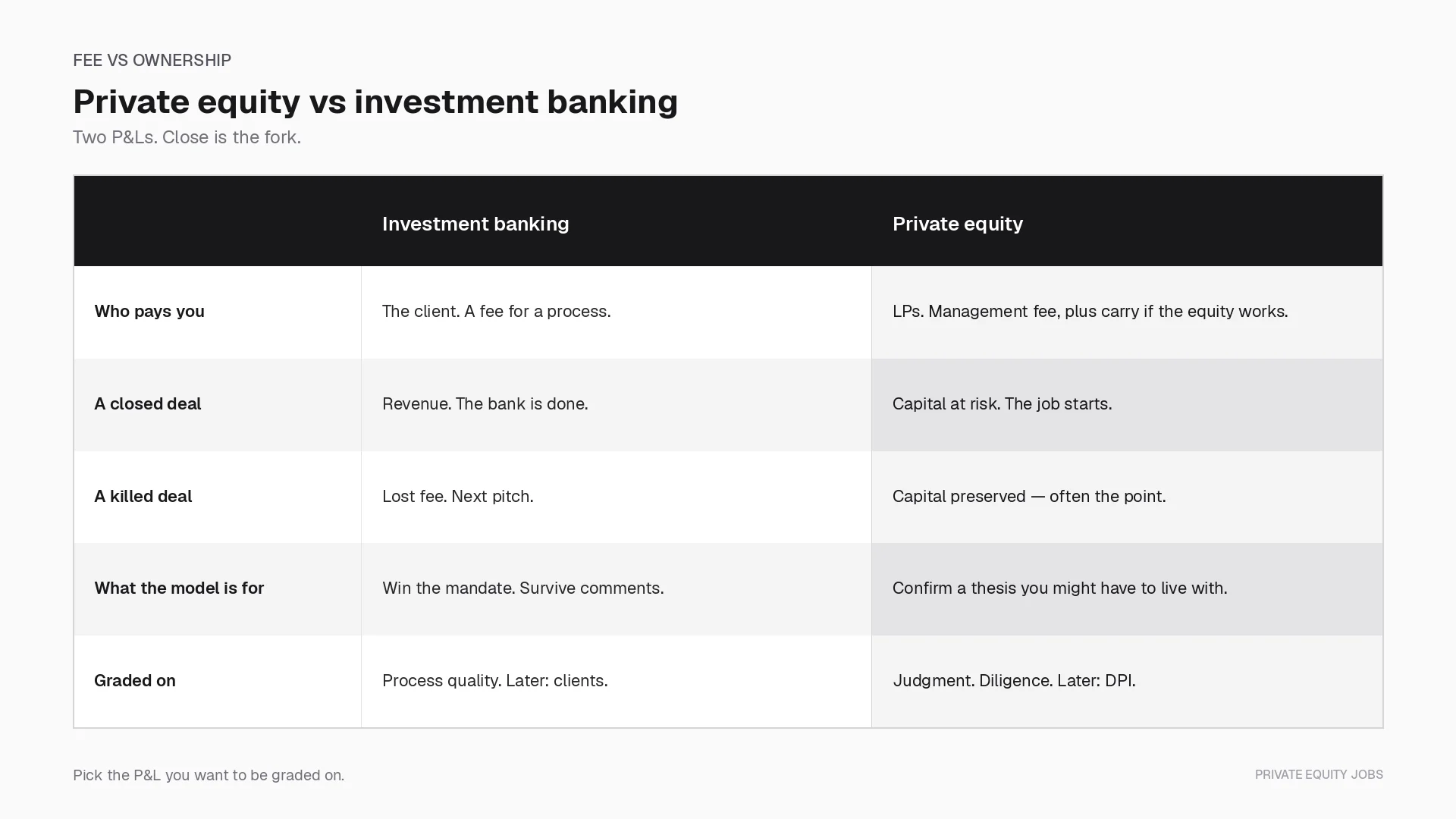
Investment banking and private equity sit next to each other on a résumé. They are different businesses. A bank is paid a fee to run a process (raise capital, run an auction, close a merger). When the deal closes, the bank is done. A private equity fund is paid to own a company: a management fee on committed capital, and carried interest if the equity works. When the deal closes, the job starts. Hours, pay, and which seat to take all follow from that.
The banker is a real-estate agent for businesses; the fund is the buyer who owns the building. The same cut, in sell-side / buy-side language, is the one that holds.
What is private equity vs investment banking
Investment banking is a services firm. The products are mergers and acquisitions, underwriting, sales and trading, and advisory. The bank is hired by a client (a corporation, a government, a sponsor). It is paid a fee if the process happens: a retainer, a success fee on close, an underwriting spread on an offering. After close, the bank’s P&L does not depend on whether the buyer overpaid. Junior production is whatever makes the fee more likely (pitch books, models built to win the mandate, comments turned overnight because the client asked).
Private equity is an investment partnership. Limited partners (pensions, endowments, sovereigns, family offices) commit capital. The general partner calls it, buys companies (or takes public companies private), tries to increase equity value, and returns cash over a fund life measured in years. The firm is paid a management fee on that pool and, if the vintage clears its hurdle, carry (classically a fifth of the gains, delayed and vested). PE investors are investors, not advisors. A closed buyout is not a revenue event. It is the moment capital is at risk.
That is why a killed deal means opposite things. On the bank, a process that dies is a lost fee and a slot for the next pitch. On the fund, a process that dies is often the correct outcome: capital preserved. The file is an underwriting, not a sales document.
Private equity is not “the private-company version of a bank.” Banks advise private companies every week. Funds also take listed companies private. The distinction is ownership. The bank sells a process. The fund lives with the company.
Key differences
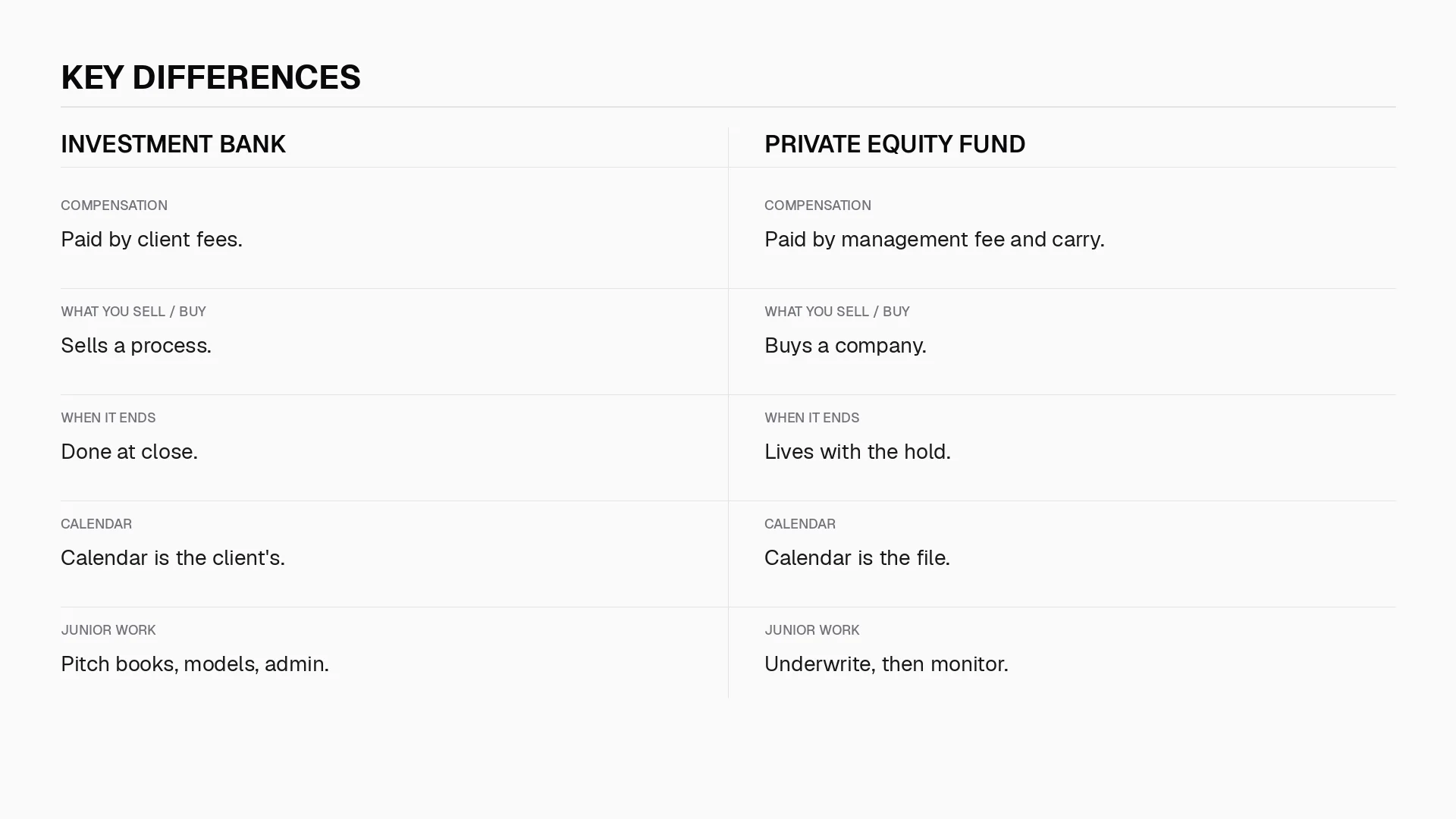
Sell-side versus buy-side is the clean cut. The banker sells a business interest, a financing, or an idea to a client. The PE associate buys on behalf of a fund that already has committed capital. Time horizon follows: a live mandate is weeks to months; a hold is years, until an exit returns cash. The bank does not take the equity risk. The fund does, usually with leverage, which is why a wrong underwrite is not a missed bonus. It is a mark the partnership has to explain to LPs.
Regulation is a real difference and a thin one for the junior. Banks sit in a broker-dealer and capital-markets regime; the file is a client deliverable under compliance. Funds sit in adviser registration and fund documents; the file is an underwriting the investment committee might actually use. The practical contrast is not the statute. It is what the model is for.
| Scoreboard | Investment banking | Private equity |
|---|---|---|
| Who pays you | The client, as a fee for a process | LPs, as a fee on committed capital, plus carry if the equity works |
| A closed deal | Revenue. The bank is done. | Capital at risk. The job starts. |
| A killed deal | Lost fee; next pitch | Capital preserved (often the point) |
| Time horizon | The mandate: weeks to months | The hold: years, until an exit returns cash |
| What the model is for | Win the mandate; survive comments | Confirm a thesis you might have to live with |
| What you are graded on | Process quality, stamina, later origination of clients | Judgment, diligence that survives contact with the company, later DPI |
How private equity firms and investment banks make money
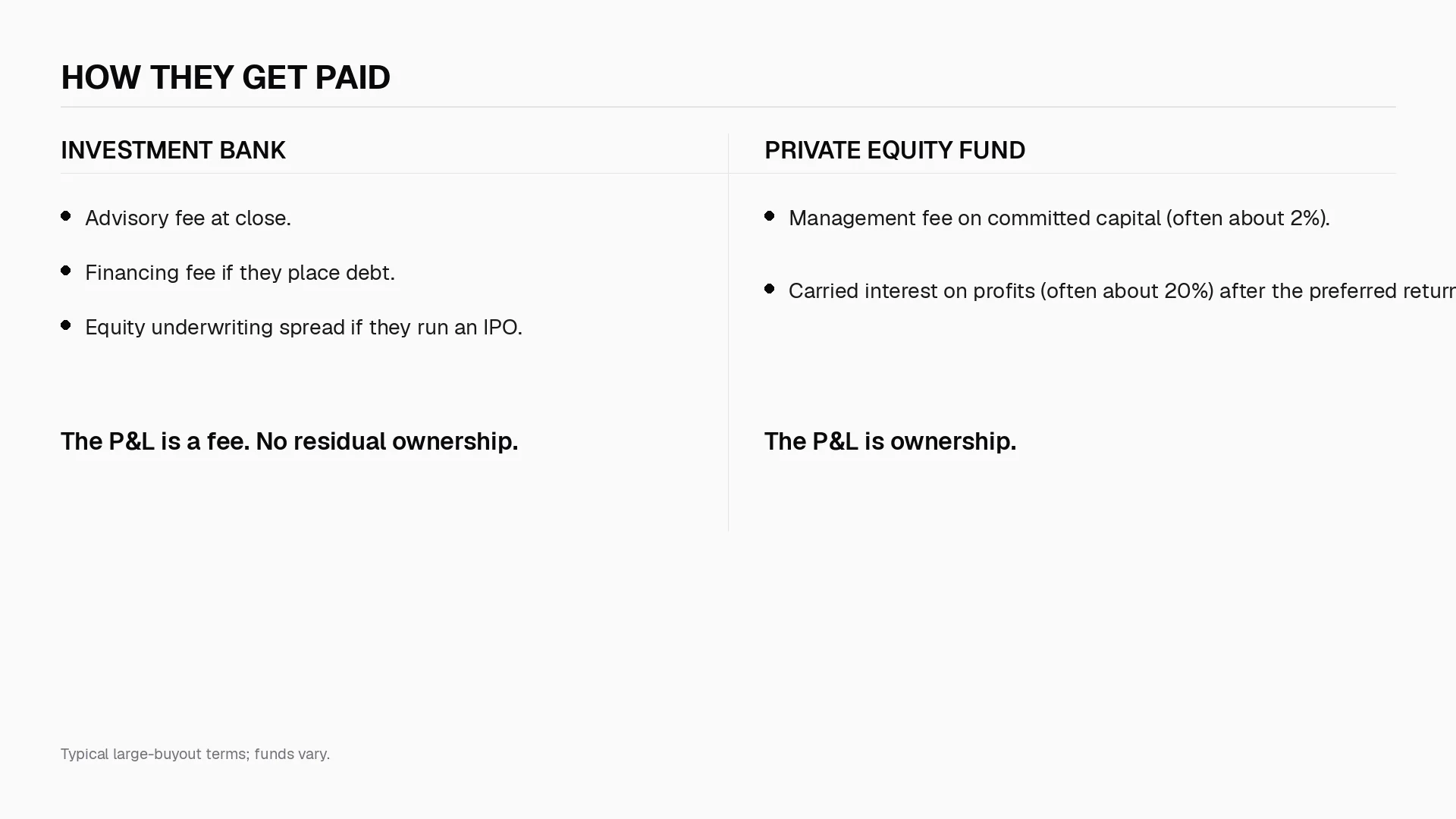
An investment bank makes money when a process happens. Advisory fees on M&A and restructuring. Underwriting spreads on equity and debt offerings. Commissions and bid-ask on sales and trading. Sometimes asset-management fees, research that pulls other mandates, loan syndication. The quality of the advice can be excellent. The P&L still does not own the company after close.
A private equity firm makes money on the pool and on the investments. Management fee (classically around two percent of committed capital during the investment period, often stepping down later) covers the firm. Carry, typically around 20 percent of profits above a hurdle (often 8 percent), is how partners get rich, and it is delayed: the vintage has to clear, the points have to vest, and you have to still be there. Leverage amplifies equity returns when EBITDA grows and works in reverse when it does not. Dividends and recapitalizations can return cash during the hold. The exit (a sale to a strategic, a sale to another fund, an IPO) is when LPs are supposed to be paid. None of that is a success fee on signing.
Bain & Company’s 17th Global Private Equity Report (released 23 February 2026) is why that distinction got sharper, not softer. 2025 global buyout deal value (excluding add-ons) rose 44% to $904 billion; buyout-backed exit value rose 47% to $717 billion; both were the second-highest on record. Thirteen deals above $10 billion accounted for 30% of deal value. Buyout dry powder sat at $1.3 trillion. Holding periods at exit hovered around seven years. Distributions to LPs as a share of NAV stayed below 15% for a fourth year. Buyout fundraising fell 16% to $395 billion. The recovery was real and narrow. Bain’s rule of thumb: “12 is the new 5.” In the 2010s, roughly 5% annual EBITDA growth could underwrite a target 2.5x MOIC / ~20% IRR over five years. With higher rates, less leverage, and little multiple expansion, Bain says typical deals now need something closer to 10–12% annual EBITDA growth for the same return. The PE P&L is no longer a leverage story with a process appendix. It is an ownership story that has to find growth.
Day-to-day work
On a bank, the day is reactive because the client owns the calendar. The junior job decomposes into three tasks: pitch-book creation, modeling, and administrative work. A coverage Tuesday can be a CIM update, a buyer list, a management-meeting prep, a lender call the MD wants in twenty minutes, and a live process that does not care that you also have a pitch due Friday. You are producing artifacts that make a fee more likely. You do not have to like the company. You have to make the process go.
On a fund, the day is for underwriting and then living with the company. Peak Frameworks’ Private Equity Hours budgets the time: in normal markets, at least two-thirds of an associate’s week is looking at new opportunities, meeting management, and doing diligence; portfolio company work and the rest (marks, conferences, fundraising slides) take the remainder. Screening is killing a teaser on customer concentration before it becomes a process. Underwriting is an LBO the investment committee might actually use (sources and uses that balance, a returns bridge, not a twelve-tab monument) and a quality-of-earnings add-back you do not believe is run-rate. Living with the company is the flash that says revenue missed and working capital ate cash, and a board pack that still has to be right. You own the file. You do not own the yes.
That description is the post-banking associate at a fund that actually does deals. Direct-from-undergrad analysts exist. They have less autonomy. You are not managing a process the week after graduation; you are assisting people who have closed several. At a small shop you can spend the year sourcing. There is still selling in PE (to the investment committee, to lenders, to LPs) and “improving operations” is usually board-level, not a founder’s calendar.
The modeling difference is the same P&L in Excel. Bankers build models to impress clients and win advisory business; funds build models to confirm an investment thesis where they have skin in the game. The bells and whistles come out. The operations of the business go in. That is what happens when the file has to survive a hold period instead of a closing dinner.
Intensity is easy to miss if you only compare clocks. Peak Frameworks: the average hour in PE is heavier than the average hour in banking because the decision has permanence and there is often no one behind you to catch a wrong cell. Hours can still be better. The work is not lighter. A live process at a large fund will feel like banking because it is a deal sprint (advisers, data room, IC, lenders) with the extra constraint that you are supposed to have a point of view overnight on a deal everyone in the room already suspects will die. Banking has fallow pockets between comments. PE has portfolio work after the sprint. Neither is a rest cure.
Hours and lifestyle
Published hour bands are not fake. They are averages that hide the distribution. Typical published ranges run 70–100 hours in banking against 60–80 in PE, or 80–100 against “more predictable.” Those ranges describe a typical week, not every week.
Peak Frameworks treats associate weeks as a distribution, not a number. Normal work, maybe half the time, 60–70 hours (midnight once a week, a few hours on a weekend, late evenings usually yours). Deal mode, when you have exclusivity or several processes heating up: 80+. Quiet weeks, if portfolio companies are humming and partners are not filling the funnel: 40–50, which is a real thing in PE and almost never a real thing in a live coverage group. Average around 60–65, maybe ten to fifteen hours better than banking, with megafunds grindier. Weekends are more often protected because the people are older and have families, until the process is live, at which point the process wins.
At the mega-funds, hours can be as bad as banking, or worse. Large-fund associates often run 60–80 in active periods, diligence spikes to near-banking, and if lifestyle is the primary concern, target and fund size matter as much as the PE-versus-banking label. Smaller funds and some family offices can look like 50–60. Treat “PE has better hours” as a claim about the average middle-market week, not as a law.
Culture follows size more than the industry label. A fund of fifteen people means the partners know your name and what you are working on. A bulge-bracket coverage group does not. Banking builds close peer friendships in the trench; that is real and it is not a reason to stay if you want to be graded as an owner. Do not pick the industry for the quiet week. Pick it for the P&L you want to be graded on when the week is not quiet.
Compensation
Junior cash in both seats is high-finance money. A PE associate’s base is usually on par with banking; the bonus weights fund performance more; associates seldom receive carry. The “PE associates earn $300k+” slide is a megafund associate slide, not a law, and PE analysts often earn less than IB analysts. Banking pays you for processes that close this year: base plus a bonus that is a function of you, the group, and the firm. PE pays you cash now and a path-dependent claim later.
Heidrick & Struggles’ 2025 North America Private Equity Investment Professional Compensation Survey (19 November 2025), a survey of 656 North American investment professionals, is why you should not collapse this into one cell. Hiring is two-speed: activity from VP through managing partner at firms that have raised or will raise, and little movement for everyone else. Upper-quartile total cash scaled with AUM. Half of 2025 base increases were 10% or less; about three-quarters of bonuses stayed discretionary. A megafund PE associate and a lower-middle-market PE associate are not in the same market. Neither is automatically ahead of a strong banking associate on cash. Do not average either with a bulge-bracket banker and call the result “PE pay.”
The ceiling is carry, and carry is a delayed claim on fund profits, typically above a hurdle, vested over years, and often thin until VP. The career-path essay owns vesting, good-leaver / bad-leaver language, and the GP capital contribution. If you need the money this bonus cycle and you do not want your net worth tied to a fund, that is information, not a failure of ambition.
Career path and exit opportunities
Usually you need investment banking first for a classic US buyout associate seat. Banking is the default feeder; every other path is a gap you close in public. Direct-from-undergrad PE exists and is still a minority product. Firms like people who have already sat in a live process. That targeting (on-cycle versus off-cycle, which groups place, what non-IB candidates must prove) lives in the break-in guide. Do not rewrite it here as a cert list. A bachelor’s in finance is common and not required. CFA, CAIA, and modeling certificates are optional credentials, not a recruiting gate.
The banking ladder is a client machine: analyst (models, pitch books, research, two or three years), associate (the link to seniors, often post-MBA or promote), vice president (deal team and client), director (origination), managing director (winning mandates). The PE ladder is an investing machine: a thin analyst product at some firms, then associate, vice president, principal, partner. Early years are models, diligence, IC support. Later years are origination, judgment, fundraising, LP relationships. Economics shift toward carry. Promotion is slower than banking because more people want to stay and the incentive is to wait for the vest. The dedicated career-path essay owns that ladder, the MBA fork, and megafund versus middle-market promotion. For this comparison: a lean middle-market seat where you sit in IC can teach investing faster than a narrow slice of a mega-process.
Bankers move to PE for a reason that is not “better hours.” They want to be graded on a thesis, not a process. They want a shot at carry. They want to stop revising the font on a pitch. Those are real. They are not automatic. The bank taught you to run a process. The fund is hiring you to stop treating the process as the product. In a fit interview, “the work is more interesting” dies if you cannot say what you would have underwritten on a deal you already sat.
The skills that transfer are the ones the day actually uses. Both seats need a model that ties, a valuation you can defend, and the stamina to turn comments. Banking adds client-facing pitch craft, process design, and a wide professional network. PE adds investment judgment, commercial diligence, and the patience to live with a company after the closing dinner. Soft skills are not a footnote: extracting information from a management team that does not like you is a PE skill banking does not grade the same way.
Exits from banking are broader. Private equity, hedge funds, growth equity, corporate development, MBA, start-ups. The brand on a large bank still travels outside finance in a way most fund names do not. Everyone has heard of Goldman Sachs; most people outside the industry have not heard of a strong middle-market sponsor. PE still exits well (operating roles, later funds, the occasional hedge fund). They are just not as wide, and the fund taught you to say no. Going from PE back to banking is rare. The bank is hiring a process athlete with a client-facing brand. People do it toward capital markets or sponsor coverage if the story is coherent. Do not underwrite it as a plan. If you want similar work and a life, corporate development is the honest alternative, not a failed PE outcome.
Which to choose
There is no global winner. There is a scoreboard you are willing to be graded on.
Stay in banking, or start there, if you want optionality and you do not yet know which principal seat you want, or if you know you like clients, variety, and the craft of getting a process to close. If you lack a long-term view, banking puts you at the center of the capital markets and, depending on the group, across more transaction types. You get reps: you look at a lot of deals in PE and pass on most of them quickly, so you close fewer. If you are early and PE is the primary goal, a banking analyst seat is still usually higher expected value than hunting a rare undergrad PE offer. Banking is a service craft with a wide option set. Do not apologize for wanting that.
Go to PE, or take a direct PE seat, if you want to be graded as an owner and you have evidence you will actually like the quiet parts (the killed deal, the portfolio flash, the year the model was wrong). The filter for skipping banking out of undergrad is still: only if you are certain you want the buy-side, the offer is at a known established firm rather than a $100 million AUM cold-calling shop, you will work on real deals rather than sourcing as a glorified assistant, and there is a path to associate rather than a two-year door. A Silver Lake analyst assisting post-IB associates is not the same product as Dollar Dial Capital. If those are not true, the shiny PE title is a worse trade than a strong banking group.
Do not go to PE for lifestyle. Hours are a distribution. Megafund PE can match banking. Intensity is higher. Junior cash is not a raise unless you landed the specific seat that pays like one. Carry is a vest, not a bonus.
Do not stay in banking because you are afraid of a smaller letterhead. If you want the company (the underwrite, the hold, the exit), the fund is the P&L that grades that. The career-path essay is where fund tier changes promotion. The comparison is prior to that: do you want to sell the process, or live with the company?
Private equity vs venture capital
Buyout private equity is usually control, leverage, cash-flow underwriting, a hold measured in years, and an exit that has to return capital to LPs who already waited. Venture is minority capital into early companies, a loss function in which most investments fail and a few return the fund, and an interview that will punish you for walking in with a paper LBO. Growth equity sits in between: less leverage, more founder dynamics, more sourcing, less classic LBO machinery. If you mean venture, say venture. If you mean owning a business with debt, you mean a buyout.
How investment banks and private equity firms work on the same deal
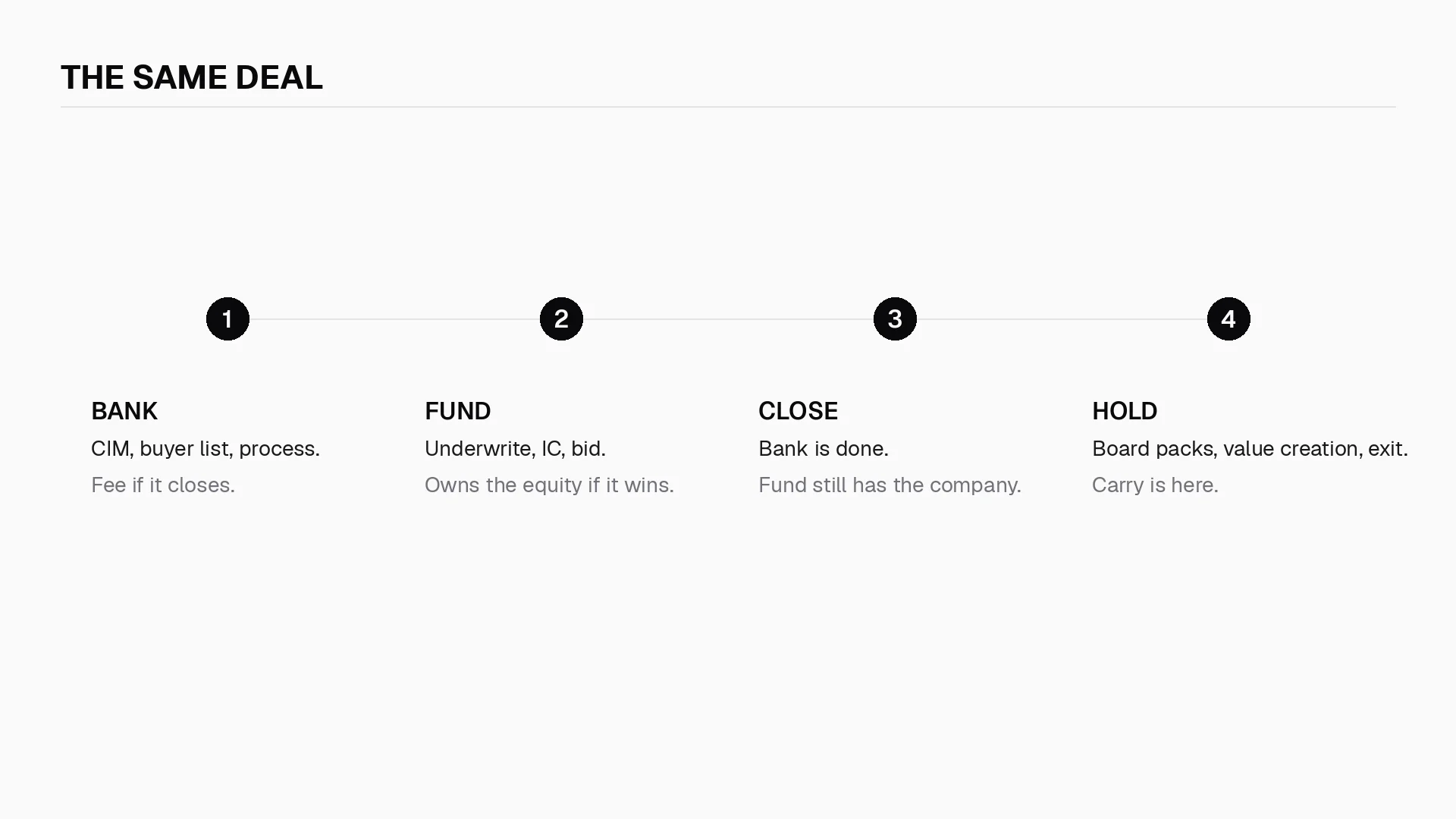
The two businesses meet on a live deal.
A full-service bank covers financial sponsors the way it covers any other client: pitch ideas, run sell-side processes, arrange financing. A dedicated sponsors group will take buyout ideas to PE shops to convince them to pursue a deal; the same bank will try to provide the debt. Sponsor coverage, M&A, and leveraged finance are the banking seats whose daily work maps onto a buyout, which is why they place into PE, a fact the break-in guide already owns as a targeting rule.
Take a process. The bank is hired by a seller. Juniors build the CIM, the model that makes the company look coherent, the buyer list that includes the usual sponsors. Sell-side work starts early: clean numbers, a narrative, fewer surprises once buyers engage. The PE associate receives the book. The job is not to make the company look coherent. The job is to find the lie: customer concentration, working-capital cash that is not cash, an add-back that is run-rate only in the CIM, a management case that assumes Bain’s 10–12% EBITDA path without naming how the company gets there. Expert calls, quality of earnings, commercial diligence, a model that gets simpler rather than prettier. Buyers pull threads. Sellers guide attention. If the fund passes, the bank still has other buyers. If the fund signs, the bank’s success fee is in view and the fund’s capital is about to be.
Close is the fork. The bankers who ran the process go to the next mandate. The PE team now owns a company. Board packs, 100-day plans, add-ons, refinancings, the slow discovery of whether the memo was true. Bain is explicit about what that fork now demands. Too often, diligence is defensive: confirm the CIM, build a case conservative enough for a lender and aggressive enough for a “good enough” return. In a world where 12 is the new 5, good enough does not cut it. What Bain wants is full-potential diligence (revenue, operations, technology) so you know what the asset can be worth, not only what the book says it is. The sponsors banker is still paid to sell the process. The associate is now paid to live with the answer.
When you compare firms rather than slogans, use the companies directory to see who is actually a buyout shop, a growth shop, a credit shop, or a real-assets shop. “PE” is not one client of the sponsors group.
The titles are adjacent. The businesses are not. Banks sell a process for a fee. Funds buy companies and live with them. Pick the P&L you want to be graded on.
When you are ready to look at live investing seats, start on Private Equity Jobs, research the GP on the companies directory, and keep the glossary open. If you still need the first door, use the break-in guide. If you already have a seat, use the career-path essay. Job alerts live at sign-up.
Related posts

Buy-side firms such as private equity funds invest capital for a return, and sell-side banks are paid fees and commissions to arrange the deals and trades. Which firms sit on each side, how each is paid, how research and licensing differ, and how careers move from banking into private equity.

When a private equity fund buys a company, the company takes on the acquisition debt, the fund takes the board, and a plan to raise earnings starts on day one. What changes for managers and staff, what the research says about jobs and failure, and how the ownership ends.