What Is an LBO (Leveraged Buyout)?
A leveraged buyout is a purchase paid mostly with borrowed money the company, not the fund, has to service. Sources and uses, three return levers, a worked $200 million close, and why 2026 mix is less debt on a more expensive company.
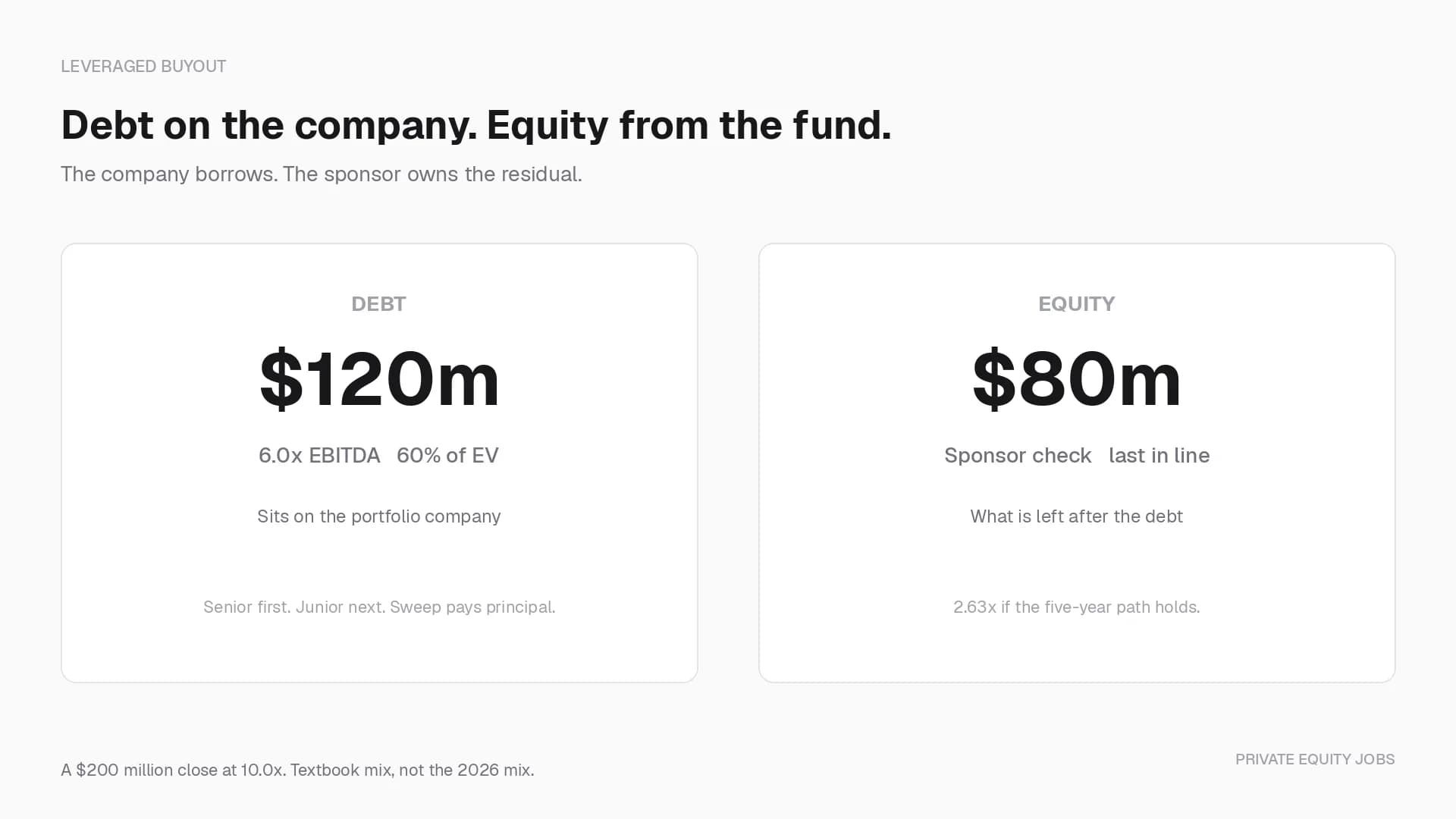
A leveraged buyout is a purchase of a company paid mostly with borrowed money that the company, not the fund, has to service. The private equity sponsor puts in equity. Lenders put in debt against the company's cash flows and assets. Equity is what is left after that debt. If free cash flow pays the interest and some of the principal, the equity claim grows. If it does not, the company is the one in distress.
That is the deal. It is not a slogan about "buying with other people's money," and it is not a plan to load a business with debt so it can later fail. Bankruptcy is a path when the underwrite was wrong.
How a leveraged buyout works
The buyer is usually a financial sponsor, a private equity fund that takes control. The fund does not borrow the purchase price on its own balance sheet. It stands up a vehicle, buys the equity, and places new debt on the portfolio company. The company's assets and future cash flows are the collateral. The fund's other companies are not.
The house-mortgage metaphor is the usual shortcut, and it is incomplete. A mortgage buys a house that you live in. An LBO buys a business that has to generate the payment. The company is the borrower. Interest and required amortization come out of its cash flow before anyone talks about equity value.
The loop is short.
- Find a company whose cash flow can carry debt.
- Agree a price, usually as a multiple of EBITDA.
- Fill the price with new debt plus sponsor equity (and sometimes rollover equity from sellers or management).
- Own the company for several years. Improve operations. Use free cash flow to pay interest and, if the documents require it, pay down principal.
- Exit: sell to a strategic buyer, sell to another fund, or take the company public. Equity value at exit is enterprise value minus remaining net debt.
The hold on a company is not the life of the fund. A classic underwrite is about five years. Bain & Company's Welcome to a New Era in Private Equity essay, part of the 17th Global Private Equity Report (23 February 2026), puts average holding periods at exit closer to seven years. The extra time is harvest slipping, not a different model.
Sources and uses
Every close has two columns that have to match.
Uses are what the money is for: buy the equity, refinance the debt that is already on the company, and pay transaction fees.
Sources are where the money comes from: new senior debt, any junior or mezzanine debt, sponsor equity, and equity that sellers or managers roll.
Take a simple close. The company earns $20 million of EBITDA. The sponsor pays 10.0x, so enterprise value is $200 million. Existing net debt is refinanced. Fees are ignored so the arithmetic stays visible.
| Sources | Amount | Uses | Amount |
|---|---|---|---|
| New debt | $120,000,000 | Equity purchase (enterprise value) | $200,000,000 |
| Sponsor equity | $80,000,000 | ||
| Total | $200,000,000 | Total | $200,000,000 |
The $120 million is 6.0x EBITDA and 60 percent of enterprise value. That is the textbook mix. It is not automatically the 2026 mix.
The debt is not one loan. It is a stack, ranked by who gets paid first.
- Senior debt. A revolving credit line plus a term loan, usually secured, cheapest, first in line. Often syndicated across banks and institutional lenders.
- Junior debt. Second-lien, high-yield bonds, or mezzanine. Unsecured or second in line, more expensive, sometimes with warrants.
- Equity. Last in line. First to absorb a loss. The residual if the exit works.
A cash sweep, when the credit agreement has one, forces excess free cash flow onto the senior principal after interest and required amortization. That is how deleveraging happens even when EBITDA is flat. Interest coverage (EBITDA divided by interest expense) is the lender's cushion. If coverage is thin at close, the stack does not get built.
Bain's 2025 illustration uses a 14.0x entry multiple and leverage of about 36 percent of enterprise value. Thirty-six percent of 14.0x is about 5.0x EBITDA. The old "60 to 90 percent of the purchase price" line is a share of a cheaper company. On a 14x deal, 60 percent would be 8.4x EBITDA. Credit does not write that ticket in this rate world.
How LBO returns work
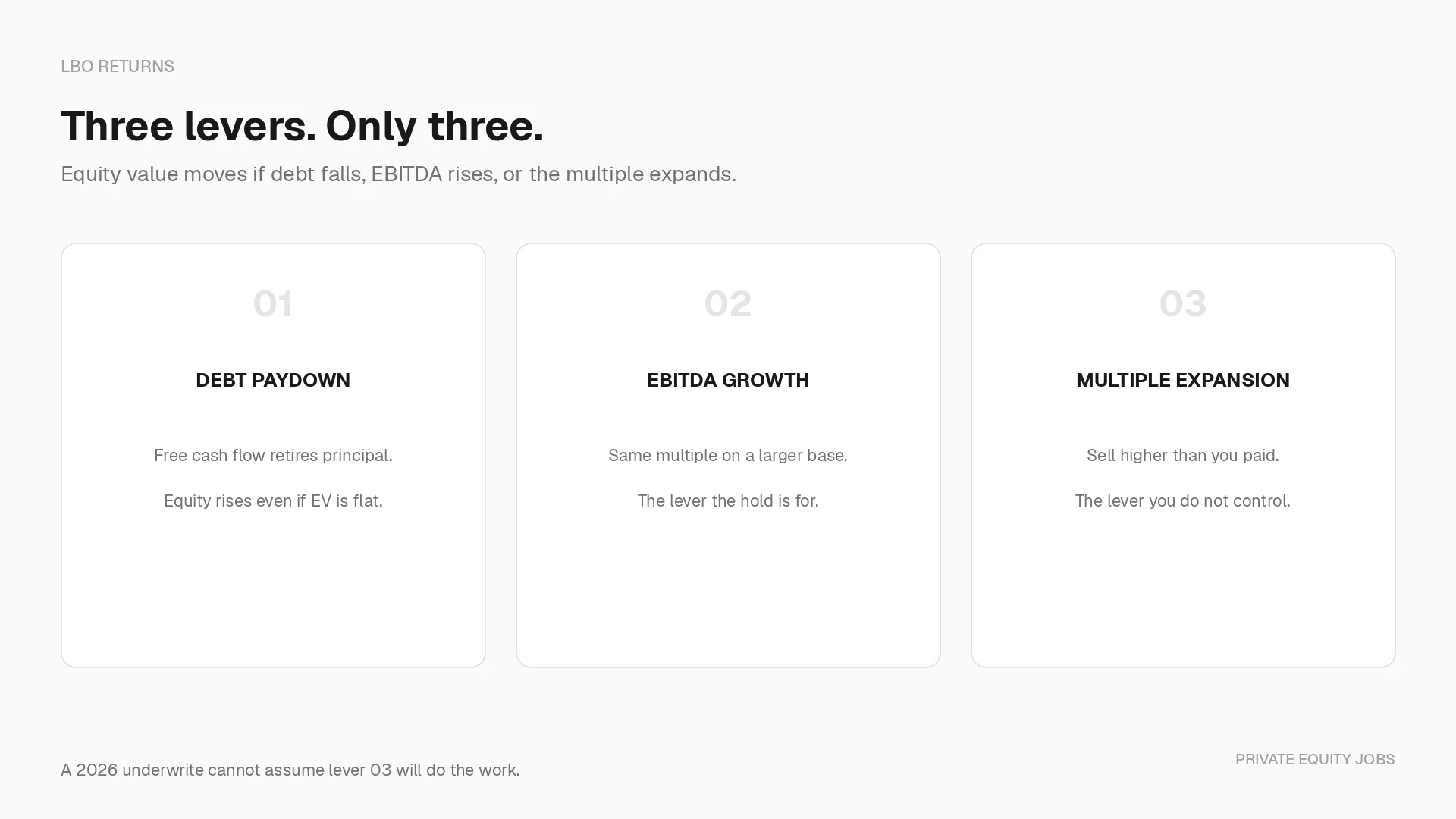
Returns come from three places, and only three.
- Debt paydown. Free cash flow retires principal. Enterprise value can sit still. Equity still rises because less debt is subtracted.
- EBITDA growth. The same exit multiple on a larger earnings base is a larger enterprise value.
- Multiple expansion. Sell at a higher multiple than you paid. This is the lever the sponsor does not control.
Take the $200 million close. Hold five years. EBITDA grows about 7 percent a year, from $20 million to $28 million. Exit at the same 10.0x. No multiple expansion. Debt is paid down from $120 million to $70 million.
| Entry | Exit (year 5) | |
|---|---|---|
| EBITDA | $20,000,000 | $28,000,000 |
| Multiple | 10.0x | 10.0x |
| Enterprise value | $200,000,000 | $280,000,000 |
| Debt | $120,000,000 | $70,000,000 |
| Equity value | $80,000,000 | $210,000,000 |
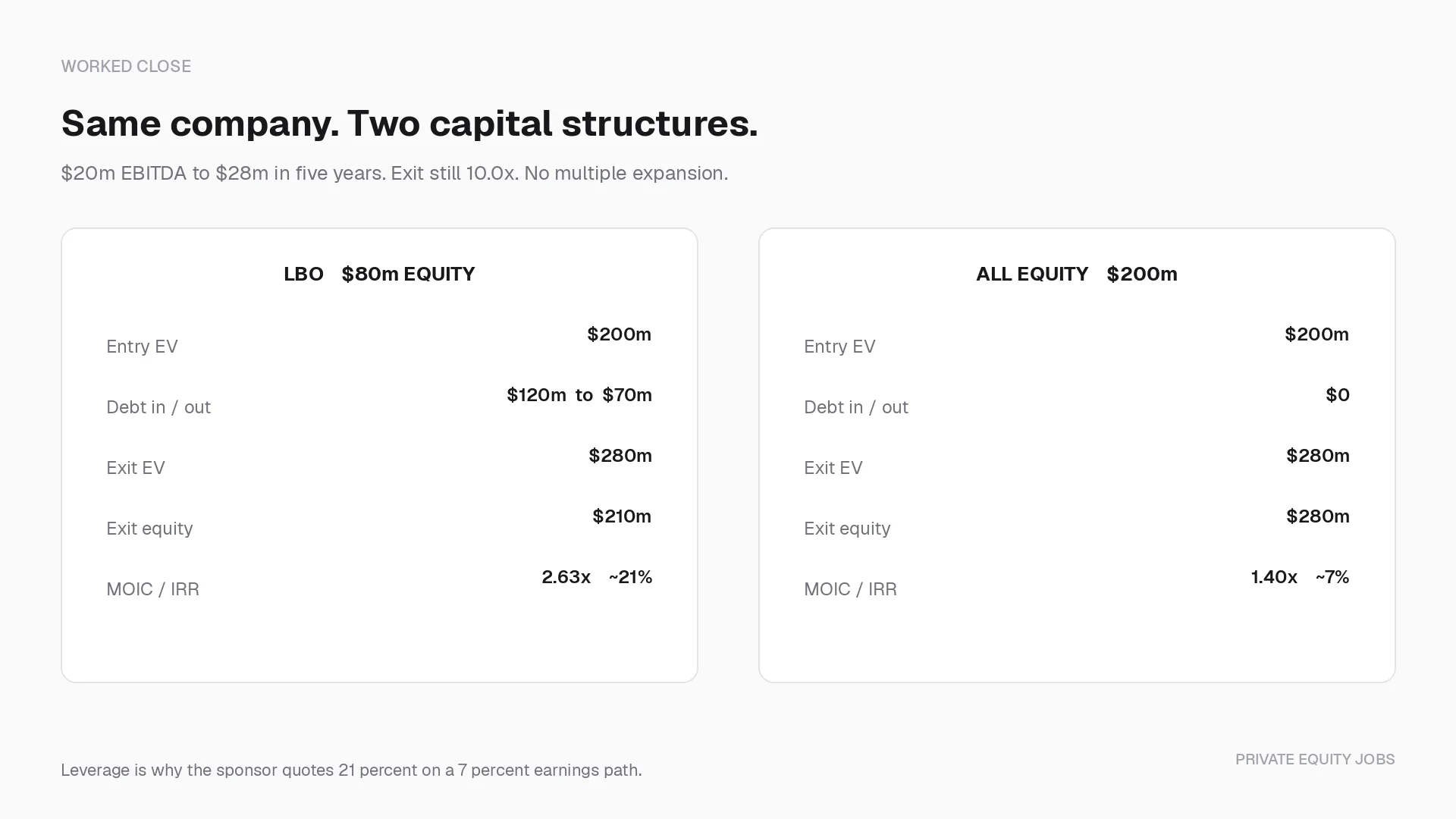
The fund put in $80 million and took out $210 million. MOIC is 2.63x. IRR is about 21 percent. MOIC is how many times the cash came back. IRR is that multiple with a clock on it. The same 2.63x over seven years is a mid-teens IRR. That is why slipped holds hurt even when the multiple looks fine.
The $130 million of equity gain splits across two levers. Debt paydown created $50 million (the principal that disappeared). EBITDA growth created $80 million ($8 million of extra EBITDA times the 10.0x). Multiple expansion created nothing.
The same operating path without leverage is a different job. An all-equity buyer pays $200 million and sells at $280 million: 1.40x, about 7 percent a year, the growth rate of EBITDA. Leverage is why the sponsor quotes 21 percent on the same company. It is also why the failure case is worse.
Failure case, same entry. EBITDA stays $20 million. The exit multiple contracts to 8.0x. Little principal is paid (debt still $110 million). Enterprise value is $160 million. Equity is $50 million. MOIC is 0.63x. The fund lost more than a third of the equity. The lenders are still ahead of it.
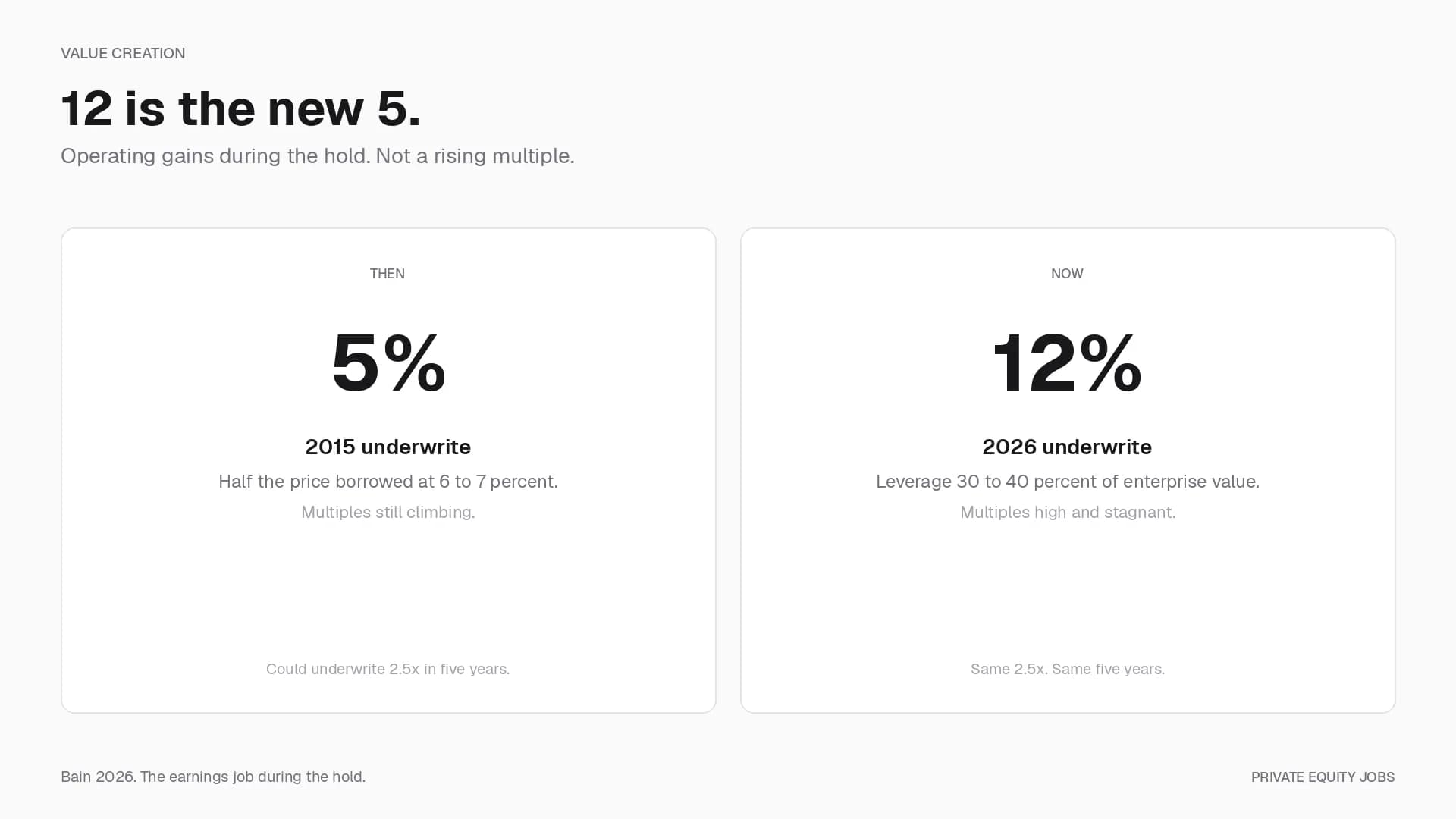
Bain's 2026 rule of thumb is why the textbook close is no longer the underwrite. In a typical 2015 buyout, about 50 percent of the price was borrowed at 6 to 7 percent, and multiples were still climbing (Bain's illustration: 10.0x in, 12.5x out). Roughly 5 percent annual EBITDA growth could underwrite a target 2.5x MOIC over five years. In 2025, borrowing costs sit in the 8 to 9 percent range, leverage is closer to 30 to 40 percent of enterprise value (about 36 percent in the illustration), and multiples are high and stagnant (14.0x in, 15.0x out). The same 2.5x now needs something closer to 10 to 12 percent annual EBITDA growth. "12 is the new 5."
That is the job on a 2026 deal: find the earnings path. Do not assume the multiple will do the work.
What makes a good LBO candidate
Lenders and sponsors are underwriting the same thing: cash that shows up after interest.
A good candidate is mature enough to have a history, stable enough that next year's cash flow is not a guess, and light enough on capital expenditure that EBITDA is not a fiction. Recurring revenue, high retention, and a product customers already pay for all help. A tangible asset base helps the senior lenders. A management team that will stay, or a team the sponsor can install, helps the hold.
EBITDA is a shorthand for operating profit. It is not free cash flow. It ignores capital expenditure, working-capital swings, and cash taxes. A company can print a clean EBITDA margin and still fail a cash sweep if it has to restock, retool, or pay cash taxes the model treated as optional. The LBO model builds a cash-flow forecast for that reason.
A poor candidate is an early company whose loss function looks like venture, a cyclical whose trough coincides with a rate reset, or a business that has to reinvest every dollar it earns just to stand still. Growth equity can still be a good investment. It is a worse LBO.
The sponsor also needs an exit it can describe on day one: a strategic buyer who would want the asset, a larger fund that buys platforms, or a public market that will take the story. Secondaries (one fund selling to another) are a common path, not a failure of imagination.
Types of leveraged buyouts
The machinery is the same. The roster changes.
Sponsor buyout. A fund takes control of a private company. This is the default.
Management buyout (MBO). Incumbent managers buy a stake, usually with a fund, because they cannot write the whole equity check. Management buy-in (MBI) is the same idea with an outside team.
Public-to-private. The fund buys a listed company and delists it. The price is a premium to the undisturbed share price. The process has a board, a shareholder vote, and more disclosure than a private auction.
Secondary buyout. One sponsor sells to another. Secondary buyouts are a large share of sponsor exits, often a quarter to a third of buyouts. The selling fund gets a realization. The buying fund gets a company that has already lived with leverage.
Carve-out. A parent sells a division. The division needs its own balance sheet, its own systems, and its own debt capacity. The LBO is also a stand-up.
Hostile takeovers exist. They are rare in sponsor buyouts. Most LBOs are negotiated with the board and with management. The folklore that an LBO is a raid is a 1980s story, not the 2026 process.
Notable leveraged buyouts
Two closes, both from documents, not from memory.
On 3 July 2007, Hilton Hotels announced an all-cash sale to Blackstone funds at $47.50 a share, a 40 percent premium, valuing the company at about $26 billion. The 24 October 2007 close release is the capital structure: about $20.6 billion of mortgage and mezzanine debt on Hilton subsidiaries, and about $5.7 billion of Blackstone equity. That is a classic pre-crisis mix, debt-heavy, secured by the assets. The deal closed weeks before the credit market froze. The later public exit is why the deal is remembered as a success. The close is why it was an LBO.
On 29 September 2025, Electronic Arts announced an agreement to be acquired by a consortium of PIF, Silver Lake, and Affinity Partners. The company release values EA at about $55 billion of enterprise value, $210 a share in cash, a 25 percent premium to the unaffected price of $168.32. Funding is about $36 billion of equity (including PIF rolling its 9.9 percent stake) and $20 billion of debt committed by JPMorgan, $18 billion of which is expected at close. That is a take-private with leverage. It is not a 60 percent-debt textbook. Equity is most of the check. That is the 2026 shape: large, sponsor-backed, and less levered as a share of enterprise value than Hilton was.
RJR Nabisco in 1989 is the famous 1980s auction, later the book and the film. It was the largest LBO for years. The useful fact is the structure, not the auction folklore.
Risks of a leveraged buyout
Leverage multiplies the equity return because it multiplies the equity risk.
Interest is due whether revenue is. A coverage ratio that looked fine at close can fail in a downturn, a price war, or a rate reset on floating debt. A cash sweep that looked like a virtue (faster deleveraging) is a vice if the company needed that cash for maintenance capex. Covenants can restrict more debt, more dividends, or more acquisitions. Breach is a negotiation with lenders, not a rounding error.
A dividend recapitalization pulls cash out early by putting new debt on the company. It can raise IRR because cash came back sooner. It also raises the interest bill and shrinks the equity cushion at exit. It is a tool. It is not free.
If cash flow cannot service the stack, the company restructures or files. The fund's other portfolio companies are not on the hook. The equity in this company can go to zero. That is the failed underwrite. It is not the strategy.
The LBO model
The model answers one question: if we buy this company today, what do we hold at exit?
The steps are the same ones a paper LBO asks in an interview, written as a forecast instead of a napkin.
- Set the entry (EBITDA, multiple, enterprise value, debt, equity).
- Build sources and uses so the columns match.
- Forecast revenue, margin, capex, and working capital far enough to see free cash flow.
- Build the debt schedule: interest, mandatory amortization, optional sweep, remaining principal.
- Set the exit (year, EBITDA, multiple), subtract remaining net debt, and compute MOIC and IRR. Then change the assumptions.
That is the whole object. It is not a third religion. Sensitivity on entry multiple, leverage, growth, and exit year is the job, because 2026 deals do not work on a 5 percent earnings path.
Common questions
What does LBO stand for?
Leveraged buyout. A purchase of a company financed with a significant share of debt placed on that company.
Who borrows the money?
The company, through the acquisition vehicle. The fund contributes equity. Lenders do not have recourse to the rest of the fund.
What is a good LBO return?
Sponsors still talk about a 2.0x to 3.0x MOIC and a mid-teens to 20 percent IRR over a five-year hold. Bain's 2026 illustration needs 10 to 12 percent annual EBITDA growth to underwrite 2.5x in five years. A 20 to 30 percent IRR list is a target, not a market average.
How is an LBO different from an ordinary acquisition?
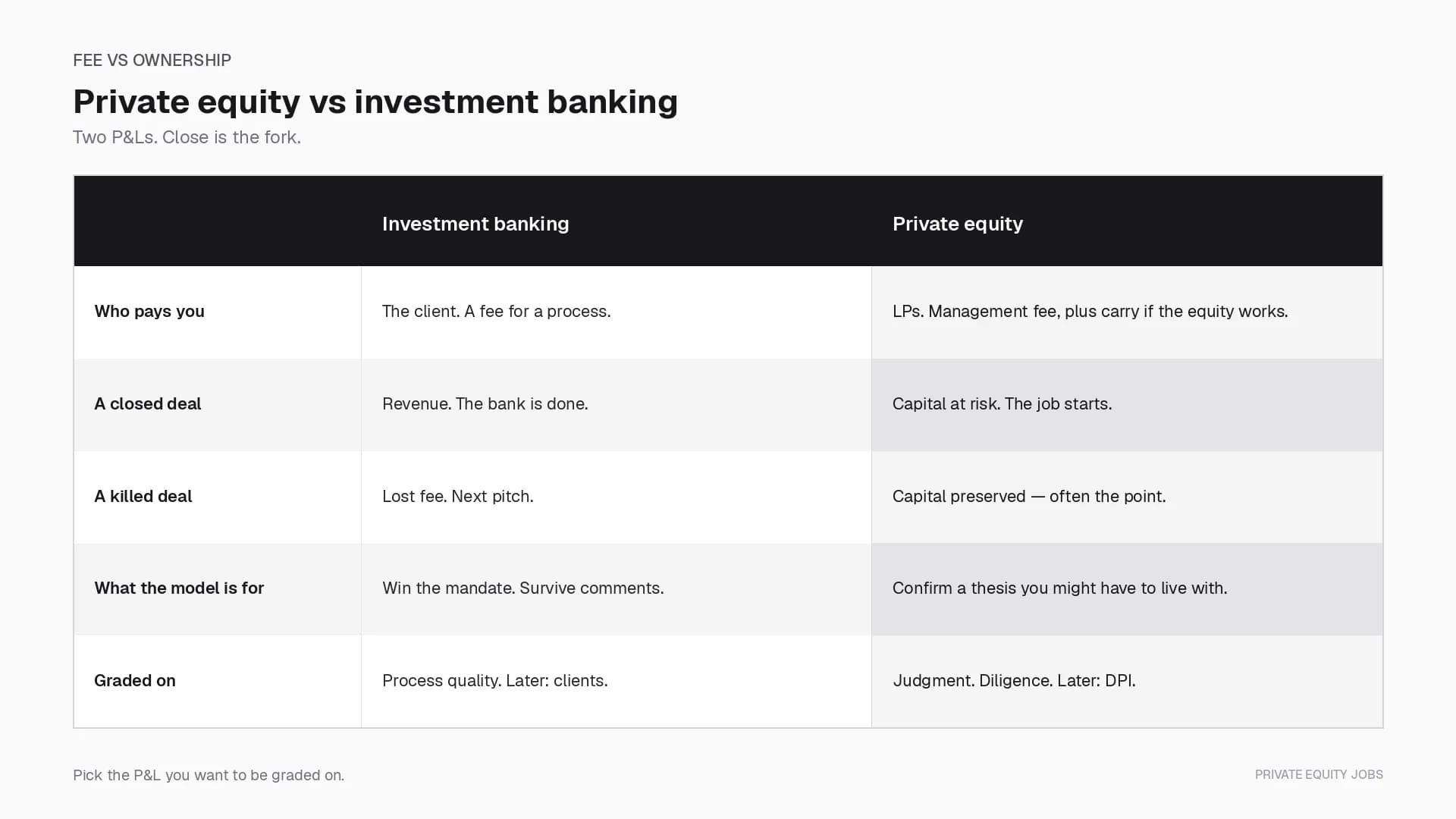
A corporate buyer often pays with cash or stock and keeps the company. A sponsor pays with a debt-and-equity stack, lives with the company for a hold, and needs an exit that returns cash to limited partners. The operations can look similar. The capital structure and the clock do not.
What is a paper LBO?
A stripped interview version of the model: entry, debt, a few years of cash flow, exit, MOIC and IRR, in your head or on one sheet. The break-in guide is the place for that test.
Sources
Bain & Company, Welcome to a New Era in Private Equity, 17th Global Private Equity Report, 23 February 2026. Hilton Hotels and The Blackstone Group, close release, 24 October 2007. Electronic Arts, agreement to be acquired by PIF, Silver Lake, and Affinity Partners, 29 September 2025.