How to Break Into Private Equity
Breaking into PE in 2026 is a probability problem of path × city × fund tier. Megafund on-cycle is a 2–5% game most candidates were never in; middle-market off-cycle is where the industry actually hires.
The standard story of how to break into private equity still describes a process that 2026 no longer runs. Join a bulge-bracket class, wait for the fall on-cycle, sit a paper LBO, collect a megafund offer that starts two years later. Some version of that machine still exists. It is not the industry. It is a headhunter-mediated sprint for a thin slice of New York first-years. The Private Equiteer’s How to Get Into Private Equity: The Complete 2026 Career Guide puts the offer rate at the top mega-funds at roughly 2–5% of the people who apply. Treating that sprint as the plan is how most candidates finish the year with nothing.
Breaking in is a probability problem. The variables are path, city, and fund tier. A Goldman M&A analyst in New York playing megafund on-cycle, a middle-market industrials banker in Chicago playing off-cycle, and a McKinsey consultant targeting Advent International are not in the same market. Those markets changed after JPMorgan threatened to fire juniors for taking future-dated buyout offers in June 2025, and after on-cycle for 2027 associate seats restarted on January 5, 2026.
If you are deciding whether PE is realistic, start with path × city × fund-tier fit and your bank’s written recruiting policy, not logo shopping. Keep IRR, MOIC, and due diligence language precise in the Private Equity Glossary. If you are still choosing the business (fee for a process versus owning the company), that is Private Equity vs Investment Banking.
What the private equity job is
Most candidates mean a pre-MBA associate seat on an investing team: building and stress-testing models, running diligence workstreams, drafting investment-committee materials, and monitoring portfolio companies. That is not every job with “private equity” in the title, and it is not how an accredited investor buys into a fund. This page is the job. Partners hire against a role. “I’m exploring PE” underperforms “I’m preparing for off-cycle associate conversations at lower-middle-market industrial funds.”
The investing associate (or the thinner undergrad analyst product) is the classic break-in target, and it is scarce relative to applicant volume. Portfolio operations and value-creation are real firm roles on commercial and operating improvement: a parallel track, not an automatic promotion onto the deal team. Working inside a PE-backed company gives you sponsor and board exposure; it is a bridge, not the fund seat. After you are in, a common investing progression runs analyst to associate to senior associate to vice president to principal to partner. Early years are models, diligence, and IC support. Later years are origination, judgment, and fundraising. The Private Equity Career Path is the seat-by-seat ladder, the MBA fork, and how megafund versus middle-market promotion actually works. Do not mix those tracks when you recruit.
Do not mix direct-from-undergrad analyst programs with the January megafund associate sprint. Analyst programs hire seniors (or convert junior-summer interns) into the most junior investing seat. Associate on-cycle hires first-year bankers for a seat that starts 12–24 months later. CT Acquisitions’ How Do You Get Into Private Equity: The 2026 Career Playbook names Carlyle, Apollo, Blackstone, Bain Capital, Vista, and Thoma Bravo, plus a Boston cluster (Berkshire Partners, HarbourVest, Summit Partners, TA Associates, Charlesbank), and says the Buyside Hub 2025 recruiting tracker counted 28 U.S. buyout and growth firms running active undergrad pipelines, up from 6 in 2018. Volume is still small: a typical class is 2–8 analysts per firm per year, with a higher bar than banking (target school, GPA above 3.7, prior PE or banking internship, modeling already fluent). If you have that shot, take it. If you do not, the highest-EV move is still a banking analyst program, not waiting for a campus PE seat that will not appear.
If you are starting from zero: a private equity fund is a closed-end pool. Limited partners (pensions, endowments, sovereigns, family offices) commit capital. The general partner (the firm) calls that capital, buys companies, tries to increase equity value, and returns cash over a roughly ten-year fund life. The GP is paid by LPs: a management fee on committed or invested capital, plus carry on profits above a hurdle. That is not a fee the portfolio company pays for “GP services,” and it is not LP reporting, fund accounting, or a portfolio-company FP&A job that happens to say “PE-backed” on a résumé. The associate seat you want sits on the GP investing team.
Most US buyout associates underwrite control deals financed with a mix of equity and debt. The company’s cash flows service the debt. Equity returns come from some mix of EBITDA growth, debt paydown, and change in exit multiple. Growth equity uses less leverage and more minority / founder dynamics. Venture capital is a different asset class with a different interview; do not walk in with a paper LBO. Buyouts are not a strategy reserved for failing companies. Plenty of healthy businesses are taken private because the cash-flow case and the control case line up. Credit, secondaries, real assets, and infrastructure are PE careers with their own feeders. Treat them as products, not as failed buyout attempts. Definitions live in the glossary.
The associate is hired to produce: a sources-and-uses that balances; an LBO that ties; a quality-of-earnings conversation that does not treat reported EBITDA as cash; a working-capital view that can invent or destroy free cash flow; and a short IC narrative (thesis, three risks, value-creation plan, exit). Recruiting is a compressed exam in those artifacts. Fundraising, board work, and origination are real, and they are not the junior job.
Funds are not hiring for the 2010s deal math. Bain’s 2026 Global Private Equity Report, released February 23, 2026, finds a recovery that is real and narrow: 2025 global buyout deal value (excluding add-ons) rose 44% year-on-year to $904 billion; buyout-backed exit value rose 47% to $717 billion; both were the second-highest on record. Thirteen deals above $10 billion accounted for 30% of deal value. Buyout dry powder sat at $1.3 trillion. Holding periods at exit hovered around seven years, up from five to six in 2010–2021. Distributions to LPs as a share of NAV stayed below 15% for a fourth year. Buyout fundraising fell 16% to $395 billion.
Bain’s rule of thumb: “12 is the new 5.” In the 2010s, ~5% annual EBITDA growth could underwrite a target 2.5x MOIC / ~20% IRR over a five-year hold. With higher rates, less leverage, and little multiple expansion, Bain says typical deals now need ~10–12% annual EBITDA growth for the same return. McKinsey’s 2026 Global Private Markets Report makes the same turn: alpha is made in operations, not found in cheap debt. Preqin’s US Buyouts 2026 primer puts the US exit-ready overhang at $989 billion and notes continuation-fund capital nearly doubling to $24 billion in 2025.
That is why funds grill commercial judgment, not only model speed, and why consulting and operator backgrounds have a narrower but more honest door into value-creation and sector seats. The hours and the cash are recruiting facts later on this page. They are not a thesis.
Is it hard to get into private equity
Yes. The investing class is small, and the filter is specific: funds hire people who can plug into a live process. Equiteer’s 2–5% figure is the megafund application-to-offer rate, not the hit rate for the whole industry. A middle-market off-cycle search with a real deal sheet is a different probability. Treating “is it hard” as a personality question is how candidates skip the targeting math and then call a blank megafund weekend a verdict on PE.
People want the seat for reasons that are true and mostly unsayable in a fit interview. Compensation can be high. Hours are often better than peak banking. You underwrite as a principal rather than selling a process. You go deeper on a sector. None of that is “why PE.” “Better hours and pay” dies. So does “more interesting work” if you cannot name how you would create value under Bain’s 10–12% EBITDA-growth math. The honest filter is whether you want to live with a company for five to seven years, and whether you can already produce the artifacts the associate is hired for.
It is the wrong seat if you want public-markets trading, a 40-hour week, or a job you can learn after you arrive. Excellent grades, a CIM you can interrogate, and an LBO you can run cold are the floor, not a differentiator. Non-traditional backgrounds do get in. They get in where the fund already buys their skill, not by arguing the filter is unfair, and not by telling a partner they will “do anything.” Coming in with zero deal proximity is not a plan. It is a reset: banking, TAS, corp-dev, or a sector seat that maps, then the associate process from there.
How to get into private equity
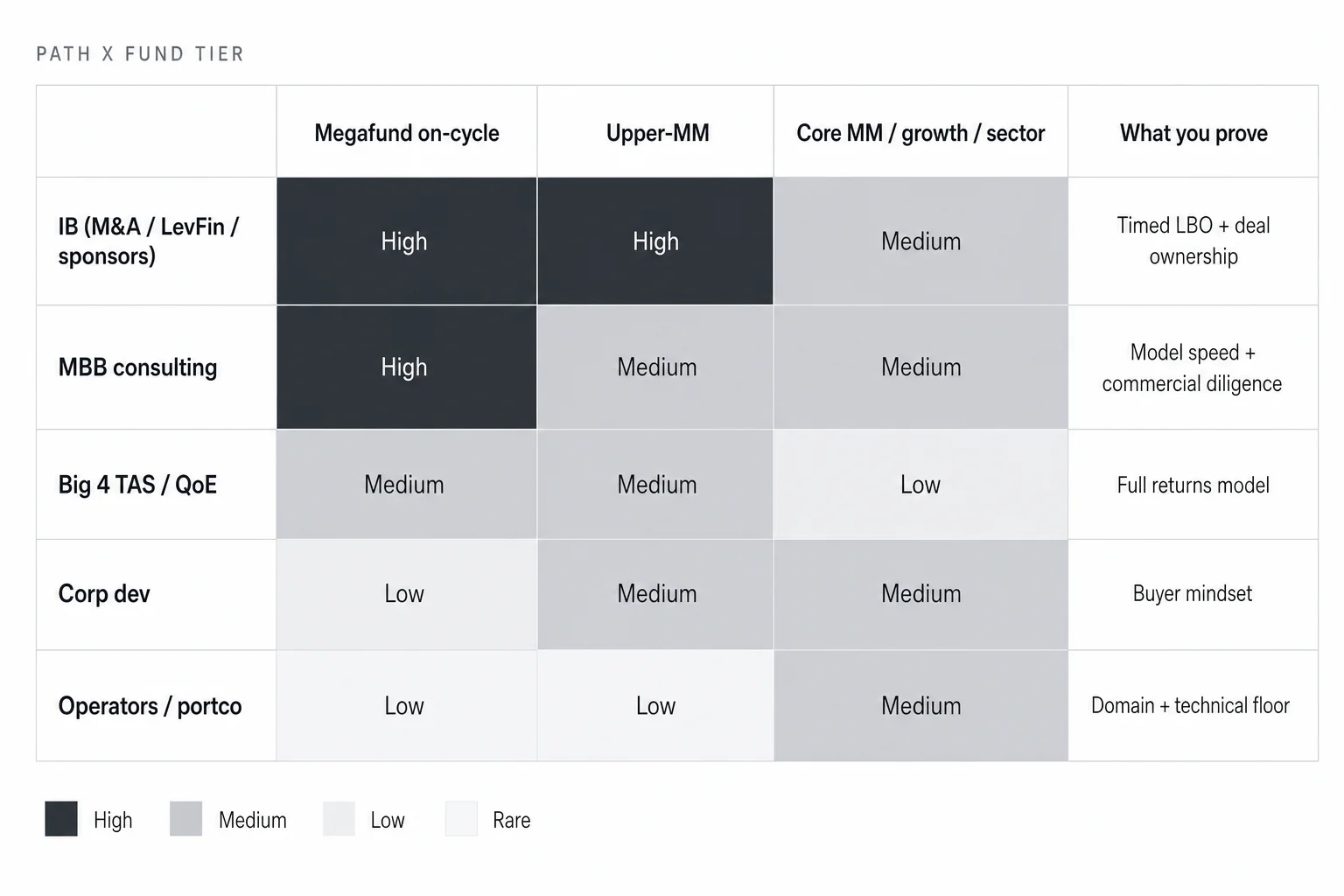
Private equity hiring is risk-averse. Funds prefer people who can plug into a live process. That is why banking dominates associate classes, and why “alternative paths” are real without being equally likely at every tier. The Equiteer 2026 guide finds that roughly 85% of PE associates come from investment banking. Heidrick & Struggles’ 2025 North America Private Equity Investment Professional Compensation Survey, a survey of 656 North American investment professionals, as cited by CT Acquisitions’ 2026 playbook, finds about 70% of pre-MBA associates at US buyout firms come from IB analyst programs, and about 15–20% from top-tier consulting. Those are not the same census. Do not average them. Banking is the default feeder. Every other path is a gap you have to close in public.
| Path | Megafund on-cycle | UMM / MM off-cycle | Growth, sector, or ops |
|---|---|---|---|
| Investment banking (sponsors, M&A, LevFin) | Default feeder | Strong | Strong |
| MBB / top strategy consulting | Harder without a working LBO | Real at named doors | Value-creation and sector seats |
| Big 4 TAS / QoE | Rare | Real if you can defend an LBO cold | Diligence-adjacent |
| Corporate development | Rare | Possible with a deal sheet you owned | Growth teams more flexible |
| Operator / domain expert | Almost never the associate class | Specialized investing, sometimes | The honest door |
Inside banking, the door is narrower still. A 10X EBITDA class analysis (2020+) found Apollo, Blackstone, and KKR filled ~60% of associate seats from Goldman, Morgan Stanley, and Evercore alone. Sponsor coverage, M&A, and leveraged finance place best because the daily work maps onto buyouts. ECM/DCM and some coverage groups place worse. FIG coverage, even with fintech clients, does not read as a tech growth-equity seat; an oil-and-gas desk in Houston targeting NY generalist or tech funds is a mismatch headhunters will not spend political capital to fix. If you are early and PE is the primary goal, optimizing for a banking analyst seat is usually higher expected value than hunting rare undergrad PE offers. Banking still does not teach paper LBOs or investment-committee taste. You prepare separately, and you now prepare against your bank’s written policy on future-dated offers.
Megafund on-cycle and middle-market off-cycle are two games, not two ends of a spectrum. On-cycle compresses into 72 hours to two weeks; off-cycle runs four to twelve. Mega processes explode into same-week offers you sign before you leave the building; middle-market is slower, and the funds that show interest are often not the ones on your first list. Mega associate seats are usually two-and-out toward an MBA; middle-market shops often promote without school. Carry is usually not part of the mega associate package; it sometimes shows up earlier at MM. Cash by tier is offer math, later on this page. The point here is targeting. If you chase mega on-cycle for the logo, you are opting into the 2–5% game. If you chase middle-market off-cycle, you are opting into the market where most of the industry actually hires.
Consulting places every year. It does not place the way banking does. Top strategy firms skew toward funds that care about commercial diligence and toward portfolio-support teams at larger platforms. Pure megafund deal-team seats are harder without banking-level modeling. Bain’s “12 is the new 5” is the honest pitch: funds need people who can find EBITDA, not just lever it. CT’s 2026 playbook lists Bain Capital, Advent International, Berkshire Partners, TPG, Audax, and L Catterton as funds that actually hire MBB; Bain Capital is the canonical consultant-to-investor conversion. Reposition every project as value creation you can quantify (pricing work that moved EBITDA, a GTM project that cut churn, margin or working-capital work with a number attached), then close the LBO gap in public, because consulting does not hand you the paper LBO. Alumni who already made the jump beat cold emails. Do not argue that commercial insight should substitute for a working returns model.
Big 4 quality of earnings, financial diligence, and valuation put you adjacent to PE clients. That adjacency is the opening. The objection is technical: can you build and defend an LBO cold? Close it with deliberate practice, then target middle-market funds that already buy your firm’s diligence product. In-house M&A is relevant when you can speak to process design, valuation debates, and post-close reality, not synergy slides. Middle-market and growth teams are more flexible than megafund on-cycle machines. Bring a deal sheet that isolates your analysis. Sector funds and operationally oriented platforms will entertain deep domain experts (software, healthcare services, industrials). Classic on-cycle megafund associate classes generally will not. Many successful operator transitions land in value-creation, portfolio talent, or specialized investing rather than a generalist buyout class. That can still be an excellent PE career. It is a different door.
Credit and special situations
Private credit is a sixth path, not a failed buyout attempt. Private credit AUM, in CT Acquisitions’ 2026 playbook, was about $1.7 trillion in 2024 and is projected at about $2.8 trillion by 2028. The named doors are Ares, Blue Owl, Sixth Street, and Oaktree on the credit side, and special-situations / hybrid-value teams at Apollo Hybrid Value, KKR Special Situations, and Centerbridge. The feeder is leveraged finance and restructuring, not a generalist coverage group you are trying to rebrand. The interview is credit: documentation, covenants, recovery, and whether you can underwrite a structure, not whether you can narrate a 12% EBITDA growth case. If that is the work you already do, the only respectable exit is not a megafund buyout associate class.
If you are not a banker
Non-investment-banking backgrounds can break in. In the US and UK that is possible, not probable. Funds hire against risk: they want someone who has already sat in a live process. If you are not a banker, you are asking them to underwrite that gap. Do not say you will do “anything.” That reads as they will have to train you to do everything. Name two or three skills that map onto the associate day, with anecdotes, and pick firms whose team pages already show non-traditional hires. Adjacent transactional seats still map (TAS, corp-dev, real-estate lending or brokerage if the target is REPE). Hopeless, or close to it, for a classic US/UK buyout associate class: corporate law without a deal seat, a science or engineering PhD with no transactions, a post-MBA banking associate who missed the analyst window, and late-career corporate finance without ownership of live deals. Starting a committed fund with no track record is not a junior path either. Do not argue that the filter is unfair in a fit interview. Replace the signal or change the door.
If the classic associate seat is not the honest path, the honest doors are still real. Real estate private equity via commercial brokerage or real-estate lending is a different product and a real PE career. Corporate development is similar work, lower pay, a life, and a later bridge into middle-market PE if you own analysis on closed deals. A top MBA is the expensive pivot, not a modeling course: useful when you exploit summer recruiting from an adjacent seat, a weak PE reset if you arrive with no deal proximity. Later, as an operating partner or value-creation hire, is a senior operator path, not a junior associate class. Ops is parallel, not a stealth promotion onto the deal team. Outside the US/UK, non-bankers get in more often, and there are fewer seats. That trade is geography, not a loophole.
If you are a first-year BB/EB analyst and on-cycle is still in play, read your bank’s PE-offer policy in writing. Build a one-page deal sheet even if the “deals” are live processes. Paper LBO daily; one timed Excel LBO this weekend. List target funds by strategy and size. Confirm you are on lists at two or three of CPI, SG, Henkel, Amity, Dynamics, Oxbridge, Gold Coast, or Bellcast, without treating a first email as a relationship. Do not skip training to take a “coffee.”
If you missed the January 2026 weekend, or you will never be in that funnel, you did not fail PE. Recalibrate to middle-market, growth, and sector off-cycle. Alumni first, then funds that just raised. Five to ten specific outreach notes, each with a deal or strategy observation, beats a spray of “I’d love to pick your brain.” Browse live roles on Private Equity Jobs and shortlist firms via the companies directory.
If you are coming from consulting, TAS, or corp-dev, the gap is the model, not your intelligence. One paper LBO a day and one 60-minute Excel LBO is the floor. Write a two-page memo on a public company in a sector you can defend. Target funds that already use your firm’s diligence product or hire your background rather than arguing that banking is an outdated filter. If you are an operator, pick the door: value-creation versus specialized investing versus a generalist megafund associate class. Only the first two are realistic without a banking reset. If you are still in school, the highest-EV path remains a banking analyst program unless you have a live shot at a direct PE analyst seat. Student funds and self-written memos help; they do not replace the feeder.
Once the door is chosen, ninety days is enough to make the file look like someone who has already done the job: a written path-plus-tier, a deal sheet or two deal-proxy memos, paper LBOs to boredom, timed Excel until a basic model is sub-60 minutes and a standard one is sub-90, five to ten quality conversations a week, two sectors you can defend when 12% EBITDA growth is the underwriting problem, and a live firm list.
Private equity hours
Hours are a recruiting fact, not a reason to want the job. Most pre-MBA associates sit in a 60–70 hour week when the calendar is quiet, with live-deal spikes that can look like banking again. That is better than an 80–100 hour coverage stretch. It is not a 40-hour product. The average PE hour is often heavier than the average banking hour because the decision has permanence: you live with the company after close.
Quiet weeks exist in PE and almost never in live coverage. Megafund deal teams can be worse than the slogan. Do not pick the industry for the quiet week, and do not use lifestyle as your “why PE.” How the day changes from analyst to partner, and how megafund versus middle-market seats actually feel, lives on the career path page. Here the question is whether you will still want the offer when the live deal eats the weekend.
Private equity compensation
Junior cash is high enough to distort targeting. Treat it as offer math, not a career thesis. Megafund associates land roughly $325k–$425k all-in; middle-market roughly $225k–$350k. Heidrick’s survey puts median pre-MBA all-in at $348k at firms with $5 billion or more of AUM (75th percentile $408k) versus $287k at $1–5 billion. Upper-quartile cash scales with AUM. Carry is usually not in the mega associate package; it sometimes appears earlier at MM. Do not average a megafund associate, an LMM associate, and a bulge-bracket banker into one “PE pays more” line.
The seat-by-seat ladder, bonus mix, and carry vesting are the career path article’s job (Compensation and carry vesting). This page only needs the targeting implication: chasing mega on-cycle for the cash is opting into the 2–5% game. Middle-market cash is lower and the process is the one most of the industry actually runs.
Skills and resume
The resume is a deal sheet plus proof you can already do the associate day. For undergrad analyst seats: a target school, GPA at or above 3.7, finance or banking internships, and modeling already fluent. Leadership and a second language help; they do not replace the internship. For pre-MBA associates: two or three years at a bulge-bracket or elite-boutique bank (or MBB, with the modeling gap closed), and two or three deals you can walk as if you were the buyer. Post-MBA senior hires are graded on the latest school and the latest seat; investing before the MBA still places best.
What the page has to show, in order: transactions you owned a workstream on, models you can defend, a sector you can talk about as an owner, and a reason this firm rather than “PE.” Quantify. “Worked on a sell-side CIM” is weaker than “built the LBO the sponsor used in round two.” Fit is the small-team test, not a values essay. Ten to twenty people, high-stress weeks. Research two portfolio companies well enough to say how you would create value under 10–12% EBITDA-growth math. Do not spray a generic banking resume at a sector fund, and do not tell a headhunter you will do anything. They will hear that they have to train you to do everything.
Technicals are a gate. Judgment (talking about a business as an owner, not a fee generator) is what funds say is hardest to fake. Equiteer’s 2026 guide publishes screen weights: technical skills about 30%, deal experience about 25%, investment judgment about 25%, culture fit about 20%. A polished public profile and a clean social footprint are hygiene. They are not a path.
On-cycle vs off-cycle recruiting
Large US buyout firms fill a pre-MBA associate class in a compressed sprint: a few days to two weeks once one shop starts, headhunter-gated, exploding offers, a start date 12–24 months out. That is on-cycle. Most smaller US firms, and most of Europe and Asia, hire when a seat opens. That is off-cycle: weeks to a few months, more alumni and referrals, a start date measured in weeks not years. They are not two ends of a prestige spectrum. They are two processes. What January 2026 did to the megafund weekend is a separate, dated fact later on this page. The evergreen split is the one you target against.
Off-cycle is not the consolation bracket. CT’s 2026 playbook finds that the middle-market off-cycle process runs year-round and is now the dominant path for anyone who is not in a top investment-banking group in a top city. Missing megafund on-cycle is the expected outcome for most of the industry, not a personal failure. UMM/MM funds often prefer it: later, with real deal experience, over weeks or months. Do not confuse a megafund’s January “second weekend” with true MM off-cycle. It favors MM and boutique bankers; consultants and TAS who have closed the modeling gap; corp-dev and operators with proof; anyone who missed on-cycle. Process shape: remote fit plus a paper or 60-minute LBO; then office loops with associates through partners; then a take-home case (CIM or self-sourced company) where the thesis, not the tab count, decides it. If a process crosses six months of silence, reallocate time.
When you are ready to scan live mandates rather than theory, use the board and research sponsors in the companies directory. Off-cycle seats appear and disappear without a headhunter blast.
The process you are in is a function of the city, not just the fund. New York on-cycle is a headhunter-gated sprint for BB/EB first-years. Interviews compress into a weekend or a week. Offers lock a start 12–24 months out. London is later than NY. Headhunters mix “start immediately” seats with advance-start processes. Larger London funds run more of a calendar than boutiques, but it is not the NY weekend machine. Smaller and emerging markets run more growth equity than classic LBOs, more off-cycle, fewer seats, weaker headhunter power, more conversion from internships and undergrad. Networking matters more because there is no CPI list that can save you. Brazil is a useful worked example, and the differences travel. The industry is far smaller (total PE deal value is around 5% of North America), so there are fewer firms and fewer chairs. Growth equity is more common than leveraged buyouts. Almost every process is off-cycle and can run three weeks to several months. Technicals look familiar; the case is more often a lightly levered 3-statement growth model than a paper LBO. Scan live mandates on the board and research the GP in the companies directory before you treat a city’s “easier process” as a higher hit rate.
Headhunters: the on-cycle gate, not a career coach
On-cycle access runs through a small set of PE search firms. CPI, Dynamics Search Partners, SG Partners, Henkel, Amity, and Oxbridge are the names first-year New York bankers actually hear. Odyssey Search Partners sits on the same short list. CT Acquisitions’ 2026 playbook adds Gold Coast Search and Bellcast to that same short list (and names Ratio as a further shop). Treat the first meeting as an interview: they will reference-check you with seniors in your group, and a sloppy paper LBO in a “getting to know you” call is remembered.
Timing is earlier than most seniors think. CT Acquisitions: headhunters begin outreach to summer analysts before senior year ends. Waiting until November of analyst year 1 to introduce yourself is how you miss the list. Have a specific list (strategy, geography, check size), not “mega or bust.” Take every serious call; you cannot shop a process you were never submitted into. Do not badmouth your bank or other funds. The market is a village. If you are not at a recognized BB/EB coverage, LevFin, or sponsors group, assume headhunters are a weak instrument and build off-cycle outreach in parallel.
On-cycle, be specific: a TMT banker targeting TMT funds in a defined AUM band. Spray-and-pray wastes the one weekend you get. Off-cycle, go wide. The funds that show interest are often not the ones on your first list. Competitive tension is the first question, “who else are you speaking with?” Name comparable funds. An email thread or a coffee can be “I am speaking with X and Y.” Do not invent superdays you do not have.
If you win an on-cycle offer, you are usually locking a 2027 (or later) start while finishing banking. If you win off-cycle, you may start in weeks. Accept, especially off-cycle. Shopping exploding offers is how people lose the banking job and the PE seat. Read your bank’s written policy before you treat a Sunday coffee as a free option. If you win nothing, separate the constraint, then fix one. Not enough interviews is targeting or access: on-cycle, the headhunter list and group/bank fit; off-cycle, the volume of specific outreach. Story is why PE, why this firm, why you. Technical is the paper LBO, the timed Excel, the take-home thesis. Megafund on-cycle with a FIG or ECM seat is a different problem from middle-market off-cycle with a real deal sheet. Fix the list before you fix the model.
Interviews and modeling tests
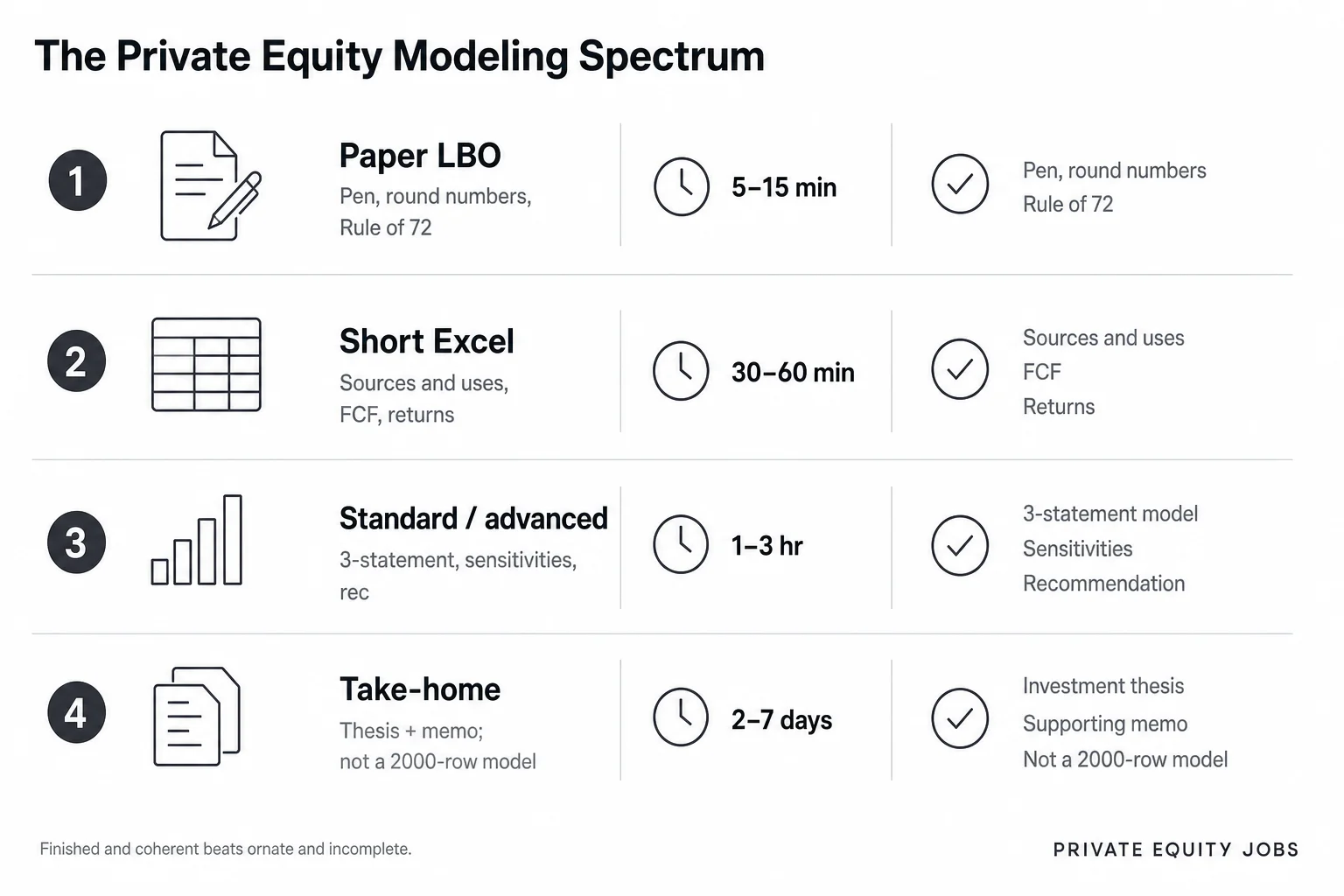
Memorize the interview spectrum so you practice the right artifact. The paper LBO is five to fifteen minutes (WSP: 5–10; some screens run 15–30): pen, paper, or verbal, round numbers, no calculator, IRR and MOIC by approximation. It shows up in headhunter screens and early fund rounds. A short Excel LBO is thirty to sixty minutes: a cash-flow LBO from a prompt, sources and uses, debt, returns. Finished and coherent beats ornate and incomplete. That is the on-cycle speed test and the first middle-market case. Standard and advanced Excel runs one to three hours (WSP: one hour standard, up to three or four at large funds), often a 3-statement build with sensitivities and a verbal or written rec, at megafund and UMM later rounds. Take-homes run two days to a week: model plus investment thesis. Extra time is for industry and recommendation, not a 2,000-row model. Off-cycle finals and smaller funds live here.
The Equiteer 2026 guide describes the full in-room (or short take-home) build as a separate artifact from the paper LBO: 2–3 hours; a 3-statement LBO plus returns plus sensitivities; pass equals a working model, a correct IRR, and no broken links. Do not overwrite the five-to-fifteen-minute paper LBO with it. Paper LBO is mental math and framing. The two-to-three-hour test is whether the file ties. Their speed note: a finished model with the right answer beats a beautiful model you did not finish; practice until a basic LBO is under 90 minutes. Equiteer uses ~200+ hours as the planning number for LBO practice, mocks, and cases, not a weekend crash course.
A paper LBO you can run without a laptop
WSP’s five-step paper LBO is the one to drill until it is boring:
- Transaction and operating assumptions, entry TEV = LTM EBITDA × entry multiple; lock growth, margin, tax, D&A, capex, NWC.
- Sources & uses, debt = leverage turns × EBITDA; sponsor equity is the plug.
- Forecast, revenue → EBITDA → interest → tax → net income. Round aggressively.
- Free cash flow, NI + D&A − capex − ΔNWC (− mandatory amort if given). Some prompts assume no paydown; do not invent a cash sweep.
- Exit and returns, exit TEV = exit-year EBITDA × exit multiple; equity = TEV − remaining net debt; MOIC = exit equity ÷ sponsor equity. Approximate IRR with the Rule of 72 (years to double ≈ 72 / rate) and the Rule of 115 for a triple. A ~2.0x in five years is ~15%; ~3.0x in five years is ~25%.
Graders want a working returns answer and a sentence on what drives it (leverage paydown vs EBITDA growth vs multiple). A beautiful unfinished model loses to an ugly finished one. Same rule on Excel tests: Wall Street Prep’s basic one-hour prompt is sources & uses, FCF, debt schedule, IRR/MOIC (accuracy and speed, not ornaments).
What the model is for
A finished IRR is not the job. The job is knowing which lever moved it. Cash-free, debt-free is the default buyout convention: seller keeps excess cash and retires existing debt; new capital structure is sized off entry enterprise value. Do not net old debt into the sponsor check unless the prompt is a take-private. You are buying equity per share and assuming the net-debt stack. Reported EBITDA is not underwritable EBITDA. A quality-of-earnings review adds back true one-time items and subtracts run-rate holes: customer concentration, channel stuffing, under-accruals, normalized capex. Interviewers will ask which add-backs you would fight. Working capital is cash. A 1% of revenue NWC line in a paper LBO is a plug. In a live process, inventory, deferred revenue, and payables timing move FCF more than a 100 bps tweak to the growth case. Split MOIC into operations versus deleveraging versus multiple. Bain’s “12 is the new 5” is the interview implication: if you cannot name how the company gets toward double-digit EBITDA growth, you do not have a thesis. Do not invent a cash sweep or extra PIK the prompt did not give you. Graders fail people who “improve” the case.
Five buckets still describe the room. Technicals are a gate, not the offer. Fit is why PE, why this firm, why you. Know two portfolio companies well enough to say how you would create value under Bain’s 10–12% EBITDA-growth math. Market is a sector you claim, a company you would buy, a market the consensus has wrong. Technical is accounting, valuation, LBO mechanics, quick IRR math, not only LBOs; merger and DCF questions still appear. Deals are two processes you can walk as an investor: thesis, your workstream, what you would have underwritten, what went wrong. Interviewers flip sell-side work: would you have bought your client? Case is the spectrum above. Off-cycle weights thesis and presence more; on-cycle weights speed.
Write the investment-committee version of every deal on your sheet, even if you were sell-side: what we are buying, why the cash flows are durable, three things that kill the return, the 100-day value-creation plan that could actually produce Bain-like EBITDA growth, and who buys this in year five. That memo is the curriculum product. The model is the appendix. The offer formula that holds up: fundamentals right in the model; a real investing reason to be in the industry; evidence you can run a workstream without a babysitter; airport test. Extra Excel bells and whistles do not compensate for a hollow deal story.
Private equity vs investment banking
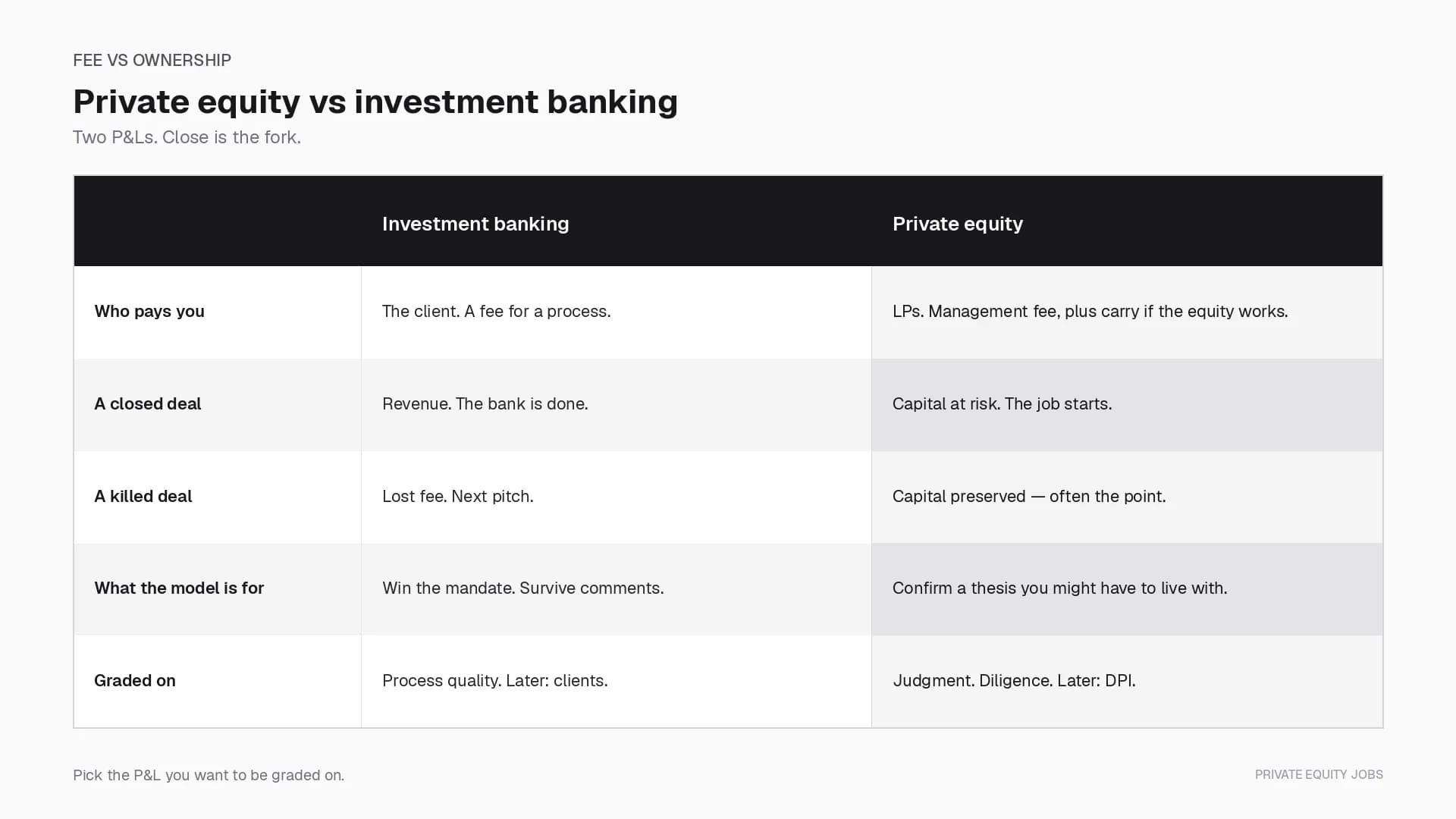
A bank is paid a fee to run a process. A fund is paid to own the company after close. That is the whole distinction; the comparison article, Private Equity vs Investment Banking, is where the P&L, the day, and the choice live. The recruiting hinge is narrower. If you are still in banking and a buyout associate class is the goal, sponsors coverage, M&A, and leveraged finance are the groups whose daily work maps onto the underwrite. ECM, DCM, and FIG generally do not, even when the logos look adjacent. Headhunters will not spend political capital to rebrand a mismatch. Venture capital is a third product: minority stakes, a loss-function, no paper LBO. Growth equity sits in between. If you mean venture, say venture, and do not take a buyout case into that room.
What changed in the 2026 recruiting calendar
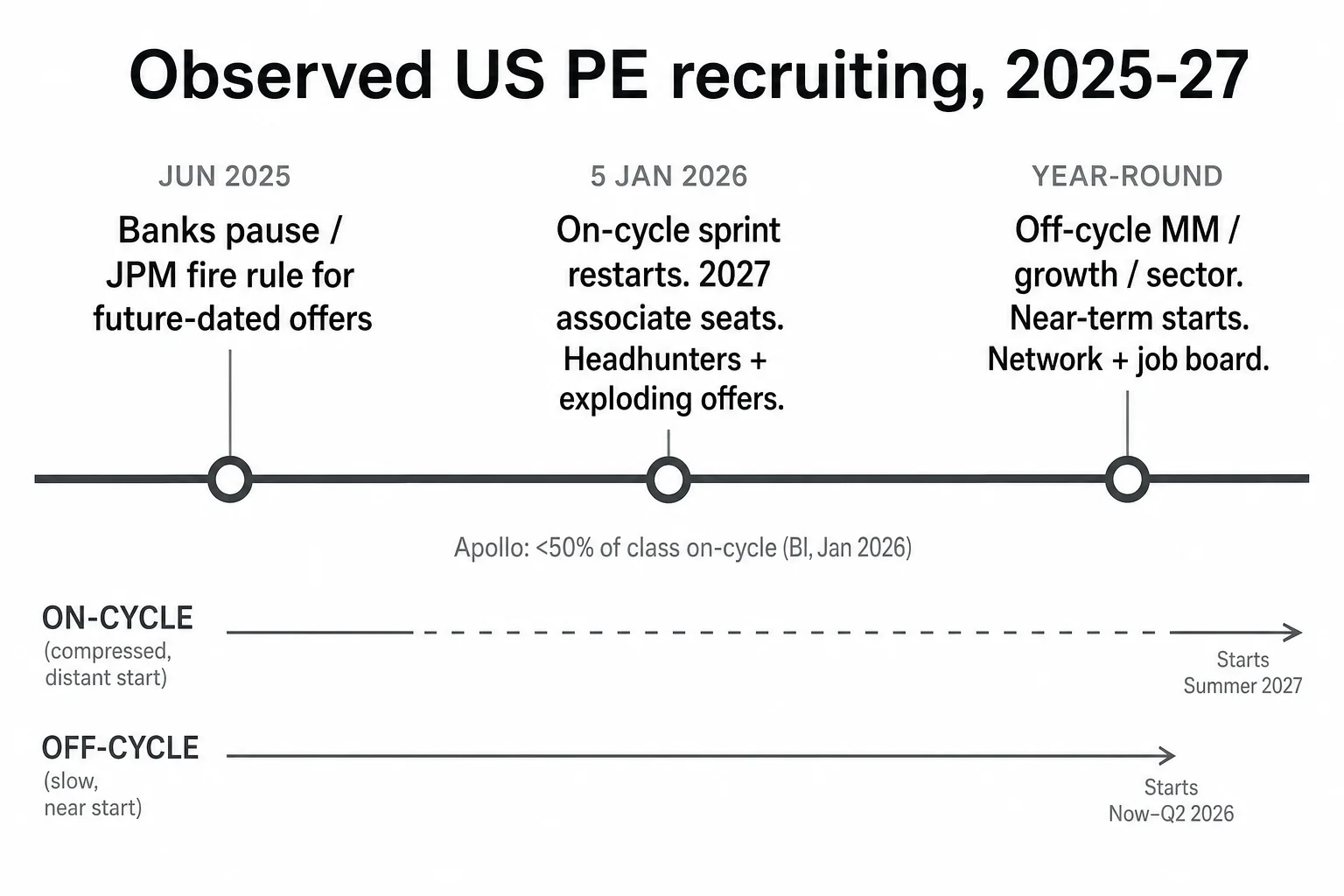
On June 5, 2025, Business Insider reported a JPMorgan memo from global banking co-heads John Simmons and Filippo Gori: juniors who accepted a future-dated job, or skipped training to interview, would be given notice and terminated. CEO Jamie Dimon had called early PE recruiting “unethical.” Apollo, then General Atlantic and TPG, publicly stalled 2027 hiring. Other large banks layered on disclosure rules rather than a hard fire policy.
Business Insider’s January 13, 2026 account: after about six months, outreach for 2027 associate roles resumed as first-year bankers returned from holidays. Most interviews on January 5, some into the next day. A bulge-bracket first-year described lobbies with up to 100 people in suits; he spent 7 a.m. to 10 p.m. at one firm and was asked to sign before leaving the building. A former megafund associate told BI of a candidate held nearly 13 hours and sent home with nothing. Blackstone, Apollo, KKR, and Thoma Bravo were among more than a dozen firms running late-night processes and exploding offers. An Apollo spokesperson told BI the firm generally fills less than half its associate class on-cycle. Recruiters said the extra months on the desk produced better modeling and deal mechanics. Anthony Keizner, managing partner at Odyssey Search Partners, told BI firms had been unhappy with how unprepared June-cycle analysts were; five months of live work changed that. Candidates used December to prepare.
This is not a permanent later calendar. Keizner’s open question in that same piece: will firms wait until the new year again, or drift back toward summer for 2028 seats? Treat January 2026 as the last observed megafund sprint, not a law of nature. Be ready before the phone rings. Missing that weekend is not “failing PE.” It is a shift into the market where most of the industry actually hires.
Bank policies on future-dated PE offers (as of August 2025)
Business Insider compiled the five largest US banks on August 10, 2025. Verify with your staffer before you interview; policies can move.
| Bank | Disclosure | If you accept a future-dated PE seat |
|---|---|---|
| JPMorgan | Do not skip training to interview | Termination if you accept another job before or within the first 18 months |
| Goldman Sachs | Quarterly attestation | Disclosure: not fired. Also pitched internal mobility into Asset Management after two years in IBD (July 2025 intern letter) |
| Morgan Stanley | Quarterly attestation (formalized May 2025) | Disclose: not fired. Fail to disclose: possible discipline including termination |
| Bank of America | Asked to disclose | Not terminated; reassigned inside the bank |
| Citi | July memo: attest to any future employment offers | “Case-by-case” discipline |
Practical implication: an exploding PE offer can cost you the banking job that the PE firm is underwriting. Read your policy before you sit a Sunday “coffee chat” that is actually a superday. Boutiques generally did not copy JPM’s fire rule; that does not make them indifferent to conflicts. If your bank fires people for accepting PE offers, you have a sequencing problem, not a motivation problem. An offer you cannot keep is not an offer.
Most of the industry is not a megafund on-cycle weekend. Most people who get in target the market they are actually in. When you are ready to look at live roles and firms, start on the board, research sponsors on the companies directory, keep the glossary nearby, and use the career path map once you have a seat to choose among.