

The private equity career path is usually drawn as a ladder: Analyst → Associate → Senior Associate → Vice President → Principal (or Director) → Partner / Managing Director. The drawing is a convenience. Those titles share a letterhead and almost nothing else. Analysts and associates execute: models, due diligence workstreams, investment-committee materials, portfolio company monitoring. Vice presidents quarterback live deals. Heidrick & Struggles’ 2025 North America Private Equity Investment Professional Compensation Survey (19 November 2025), a survey of 656 North American investment professionals, literally defines the VP as the deal “quarterback.” Principals are judged on origination and whether the partnership will put their judgment in a room. Partners live in fundraising, limited partner relationships, and firm strategy. Promotion is not a syllabus you complete. It is a tournament that runs inside a fund cycle, and the cycle is what decides whether a next seat exists.
Most people should underwrite vice president as a career, not a layover on the way to partner. Megafunds often treat the associate seat as a two- or three-year program with an MBA fork. Many middle-market and growth shops promote in place. Portfolio operations, investor relations, and fund finance are parallel tracks, not automatic conversions onto the deal team.
What private equity professionals do
A private equity firm is a general partner. It raises a closed-end fund from limited partners (pensions, endowments, sovereigns, insurers, family offices), calls that capital, buys companies, tries to increase equity value, and returns cash over a fund life measured in years. The firm is paid a management fee on the pool and, if the vintage clears its hurdle, carried interest. The companies are private at purchase, or become private because of it. That is the mechanism. It is not “the private-company version of a bank.” Banks advise private companies every week. Funds also take listed companies private. The distinction is ownership.
Buyout is the career most people mean: control, leverage, cash-flow underwriting, a hold of several years, an exit that has to return capital. Growth equity is minority or structured capital into companies that already have a product, with less leverage and more founder dynamics. Venture is early-stage minority capital with a different loss function; if you mean venture, say venture. Distressed, secondaries, credit, and real assets are adjacent products with their own ladders. The ladder below is the investing seat at a buyout or growth shop unless it says otherwise.
The professional work is the fund lifecycle, split by seat. Someone sources or screens. Someone underwrites (an LBO the committee might use, commercial and quality-of-earnings work, a memo). Someone runs the process to close. After close, someone lives with the company: board packs, add-ons, whether the memo was true. At exit, someone has to get capital back to LPs. Juniors spend most of their time on the file and the process. Seniors spend it on origination, judgment, and fundraising. The titles name those jobs. They do not make them the same job.
Why work in private equity
The interview answer is that you want to invest and sit with companies over a hold period. The actual reasons people take the seat are more ordinary: cash that is high-finance money at every investing level, hours that are often better than peak banking at mid-sized and smaller funds, and work that is the company rather than a client process. Some people also want the intensity of large deals and a small team that will actually know whether your file was right.
Private equity is often treated as the destination, not a stepping stone. Exit opportunities means leaving the investing seat, not why you joined. If you want a wide option set and a brand that travels outside finance, a large bank still does that job better. If you want to be graded on a thesis you might have to live with, this is the P&L that grades it.
The 2026 hiring market is two-speed, which is part of the reason, not a footnote. Heidrick’s survey finds activity from VP through managing partner at firms that have recently raised or plan to raise, and little movement for everyone else. Closed-deal talent at those platforms moves. The rest of the ladder often does not. Do not underwrite “we will promote after the next fund” at a GP that cannot point to deployment, distributions, and a live raise. Do not take the seat for lifestyle. Megafund weeks can match banking. Carry is a vest, not a bonus.
Skills, education, and how to get in
The skills the career actually uses are a working LBO, accounting that can see an add-back that is not run-rate, enough commercial sense to kill a teaser, and the ability to put a recommendation in a paragraph. Modeling, valuation, and diligence are how juniors are hired. Judgment, presence on a management call, and origination are how people stay. Relationship lists and charter acronyms are not a substitute for a deal sheet.
A bachelor’s degree is the floor, usually in something analytical. The MBA is a platform-specific instrument, not a generic next step; that fork lives in the hierarchy section below. CFA and CAIA are optional credentials, not a recruiting gate. Funds hire deal proximity and a model that ties.
The default US buyout associate still comes from two or three years in investment banking. Consulting, transaction advisory, and corporate development get in when they can close the LBO gap in public. Direct-from-undergrad analyst programs exist and remain a minority of large-cap hiring. Getting in after an MBA with no prior banking or PE is the hard way. The rungs below assume you have a seat, or you are choosing among seats.
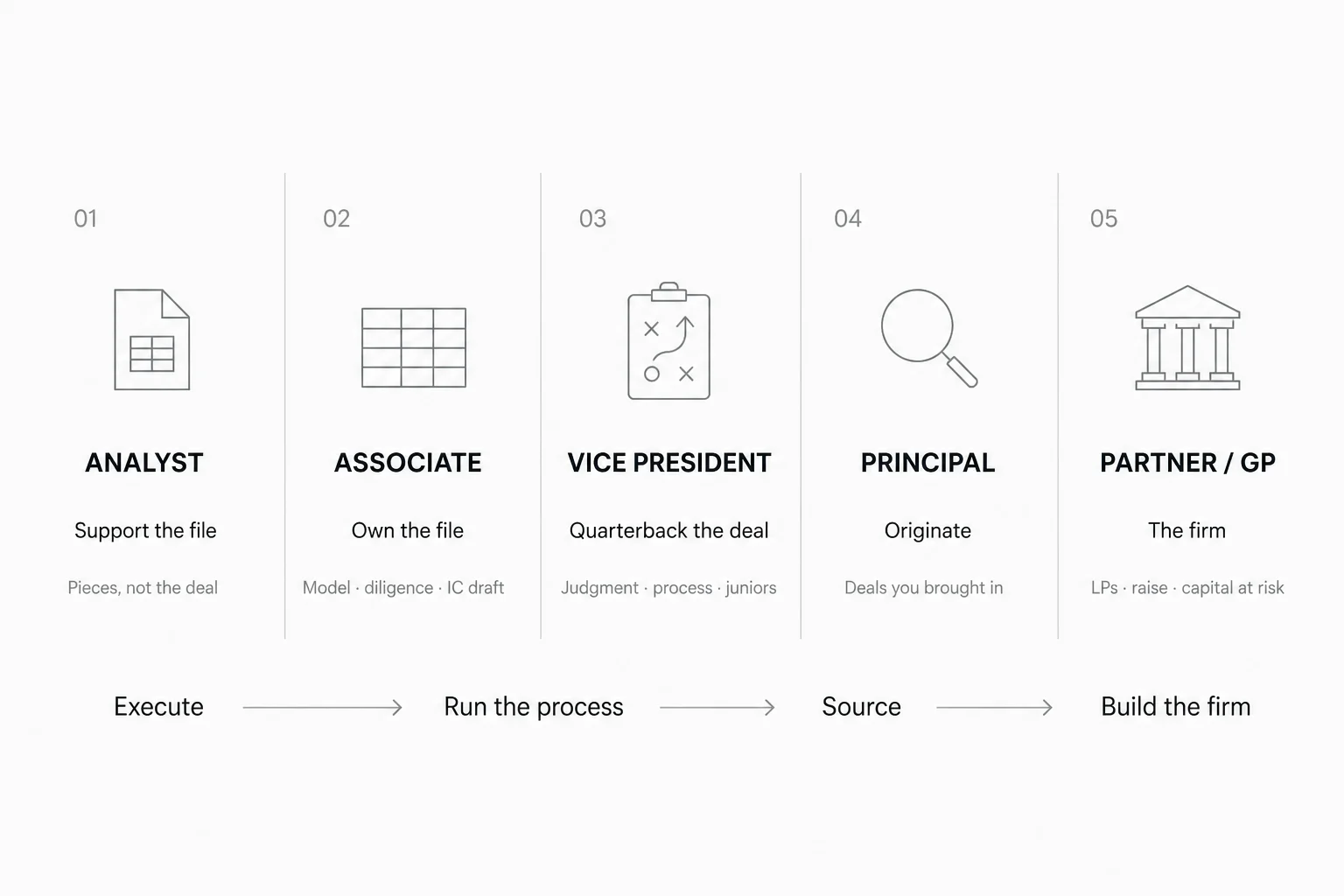
Private equity career path and hierarchy
Titles vary. Some buyout platforms skip Analyst and hire at Associate. Some shops collapse Vice President and Principal. Growth equity and lower-middle-market teams can look flatter than a megafund org chart. The work still clusters into the same six jobs. Time-in-seat figures below are ranges, not a pension schedule. Promotion is a function of deal flow, fund cycle, partnership slots, and whether the firm even has a next seat.
| Seat | Typical time in seat | What you actually do | What the next rung tests | Pay mix (typical) |
|---|---|---|---|---|
| Analyst | 2–3 years (where the seat exists) | Support models, data rooms, research, logistics | Independence: can you own a workstream without being walked through it? | Cash. Carry unlikely. |
| Associate (pre-MBA) | 2–3 years | Own the model, diligence coordination, IC drafts, portco monitoring | Judgment under ambiguity; can seniors trust your numbers and your view? | Cash dominates. Token carry at some shops. |
| Senior Associate | 1–3 years | Same execution core, more process leadership and junior oversight | Readiness to run a deal, not just a tab in the model | Cash; small carry more plausible |
| Vice President | 3–4 years | Deal quarterback: workstreams, advisers, management, IC narrative | Investment taste plus the ability to source something | Cash still large; carry starts to matter |
| Principal / Director | 3–4 years | Origination, negotiations, board seats, IC weight | Track record and whether LPs/partners will put you in the room | Carry becomes the scoreboard |
| Partner / MD | Ongoing | Fundraising, LP coverage, strategy, capital at risk | Firm construction. There is no next title that saves a weak fund. | Carry and GP economics dominate |
Public clocks still describe two to three years at analyst and associate, three to four at VP and principal, and a decade-plus from first PE seat to partner. US years-in-PE typically cluster similarly (associate ~2–4, VP ~6–8, principal ~8–11, partner 11+). Those are clocks, not offers. The clock does not create a seat. A fund cycle does.
Associate vs analyst
Associate is the default investing entry after banking. Analyst programs exist, are more common than a decade ago at some platforms, and are still a minority of large-cap buyout hiring. Analysts are hired out of undergrad. They support: comps, data-room hygiene, process tracking, first-pass research, model updates the associate does not have time to touch. Associates are hired after two to three years in a deal seat. They are expected to coordinate a process from teaser to IC draft without being walked through it. Associates own the file. Analysts own pieces of that file. Ignore copy that calls PE analysts “people with 2–4 years of experience.” That is an associate, mislabeled. Ignore copy that says the associate seat is what you get after an MBA. That is the wrong default for US pre-MBA hiring.
Approximate conversion through the investing ladder:
| Step | Time in seat | Conversion rate |
|---|---|---|
| Associate → senior associate | 2–3 years | ~70% |
| Senior associate → VP | 1–2 years | ~60% |
| VP → principal | 2–4 years | ~50% |
| Principal → partner | 3–5 years | ~30–40% |
Cumulative, associate-to-partner is 15–20 years, and only ~5–10% of starting associates make Partner. At megafunds, 70–80% leave at associate. That is a megafund two-year program. It is not a middle-market law. Compound those conversion rates and partner is a residual claim, not a destination the partnership owes you. Plan as if VP is a real career. Partnership slots, fund performance, and succession are the limiting reagents, not a published syllabus.
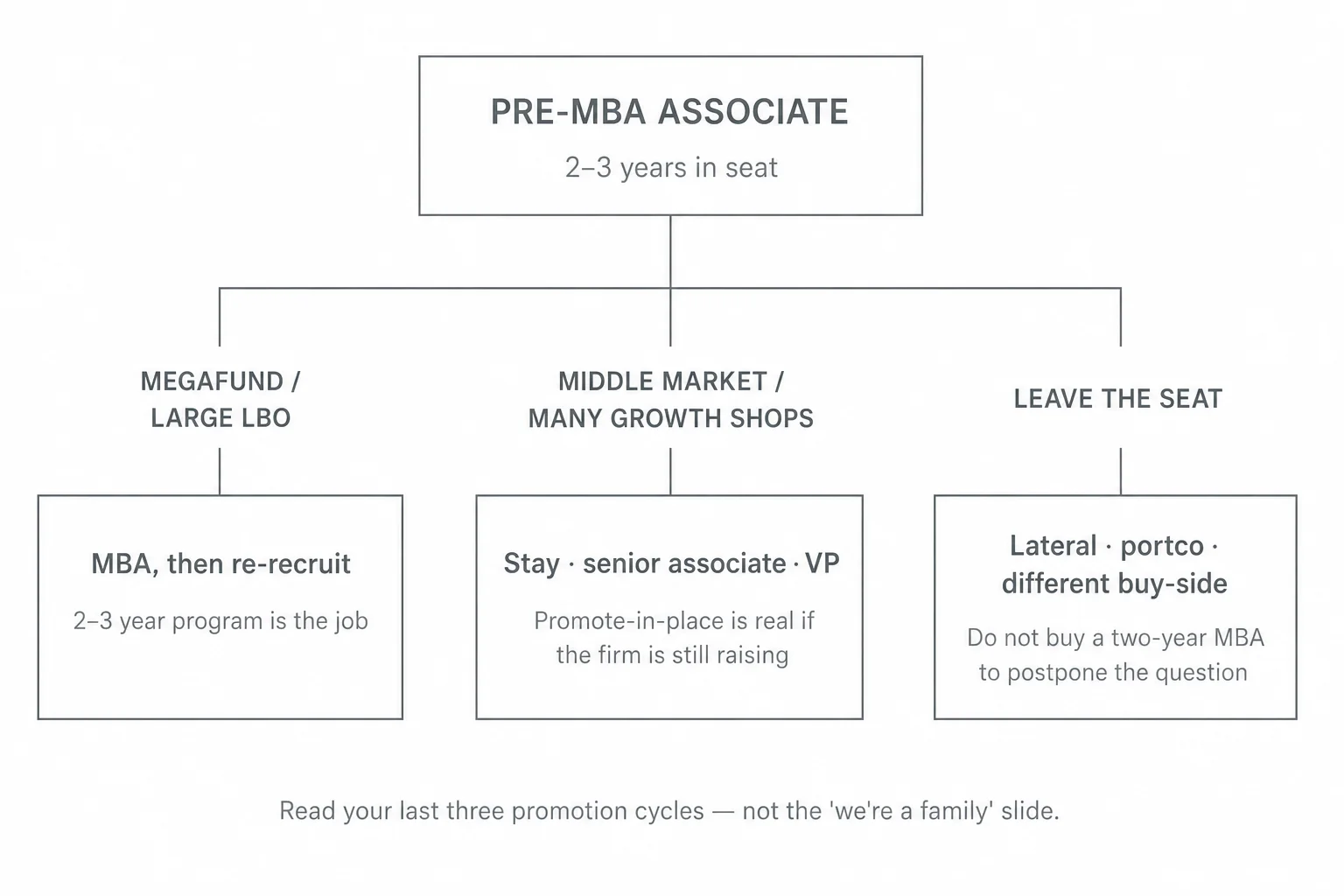
The MBA fork is the decision most associates actually face. It is not the same as on-cycle versus off-cycle entry recruiting. This fork is: stay and promote, leave for a top MBA and re-recruit, or lateral without school. The mistake is treating the degree as a generic next step. It is a platform-specific instrument.
If your platform looks like a large US LBO or megafund associate program, the MBA is usually expected: a two- or three-year seat, then a top school, then re-recruit as a post-MBA associate or VP. A majority of US pre-MBA associates are hired into a 2–3 year program and are typically expected to attend a top-tier MBA. Large LBO shops are more regimented, with limited internal promotion and limited associate sourcing. Treating the MBA as optional on that platform is how people get stranded with neither a VP seat nor a class.
If your platform looks like a growing middle-market shop or certain growth firms, the MBA is often optional. Promote to senior associate or VP without school is a real path, especially if the firm is still raising larger funds. TA Associates and Summit Partners more often promote internally. If the last three classes made VP without school, staying is often the higher-EV path, provided you actually want this career.
If you want out of this firm, or out of PE, the MBA is a structured pivot and a recruiting process, not a modeling course. The cash cost is forgone associate pay plus tuition (high-hundreds of thousands of dollars) against a modest immediate cash bump and a promotion-track ticket at firms that still require the degree. If you are unsure you want PE at all, do not spend two years of tuition to postpone the question. Headhunters matter for the entry associate sprint. They are a weaker instrument for “should I stay.” That call is you, your deal sheet, and a sober read of the last three promotion cycles at your firm. Heidrick’s market note is the other half of that read: a platform that cannot point to DPI, deployment, and a live fundraising path is a worse place to underwrite a five-year vest, with or without the degree.
Roles at each level
Each title is a different job. If you treat promotion as “more of the same, better paid,” you will be excellent at a job the next seat has already stopped grading.
Analyst
Where the seat exists (more often at growth platforms, some middle-market firms, and a thinner set of large-cap programs), the analyst is hired out of undergrad. You do not own the deal. You own pieces: comps, data-room hygiene, process tracking, first-pass research, model updates the associate does not have time to touch. Analyst work is more logistical than the associate’s: calls, documents, supporting internal materials.
Do not confuse this with a banking analyst class. Teams are smaller. You sit closer to the people who will say yes or no. The trade is less formal training and more exposure, if the firm actually lets you into the work. Promotion to associate is not automatic. Some platforms expect you to recruit out, the same way banking analysts do. This seat is typically two to three years where it exists.
Associate
This is the standard entry seat after two to three years in investment banking, or, less often, consulting, transaction services, or corporate development. Associates live in Excel, CIMs, QoE reports, and the unglamorous middle of a live process: coordinating accountants and consultants, keeping the model honest as diligence findings land, drafting the memo someone more senior will rewrite.
The associate job is to make the file and the process honest. Screen teasers so a concentrated customer book does not waste a week. Build an LBO that ties (sources and uses, a returns bridge), not a twelve-tab monument. Challenge quality-of-earnings add-backs that are not run-rate, change the model, and flag them in the memo. Keep the portfolio-company flash and the board pack true when revenue misses and working capital eats cash. The associate owns the work on the file and does not decide whether the fund buys.
The associate job still rewards banking muscles: speed, control of the file, stamina. It starts testing something banking does not: whether you have a point of view on the business, not only a process narrative. If you were the buyer, would you underwrite this LBO at this price, with this leverage, toward this IRR / MOIC?
At large LBO shops, a majority of US pre-MBA associates are hired into a two- or three-year program and are typically expected to leave for a top MBA. Associates at those platforms get limited sourcing. That is the job you accepted, not a personal failure. It is also why “I will stay and make VP here” is, at those platforms, a plan the org chart never offered.
Senior Associate
Often the same job with a longer leash: either a promoted pre-MBA associate or a post-MBA returner. You still build and defend the analysis. You also start running workstreams, pushing back on advisers, and sitting closer to management. At firms that promote in place, this is the first “we might keep you” signal. At firms that run a two-year program, it can be a courtesy title on the way out the door. Read which one you are in before you treat the title as a promotion.
Vice President
This is where the title stops matching the work. Heidrick’s methodology note defines the VP in one phrase: deal quarterback. You are the person who keeps the process from dying (adviser coordination, management trust, IC storytelling, junior quality control). Technical excellence is assumed. Soft failure modes take over: you cannot run a call, you cannot make a recommendation, you cannot manage an associate without creating rework.
The identity change is the scoreboard. The associate is graded on whether the file is right, on time. You are graded on whether the recommendation was good and whether the process survived. Sourcing, which is usually limited for associates at large LBO shops and broader at many middle-market and growth seats, becomes a real expectation: a banker who calls you, a sector map, an executive who will take a meeting. Firms almost always offer some carry at VP and principal. Vesting and leaver terms now matter, because the points are no longer a rumor.
The VP job is to keep the deal alive and make a recommendation. You run the management meeting; the associate takes notes and updates the model. You kill or keep a workstream (QoE, commercial, insurance) so the process does not die of adviser sprawl. You tell the partner whether you would underwrite this price and this leverage, in a paragraph, not a tab. You QC the associate’s IC appendix and send two comments, not a rewrite. If you cannot run that management call, the model will not save you.
If you liked being the smartest person in the spreadsheet, VP will feel like a different profession. That is the point, and it is why most people should underwrite this seat as a career rather than a layover. Many strong associates stall here because the skills that won the seat do not automatically produce judgment, presence, or origination. A fair number of people go “downmarket” to make VP rather than wait for a megafund slot that will not open. A fair number of people take that move because it is how they get a vice president job that actually runs deals.
Principal / Director
Principals are partners in training, not super-VPs. Heidrick’s title definitions put the principal as an investment professional with early experience originating and leading their own investments (an accomplished executor with board experience, personal track record not yet extensive). Execution still happens, but the scoreboard shifts to deals you brought in, negotiations you closed, boards you sit on, and whether the partnership wants you in front of LPs. Origination is a different sport: bankers who call you first, executives who will take a meeting, a sector reputation that creates inbound.
Attribution fights start here. Several people can “own” a deal in the retelling. Only some of them make partner. If you are still optimizing for process excellence at this seat, you are studying for an exam the partnership has stopped giving.
Partner / Managing Director
Partners raise the next fund, cover LPs, set what the firm will and will not buy, and put personal capital into the vehicle. Spreadsheets still exist. They are no longer the job. If you are risk-averse about having your net worth tied to fund performance, this is a bad terminal seat even when the cash compensation looks like the prize.
Most people who start as associates never get here. That is the structure of a small partnership, not a moral failure. Leaving for a smaller fund, a portco seat, or a different buy-side job is the common path, not the exception. The other terminal path is starting a firm. Heidrick’s letter is blunt: PE institutionalized in the 1980s, very few firms have planned or resolved succession, and more investment professionals leave to raise their own funds. A spinout is still this ladder (origination, LP coverage, personal capital at risk) without a letterhead that already exists. Underwrite it like a principal underwrites a deal: DPI story, who follows you, and whether you can actually raise. “Wait for a partner slot” is often a worse plan than it looks on a slide.
People who stay long enough to become partner are usually the ones who can find deals without a banker bringing them, who have a view they will put money behind, who can point to something they changed at a company the fund already owns, who can talk to limited partners without a script, who can hire and keep juniors, and who simply stay after most of their class has left. Wall Street Playbook's 2026 career-path guide lists those six as the difference between a technical vice president and a partner.
Some firms distinguish Senior Partners with a larger share of the partnership. At megafunds there are also C-level seats (COO, CEO) with no set path from the investing ladder. There is little public information on those rooms, and most associates will not reach the middle of it. Treat them as firm-construction jobs, not as the next promotion after MD.
Compensation
Do not plan a life around a number you saw in a group chat. Public 2026 industry guides disagree on exact bands because they mix megafund and middle-market, US and Europe, and cash vs carry. For a negotiation, use a current recruiter conversation and a dated report. Heidrick’s survey is the one to put in that email.
An undated public North America 25th–75th cash table still circulates: analyst $100k–$150k, associate $150k–$300k, senior associate $250k–$400k, vice president $350k–$500k, principal $500k–$800k, partner $700k–$2m. That table is undated. It is not a 2025–26 survey. Heidrick does not publish a standalone analyst 25th–75th; junior seats are grouped with associates in some cuts, and cash there is still mostly base. At associate, Heidrick’s finding is that cash rose, especially at this seat, with tables sliced by AUM rather than a single all-firm 25th–75th. Upper-quartile 2024 total cash scaled with AUM. Half of 2025 base increases were 10% or less; about 76% of bonuses stayed discretionary. Senior associate is incremental to associate, not a new profession. Vice president is where cash still rose and cash growth slows relative to the identity change. Carry points become the negotiation. Principals and directors saw cash rise; carry and origination, not the bonus, are the scoreboard. Public-guide partner cash is the floor people quote; outcomes are extremely wide, and carry dollars-at-work plus GP capital dominate. Those tables exist in the survey. If you need a number, take the survey plus a recruiter who will say where this fund sits on AUM.
What is consistent across dated 2025–2026 sources is the shape, not a cell. Junior all-in cash is high-finance money, not founder money. US associates clear well into six figures; megafunds sit at the top of published ranges; lower-middle-market seats sit below. VP is where cash growth slows and carry points become the scoreboard. Partner outcomes are extremely wide.
Base and bonus are not the same number. GP Intel's 1 June 2026 careers guide puts US associate base around $165,000 to $180,000, with bonuses that often match base. That is how you get all-in cash of about $275,000 at middle-market firms and $325,000 to $450,000 at megafunds. The Private Equiteer's 2026 associate breakdown slices first-year cash by fund size: megafunds ($10 billion and up) $325,000 to $425,000 all-in on a $165,000 to $180,000 base; large funds ($1 billion to $10 billion) $275,000 to $375,000; middle-market ($250 million to $1 billion) $250,000 to $340,000. Carry is usually absent in year one. Those figures are 2025 actuals with a modest 3 to 5 percent lift expected for 2026, as printed there. They are public guides, not a PEJ survey.
Wall Street Playbook's 2026 compensation page prints a directional all-in grid (base, bonus, and expected co-invest). Use it as a range, not a promise. Group, city, and the bonus philosophy move the outcome.
| Level | Megafund | Upper-MM | Middle-market | Lower-MM |
|---|---|---|---|---|
| Associate 1 | $325k-$400k | $275k-$350k | $225k-$300k | $175k-$250k |
| Associate 2 | $375k-$450k | $325k-$400k | $275k-$350k | $225k-$300k |
| Senior associate | $425k-$525k | $375k-$475k | $325k-$425k | $275k-$375k |
| Vice president | $500k-$700k | $450k-$600k | $400k-$550k | $350k-$475k |
| Principal | $700k-$1.2m | $600k-$1m | $500k-$850k | $400k-$700k |
| Partner | $1.5m-$5m+ | $1m-$3m+ | $800k-$2m+ | $600k-$1.5m+ |
When carry is realized at a few funds, partner outcomes can reach $10 million-plus. That payment is tied to a vintage, not a yearly salary.
US vs UK / Europe cash
The North America bands above are what US candidates Google. Public salary surveys compile a separate US vs UK/Europe total-cash picture. Those compilations skew toward mega-funds and the upper middle market. Analyst UK is in pounds; associate and up are in euros. That is how they printed it. Figures are shown as published; currencies are not converted.
| Level | US total cash | UK / Europe |
|---|---|---|
| Analyst | $100k–$200k | £60k–£120k |
| Associate | $275k–$450k | €150k–€250k |
| Senior associate | $350k–$600k | €200k–€350k |
| VP | $500k–$800k + carry | €300k–€550k + carry |
| Principal | $700k–$1.5M + carry | €450k–€900k + carry |
| Partner / MD | $1M–$3M+ cash + carry | €800k+ cash + carry |
Same compilations put the average London PE associate around £151k (typical range roughly £99k–£235k; top earners above £350k). US cash leads at every level. Senior London carry can still reach eight figures on a strong vintage.
That table is the US and the UK or Europe. Growth Equity Interview Guide's career-path page describes a third cut that is not in the table. US funds tend to run a more structured associate-to-partner ladder. European shops are more often middle-market, and interviews more often ask about environmental, social, and governance screens. Asian seats are more often growth-capital, with a less defined title ladder. That is one paragraph of career dynamics, not a second cash table.
Wall Street Playbook prints typical carry points, not a guarantee.
| Level | Typical carry points |
|---|---|
| Associate | None (rare exceptions) |
| Senior associate | 0-0.1% |
| Vice president | 0.1-0.5% |
| Principal | 0.5-1.5% |
| Partner | 2-10%+ |
Their example assumes a $2 billion fund at a 2.0x gross multiple on invested capital over the fund's life. The Private Equiteer prints the same idea in basis points: associates 0-10 bps (rare), senior associates 10-25, vice presidents 50-100. Ask when it vests, whether you keep it if you leave, and whether prior funds actually paid non-partners.
The carry mechanics are the part a cash table cannot tell you. Heidrick, on carry questions answered by 476 professionals: most respondents’ carry is only partially vested. The most common vesting basis is time from inception of each new fund (46% of that sample), then after the first-year anniversary of deal closing (32%). A majority of reported carry is on a fund basis rather than deal-by-deal. At all levels, at least half of respondents fund the GP capital contribution toward their carry with after-tax income. Co-invest eligibility is common at senior levels and is a second, separate risk (your cash in the deal). The industry-convention waterfall those points sit inside: classically 20% of gains above an 8% hurdle, allocated in points, vested over years. Negligible at associate; material from VP. Vested carry can still be worthless if you leave as a “bad leaver,” or if the vintage never clears the preferred return. Cash pays the rent until a distribution shows up. Carry is rarely an analyst fact, sometimes a token at associate, and a real negotiation from VP up, and only if you stay through vesting and the fund clears its hurdle.
For definitions of carry, hurdle, IRR, and MOIC, use the glossary.
Day-to-day work
A live process is a teaser, a model, a management meeting, and an investment-committee memo. That list leaves out the quiet week, the deal that dies, and the monthly portfolio flash.
Associates spend most of their time on companies the fund might buy or already owns. They read teasers and drop the ones with a customer book that is too concentrated. They build the model, sit through quality-of-earnings, and write the memo the committee will use. After a purchase closes, they keep the monthly numbers honest when revenue misses or working capital eats cash. The associate owns the work on the file and does not decide whether the fund buys. That is the post-banking associate at a fund that actually does deals. Direct-from-undergrad analysts exist. They have less autonomy. They are not running a process the week after graduation. At a small shop they can spend the year finding companies.
A vice president keeps the deal moving and makes a recommendation. They run the management meeting, kill or keep a workstream so the process does not drown in advisers, and tell the partner whether they would underwrite this price and this leverage. They check the associate's work instead of rewriting the appendix. A principal's job is origination and being the person an owner will take a meeting with. A partner's job is fundraising, limited-partner coverage, and what the firm will not buy.
Hours follow the process, not the title. Expect 60–70 a week at many smaller shops and 80 or more at megafunds when a deal is live. Quiet weeks exist when the portfolio is humming and the funnel is thin. They almost never exist in a live banking coverage group. A live process at a large fund will feel like banking because it is a deal sprint, with the extra constraint that you are supposed to have a point of view overnight. Do not pick this career for the quiet week.
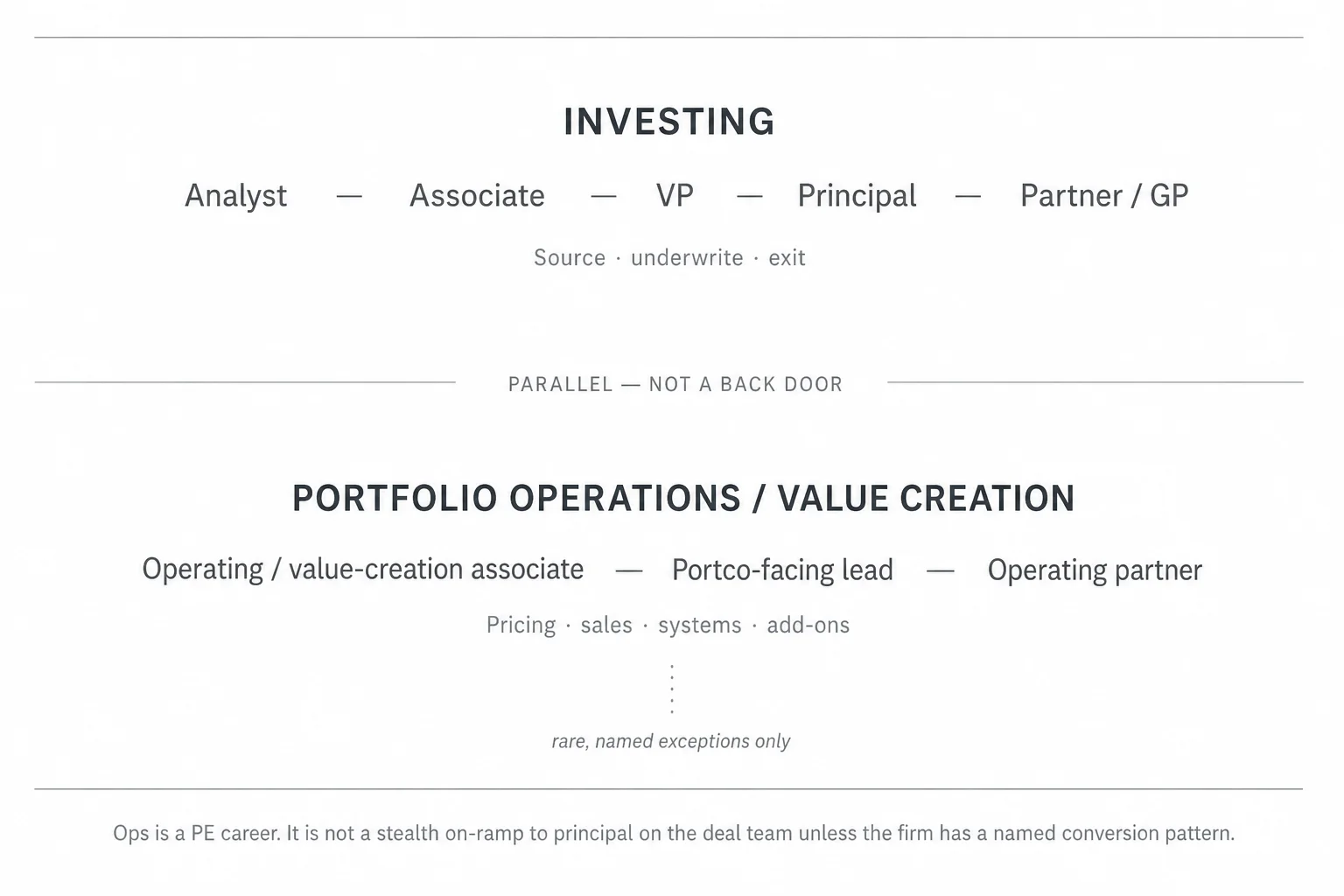
Investing vs operations vs investor relations
Private equity is not only the deal team. Most people mean the investing ladder. Three other tracks sit in the same building and do not automatically convert onto it. Believe the job posting.
Investing team
Source, underwrite, execute, monitor, exit. Usually from IB, sometimes consulting, TAS, or corp-dev. That is the ladder: analyst (where it exists), associate, senior associate, VP, principal, partner. That is the track below.
Operations / portfolio group
Sit with management on pricing, sales, procurement, systems, add-ons, sometimes in interim functional seats. Usual backgrounds: consulting, industry operators, functional specialists. It is a parallel track. Conversion onto the investing ladder is rare unless the firm has a named pattern you can actually point to. You can still build a PE career there (board-facing, carry-eligible at senior levels, portco CEO/CFO exits). Do not underwrite a title arbitrage the partnership has never done.
Bain & Company’s Global Private Equity Report (released 23 February 2026) is why the ops track is not a consolation prize. The report’s rule of thumb (“12 is the new 5”) says a typical deal that once needed ~5% annual EBITDA growth to hit a 2.5x MOIC over five years now needs something closer to 10–12%, because leverage is lower, rates are higher, and multiple expansion is no longer doing the work. Firms that cannot generate that growth will not paper over it with a prettier model. That is demand for people who can actually change a company. It is still not a stealth on-ramp to principal on the deal team.
Spencer Stuart’s Five Talent Trends in Private Equity, May 2025 (review of ~30 firms; mega-funds defined as AUM $70bn+, mid-cap $30–70bn) shows the same split in how sponsors hire around portcos: mega-funds are likelier to run confidential management referencing in diligence (69% established vs 33% of mid-cap funds) and to have standing team-effectiveness programs. Spencer Stuart’s Private Equity Is Still a Magnet for Top Leaders (2026), a survey of 1,015 leaders, finds 86% of executives already in PE-backed roles would take another PE executive seat, while interest in advisory and board roles (90%) now outruns interest in running a company (77%). Ops careers inside the GP and C-suite careers inside the portco are both real. They are not this investing ladder.
Investor relations
LP reporting, fundraising support, the narrative of performance. Quarterly letters, data-room answers for a re-up, the annual meeting. Usual backgrounds: finance, communications, client-facing seats in asset management or banking. It does not convert onto the deal team. It is how the firm talks to the people who actually own the capital.
Finance and accounting
Capital calls, distributions, carry calculations, audit, fund-level reporting. Usual backgrounds: public accounting or fund administration. It does not convert either. If the posting says fund finance, believe it.
A parallel owner-operator path, not this ladder: the search fund. A searcher raises a small pool (typically $400k–$600k) to buy and operate one small business. The 2024 Stanford Search Fund Study tracked 681 funds with a top-quartile median pre-tax IRR of 35%. High variance. You end up CEO and equity holder, not an associate in someone else’s fund. Do not underwrite it as a stealth PE associate class.
Exit opportunities
Most people exit before the top, and that is not failure. Exit is the design of a small partnership, not the bug. The tournament numbers live in the hierarchy section. This section is what people do instead of waiting for a partner slot.
Associates leave megafunds at 70–80% because 2-and-out to MBA is expected, because the pyramid is real, because the hours are the hours, and because some of them can get hedge-fund cash without waiting on a vest. VPs leave because they were passed over for principal, because a portco seat showed up, because lifestyle and family finally have a veto, or because carry economics are better at a smaller fund that will actually put them on the letterhead. Principals leave because they are not on the partner track, because a smaller firm will make them partner, because a portco CEO or COO seat is the job they have already been practicing, or because fifteen-plus years is enough.
Associate-level exits
After two or three years the MBA is the most common megafund exit: not a cash outcome, a re-entry ticket into post-MBA PE or a hedge fund. Public off-ramp cash bands are prevalence labels, not a survey. A lateral to another PE fund sits at $300k–$450k and is common. Growth equity or VC sits at $250k–$400k as a growing path. Corporate development is $180k–$250k and very accessible. Portfolio-company strategy is $150k–$220k and common. Hedge funds sit at $300k–$500k+ if the public-markets interest is real. The implication is not that you should leave. It is that the associate seat already has a market, and pretending the only respectable next step is partner is how people stay in a two-year program that was never going to promote them.
VP / principal exits
Five to ten years in, the exits change character because you now have a process you can run and, at principal, a reputation someone might buy. Portco CFO sits around $400k–$1M+ cash plus equity and is called attractive. Portco COO or CEO is $500k–$2M+ cash plus equity, typically principal-plus. Partner at a smaller fund is $600k–$1.5M+ and common, the downmarket move one rung later. Corporate development VP or SVP is $300k–$500k and common. Family-office CIO is $400k–$800k and growing. Operating partner at a PE firm is $400k–$700k for people who actually want the ops job. The best portco seats often go to people the firm already trusts. Build the relationship with portfolio ops before you need the exit. Waiting until you are passed over is how you get the leftover seat.
Going from PE back to banking is rare. The bank is hiring a process athlete with a client-facing brand. People do it toward capital markets or sponsor coverage if the story is coherent. Do not underwrite it as a plan. If you want similar work and a life, corporate development is the honest alternative, not a failed PE outcome.
Pros and cons
The work is investing plus process plus, later, fundraising. It is a small partnership, not a bank. The people who stay are usually the people who wanted the company, not the process, and who can live with a vest that might never clear. The people who should leave are usually the people who wanted a syllabus.
Cash is high-finance money at every investing seat. From VP up, carry can exceed anything a banker earns in the same year, if the vintage clears the hurdle and you stay through vest. The work is the company: you underwrite, you sit with management, you find out whether the memo was true. Hours are often better than peak banking at mid-sized and smaller funds, and more predictable off-deal, even though live processes still own the calendar. Teams are small. Advancement is closer to your deal sheet than to a corporate grade. A lean middle-market seat with IC airtime can teach investing faster than a narrow slice of a mega-process. The top of the ladder is not being automated. Origination, LP coverage, and judgment still are the job. Stress is real. So is the competition for seats. Neither is a reason by itself to skip the work if you want the company.
The other side of the same facts is why underwriting partner as the plan is so often a bad trade. Hours are still long: 60–70 at many smaller shops, 80+ at megafunds on live deals. Travel rises as you become the person management will take a meeting with. Carry is a delayed, path-dependent claim. Bad-leaver language, a fund that never clears the preferred return, or a vest into a platform that cannot raise are how points become a story. Cash pays the rent until a distribution shows up. Small-firm politics are real. Partnership slots are scarce; partners do not burn out on a bank’s clock. If nobody has made principal from VP in six years, believe the funnel. Going downmarket to make VP is common. At partner you put GP capital in. After-tax income funds the contribution for at least half of Heidrick’s respondents at every level. If you are risk-averse about net worth tied to fund performance, this is a bad terminal seat even when the cash looks like the prize. Training and network are thinner than a large bank. You will close few platform deals per year. Cold calling, monitoring, and fundraising are the job, not a failure of staffing. Entry is brutally path-dependent. A late start without transactions is not a non-traditional edge.
If you want the investing seat, underwrite the hours, the vest, and the partnership math. If you want a life and similar work, corporate development is the honest alternative. The tournament already priced that exit.
Private equity career path by fund size
Fund size changes the ladder more than the org chart admits. Segmentation is about the deals you see, not just AUM. Some large platforms still buy middle-market companies. Heidrick’s survey, separately, finds upper-quartile total cash scaling with AUM, so the cash gap is real even if the work gap is about process shape, not morality. The title on the card can be the same while the job is not. A fair number of people go downmarket to make VP.
At a megafund or large-cap buyout shop the analyst seat is uncommon; associate is the default hire. Associate work is high production (model, IC deck, workstream ownership) with less IC airtime. The MBA is often expected. Promotion is narrow, and outside hires at VP and principal are common. The brand is the strongest later option you can buy: later PE, hedge funds, MBA recruiting. The work is fewer, larger, more specialist processes. Junior carry usually arrives later and thinner. You are climbing a tournament that was designed to send most of the class to school. 70–80% leaving at associate is that design.
Upper- and core-middle market is the other shape. Analyst seats are more common at some platforms. Associates are more likely to lead diligence calls and sit in IC. The MBA is often optional; promote-in-place is real at many shops. TA Associates and Summit Partners more often promote internally. Promotion odds improve if the firm is still scaling. The logo is weaker, you get more reps, and hedge-fund laterals are harder. The companies are messier, internal resources thinner; you are more often the process. Junior carry sometimes arrives earlier, in a smaller pool. That is a different career that happens to share a title.
Growth equity is mixed rather than ritualized. Analyst seats are relatively more common. Associate work is higher-volume sourcing and company evaluation, less classic LBO machinery. Promotion can be faster, or stuck, if the partnership is small. The later option depends on the platform; product and market skill transfer in a way a pure LBO file sometimes does not. The work is founder-facing, minority dynamics, less control. Junior carry varies widely by fund. None of these is morally superior. A lean middle-market seat where you see full processes can teach investing faster than a narrow slice of a mega-process. A megafund logo can buy a later option you cannot reconstruct. Pick the ladder you are willing to climb, not the one that looks best on a résumé.
The rooms that are hiring are not only classic buyout. Heidrick sees seats that used to sit on the LP side: secondaries, continuation vehicles, GP stakes, mid-hold. Bain: 2025 global buyout deal value (ex add-ons) jumped 44% to $904bn and exits 47% to $717bn, but 13 deals of $10bn+ were 30% of deal value. Buyout fundraising fell 16% to $395bn, a fourth straight down year in fund count. Distributions as a share of NAV stayed under 15% for a fourth year. Hold periods at exit ~7 years. GP-led continuation-vehicle volume was up 62% year-on-year in 2025. Preqin’s Private Equity in 2026 note: fundraising tracking slightly below 2024, with a greater share going to secondaries funds. If your deal sheet is only classic buyout, those rooms are a different ladder, often with GP talent moving across. A platform that cannot point to a live raise is asking you to vest into a cycle that is not recycling capital. Believe that over the title on the card.
When you compare firms, use the companies directory to see who is actually hiring on which strategy (buyout vs growth vs credit vs real assets) rather than treating “PE” as one employer.
Titles are a convenience. Associate, VP, principal, and partner are different jobs that share a letterhead. Promotion is a tournament inside a fund cycle, not a syllabus. Underwrite VP as a career. Match fund tier to how you want to be promoted. Keep ops, IR, and investing distinct. Underwrite the vest against the fund, not the title.
When you are ready: open live seats on the board at the title you are (and the title twelve months out), and research the GP on the companies directory before you assume a ladder exists there. Keep the glossary open.
Related posts

Buy-side firms such as private equity funds invest capital for a return, and sell-side banks are paid fees and commissions to arrange the deals and trades. Which firms sit on each side, how each is paid, how research and licensing differ, and how careers move from banking into private equity.

When a private equity fund buys a company, the company takes on the acquisition debt, the fund takes the board, and a plan to raise earnings starts on day one. What changes for managers and staff, what the research says about jobs and failure, and how the ownership ends.