Private Equity Secondaries
An LP sells a fund interest, or a GP moves companies into a continuation vehicle so some LPs can cash out while the firm keeps the asset. Both exist because the fund clock is real.
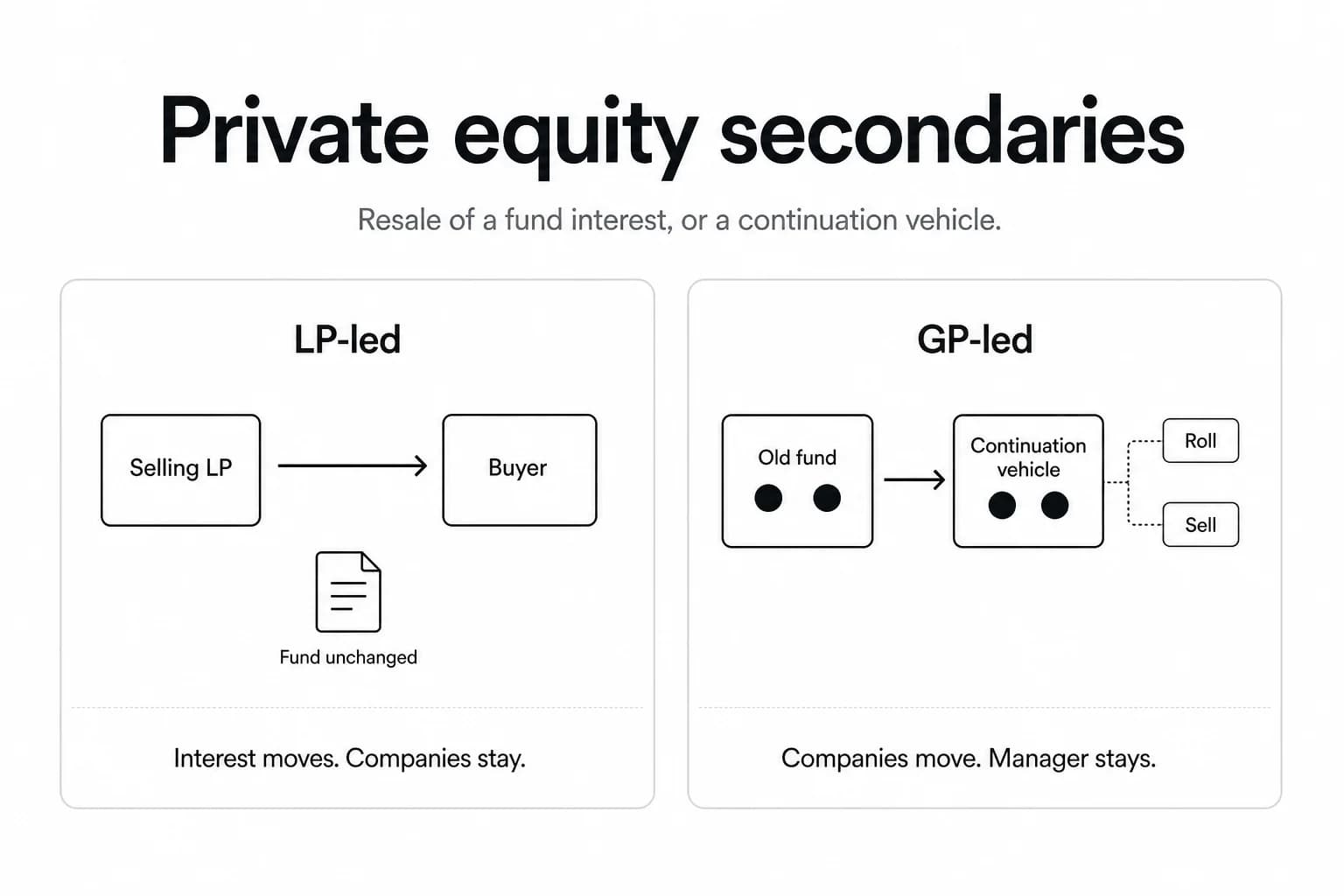
Private equity secondaries are the resale of an existing limited-partner interest in a fund, or of companies sitting inside one, before the fund's clock ends. The buyer takes the seller's rights and the remaining unfunded capital calls. When the general partner (GP) starts the process, the usual form is a continuation fund: selected companies move into a new vehicle, existing limited partners (LPs) can take cash or roll their exposure, and the firm keeps managing the asset.
A primary commitment is a signature on a new private equity fund. A secondary is the purchase of that interest from an investor who already holds it. There is no exchange. Each transfer needs the GP's consent, and the price is usually a percent of the last reported net asset value (NAV).
The closed-end partnership does not redeem, and an interim mark is not a wire. Secondaries exist because someone needs cash, or a different set of names on the register, before harvest finishes.
What are private equity secondaries?
A secondary is a transfer of an already-issued position. The selling LP does not get a new commitment from the fund. The fund does not receive the purchase price. Cash moves from the buyer to the seller. After the GP consents and the register is updated, the buyer is the LP: it receives future distributions, and it has to fund remaining calls.
That last point is easy to miss. The interest being sold is not only the current NAV. It is also the unfunded commitment still sitting at the seller. A buyer who pays 90 percent of a $10 million NAV still has to wire whatever is left uncalled when the next notice arrives. If $2 million is unfunded, the economic ticket is the check plus those future calls.
Primary and secondary are the same partnership seen at two moments. In a primary, the LP commits while the fund is still a blind pool: capital will be called into companies that have not been bought yet. In a secondary, the buyer can see a portfolio that already exists, often several years into the hold. The J-curve of fees-before-exits is partly behind it. The remaining duration is shorter. The price is a negotiation over that known book, not a signature on a strategy deck.
For an LP, this is the resale market for a fund interest. It is the way out before the fund is fully liquidated. It is not a stock exchange. There is no continuous bid. Transfers are negotiated, documented, and consented.
The word "secondaries" is also used for other trades. A secondary buyout is one sponsor selling a company to another sponsor. A direct secondary is often a minority stake in a private company sold by an employee or an early venture holder. Those are different instruments. Fund-interest transfers and GP-led continuation vehicles are what the term usually means in this market.
Why secondaries exist
A classic drawdown fund is raised for about ten years. LPs cannot redeem the way a mutual-fund holder can. Cash comes back when companies exit. When distributions to paid-in (DPI) lag the marks on the books, the partnership still works as designed. It does not produce cash on demand. Someone who needs a wire before harvest has two paths: sell the fund interest, or wait for the GP to manufacture an exit inside the portfolio.
Jefferies' Global Secondary Market Review (July 2026) put the cash problem in numbers. Annual distribution yield from LP portfolios stayed near 10 percent in the first half of 2026, and has sat below 20 percent since the beginning of 2023, against a historical average of 25 percent since 2001. That is why supply showed up without a distress wave. In the same half, Jefferies said LP sellers used the market to generate or accelerate liquidity (45 percent of LP volume), wind down older vehicles (26 percent), rebalance from overallocation (16 percent), and cut non-core strategies and GP relationships (13 percent). Pensions and sovereign wealth funds were 48 percent of that LP supply.
Those seller motives match the allocator list that has been true for years. An LP sells for cash, to correct an overweight after public marks fell faster than private ones (the denominator effect), to cut the number of GP relationships, to drop a vintage or a manager that no longer fits, or to reduce an unfunded balance that is too large to keep writing.
Buyers show up for the other side of the same clock. They skip some of the early J-curve. They can underwrite a known portfolio instead of a blind pool. They get vintage, manager, and sector diversification in one close. They often buy at a discount to NAV, which can improve the entry multiple if the mark was honest. They do not always buy at a discount. Jefferies put average LP-portfolio pricing at 87 percent of NAV in the first half of 2026, the same print as year-end 2025. High-quality buyout interests often clear closer to par. Discounts vary by strategy and vintage, and they are not guaranteed. J.P. Morgan's Montserrat Serra-Janer made the related cut: selling at a discount to NAV is not the same as selling at a loss. The mark can be stale, optimistic, or both. A cheap percent of a high mark is not a bargain.
The backlog behind those sales is large. Serra-Janer, on J.P. Morgan's private market secondaries note, put about 30,000 portfolio companies awaiting exit, representing around $3.7 trillion of unrealized value. Even a strong IPO year does not clear a book that size. Secondaries are how some of that value becomes cash without a listing or a strategic sale.
LP-led and GP-led secondaries
Two processes do most of the volume.
An LP-led secondary is a replacement LP. The selling investor transfers its interest in one fund, or a strip of funds, to a buyer. The underlying companies stay where they are. The limited partnership agreement (LPA) does not get rewritten for the whole partnership. The GP consents to the transfer, often after a right of first refusal (ROFR) process written into that agreement. The buyer steps onto the register and inherits rights and unfunded calls. A single interest can be exposure to dozens of companies. Buyers therefore underwrite the positions that dominate NAV in depth and treat the tail as a portfolio.
A GP-led secondary is initiated by the manager. The usual form is a continuation vehicle that buys one company or a cluster of companies from the existing fund. Existing LPs are asked to elect: sell for cash, roll into the new vehicle, or, when the process still offers it, keep the status quo in the old fund. New capital from a lead secondaries buyer (and often a syndicate) funds the purchase. The GP keeps managing the asset, usually with a new fee and carry schedule on the continuation vehicle.
| LP-led | GP-led | |
|---|---|---|
| Who starts it | The selling LP | The GP |
| What moves | A fund interest (NAV plus unfunded calls) | One or more companies, into a new vehicle |
| The old fund | Unchanged, except the name on the register | Loses the transferred assets; remaining LPs who sold are cashed out on those assets |
| Existing LPs | Replaced | Elect roll, sell, or (if offered) status quo |
| What the buyer underwrites | A portfolio of funds, then the companies that dominate NAV | One company or a small set, closer to a buyout file |
| Typical clock | Weeks, if consent is clean | Months, because a new vehicle, a process, and elections have to close |
Other shapes exist and are still secondaries. A fund recapitalization moves most or all of the remaining book into a new vehicle so the old fund can wind down. A stapled secondary pairs a purchase of an existing interest with a commitment to the GP's next fund. A spinout or synthetic secondary lifts a captive portfolio (a bank's, an insurer's) into a new partnership with a team that is leaving the parent. Structured trades split economics between buyer and seller, or defer part of the price. Collateralized fund obligations securitize a portfolio of interests. Early secondaries, sometimes called late primaries, are interests in funds that have called only a small share of commitments. Those variants matter at the margin. The volume sits in LP transfers and continuation funds.
Direct secondaries, in the venture and growth sense, are minority stakes in a company sold by employees or early holders. The company's control barely moves. They are a liquidity path for people on a cap table, not a transfer of an LP interest in a buyout fund.
Continuation funds
A continuation fund is a new partnership the GP raises to buy one or more companies from a fund it already manages. The old fund gets an exit. Some LPs get cash. Rolling LPs keep the exposure. The GP stays in the seat, often with a reset clock, a new commitment of its own capital, and a new carried-interest arrangement. Single-asset continuation vehicles (SACVs) hold one company. Multi-asset continuation vehicles (MACVs) hold a cluster.
The commercial case is that the remaining hold thesis outlasts the fund clock. Selling to a strategic buyer or another sponsor would crystallize DPI for the old vintage and give the firm a realization. It would also hand the upside to someone else. A continuation vehicle is the firm's way of selling the company to a vehicle it still manages. That is why the conflict is structural: the GP sits on both sides of the trade, as seller (for the old fund) and as buyer (for the new one).
Jefferies' July 2026 review put GP-led volume at $62 billion in the first half of 2026, 53 percent of its $118 billion total, the first GP-led majority since 2021. Single-asset CVs were 68 percent of CVs; multi-asset CVs were 32 percent. Eighty-two of the top 100 sponsors by assets under management had executed a CV. Evercore PCA's H1 2026 Secondary Market Review (July 2026) used a wider GP-led bucket and a different split: $65 billion of GP-led volume, of which SACVs were 53 percent (about $34 billion) and MACVs 33 percent, with preferred equity, directs, and tenders filling the rest. Those two SACV shares are not the same statistic. Jefferies is a share of continuation vehicles. Evercore is a share of all GP-led volume.
Pricing is not the LP-portfolio discount. Evercore's H1 survey found most SACV volume transacting at par to the reference NAV, with 14 percent clearing above NAV. Buyers still underwrite SACVs to higher target multiples than diversified LP strips, because they can diligence one company the way a buyout firm would. Lazard's Interim 2026 Secondary Market Report (13 August 2026) added a newer exit path: continuation-fund-to-continuation-fund sales, used when a GP wants another hold on a trophy asset rather than a sale to a stranger.
Existing LPs face a short election. Roll, and you take the new terms, the new clock, and the GP's next plan. Sell, and you take the price the process cleared, which may be par on a SACV and a discount on a mixed book. Keep the status quo, if that option is actually on the table, and you stay in the old fund with whatever remains after the transfer. Compressed timelines are the usual complaint. The Institutional Limited Partners Association's 2023 continuation-fund guidance named that complaint, along with incomplete disclosure and the missing status-quo option, as the reasons processes go badly for existing LPs.
Secondaries vs secondary buyouts
A secondary buyout is an exit of a company. One leveraged buyout sponsor sells a portfolio company to another sponsor. The selling fund gets a realization. The buying fund gets a business that has already lived with leverage. Secondary buyouts are a large share of sponsor exits, often a quarter to a third of buyouts. The instrument is the company.
A private equity secondary, in the sense of this market, is a transfer of a fund interest or a GP-led move of companies into a continuation vehicle. The instrument is the partnership interest, or a slice of the partnership's portfolio sold to a vehicle the same GP still runs.
The words collide because both involve a "second" owner. They do not collide in the documents. In a secondary buyout, the company's shareholders change and a new LBO usually sits down. In an LP-led secondary, the company's shareholders do not change. Only the name on the fund register does. In a continuation fund, the company's shareholder of record becomes the new vehicle, but the manager is the same firm.
Direct secondaries sit in a third pile. An employee or an early venture fund sells a minority stake in a still-private company. Control does not flip. There is no continuation vehicle and no LP substitution in a buyout fund. Treat those as cap-table liquidity, not as this market.
How a secondary transaction works
An LP-led transfer is a consent-and-register process. A GP-led continuation fund is a sale process plus a new fundraising.
1. Permission. The seller (or its advisor) reads the LPA. Transfer restrictions, ROFR, and any LP advisory committee (LPAC) mechanics sit there. A ROFR can let existing LPs match an outside bid and kill a trade that looked done. Intermediaries are common on large strips. They run a process, find a clearing price, and keep the LPA steps from being skipped.
2. Diligence and valuation. The buyer wants the last capital-account statements, quarterly reports, and enough look-through on the companies that dominate NAV. Access is not automatic. A GP with a scarce, high-performing fund has little reason to help an exiting LP, and can keep the data room thin. Price is negotiated as a percent of a reference-date NAV. Deferred purchase price, where part of the check lands later, is a way to bridge a bid-ask gap without moving the headline percent. Jefferies said about one-third of LP transactions in the first half of 2026 used some form of structure.
3. Documentation and consent. Lawyers draft a purchase and sale agreement (PSA). The GP's consent is a closing condition in almost every LPA. A GP that does not want the incoming LP in the next fundraise can refuse. Know Your Customer (KYC) and anti-money-laundering checks on the buyer start here, not after the wire.
4. Close and the register. The buyer wires. The fund administrator replaces the seller on the partner register, updates contact and wiring instructions, and routes future calls and distributions to the new LP. Until that update posts, the legal LP is still the seller.
A clean LP-led sale can close in a few weeks. A continuation fund takes months: a new vehicle, a financial advisor process, a fairness opinion if one is commissioned, LPAC conflict waivers, an election window, and a close that has to fund both the rolling LPs and the lead buyer.
Tax for the selling LP is generally a capital-gains event on the interest. The buyer's basis is the price paid, and the buyer steps into the remaining calls. None of that substitutes for counsel on a specific partnership.
The market in 2025 and 2026
Advisory firms print different totals because they count different tapes. Evercore PCA's 2025 Secondary Market Report (February 2026) put 2025 volume at $226 billion, up 41 percent. Jefferies' 2025 Global Secondary Market Review put $240 billion, up 48 percent. PitchBook, as cited by J.P. Morgan, printed $226 billion, up 41 percent. PJT Partners, as cited by Alternatives Watch (29 January 2026), printed $225 billion, up 36 percent. William Blair, as cited by Preqin First Close (3 June 2026), printed $220 billion. Those figures should be read as a disagreement, not blended into one number.
| Source | 2025 volume | 2025 LP / GP | H1 2026 volume | H1 2026 LP / GP | What they call 2026 |
|---|---|---|---|---|---|
| Evercore PCA (Feb 2026 report; July 2026 H1 review) | $226bn (+41%) | LP $120bn; GP $106bn | $121bn (+19%) | LP $56bn; GP $65bn | Path about $250 to $260bn; dry powder $194bn at mid-year |
| Jefferies (2025 review page; July 2026 PDF) | $240bn (+48%) | LP $125bn (52%); GP $115bn (48%) | $118bn | LP $56bn (47%); GP $62bn (53%) | Outlook about $260bn; dedicated capital $290bn at mid-year |
| Lazard (13 Aug 2026 interim page) | $124bn (about +28%) | LP $63bn; GP $61bn | Trailing-twelve-month about $260bn; full-year prediction $275bn | ||
| PitchBook, as cited by J.P. Morgan | $226bn (+41%) | ||||
| PJT Partners, as cited by Alternatives Watch (29 Jan 2026) | $225bn (+36%) | Forecast $275bn | |||
| William Blair, as cited by Preqin First Close (3 Jun 2026) | $220bn | Forecast $250bn |
Jefferies' dedicated capital and Evercore's dry powder are not the same pile. Jefferies put dedicated available capital at $327 billion at year-end 2025 and $290 billion at the end of the first half of 2026. Evercore put secondary dry powder at $215 billion at the start of 2026 and $194 billion at mid-year, about one year of volume, and was explicit that the figure excludes a growing non-traditional pool (evergreen vehicles, insurers, sovereigns, co-investors, leverage). Treating those two figures as one number would invent a print neither firm published.
Preqin's own contribution is assets under management and fundraising, not a substitute volume print. Secondaries AUM rose from $224.2 billion in 2019 to $522.2 billion at the end of 2024, and Preqin forecasts $1.3 trillion by 2030. Secondaries funds raised $29.7 billion globally in the first quarter of 2026. EQT agreed to acquire Coller Capital for $3.2 billion, cited in the same Preqin note.
Some explainers still cite $160 billion for 2024 or $134 billion for 2021. Those are earlier years.
Conflicts, roll or sell, and the ILPA template
A continuation fund asks existing LPs to make a portfolio decision on a compressed clock, using information the GP controls, about a sale in which the GP is on both sides. That is the conflict. Alignment tools (a GP cash commitment into the new vehicle, rolled carry, a third-party process, a fairness opinion, LPAC waivers) mitigate it. They do not delete it.
The Institutional Limited Partners Association released a Continuation Fund Disclosure Template on 27 January 2026. It does not replace the private placement memorandum, the purchase documents, or the advisor book. It is a single form that is supposed to put the high-level facts in one place so an LP can start a roll-or-sell analysis without hunting through a data room for the thesis. Katten's summary of the public template (and of Coller's later mock) lists four sections:
- Asset information. Why this transaction, versus an ordinary exit. The original thesis against performance. Current valuation and method, including whether a third-party valuer or fairness opinion was used and how that advisor was chosen.
- Transaction process. Election and closing dates. The secondary advisor's mandate and fees. Alternatives the GP considered. Bid dynamics. LPAC and consent mechanics, including conflict waivers. What the GP itself receives (stapled commitments, extra carry). Who the lead buyer is.
- Continuation fund return profile. Record date and price versus NAV. Roll, sell, and any partial election. When sale proceeds land, and whether any of the price is deferred. The hold-period plan and expected exit. Recent performance of other continuation funds the GP has run.
- Terms of the continuation fund. Fees and carry for rolling LPs compared with the old fund. Waterfall, including crystallized or rolled carry and where the hurdle stands. GP commitment. Governance and reporting changes. Side letters. Who pays transaction expenses.
ILPA partnered with Coller Capital on mock completed templates for a single-asset deal and a multi-asset deal. Katten dates those mocks to May 2026. They are illustrations of the level of detail the association wants, not precedent terms for the next process you see.
The 2023 note, Continuation Funds: Considerations for Limited Partners and General Partners, is still the process guidance: maximize value for existing LPs, do not leave rolling LPs worse off, say why this trade beats a sale, and engage the LPAC on conflicts and alternatives. ILPA put a draft update of that continuation-vehicle guidance out for comment; the window closed on 5 August 2026, with a final expected later in 2026. Until that final ships, the 2023 note plus the January 2026 template are the documents an associate should know exist.
A process that skips status quo, starves the data room, or asks for an election in ten days is asking LPs to take the GP's word for a related-party sale. The template is how the industry named that problem without pretending the conflict went away.
Working in secondaries
Three seats touch this market, and they are not the same job.
Private capital advisory sits on the sell side, usually at a bank. The team runs LP-portfolio auctions and GP-led processes: positioning the book, running the bid, getting LPA consent over the line. It is an advisory seat. The team models the book and does not own it.
Secondaries investing sits on the buy side, at a dedicated secondaries firm, a fund of funds, or a secondaries group inside a larger platform. On an LP-led strip the work is triage: a handful of companies that are most of NAV get a real file, the rest get a shorter model. On a GP-led deal the file looks more like a buyout, plus a read on whether the GP is rolling enough economics to mean it. Open investing seats sit on Private Equity Jobs. The companies directory is where those platforms are listed.
The buyout GP is the third seat. Continuation funds are now part of how a sponsor harvests. The associate who already covers the company writes the hold case the LPAC will read. That work is the ordinary investing ladder, not a secondaries investing team.
Most secondaries investing seats still hire from banking, existing secondaries groups, or funds of funds. People trying to get a first associate seat at a buyout fund are in a different recruiting process. Secondaries investing is a later specialization, not a parallel on-cycle.