What Does a Private Equity Vice President Do
A private equity vice president keeps a live deal moving: the workstreams, the advisors, the memo. They recommend a price and a structure. They do not write the check. The same title is a different job at a megafund, a middle-market shop, and a growth fund.

A private equity vice president is the person who keeps a live deal moving. They run the workstreams, the advisors, and the memo the investment committee will use. They tell a partner whether they would underwrite this price and this leverage. They do not write the check. The committee does that.
Heidrick & Struggles' 2025 North America Private Equity Investment Professional Compensation Survey (19 November 2025), a survey of 656 North American investment professionals, calls the seat the deal quarterback. The same word on the card is a different job at a megafund, a middle-market shop, and a growth fund. Ask who owns origination, who holds the board seat, and who can kill a workstream. Those answers describe the work better than the title.
Open investing seats sit on Private Equity Jobs. Firm names sit in the companies directory.
What a private equity vice president does
A private equity firm raises a closed-end fund from limited partners, calls that capital, buys companies, tries to increase equity value, and returns cash before the fund ends. A vice president is involved in each of those stages. Most of the hours sit in two places: companies the fund might buy, and portfolio companies it already owns.
On a live process they decide which advisor streams to open, which to wait on, and which to kill. They run the management meeting. The associate takes notes and updates the model. They rewrite the investment-committee narrative until it is a recommendation, not a stack of findings. After a purchase closes they are often the person a CFO calls between board meetings: a hire, a bolt-on, a covenant, a miss against the case the committee underwrote.
Job-description pages sometimes say the vice president found the company, persuaded the partnership to pursue it, led the close, and now sits on the board. That overstates the seat at most large buyout shops. Partners and senior principals still originate the names that matter. The committee still votes. A full director seat, when the fund has one, usually sits with a principal or partner. The vice president owns the process that turns a live file into something the committee can actually decide.
Technical excellence is assumed. The scoreboard is whether the recommendation was good and whether the process survived. If you cannot run that management call, the model will not save you.
Deal work: workstreams, the model, the memo, and the close
A teaser or a confidential information memorandum arrives. The vice president's first job is the same as the associate's, with a different cost of being wrong: kill it when it is obviously outside the mandate, too small, too concentrated, or a growth story the company has never earned. The ones that survive get a short view a partner can kill in a meeting: why this company, why now, why this fund, and at what price the math still works. Forwarding every banker book upward burns the firm's reputation with the desk that sent it.
The associate usually builds the leveraged buyout (LBO). The vice president owns the logic. Operating case, capital structure, debt paydown, cash taxes, working capital, capital expenditure, management incentive dilution, fees, and exit. A model is a decision tool. It has to show which assumptions move internal rate of return (IRR) and multiple on invested capital (MOIC) and which are decoration. Sensitivity tables that only flex entry and exit multiple hide the risks that actually break deals: gross margin, churn, integration delay, refinancing capacity. When quality of earnings accountants send add-backs that are not run-rate, the vice president makes the associate change the model and put the fight in the memo. Back-solving the file to a partner's preferred rate is how recommendations get dishonest.
Due diligence is where the hours go. The vice president owns the workstream list: financial, legal, commercial, insurance, tax, and whatever else this company actually requires. Early work should test deal-killers before expensive reports launch. Later work should validate the case and produce closing deliverables. Running every stream in parallel without naming the few issues that can break the deal burns associate time and third-party budget together. A live issue log is the control: owner, source, open question, materiality, and a date. The useful test is simple. If this item is true, does it change price, structure, financing, governance, or the decision to proceed?
The investment-committee memo is the product. It is not a transaction archive. It says what you are buying, why cash flows are durable, which add-backs you do not believe, the work in the first hundred days that could produce real earnings growth, who buys this in year five, and what remains unproven. The associate drafts it. The vice president rewrites it. At some shops the vice president presents. They still do not vote. Before a major internal meeting, the useful page is five lines: what changed since the last decision, which model assumption moved, what evidence caused the move, what decision is needed, and what happens if the firm waits.
Closing is economics, not a calendar. The model has to tie to the purchase agreement, the debt documents, equity funding, rollover, option pool, transaction expenses, the working-capital mechanism, and the funds flow. Errors in leakage, indebtedness-like items, or management rollover move returns after the committee has already said yes. The financing package has to match the operating case. A seasonal working-capital business cannot live on a revolver that is unavailable when the company needs cash. A roll-up cannot assume acquisition debt a credit agreement will not permit. Direct lenders can close faster and write tighter documents. The vice president does not need to be the capital-markets lead. They need to know whether the plan is actually fundable. They are rarely the person negotiating every clause of the purchase agreement. They are the person who knows which bullets on a revised term sheet will matter to the partner tonight.
Many processes die. The vice president still ran the streams, sat the calls, and wrote the slides. From the firm's side that is how the partnership learns what it will not buy. From the vice president's side it is a month that did not produce a deal.
After the purchase closes
Banking ends at announcement. The vice president's job does not. They are often the daily point of contact between the fund and portfolio-company finance: monthly flash, board pack, budget, covenants, lender reporting, valuation support, and the first look at an add-on. Associates update the internal model. The vice president is supposed to reconcile actuals to the investment-committee case, not only to management's revised budget. A miss that is timing is not the same as a miss that is execution, market, a diligence miss, or a thesis that was wrong. Each category wants a different response.
How deep they go depends on the company. A carve-out that is still standing up finance, tax, and systems will swallow the deal team. A large business with its own chief financial officer needs a clean flash and a skeptical read of the board book. Management teams are not clients. They are operators the fund now owns alongside. Vice presidents who treat them like a sell-side counterparty lose the room.
A board observer sits in the meeting, can speak, and does not vote. A director is a fiduciary. Job-description copy that says "the VP sits on the board" is usually describing observer status, or a smaller fund where titles collapse. Full director seats more often sit with principals and partners. Ask which one the offer actually includes.
Value creation after close is the work of the hold. The vice president is rarely the person who changes pricing or sales. They are the person who keeps the file true, screens the bolt-on, and tells the partner whether the company is still the one the committee bought. Exit work (buyer universe, timing, a recap versus a sale) shows up here too. Partners still own the process that actually sells the company.
How the job changes by fund size and strategy
A software growth-equity vice president in California and a New York megafund vice president on a public-to-private are both called vice presidents. The days are not interchangeable.
At a megafund or large-cap buyout shop, origination still sits with partners and senior principals. The vice president quarterbacks a large auction: specialist advisors, a full leveraged buyout, an investment-committee deck, debt that has its own capital-markets team. Hours on a live process match banking. Board seats are scarce. Lateral hiring at this rung is more common than at associate, because funds that have just raised need people who can run a process now. Heidrick's 2025 survey finds hiring activity from vice president through managing partner at firms that have recently raised or plan to raise, and little movement for everyone else.
At a middle-market shop the vice president is closer to the owner, more likely to lead a lender discussion, and more likely to sit in the room when a founder decides whether to sell. Origination is a real share of the week: bankers who call you, a sector map, an executive who will take a meeting. The model is still an LBO, often with fewer debt layers. Promote-in-place is a real path at many of these firms. A fair number of people leave a megafund associate program and take this seat because it is how they get a vice president job that actually runs deals.
Growth equity puts more of the week on company evaluation and founder coverage, less on classic LBO machinery. The vice president still owns diligence and the committee narrative. Debt is not the point. Minority rights, retention, and sales efficiency are.
| Megafund buyout | Middle market | Growth equity | |
|---|---|---|---|
| Origination | Limited. Partners and bankers. | Broader. Teasers plus a pipeline the VP is expected to build. | Founder coverage and themes. |
| Diligence | Large auctions, specialist streams. | Leaner. VP closer to management and lenders. | Higher-volume screening, less leverage work. |
| Board | Observer more often than director. | More likely a real seat on a smaller board. | Founder-facing after a minority close. |
| Investment committee | Recommendation. Partner sponsors. | More airtime. Still not the vote. | Recommendation on a minority case. |
| Next seat | Principal is origination plus IC weight. Narrow. | Principal is more often the same job with a longer leash. | Mixed. Partnerships are small. |
Building Industry Partners' public vice president posting is one middle-market version of the execution seat: the associate is the day-to-day diligence project manager, the vice president oversees the streams, faces the seller, and presents with leadership to lenders. Treat it as that firm, not as a law of private equity.
Vice president versus associate, and versus principal
The associate owns the file. They screen, model, sit in the data room, and draft the memo. They are graded on whether the work is right, on time. They do not vote.
The vice president owns the process. They kill or keep a workstream so the file does not drown in advisors. They run the management meeting. They tell the partner, in a paragraph, whether they would underwrite this price and this leverage. They check the associate's appendix and send two comments, not a rewrite. Forwarding email is not delegation. Delegation is the decision context, the deliverable, the standard of proof, and a review before the partner sees it.
The principal is a different job again. At firms that staff both a vice president and a principal on the same deal, the split is visible: the vice president runs execution, the principal originates, sits in the hard negotiation, and wins buy-in from partners. At firms that collapse the two titles, the "vice president" is already being graded on origination. Look at how the firm actually staffs a live deal. If there is usually a principal on the paper, origination is not yet your scoreboard. If there is not, it is.
Europe sometimes prints "investment manager" for the same mid-level seat. Credit, infrastructure, and growth platforms map the title onto different underwriting. Ask who can say no, who sits in the board seat, and who gets credit when a name comes in.
Hours
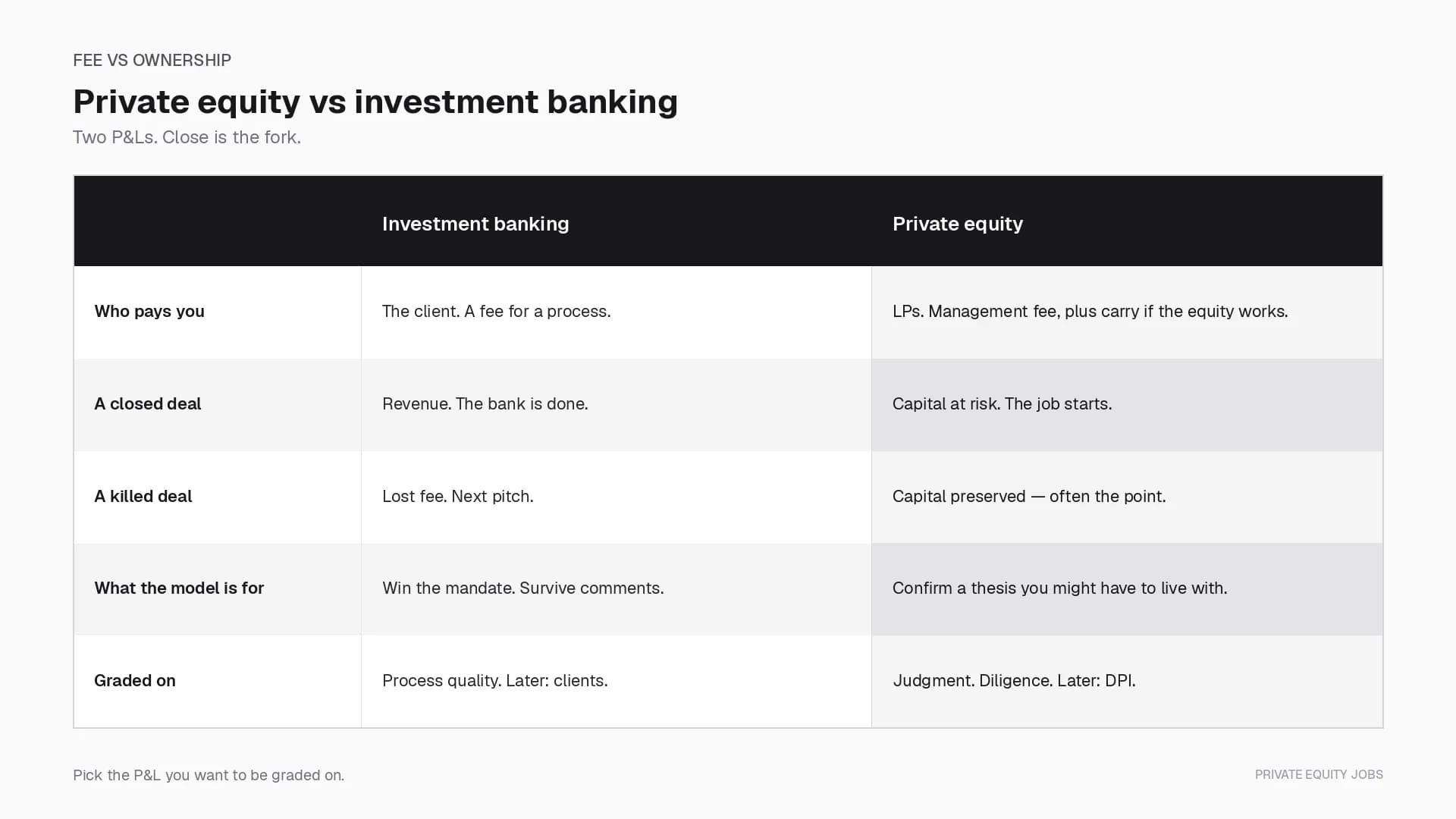
Hours follow the process, not the title. At many smaller and middle-market funds the week is 60 to 70 hours, mostly weekdays, with weekends when a deal is live. At megafunds a live process is banking hours again: all day, often late, weekends included. Quiet weeks exist when the portfolio is humming and the funnel is thin. They almost never exist in a live banking coverage group.
The day is not a modeling day. It is calls, comments, and a memo that has to survive a partner who will ask what you are missing. Travel rises because you are the person management will take a meeting with. Do not pick this seat for the quiet week.
Pay and carried interest
Undated bands go stale. GP Intel's 1 June 2026 careers guide, which skews toward megafunds and the upper middle market, puts US vice president all-in cash at $500,000 to $800,000 plus carried interest. Carry usually starts here. Those figures are a public guide, not a Private Equity Jobs survey. Cash still pays the rent. Carry is a vest.
The quoted points are not a bonus. They are an illiquid claim on a vintage: fund performance, vesting, forfeiture, realization timing, clawback, tax, and whether you are still employed when a distribution shows up. A vice president joining today starts accruing on new deals immediately. Cash from that carry often waits until companies are actually sold, years later. Ask when it vests, whether you keep it if you leave, whether it is fund-wide or deal-by-deal, and whether prior funds actually paid people who were not partners.
Heidrick's 2025 survey finds cash still rose at vice president. Half of respondents said their 2025 base increase was 10 percent or less. About three-quarters said bonuses stayed discretionary. Candidates in that market are screening how deployed the current fund is, its distributions to paid-in, its deal record, and whether it can raise. Do not underwrite a five-year vest at a general partner that cannot point to those facts.
How people get the seat
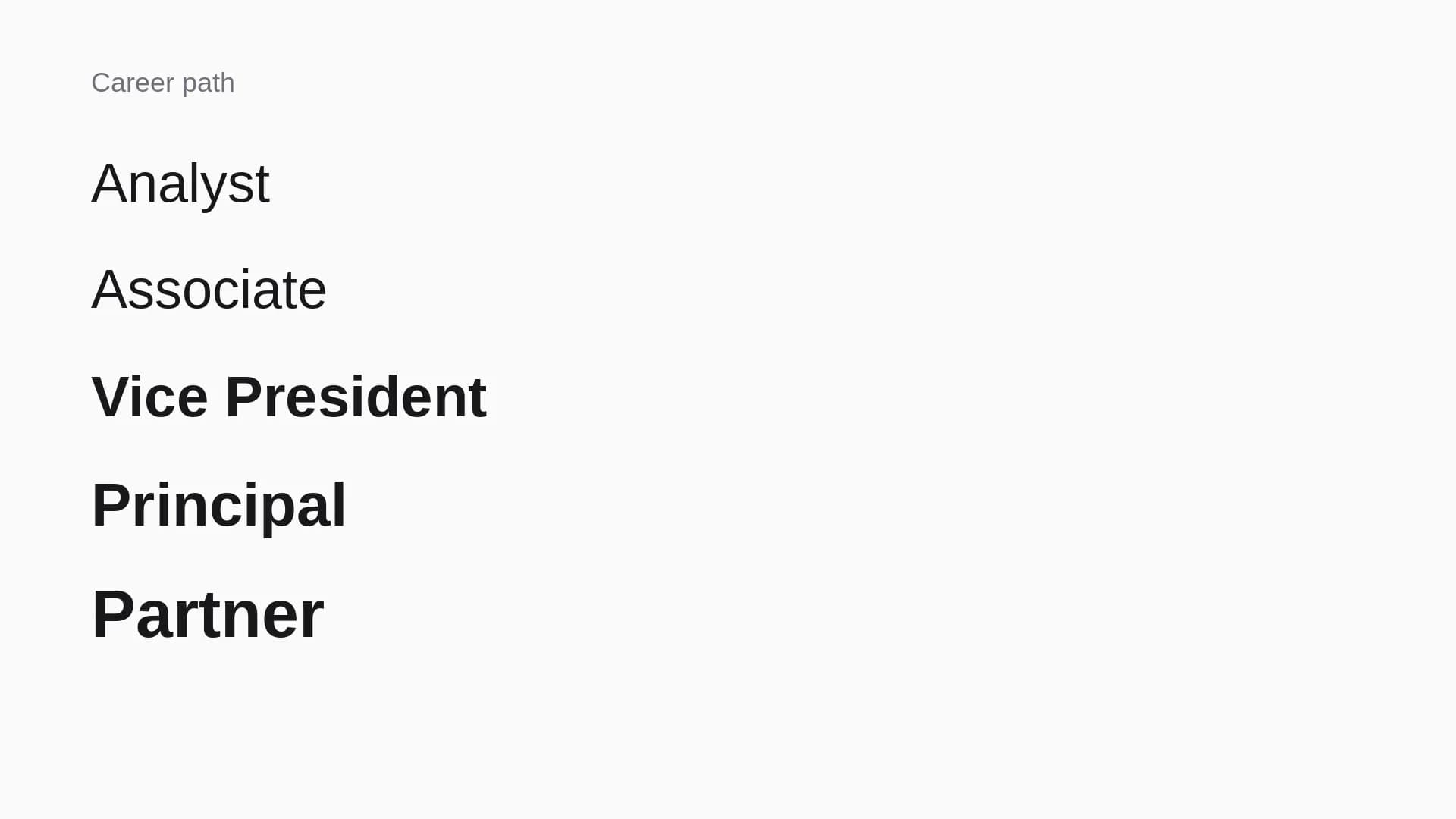
The common path is investment-banking analyst to private equity associate, then senior associate, then vice president. Two to four years in the associate seats is typical. It is not automatic. Megafunds often treat the associate seat as a two- or three-year program with a business-school fork. Many middle-market shops promote in place. That private equity career path is a tournament inside a fund cycle, not a syllabus.
Lateral hiring is more common at vice president than at associate. Headhunters run processes when a fund has just closed, a vice president has left, or a new strategy needs people who can run a deal now. The file they want is closed-deal experience, a sector you can actually talk, and evidence you have run a process rather than staffed one. Modeling tests are less common than at associate. A case on a company you would or would not buy is more common.
A fair number of people go downmarket to make vice president rather than wait for a megafund slot that will not open. The brand is weaker. The job is often more of the process.
Independent-sponsor vehicles are a parallel path some vice presidents take, not this seat. Do not underwrite "I will originate here and then raise my own fund" as the job you just accepted.
Common questions
Does a private equity vice president vote on deals?
No. They recommend. The investment committee votes. Partners sponsor.
Do vice presidents source deals?
At large buyout shops, usually as a supporting job. Partners and senior principals keep the names that matter. At middle-market and growth shops, a pipeline you can point to is often what the next seat tests.
Is the vice president on the board?
Sometimes as an observer. A voting director seat is less common, and more often a principal or partner title, except at smaller funds where titles collapse. Ask.
When does carried interest pay cash?
After companies are sold and the fund has returned capital, often many years after you start accruing. Points are not a year-one bonus.
Is vice president a layover on the way to partner?
Treat it as a career. Most associates never get here. Most vice presidents never make partner. The next seat tests origination and whether the partnership will put your judgment in a room.
Sources
Heidrick & Struggles, 2025 North America Private Equity Investment Professional Compensation Survey (19 November 2025). GP Intel, Private Equity Jobs and Salaries: The 2026 Careers Guide (1 June 2026).