
Private equity value creation is what a fund does after it buys a company to make that company worth more. Over the next three to seven years, the general partner (GP) and the management team try to grow earnings before interest, tax, depreciation and amortization (EBITDA), improve the cost base, or buy smaller companies and combine them. Then the fund sells.
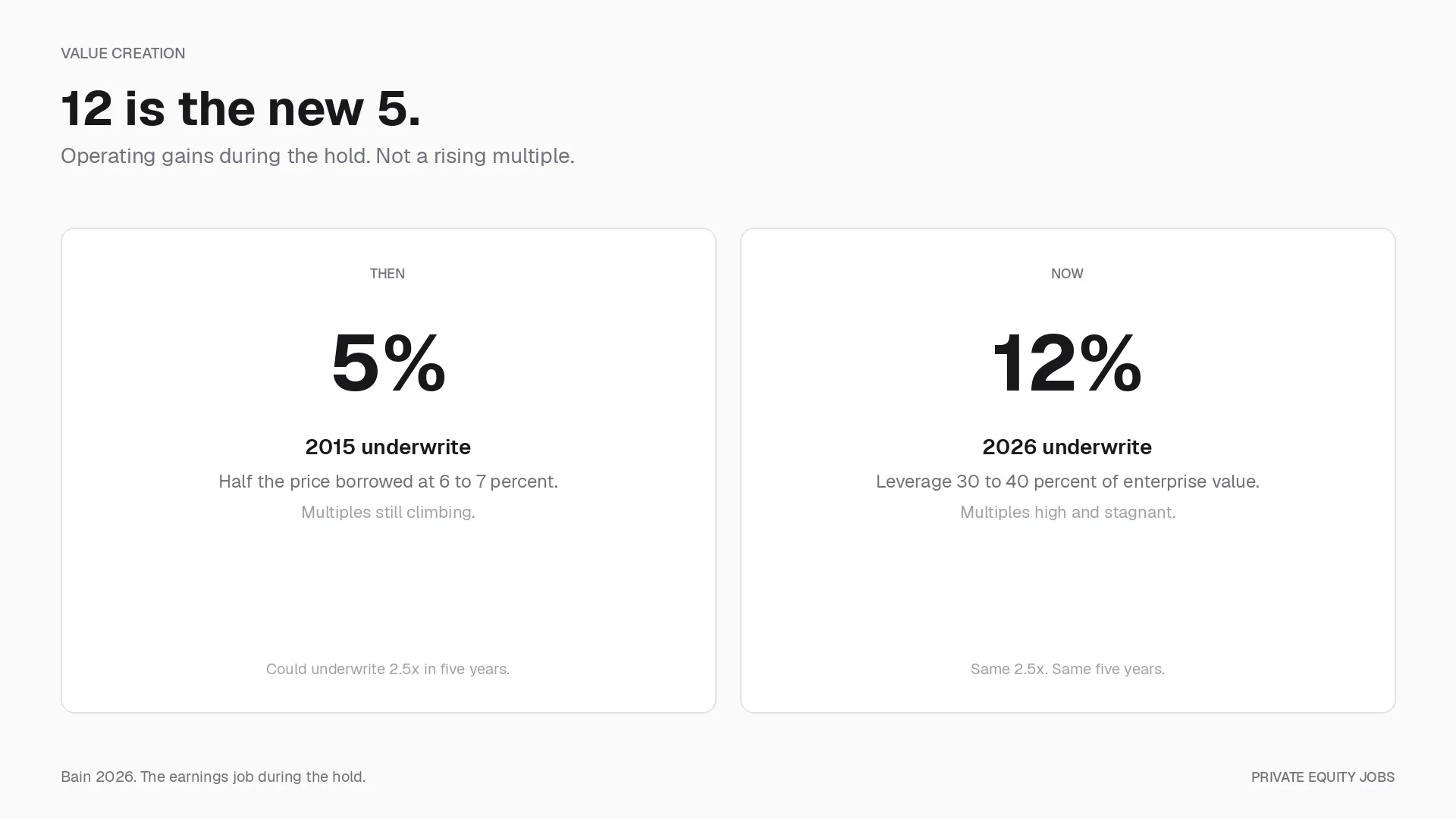
Bain's 17th Global Private Equity Report (23 February 2026). In a typical 2015 buyout, about half the price was borrowed at 6 to 7 percent, multiples were still climbing, and roughly 5 percent annual EBITDA growth could underwrite a 2.5x multiple on invested capital (MOIC) over five years. Today borrowing costs sit in the 8 to 9 percent range, leverage is closer to 30 to 40 percent of enterprise value (about 36 percent in Bain's illustration), and purchase multiples are high and stagnant. The same 2.5x now needs something closer to 10 to 12 percent annual EBITDA growth. Bain calls that "12 is the new 5."
A leveraged buyout (LBO) is the purchase. Value creation is what you do while you own the company.
Why 2026 deals need operating gains
In the 2010s you could buy a decent company and wait. Low rates pushed sale prices up. Cheap loans made the equity more valuable. Funds sold sooner, so cash came back to limited partners (LPs) in time for the next fund. Bain says rising multiples powered more than 50 percent of buyout returns in that decade.
That is no longer how deals work. Buyout funds sit on $3.8 trillion of unsold companies. The average company is now held about seven years before sale. Cash coming back to LPs, as a share of the value still on the books, has stayed weak. A 2.5x that takes seven years instead of five is about 14 percent internal rate of return (IRR), not 20 percent.
Funds still use debt, and some sales will still fetch a higher multiple than the entry price. You just cannot build the deal around those two things anymore. Bain's 2015 illustration assumed 10.0x in and 12.5x out. The 2025 illustration assumes 14.0x in and 15.0x out. One extra turn on a more expensive company adds less, and you cannot assume the multiple will rise again. Before you bid, you need to know whether a 12 percent earnings path is actually there. That means looking at revenue, operations, and technology, not just the selling memo. Hg's take-private of OneStream in January 2026, at about $6.4 billion with minority capital from General Atlantic and Tidemark, is Bain's example. Hg had watched the company for years, then ran one combined commercial, technical, and product review so the bid was based on what the company could become.
How the mix of returns has changed
Returns still come from three places: more EBITDA, a different sale multiple, and less net debt. What changed is how much each one contributes.
McKinsey's Global Private Markets Report 2025, Braced for shifting weather (May 2025), cites StepStone Group on 3,056 realized buyouts entered from 2010 through 2022. Leverage and market multiple expansion were 61 percent of those returns. Revenue growth and EBITDA margin expansion were the other 39 percent.
A longer sample says the same thing over more years. CAIS, in How Do Private Equity Firms Create Value?, reports Institute for Private Capital work on 2,951 fully exited deals from 1984 through 2018 (a StepStone proprietary set, about $945 billion of equity). Leverage was 70 percent of value creation before 2000. After 2008 it was 25 percent. Growing revenue and expanding margins was the most consistent contributor across those three eras. Market multiple expansion was 25 percent of value creation after the crisis and negative before 2000. You can try to earn a higher multiple by changing what the company does. You cannot plan on the whole market paying more.
Steven Kaplan and Per Strömberg, writing in the Journal of Economic Perspectives in 2009 (Leveraged Buyouts and Private Equity), split the work into the capital structure, the board and incentives, and the operating plan. A later survey of 79 firms (more than $750 billion under management) by Paul Gompers, Kaplan, and Vladimir Mukharlyamov (What Do Private Equity Firms Say They Do?, 2016) found that increasing revenue showed up in more than 70 percent of deals, follow-on acquisitions in more than 50 percent, and cost cuts in 36 percent before close and 47 percent after.
Take a specialty distributor that earns $12 million of EBITDA. The fund pays 11.0x, so the company is worth $132 million. New debt is 4.0x EBITDA, or $48 million. The fund puts in $84 million of equity.
Over five years, EBITDA grows about 12 percent a year, from $12 million to $21 million. The fund sells at the same 11.0x. The sale multiple does not rise. Cash from the business pays debt down from $48 million to $20 million.
| Entry | Exit (year 5) | |
|---|---|---|
| EBITDA | $12,000,000 | $21,000,000 |
| Multiple | 11.0x | 11.0x |
| Enterprise value | $132,000,000 | $231,000,000 |
| Debt | $48,000,000 | $20,000,000 |
| Equity value | $84,000,000 | $211,000,000 |
The fund put in $84 million and took out $211 million. MOIC is 2.51x. That is the 2.5x target on a five-year clock, earned almost entirely on earnings and debt paydown. Of the $127 million equity gain, $99 million comes from the extra $9 million of EBITDA times 11.0x, and $28 million comes from debt that was paid off. None of it comes from a higher sale multiple.
The operating plan that produces the extra $9 million of EBITDA is the value creation plan, not the purchase agreement. On this company it is four lines: raise catalog prices 3 percent on $80 million of sticky revenue (about $2.2 million of EBITDA if most of the increase drops through); close two overlapping warehouses ($1.5 million); buy one $4 million-EBITDA add-on at 7.0x and take $0.8 million of procurement out of the combined cost base; lift sales productivity for the rest ($0.5 million). If those four lines do not happen, the fund does not get 2.51x.
The value creation plan
A value creation plan (VCP) is the document that turns the investment thesis into owners, numbers, and dates. It is not a strategy memo that sits unused in the data room. It is also not the same thing as the 100-day plan. The 100-day plan is just the first slice of the same document.
A complete plan names:
- The thesis. One or two beliefs that justify the price. If you cannot say them in a sentence, you do not have a plan.
- Four to seven initiatives, not twenty. Each traces to a driver: revenue, margin, an add-on, or a risk you are taking off the table.
- One owner per initiative, inside management if you can, with an operating partner sitting beside the ones that need it.
- A baseline agreed in diligence. Day-one EBITDA, margin, revenue mix, and the operating key performance indicators (KPIs) you will actually look at. If you argue about the starting numbers after you own the company, the plan usually fails.
- A target, a budget, and a date for each line.
- A risk and a kill criterion. If the warehouse consolidation needs a second year, say so. If the add-on pipeline is empty in month six, the plan has to change.
- The exit the company is being built for. A strategic buyer, another fund, or a public listing will not pay for the same story.
Write the plan during diligence. A plan written before you buy helps set the price and tells you what to do in the first week. A plan written in month four is you trying to catch up.
Most firms review each initiative as red, amber, or green at the quarterly board, and look monthly at the lines that are off. The first 100 days are for the baseline, the team, and the quick wins (price, obvious cost, reporting). Years one and two are for the initiatives that have to show up in EBITDA. Years three and after are for scale, the remaining add-ons, and a file a buyer can underwrite. Holds that slip toward seven years, which is Bain's current average at exit, are more years of the same reviews.
Plans stall for ordinary reasons. The CEO never shared the thesis. Functions run their own lists. The leadership team that got the company to $12 million of EBITDA is not the team that gets it to $21 million. The metrics cannot be produced on time, so no one is accountable.
Revenue, margin, and buy-and-build
Three operating levers show up in almost every plan. Changing the mix of debt and equity, refinancing, or paying a dividend can still make the equity worth more. Those moves do less work than they did in 2015, when debt was cheaper and multiples were still rising.
Revenue. Price, mix, sales-force effectiveness, new products, new geographies. Price is usually the fastest line because most of a price increase drops through to EBITDA if volume holds. McKinsey, in Pricing: The next frontier of value creation in private equity, finds that a 1 percent price rise lifts profits about 6 percent at a typical midsize US company, against about 4 percent from a 1 percent cut in variable costs and about 1 percent from a 1 percent cut in fixed costs. On portfolio companies where a pricing program is likely to work, they typically see 3 to 7 percent margin expansion within a year. Growing volume takes longer. In the distributor example, the 3 percent catalog increase is most of the first-year earnings gain, and only if customers stay.
Margin. Procurement, sites, working capital, systems, a cost base that does not grow as fast as sales. Warehouse consolidation in the same example is $1.5 million because two buildings were doing one job. Freeing working capital does not raise EBITDA. It raises cash, which is how you pay down the loan.
Buy-and-build. A platform company buys smaller companies (add-ons, also called bolt-ons) and tries to run them as one. Scale can cut cost. A larger, less risky, more professional company can also sell at a higher multiple than the pieces would have sold at alone, if you actually combine them.
Add-ons are how most buyouts happen, counted one deal at a time. Cherry Bekaert's Private Equity Report: 2025 Trends and 2026 Outlook (25 February 2026), using PitchBook, puts add-on acquisitions at 72.9 percent of all U.S. buyouts in 2025 by count, in line with the five-year average. They are not most of the dollars. McKinsey's 2025 report puts non-platform deals at 40 percent of buyout deal value in 2024. The typical add-on is smaller than the typical platform.
Bain, in Building a Stronger Buy-and-Build (2024 Global Private Equity Report), looked at 44 buy-and-build deals from 2010 through 2019. Platforms that only bought cheaper companies and hoped to sell the pile at a higher multiple averaged a 1.4x MOIC. Platforms that also grew the existing business or improved margins averaged 2.2x.
KKR's Josh Weisenbeck, in the firm's Value Creation in Private Equity: Making Our Own Luck interview (July 2024), describes Capsugel, a 2011 carve-out that mostly made pill capsules. The fund moved a few small delivery technologies into their own unit and bought businesses with more of them, until the company was a drug-delivery platform rather than a capsule plant. A later buyer was paying for a different business.
Cinven did similar work at Phadia with the sales force. Invest Europe records the Swedish allergy-diagnostics company bought in 2007, a doubled revenue-growth rate, and earnings from €96 million to €146 million. Thermo Fisher Scientific bought it in May 2011 for €2.47 billion. The fund returned 3.4x and about €1 billion of capital gain. The work was product, the US sales force, and offices in China and India.
Who does the work
Three groups do this work.
The deal team finds the company, sets the price, builds the capital structure, and sits on the board. If the entry multiple is wrong, operations will not save the fund. That is why the deal team is still treated as the center of the firm.
The operating partner (and, at larger firms, a portfolio-operations or value-creation team) is there to make the plan happen. Upper-middle-market funds and megafunds tend to employ these people. Smaller funds often ask the deal team to do both jobs, or they hire an operator for a specific line (procurement, pricing, a plant). McKinsey's 2025 report, from a 2024 survey of operating groups, says average team size has more than doubled in three years. Advising a company that only needs 5 percent earnings growth is a different job from running one that needs 12 percent.
Management runs the company. The plan fails if they do not own the lines. Equity for the CEO and the functional heads is how the GP tries to make that true. Replacing a CEO in the first 100 days is common enough to put in the plan. Keeping a CEO who cannot run a $21 million-EBITDA company is how holds stretch to seven years.
"Value creation" is also a job title. A value-creation or portfolio-operations team is the group hired to run the plan. It is not another name for the three return drivers. Those teams hire operators and consultants, not first-year bankers. Hours are better than the deal team. Pay is usually a step below it. Moving onto the investing seat is uncommon. The private equity career path page is about the investing jobs, not these operating jobs.
How value creation is measured
At the company, you measure the plan: EBITDA, margin, revenue, and the operating KPIs on each line. A value-creation bridge splits the equity gain into the same three buckets used at purchase: how much came from earnings, how much from the sale multiple, and how much from paying down debt (and dividends). If the earnings step is small and the multiple step is large, most of the gain came from the market, not from running the company.
At the fund, LPs care about cash and the remaining mark, not the company's EBITDA on its own. MOIC is how many times the equity came back. IRR is that multiple with a clock. Distributions to paid-in (DPI) is cash already sent back to LPs. A 1.8x that is mostly companies still unsold is a valuation. It is not cash LPs have received. Bain's $3.8 trillion of unsold buyout companies is that problem at industry scale. IRR vs MOIC explains the two metrics.
Common questions
How do private equity firms create value?
They buy a company, usually with debt on that company's balance sheet, then try to grow earnings, tighten the cost base, and (often) buy smaller companies that fit. They sell. Equity value at exit is enterprise value minus remaining net debt. In 2026, growing earnings is the part you can still plan.
What is a value creation plan?
The time-bound document that names the thesis, the four to seven initiatives, the owner of each, the baseline, the targets, and the exit the company is being built for. It is written in diligence and reviewed at the board.
What is operational alpha?
The extra return that comes from running the company better, separate from cheap debt and a rising market multiple. People use the phrase for the extra return from growing earnings, not for a separate kind of fund.
What are the three drivers of private equity returns?
EBITDA growth, multiple expansion, and less net debt. McKinsey and StepStone's 2010–22 sample attributed 61 percent of realized buyout returns to leverage and multiple expansion. That mix is why a 2026 deal has to assume more earnings growth.
How is value creation different from financial engineering?
Financial engineering changes who has a claim on the cash (more debt, a refinance, a dividend). Value creation changes how much cash the company produces. Both can make the equity worth more. In 2026 you can still plan to grow earnings. You cannot plan on cheap debt and rising multiples the way you could in 2015.
Sources
Bain & Company, 17th Global Private Equity Report, 23 February 2026. McKinsey & Company, Global Private Markets Report 2025, Braced for shifting weather, May 2025, Exhibit 18 (SPI by StepStone, 3,056 realized buyouts). CAIS, How Do Private Equity Firms Create Value?, citing Institute for Private Capital on 2,951 exits, 1984–2018. Steven N. Kaplan and Per Strömberg, Leveraged Buyouts and Private Equity, Journal of Economic Perspectives, Winter 2009. Paul Gompers, Steven N. Kaplan, and Vladimir Mukharlyamov, What Do Private Equity Firms Say They Do?, Journal of Financial Economics, 2016. McKinsey & Company, Pricing: The next frontier of value creation in private equity. Cherry Bekaert, Private Equity Report: 2025 Trends and 2026 Outlook, 25 February 2026 (PitchBook). Bain & Company, Building a Stronger Buy-and-Build, 2024 Global Private Equity Report (44 buy-and-build deals, 2010–19). KKR, Value Creation in Private Equity: Making Our Own Luck, July 2024. Invest Europe, Phadia.
Related posts

Buy-side firms such as private equity funds invest capital for a return, and sell-side banks are paid fees and commissions to arrange the deals and trades. Which firms sit on each side, how each is paid, how research and licensing differ, and how careers move from banking into private equity.

When a private equity fund buys a company, the company takes on the acquisition debt, the fund takes the board, and a plan to raise earnings starts on day one. What changes for managers and staff, what the research says about jobs and failure, and how the ownership ends.