
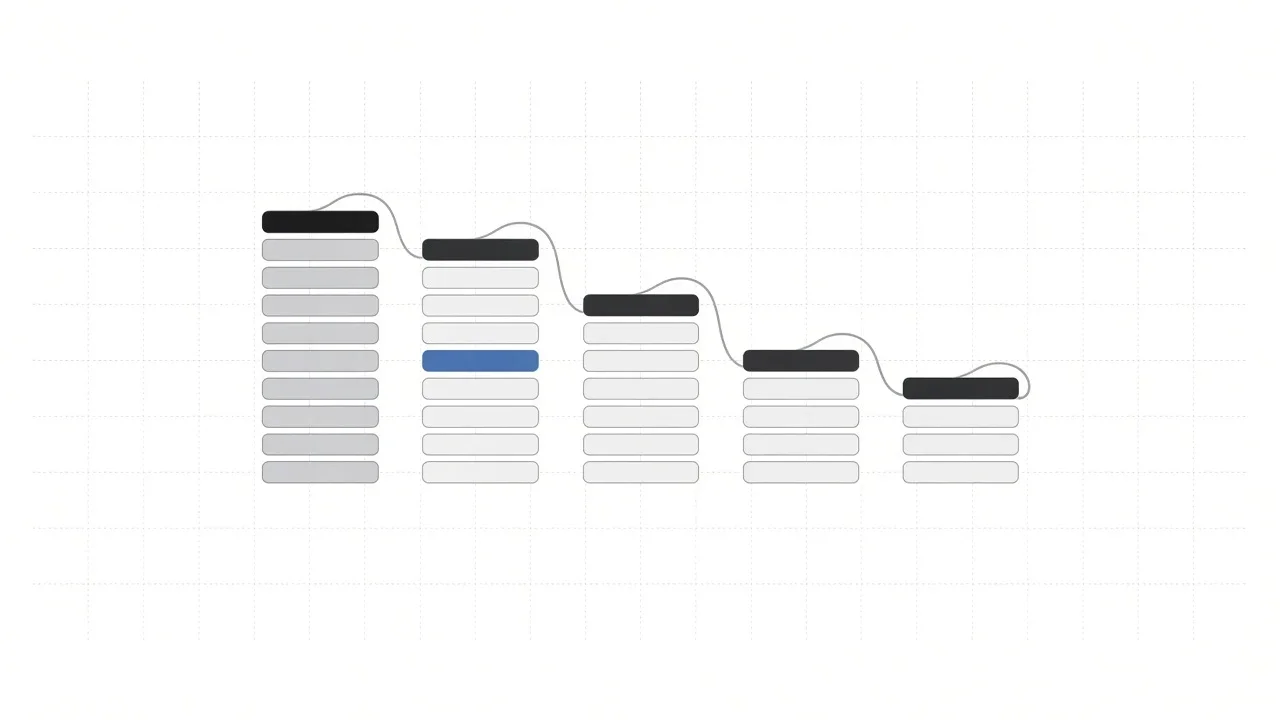
A debt schedule is the part of a financial model that tracks every borrowing a company has, year by year or quarter by quarter: the balance at the start of the period, new borrowing, required and voluntary repayments, the balance at the end, and the interest each balance costs. It turns the terms of a credit agreement into numbers the rest of the model can use. Interest expense goes to the income statement, ending balances go to the balance sheet, and borrowings and repayments go to the financing section of the cash flow statement. In a leveraged buyout (LBO) model, the debt schedule decides how much debt is left at exit, which makes it one of the main drivers of the equity return.
The terms in a real credit agreement are more detailed than the assumptions in a practice model, and some of them change the answer. When 3G Capital took Skechers private in September 2025, the buyer financed the deal with about $3.0bn of term loans in dollars and euros, €1.0bn of senior secured notes, $2.2bn of payment-in-kind (PIK) toggle notes and a $1.6bn revolving credit facility. Skechers filed the credit agreement with the SEC. Run Skechers' own pre-deal management projections through those terms, with a few stated assumptions, and the excess cash flow sweep, the feature most LBO models use to pay down debt, requires no prepayment at all from 2026 to 2029.
What a debt schedule is
A debt schedule rolls each piece of debt forward from one period to the next. Modelers call the layout a corkscrew, because each period's ending balance becomes the next period's beginning balance:
Ending balance = beginning balance + new borrowing + interest paid in kind − mandatory repayment − optional repayment
Each tranche gets its own block, because tranches differ in rate, repayment, maturity and the order in which they are repaid. Under the balance roll sit the interest calculations and, for a revolving credit facility, the commitment fee on the undrawn amount.
The schedule sits between the operating forecast and the financial statements. The forecast produces the cash the business generates before paying lenders. The schedule takes that cash, pays interest and required principal, decides whether the company has to borrow on its revolver or has surplus cash to repay debt early, and sends the results back to the three financial statements. Because interest depends on the debt balance and the debt balance depends on cash after interest, the schedule is also where most models' circular references begin.
How much detail the schedule needs depends on the model. A three-statement model of a public company often combines its debt into one or two lines with a blended interest rate, because the company is expected to keep borrowing roughly steady. An LBO model needs separate tranches with their own repayment terms, a revolver and a cash sweep, because the deal is built around paying debt down. A credit or refinancing model follows each bond and loan to its maturity date and tests whether the company can refinance it.
Business debt schedules for loan applications
Banks and small-business lenders use "business debt schedule", sometimes called a schedule of liabilities, for a different document. It is a form listing every loan a business owes, with the lender, original amount and date, current balance, rate, monthly payment, maturity date, collateral and whether the account is current or delinquent. Forms usually ask for installment loans, lines of credit, notes, mortgages and capital leases, and exclude trade payables and accrued liabilities. Lenders also expect loans from the owners made under a formal note, merchant cash advances, business credit cards that carry a balance, and lines of credit with a zero balance, which show that the facility exists. A business that controls other companies usually provides a schedule for each one. A lender asks for the form to check what the applicant already owes and to calculate a debt service coverage ratio, which divides the business's cash flow by its annual principal and interest payments. That calculation adds the payments on the new loan and leaves out any debt the new loan will pay off. The form is a snapshot of existing debt on one date, which should be the date of the interim balance sheet sent with it. Its total should agree with the borrowings on that balance sheet, where each term loan is split between the current portion of long-term debt and long-term debt, so the total will not match the long-term debt line alone. A financial modeling debt schedule is a forecast. It uses the same facts about each loan as inputs and projects the balances forward.
What goes into a debt schedule
Every input in an LBO debt schedule should come from a document: the sources and uses table for opening balances, and the commitment letter, credit agreement or bond indenture for terms. Where the documents are not available, the inputs are assumptions and should be labeled that way.
| Input | What it controls | Where it comes from |
|---|---|---|
| Opening balance by tranche | Starting principal | Sources and uses at close |
| Base rate and spread | Interest rate on floating-rate loans | Credit agreement "Applicable Rate" and benchmark definitions |
| Floor | Minimum base rate | Credit agreement, often in the benchmark definition |
| Pricing grid | Spread steps down as leverage falls | Credit agreement "Applicable Rate" table |
| Scheduled amortization | Required principal each period | Repayment section of the credit agreement |
| Maturity | Date the remaining balance is due | Credit agreement or indenture |
| Excess cash flow sweep | Share of excess cash flow that must repay debt, thresholds and timing | Mandatory prepayment section of the credit agreement |
| Voluntary prepayment terms | Whether debt can be repaid early and at what premium | Credit agreement; indenture call schedule for bonds |
| Revolver size and commitment fee | Borrowing capacity and the fee on unused capacity | Credit agreement |
| PIK terms | Whether interest can be added to principal instead of paid in cash | Indenture or credit agreement |
| Minimum cash | Cash the company keeps before repaying debt | Model assumption, sometimes a covenant |
| Financing fees and original issue discount | Amortization of capitalized fees for book and tax purposes | Commitment letter and fee letter |
Term loans are usually floating rate. The rate is a benchmark, such as the Secured Overnight Financing Rate (SOFR) for dollar loans or the Euro Interbank Offered Rate (EURIBOR) for euro loans, plus a fixed spread. Older models and loan documents use the London Interbank Offered Rate, which was phased out for U.S. dollar loans by mid-2023. A floor sets a minimum for the benchmark, so the formula is the greater of the benchmark and the floor, plus the spread. Bonds, including unsecured debentures, usually pay a fixed coupon, do not amortize and cannot be repaid early without a premium during their non-call period, which is why most models do not sweep cash into them.
The order of repayment follows seniority. Revolving loans are repaid first because they are the most flexible and usually the cheapest to redraw. Senior secured term loans come next. Subordinated debt, such as unsecured notes, mezzanine loans, seller notes and PIK instruments, sits at the end. It pays a higher rate because it is repaid after senior lenders in a default, usually has a longer maturity and no amortization, and often carries call protection, so it normally stays outstanding until a refinancing or exit. Some schedules also carry finance leases, which have their own fixed payment schedule.
How to build a debt schedule, step by step
An annual LBO debt schedule with a revolver, a term loan that amortizes, a bullet tranche and a sweep takes eight steps. A quarterly or monthly model uses the same logic with shorter periods.
Step 1. Lay out the tranches
Create one block per tranche in order of seniority, with rows for beginning balance, draws, PIK interest, mandatory repayment, optional repayment and ending balance. Link the closing balances to sources and uses. In a practice model without deal documents, tranche sizes are often given as multiples of earnings before interest, taxes, depreciation and amortization (EBITDA). At 3.0x senior debt and 1.0x subordinated debt on $100m of EBITDA, the opening balances are $300m and $100m. Put the terms of each tranche (rate, floor, amortization percentage, sweep percentage, maturity) in an assumptions area, not inside formulas. Pick one sign convention and keep it. A common one shows draws as positive and repayments as negative inside the schedule, so the ending balance is a plain sum, and carries the same signs into the financing section of the cash flow statement.
Step 2. Calculate cash available for debt repayment
Start from cash at the beginning of the period plus the cash the business generates after taxes, capital spending, working capital and interest, and subtract the minimum cash balance. This line goes by several names, including cash flow available for debt repayment and cash flow surplus or deficit. It is a levered figure. It comes after interest, and a model that starts from unlevered free cash flow has to subtract interest after its tax saving to get here. It is not the same as cash flow available for debt service in project finance, which is measured before any debt payments, ignores beginning and minimum cash, and is divided by debt service to test coverage.
Step 3. Calculate mandatory repayments
Term loan amortization is a percentage of the original principal, not of the beginning balance. A loan that amortizes 1% a year repays 1% of its closing amount every year until it is gone. Term loans held by banks, often called Term Loan A, usually amortize faster. Term loans sold to institutional investors, called Term Loan B, typically repay 1% a year, or 0.25% a quarter as on Skechers' Tranche B-1, with the rest due at maturity. The formula caps the payment at the remaining balance:
Mandatory repayment = MIN(original principal × amortization rate, beginning balance)
Prepayments change the later installments. Under many credit agreements, Skechers' among them, a prepayment is applied against the remaining scheduled installments, in the order the borrower chooses or, if it makes no choice, in direct order of maturity. A model that keeps charging the full installment after a large prepayment overstates required repayments, because the cap against the beginning balance only affects the final payment.
Subtract total mandatory repayments from the cash available in Step 2. Mandatory payments are due whether or not the business has surplus cash, so if the result is negative, the shortfall has to be borrowed.
Step 4. Draw on or repay the revolver
The revolver is the model's balancing item. If cash after mandatory payments is negative, the company draws the shortfall, up to the unused commitment. If it is positive, the company repays any revolver balance first:
Revolver draw (+) or repayment (−) = MIN(MAX(−cash available after mandatory payments, −beginning revolver balance), commitment − beginning revolver balance)
A negative result is a repayment. The MAX stops the model from repaying more than is outstanding, and the MIN stops it from drawing more than the facility allows. If the shortfall is larger than the remaining commitment, cash falls below the minimum, and the model should flag it.
Step 5. Apply optional repayments in order
Cash left after the revolver is repaid can go to term loans, in seniority order. For each tranche:
Optional repayment = MAX(0, MIN(cash remaining after more senior repayments × sweep percentage, beginning balance − mandatory repayment))
The sweep percentage is a model input. Many models use 50% or 100%. In a real deal it has two parts: the required excess cash flow percentage written in the credit agreement, and any voluntary prepayment the owner chooses to make with the rest. On Skechers' 2025 buyout terms, the required part is zero in every year from 2026 to 2029.
Step 6. Calculate interest, fees and PIK
Floating interest is (MAX(benchmark, floor) + spread) × balance. Fixed interest is the coupon × balance. The revolver also pays a commitment fee on the undrawn portion, (commitment − drawn balance) × fee rate. PIK interest is calculated the same way but added to the tranche's principal instead of paid in cash. Many models also calculate interest income on cash above the minimum. Decide whether interest runs on beginning balances or on average balances, rate × (beginning balance + ending balance) ÷ 2.
Financing fees are paid at close, usually by deducting them from the loan proceeds, and appear in uses. In the model they are capitalized and amortized over the life of the debt. The amortization is a non-cash expense, so it reduces net income and taxes but is added back on the cash flow statement and does not reduce cash available for debt repayment.
Step 7. Link to the financial statements
Total cash interest, PIK interest, commitment fees and fee amortization go to interest expense on the income statement. Ending balances go to the balance sheet. Draws and repayments go to the financing section of the cash flow statement, and PIK interest is added back as a non-cash expense in operating cash flow. In an LBO without a full balance sheet, ending balances and cash feed the exit calculation instead.
Step 8. Check the schedule
No balance should go negative. Cash should never fall below the minimum unless the revolver is fully drawn, and the model should show a warning if it does. Total debt on the balance sheet should equal the sum of tranche ending balances. Each tranche should reach zero at its maturity date unless the model assumes a refinancing. If cash builds while prepayable debt is still outstanding, the sweep is either switched off on purpose or not working.
Interest, circularity and how to resolve it
Interest on the average of the beginning and ending balance assumes repayments happen evenly through the year. It is closer to how interest accrues on a loan that is repaid during the year, but it makes the model circular. Interest depends on the ending balance, the ending balance depends on how much cash is left to repay debt, and that cash depends on interest. Excel can solve the loop with iterative calculation turned on, usually behind a switch (sometimes called a circuit breaker) such as =IF(switch = 1, rate × (beginning + ending) ÷ 2, rate × beginning). Setting the switch to zero breaks the loop, which clears the error values that otherwise spread through the model when one input goes wrong.
Interest on beginning balances removes the circularity, and some private equity firms build their models this way. Their argument is that portfolio companies do not repay debt daily and often hold a cash buffer, so average-balance interest assumes faster repayment than happens and overstates returns. The cost is a small overstatement of interest when debt is falling and an understatement when it is rising.
The difference is usually small. On Skechers' buyout debt, 2026 interest on average balances is $491.2m and interest on beginning balances is $488.8m, a $2.3m difference on roughly $6.5bn of debt. It matters more in a model with large repayments relative to the debt, or a revolver that swings from empty to heavily drawn within a year. A quarterly model cuts the gap further, because each period's beginning balance is closer to its average. Whichever method is used, the convention should be the same for every tranche and stated in the assumptions.
What credit agreements require from a cash sweep
Many models treat the cash sweep as an optional repayment the company chooses to make, with a percentage set by the modeler. In leveraged loan agreements the sweep is a mandatory prepayment. A typical excess cash flow clause has five parts, and each one changes the number:
- A definition of excess cash flow. It starts from the agreement's own version of EBITDA and subtracts cash interest, cash taxes, capital spending, increases in working capital, scheduled debt payments and a long list of other items. It is a defined term in the contract, not the model's free cash flow.
- A percentage that steps down with leverage. Agreements commonly require 50% of excess cash flow, stepping to 25% and then 0% as a leverage ratio falls.
- Deductions. Voluntary prepayments, and often acquisitions, capital spending and other investments, reduce the amount owed dollar for dollar.
- A threshold. Many recent agreements require a prepayment only to the extent the amount exceeds a fixed sum or a share of EBITDA.
- Annual timing. The payment is calculated on the fiscal year and paid after the audited financial statements are delivered, which is several months after year-end. In an annual model, a sweep earned in year one is paid in year two.
A model that assumes 50% or 100% of free cash flow repays term loans every year is therefore modeling the owner's choice, not the lender's requirement. That choice can be reasonable. Paying down a loan at 7% with cash that would otherwise earn less is often the best use of surplus cash, and an owner may choose to do it. But the schedule should show the required sweep and the voluntary repayment as separate lines, because the first is a contract term and the second is a forecast of a decision.
Example: Skechers' debt schedule after the 3G Capital buyout
Skechers U.S.A. agreed on May 4, 2025 to be acquired by Beach Acquisition Co Parent, an entity formed and controlled by a 3G Capital fund, with 3G Fund VI expected to hold at least 78.6% of the parent. The merger closed on September 12, 2025. On that date the buyer, Beach Acquisition Bidco LLC, signed a credit agreement with JPMorgan Chase Bank as administrative agent, and Skechers filed it with its 8-K. The information statement Skechers filed in August 2025 for the take-private includes the management projections Skechers provided to 3G Capital, the inputs needed to build a schedule.
The filed debt terms
| Tranche | Amount | Price | Repayment | Maturity |
|---|---|---|---|---|
| Tranche B-1 term loan (USD) | $1,555.0m | Term SOFR + 3.25%, 3.00% at first lien net leverage of 1.75x or lower; 0% floor | 0.25% of original principal each quarter, from September 30, 2025 | September 12, 2032 |
| Tranche B-2 term loan (EUR) | €1,250.0m | EURIBOR + 3.50%, 3.25% at 1.75x or lower; 0% floor | No scheduled amortization | September 12, 2032 |
| Senior secured notes | €1.0bn | 5.250% fixed, paid semiannually | Bullet | July 15, 2032 |
| Senior PIK toggle notes | $2.2bn | 10.000% in cash or 10.750% in kind, semiannually | Bullet | July 15, 2033 |
| Revolving credit facility | $1,600.0m commitment | SOFR + 3.25% stepping to 2.50% as leverage falls; commitment fee 0.50%, 0.375% or 0.25% | Not expected to be drawn at closing | September 12, 2030 |
The 8-K gives the two term loans an aggregate U.S. dollar equivalent of $3,005.0m, which implies about $1.16 per euro. The excess cash flow clause requires 50% of excess cash flow when first lien net leverage is above 2.50x, 25% from 2.50x down to 1.75x, and 0% at or below 1.75x, starting with the fiscal year ending December 31, 2026. The payment is due five business days after the annual financial statements are delivered, and it is applied to the term loans. If the secured notes' terms also require an offer to repay them, the borrower may share the payment ratably with the notes. Voluntary prepayments of debt, capital spending, acquisitions and other listed items are deducted from it.
The clause also sets a threshold. A prepayment is required only if the payment amount exceeds the greater of $370m and 25% of Consolidated Adjusted EBITDA, and only the excess is paid. If the payment amount is below the threshold, the unused part carries forward and raises the next year's threshold. The borrower can also pull forward the next year's threshold.
Two other terms matter for the schedule. Unless the issuer elects otherwise, interest on the PIK toggle notes is paid in kind at 10.750%; the issuer can elect to pay 0%, 25%, 50%, 75% or 100% of each semiannual payment in cash at 10.000%. The first interest period, from issuance on July 14, 2025 to January 15, 2026, accrued in kind. The revolver also carries a springing maintenance covenant. First lien net leverage may not exceed 5.50x, tested only when revolving loans, not counting undrawn letters of credit, exceed 40% of the $1.6bn commitment, which is $640m.
Building the schedule
Skechers' management projections give EBITDA of $1,119m in 2026 rising to $1,767m in 2029, with capital spending falling from $746m in 2025 to $375m in 2026. Unlevered free cash flow, as management defines it, is $339m in 2026, $475m in 2027, $677m in 2028 and $795m in 2029. Those projections were prepared before the deal, for Skechers on its own. Skechers' board provided them to 3G Capital on May 1, 2025, and they include management's updates for tariffs on U.S. imports. They are not the buyer's own forecast.
The schedule below is Private Equity Jobs arithmetic on the filed terms and projections. It rests on assumptions that are not in any filing. Term SOFR is held at 3.75% and EURIBOR at 2.00% for every year, as illustrations rather than forecasts. The euro is held at $1.16. Cash at the end of 2025 is a $500m minimum and the revolver is undrawn. Management EBITDA stands in for the agreement's Consolidated Adjusted EBITDA, which allows more add-backs. A higher covenant EBITDA would lower the leverage ratios and raise the threshold, and both changes make a required prepayment less likely. Cash taxes are management's tax line reduced by the tax saving on interest, with deductible interest capped at 30% of EBITDA under a simplified reading of Section 163(j) of the Internal Revenue Code, and no credit is taken in later years for interest disallowed in earlier ones. Interest runs on average balances. The issuer pays all PIK note interest in cash from 2026, an election the filings used here do not disclose, and no voluntary prepayments are made. Original issue discount and financing fees are left out, and semiannual coupons and quarterly amortization are added up by calendar year.
The first interest period, paid in kind on January 15, 2026, added $118.9m to the PIK notes (10.750% for 181 days on a 30/360 basis). The schedule treats that addition as made at the start of 2026, so the notes start the year at $2,318.9m. Opening debt is $6,476.1m. On 2025 EBITDA of $947m, first lien net leverage is 3.86x and total net leverage is 6.31x.
| $m | 2026 | 2027 | 2028 | 2029 |
|---|---|---|---|---|
| Unlevered free cash flow (management) | 339.0 | 475.0 | 677.0 | 795.0 |
| Plus tax saving on interest | 78.9 | 96.8 | 116.9 | 120.6 |
| Cash available before debt service | 417.9 | 571.8 | 793.9 | 915.6 |
| Interest, Tranche B-1 (7.00%) | (107.8) | (106.7) | (105.6) | (104.5) |
| Interest, Tranche B-2 (5.50%) | (79.8) | (79.8) | (79.8) | (79.8) |
| Interest, senior secured notes | (60.9) | (60.9) | (60.9) | (60.9) |
| Interest, PIK toggle notes paid in cash | (231.9) | (231.9) | (231.9) | (231.9) |
| Revolver interest and commitment fee | (10.9) | (11.6) | (8.7) | (6.0) |
| Scheduled amortization, Tranche B-1 | (15.6) | (15.6) | (15.6) | (15.6) |
| Cash after required debt service | (88.9) | 65.4 | 291.5 | 417.0 |
| Revolver draw (repayment) | 88.9 | (65.4) | (23.5) | 0.0 |
| Ending revolver | 88.9 | 23.5 | 0.0 | 0.0 |
| Ending Tranche B-1 | 1,531.7 | 1,516.1 | 1,500.6 | 1,485.0 |
| Ending cash | 500.0 | 500.0 | 768.0 | 1,185.0 |
| First lien net leverage | 3.33x | 2.82x | 2.14x | 1.65x |
| Total net leverage | 5.41x | 4.62x | 3.63x | 2.96x |
Cash interest is about $491m in 2026, more than the $418m the business generates before debt service, so the company draws $88.9m on the revolver in the first full year. That is 5.6% of the commitment, far below the 40% that would trigger the leverage covenant. The commitment fee on the unused $1.5bn costs about $7.8m in 2026, more than twice the $3.1m of interest on the revolver itself. The tax saving is capped. Interest of $491m exceeds 30% of 2026 EBITDA ($335.7m), so $155.5m of interest is not deductible that year under this assumption.
Why the sweep requires nothing
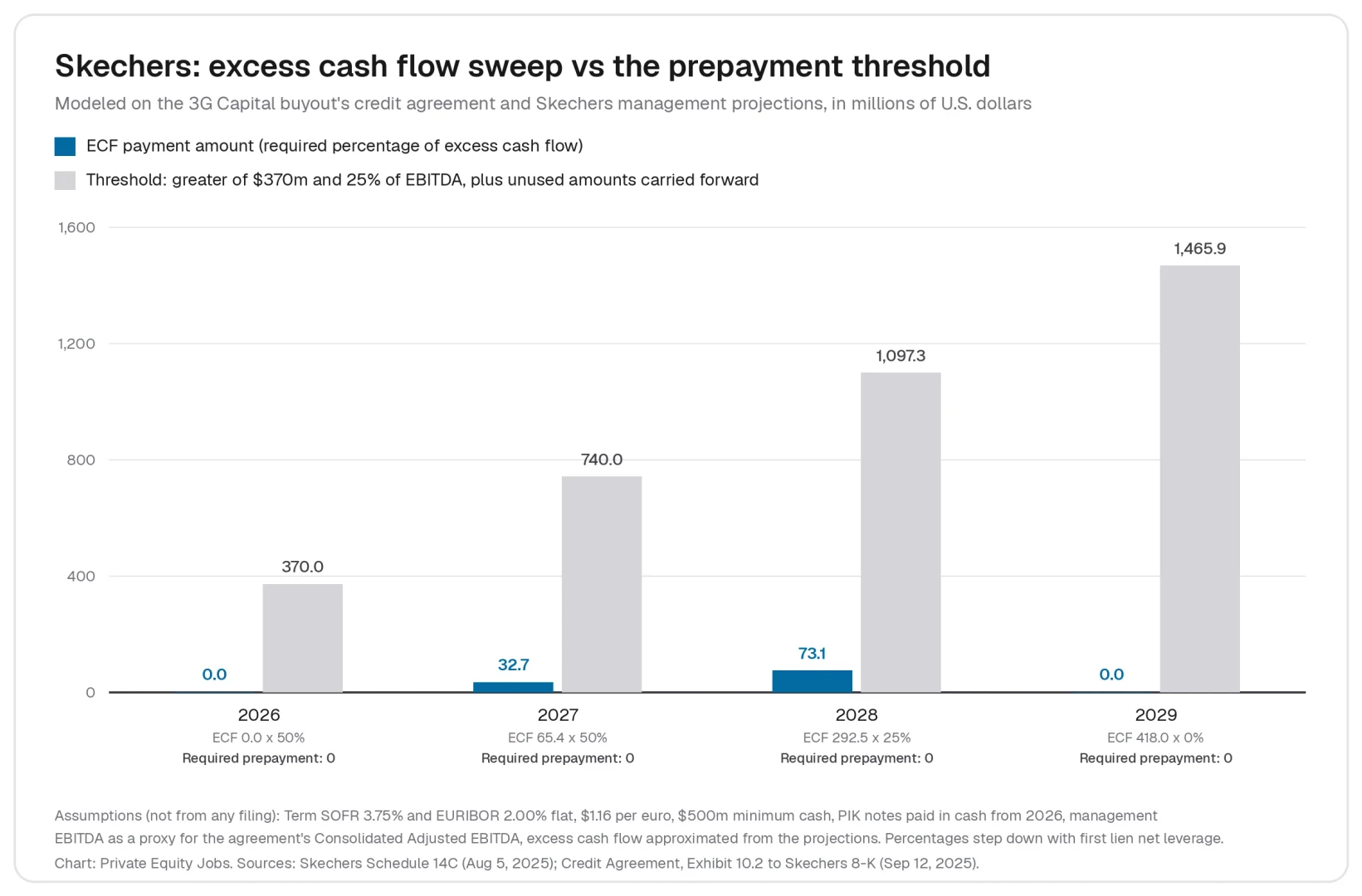
Excess cash flow is calculated on the agreement's definition, approximated here as EBITDA less capital spending, the increase in working capital, cash interest, cash taxes and scheduled repayments. It is zero in 2026, $65.4m in 2027, $292.5m in 2028 and $418.0m in 2029.
| $m | 2026 | 2027 | 2028 | 2029 |
|---|---|---|---|---|
| Excess cash flow (approximation) | 0.0 | 65.4 | 292.5 | 418.0 |
| Required percentage (by year-end first lien net leverage) | 50% | 50% | 25% | 0% |
| Payment amount | 0.0 | 32.7 | 73.1 | 0.0 |
| Threshold, including amounts carried forward | 370.0 | 740.0 | 1,097.3 | 1,465.9 |
| Required prepayment | 0.0 | 0.0 | 0.0 | 0.0 |
The payment amount never comes close to the threshold. Even against the $370m floor of the threshold with nothing carried forward, a single year would need excess cash flow above $740m at the 50% rate, or $1,480m at 25%, before any prepayment was due. Leverage falls on schedule anyway, from EBITDA growth and cash building on the balance sheet. By the end of 2029, first lien net leverage of 1.65x is below 1.75x, which cuts the required percentage to zero and the term loan spreads by 0.25%.
A model that sweeps all surplus cash into the term loan shows much faster repayment. Sweep 100% of cash above the $500m minimum into Tranche B-1 and the loan falls to $764.1m by the end of 2029 instead of $1,485.0m, and cumulative cash interest from 2026 to 2029 falls by $44.7m. Net debt is only $36m lower, because the cash the contractual case keeps on the balance sheet is subtracted in the net debt figure. The repayments in that version are a decision the owner could make. They are not required by the loan.
The PIK toggle changes the first two years
If the issuer keeps the default and pays the PIK notes in kind through 2027, cash interest in 2026 falls to $256.4m, the company does not touch the revolver, and cash rises to $946.8m by the end of 2027. The notes grow to $2,859.1m, and from 2028 their cash interest is $285.9m a year instead of $231.9m. Total net leverage at the end of 2029 is 3.05x, against 2.96x in the cash-pay case. A debt schedule for any deal with toggle notes needs a row for the election, because it moves cash, revolver usage and leverage at the same time.
Revolver mechanics and covenants
A revolver lets the company borrow, repay and borrow again up to its commitment. In a model it covers shortfalls such as the Skechers 2026 deficit, seasonal working capital and timing gaps between cash coming in and interest going out. Lenders charge interest only on drawn amounts and a commitment fee on the rest, so an undrawn revolver still has a cost. Revolver capacity is not cash and does not count toward the minimum cash balance.
Covenants limit how far the model can lean on debt. Maintenance covenants are tested every quarter, such as a maximum leverage ratio or a minimum fixed charge coverage ratio. Incurrence covenants apply only when the company takes an action, such as raising more debt or paying a dividend. Many large sponsor-backed loans are covenant-lite. In a covenant-lite deal the term loans have no maintenance covenant, and the revolver has a springing one that applies only above a usage level, as in the Skechers agreement. A breach of a maintenance covenant is usually an event of default, which lets lenders stop further lending, demand repayment and eventually enforce against the collateral. Many agreements give the owner a way to fix a breach with new equity. Under the Skechers agreement, the borrower can raise equity until 15 business days after the quarter's financial statements are due, and the cash is counted as EBITDA for the covenant test. It can do so no more than five times over the life of the loan and in no more than two quarters of any four. A debt schedule should calculate the covenant ratio each period and compare it with the limit, using the agreement's definitions of debt and EBITDA, which usually differ from reported figures.
Interest coverage (EBITDA divided by cash interest) and leverage (debt divided by EBITDA) are the summary statistics lenders and investment committees read from the schedule. For Skechers in 2026 on the assumptions above, coverage is about 2.3x and total net leverage is 5.41x.
Debt schedules in three-statement, LBO and credit models
Three-statement models. For a public company with stable borrowing, the schedule is often a single debt line and a cash line driven by policy. If projected cash exceeds a minimum, the surplus goes to buybacks, dividends or debt repayment in a stated split, and if cash falls short the company borrows. The interest rate is a blended rate on total debt. Bond maturities can be modeled as refinanced at a new rate.
LBO models. The schedule has separate tranches, a revolver and a sweep, and the model is usually built to show how fast debt can be repaid. Interest paid in kind, original issue discount, floors and commitment fees appear here, and so do exit adjustments such as prepayment premiums. An LBO modeling test usually asks for a short version: a revolver or term loan, mandatory amortization, a sweep, and interest on beginning balances unless the prompt says otherwise.
Credit and refinancing models. The focus is each instrument's maturity and the company's ability to refinance. The schedule lists bonds and loans by maturity date, forecasts how much the company can repay from cash, and assumes the rest is refinanced at a new rate. Because credit analysis is about what happens if results disappoint, the schedule is run under several operating cases, such as a base case, a downside case and a severe downside case. The analyst then tests which mix of new debt and new equity keeps leverage and interest coverage within the company's targets in each case. Each new bond issued to refinance a maturity carries its own coupon, so it needs its own row and rate. Outputs are credit statistics against a lender's or rating agency's limits.
Quarterly and monthly schedules. Lenders test covenants quarterly and many loans amortize quarterly, so lender models and portfolio-company budgets often run the schedule by quarter or month. Monthly schedules add timing detail such as quarterly payment dates and interest that accrues monthly but is paid quarterly. A test such as MOD(month number, 3) = 0 places a payment in the last month of each quarter. The timing also matters in annual models. A sweep calculated on one fiscal year is paid in the next, and a bond's semiannual coupons fall on fixed dates that may not match the model's periods.
Common debt schedule mistakes
- Amortizing a percentage of the beginning balance. Term loan amortization is a percentage of original principal, capped at the remaining balance.
- Treating the sweep as a free input. The required sweep comes from the credit agreement, with its own definition, step-downs, deductions, thresholds and timing. Voluntary repayments are a separate assumption.
- Sweeping into bonds. Notes generally cannot be prepaid at par during the non-call period.
- Letting balances go negative. Every repayment formula needs a MIN against the remaining balance.
- Ignoring the floor and the pricing grid. With low base rates the floor sets the rate, and as leverage falls the spread steps down.
- Forgetting the commitment fee and PIK accretion. Both are real costs, and PIK interest increases the balance that has to be repaid at exit.
- Counting revolver capacity as cash. The minimum cash balance has to be actual cash.
- Subtracting financing fee amortization from cash. It is a non-cash expense with a tax effect. The cash fee was paid at close.
- Hard-coding numbers into formulas. Terms belong in an assumptions block where a reviewer can check them against the documents.
- Mixing interest conventions. Average-balance interest on some tranches and beginning-balance interest on others produces results that are hard to audit.
Debt schedule interview questions
Walk me through a debt schedule. Each tranche starts with a beginning balance. Cash available for debt repayment is beginning cash plus cash generated after interest, taxes, capital spending and working capital, less minimum cash. Mandatory repayments come off first. If cash is short, the revolver is drawn. If there is surplus, the revolver is repaid, then term loans in order of seniority up to the sweep percentage. Interest is calculated on each balance and flows to the income statement, balances to the balance sheet, and draws and repayments to the cash flow statement.
Why is the revolver repaid first? It is senior secured debt that can be redrawn if needed, and a drawn balance costs the full interest rate while an undrawn commitment costs only the fee.
What is the difference between average and beginning balance interest? Average balance assumes repayments happen evenly through the period, which is more accurate but creates a circular reference. Beginning balance avoids the circularity and slightly overstates interest when debt is falling.
What does PIK interest do to the model? It increases debt instead of reducing cash. Cash flow and revolver usage improve in the near term, the balance compounds, and more debt is outstanding at exit, which reduces equity value.
How does an excess cash flow sweep work? The credit agreement requires a percentage of a defined excess cash flow to prepay term loans each year, usually 50% stepping down to 0% as leverage falls, after deductions and often above a threshold. It is paid after the annual audit.
What happens to the schedule if interest rates rise by 1%? Floating-rate interest rises by 1% of the floating balance. Cash after debt service falls by that amount less the tax saving, less debt is repaid, and the revolver may be drawn. Fixed-rate bonds are unaffected until they are refinanced.
Why does a model need a minimum cash balance? A business needs cash to operate, and lenders and owners do not plan to run it at zero. The minimum stops the sweep from using cash the company needs and is the point at which the revolver is drawn.
Debt schedule FAQs
What is the difference between a debt schedule and an amortization schedule? An amortization schedule shows the payments on one loan, usually with a fixed payment that splits into interest and principal. A debt schedule covers all of a company's debt and ties it to the company's cash flow, so repayments depend on how much cash the business generates.
Is mandatory amortization a percentage of original or beginning principal? Of original principal in almost all term loan agreements. The Skechers Tranche B-1 loan repays 0.25% of its closing amount each quarter, $3.9m, whatever the balance.
Where does the debt schedule get its interest rate? For floating-rate loans, the benchmark (SOFR, EURIBOR) from a forward curve or an assumption, with the floor applied, plus the spread from the agreement's pricing grid. For bonds, the coupon.
How are financing fees treated in a debt schedule? The cash fee is a use of funds at close. It is capitalized and amortized over the term of the debt. The amortization reduces taxable income and is added back in cash flow.
Does a debt schedule need a balance sheet? No. A paper LBO or a short modeling test can run the schedule from a cash flow forecast alone. A full three-statement model links it to the balance sheet and uses the balance sheet as a check.
What does a business debt schedule template include? For a loan application, each existing loan's lender, original amount, date, balance, rate, payment, maturity and collateral, totaled and reconciled to the balance sheet. For a model, each tranche's amount, rate, floor, amortization, maturity, prepayment terms and fees, taken from the loan documents.
Sources
Skechers U.S.A., Inc., information statement/prospectus (Schedule 14C), filed August 5, 2025: merger terms, 3G Capital ownership, financing summary, the springing covenant and the Skechers management projections. Skechers U.S.A., Inc., current report on Form 8-K, filed September 12, 2025: completion of the merger, the term loans, revolver and notes. Credit Agreement dated September 12, 2025 (Exhibit 10.2 to that 8-K): applicable rates, floors, amortization and how prepayments apply to it, maturities, commitment fees, the excess cash flow prepayment terms, and the revolver covenant test condition and cure right. Indenture for the 10.000%/10.750% Senior PIK Toggle Notes due 2033 (Exhibit 10.4): interest elections and the initial in-kind period. The debt schedule, excess cash flow figures and leverage ratios in the example are Private Equity Jobs arithmetic on the filed terms and projections, with the stated assumptions.
Related posts
What unlevered free cash flow is, how to calculate it line by line, how it differs from levered free cash flow, and how Olo's 2025 merger proxy used two versions of it.
The income statement, balance sheet and cash flow statement explained, every link between them traced through Sealed Air's 2025 10-K, and how to answer "walk me through the three financial statements" and its follow-ups.
Valuation methods explained: the income, market and asset approaches, the methods bankers and private equity firms use, how to choose one, and Clearwater Analytics' $24.55 take-private valued by two banks with every method.