
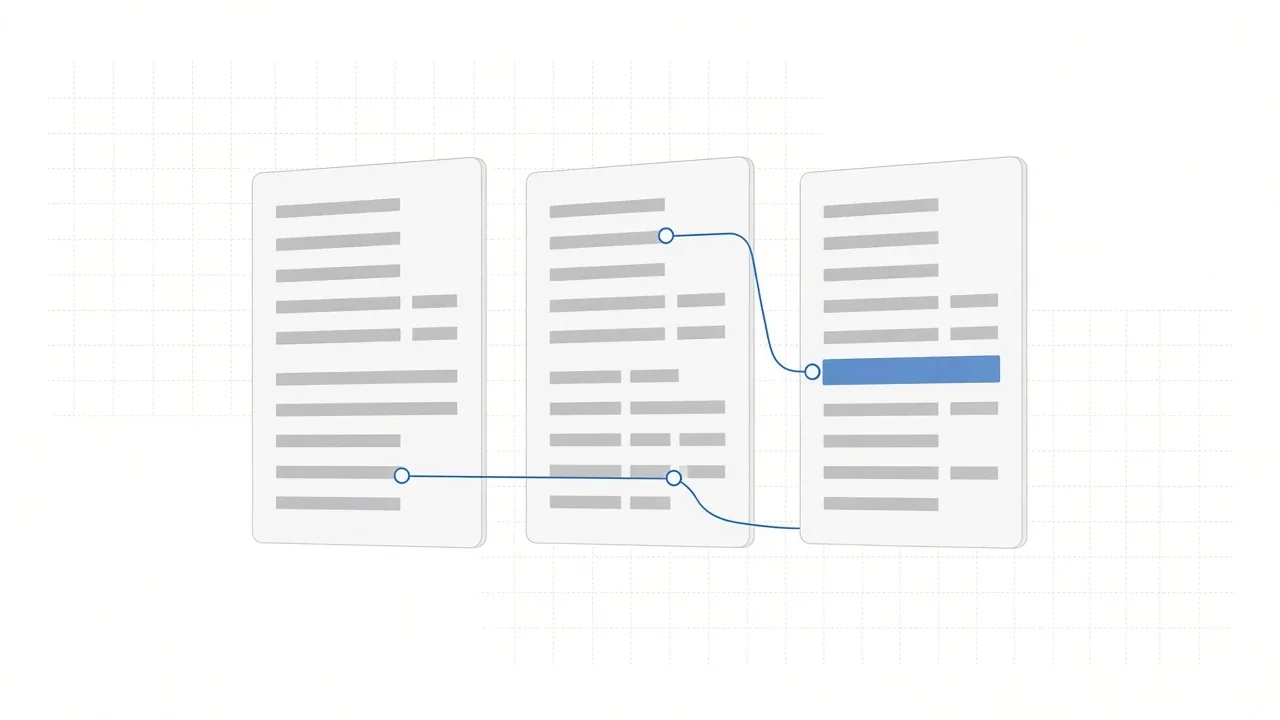
The three financial statements are the income statement, the balance sheet and the cash flow statement. The income statement shows whether a company made a profit over a period. The balance sheet shows what it owns, what it owes and what belongs to shareholders on the last day of that period. The cash flow statement shows how much cash came in and went out over the same period, and why. They link because of accrual accounting. Revenue and expenses are recorded when they are earned or incurred, not when cash moves, so profit and cash differ, and the balance sheet holds the difference. Net income flows into retained earnings on the balance sheet and is the first line of the cash flow statement, and the cash flow statement ends on the cash balance that appears on the balance sheet. Sealed Air's annual report on Form 10-K for 2025, the last one the packaging company filed before Clayton, Dubilier & Rice took it private in April 2026, shows each of those links in a real filing. Sealed Air earned $505.5 million, generated $628.0 million of cash from operations, and still ended the year with less cash than it started with.
What the three financial statements are
Public companies in the United States file all three statements with the Securities and Exchange Commission every quarter and audited versions every year in the annual report on Form 10-K. Private companies prepare the same statements for lenders and owners, and a private equity firm reads them in every deal it evaluates.
The income statement
The income statement, also called the profit and loss statement or P&L, covers a period such as a quarter or a year. It starts with revenue (Sealed Air calls it net sales), subtracts the cost of goods sold to reach gross profit, then subtracts operating expenses such as selling, general and administrative costs, research and development, depreciation and amortization to reach operating income. Operating income is close to earnings before interest and taxes. Adding depreciation and amortization back to it gives earnings before interest, taxes, depreciation and amortization (EBITDA), the profit measure lenders use to size a company's debt. Companies often report an adjusted version that also excludes items they treat as one-off; Sealed Air reported adjusted EBITDA of $1,134.3 million from continuing operations for 2025. Interest expense and other non-operating items come next, then income tax, and the last line is net income. Public companies also report earnings per share, which divides net income by the weighted average share count.
The income statement answers whether the business was profitable in the period under accrual accounting. A sale made on credit in December counts as December revenue even if the customer pays in February, and a machine bought for $10 million is not an expense in the year it was bought. Spending on an asset that will be used for more than a year is capitalized, meaning it is recorded on the balance sheet, and its cost is spread over its useful life as depreciation. Under the straight-line method, which Sealed Air uses, annual depreciation is the cost less the expected residual value, divided by the useful life in years. Sealed Air depreciates buildings over 10 to 40 years and machinery and equipment over 5 to 10 years.
The balance sheet
The balance sheet is a snapshot on one date. It lists assets (cash, accounts receivable, inventory, property, plant and equipment, goodwill and other intangible assets), liabilities (accounts payable, accrued expenses, debt, deferred taxes) and shareholders' equity. Assets and liabilities are split into current items, which the company expects to turn into cash or pay within a year, and noncurrent items. The balance sheet always satisfies one equation:
Assets = Liabilities + Shareholders' equity
Equity is the owners' claim. It is made of the capital shareholders put in (common stock and additional paid-in capital), less shares the company has bought back and holds as treasury stock, plus retained earnings, which are the cumulative net income the company has kept rather than paid out as dividends, plus accumulated other comprehensive income, which collects gains and losses that bypass the income statement, such as currency translation.
The cash flow statement
The cash flow statement covers the same period as the income statement and explains the change in cash in three sections:
- Operating activities: cash generated by running the business. Almost every company uses the indirect method, which starts with net income, adds back expenses that did not use cash, subtracts gains that did not bring in cash, and adjusts for changes in working capital.
- Investing activities: capital expenditures on property and equipment, acquisitions, and proceeds from selling assets or businesses.
- Financing activities: borrowing and repaying debt, issuing and buying back shares, and paying dividends.
The three sections add up to the net change in cash. Add the beginning balance and the result is the ending balance. Under U.S. accounting rules since 2018, that balance includes restricted cash, which is cash the company cannot use freely, so the figure at the bottom of the cash flow statement can be slightly larger than the cash line on the balance sheet.
| Income statement | Balance sheet | Cash flow statement | |
|---|---|---|---|
| Covers | A period | One date | A period |
| Question it answers | Was the company profitable? | What does it own and owe? | Where did cash come from and go? |
| Basis | Accrual | Accrual | Cash |
| Starts with | Revenue | Assets | Net income (indirect method) |
| Ends with | Net income | Equity | Ending cash |
| Main link out | Net income to retained earnings and to the cash flow statement | Changes in its accounts drive the cash flow statement | Ending cash to the balance sheet |
Annual reports contain two more statements that sit between the big three. The statement of comprehensive income adds items such as currency translation to net income. The statement of stockholders' equity reconciles each equity account from the start of the year to the end. When someone asks for "the four financial statements," the fourth is usually the statement of stockholders' equity, and the notes to the financial statements are part of the audited package as well.
How the three financial statements are linked
If a company recorded everything on a cash basis, the income statement and the cash flow statement would be the same document, and the balance sheet would hold almost nothing but cash and equity. The links exist because accrual accounting records revenue and costs in one period while cash moves in another. Receivables, inventory, payables, fixed assets and debt are the accounts that carry those timing differences on the balance sheet, and the cash flow statement reconciles them back to cash.
Net income to retained earnings
Net income at the bottom of the income statement increases retained earnings on the balance sheet. Dividends declared reduce retained earnings. The roll-forward is:
Ending retained earnings = Beginning retained earnings + Net income − Dividends declared
This is the link that keeps the balance sheet in balance when profit changes. A dollar of net income that has not been paid out belongs to shareholders, so it sits in equity, and the matching dollar sits on the asset side as cash, receivables or some other asset, or as a smaller liability.
Net income to cash from operations
Net income is the first line of the operating section under the indirect method. The statement then removes everything in net income that was not cash:
- Non-cash expenses are added back: depreciation, amortization, stock-based compensation, impairments, write-downs and deferred tax expense reduced net income without using cash in the period.
- Non-cash gains are subtracted: a gain on selling an asset or business is removed here because the cash from the sale, if any, appears in investing activities, and some gains bring in no cash at all.
- Working capital changes are applied (next section).
The result is cash from operating activities, which is usually larger than net income for a company with significant depreciation and smaller for a fast-growing company that is building receivables and inventory.
Depreciation, fixed assets and capital expenditures
When a company buys equipment, the purchase is a capital expenditure. It appears in investing activities as a cash outflow and adds to property, plant and equipment (PP&E) on the balance sheet. It does not appear on the income statement at the time. Over the asset's useful life, depreciation moves the cost to the income statement as an expense and reduces PP&E. On the cash flow statement, depreciation is added back because the cash left when the asset was bought. The PP&E roll-forward is:
Ending PP&E = Beginning PP&E + Capital expenditures − Depreciation − Impairments and disposals
Amortization does the same for intangible assets such as customer relationships and software acquired in a purchase.
Working capital
Changes in operating assets and liabilities on the balance sheet adjust net income to cash. The sign rule follows from the balance sheet equation:
- An increase in an operating asset uses cash. If accounts receivable rise by $20, the company recorded $20 of revenue it has not yet collected, so $20 is subtracted. The same applies to inventory and prepaid expenses.
- An increase in an operating liability provides cash. If accounts payable rise by $15, the company recorded $15 of costs it has not yet paid, so $15 is added. The same applies to accrued expenses and to deferred revenue, which is cash collected before the product or service is delivered. Deferred revenue is a liability because the company still owes the customer that delivery.
- Decreases work in reverse.
A sharp rise in inventory or receivables pulls cash from operations below net income. It can mean the company is struggling to sell its products or collect from customers, and the cash flow statement shows that strain before the income statement does.
Debt, interest and financing
Borrowing increases cash and debt by the same amount and appears in financing activities. Repaying principal reverses both. Neither touches the income statement. Interest expense does. It reduces pre-tax income, and in the indirect method the cash paid for interest is already inside net income, so it stays in operating activities under U.S. accounting rules rather than financing. If interest is paid in kind, meaning it is added to the loan balance instead of paid in cash, it is an expense on the income statement, an add-back on the cash flow statement and an increase in debt on the balance sheet.
Equity: dividends, buybacks and stock compensation
Dividends paid and share repurchases are financing outflows. Dividends reduce retained earnings; buybacks increase treasury stock, which reduces equity. Neither is an expense. Stock-based compensation is an expense on the income statement, an add-back on the cash flow statement, and an increase in additional paid-in capital, so equity falls through retained earnings and rises through paid-in capital. Share issuance for cash increases cash and paid-in capital and appears in financing.
Equity can also change without passing through the income statement or the cash flow statement. Other comprehensive income records items such as translating a foreign subsidiary's balance sheet into dollars, and it moves accumulated other comprehensive income directly.
Ending cash
The net change in cash from the three sections, plus the effect of exchange rates on cash held in foreign currencies, plus the beginning balance, gives ending cash. That figure appears as cash on the balance sheet, after restricted cash is separated out where a company has any. This is the check that ties the model or the filing together. If every other balance sheet change has been captured on the cash flow statement, the ending cash it produces makes the balance sheet balance.
| Link | From | To |
|---|---|---|
| Net income | Income statement, last line | Retained earnings; first line of cash from operations |
| Depreciation and amortization | Income statement expense | Add-back in cash from operations; reduces PP&E and intangibles |
| Capital expenditures | Investing activities | Increases PP&E |
| Working capital | Changes in receivables, inventory, payables, accruals | Adjustment in cash from operations |
| Debt | Financing activities | Debt balance |
| Interest | Income statement expense | Inside net income; interest paid in kind increases debt |
| Dividends and buybacks | Financing activities | Retained earnings; treasury stock |
| Stock-based compensation | Income statement expense | Add-back in cash from operations; paid-in capital |
| Ending cash | Cash flow statement | Balance sheet cash (plus restricted cash where held) |
The links in a real 10-K: Sealed Air 2025
Sealed Air, the Charlotte, North Carolina maker of Cryovac food packaging and Bubble Wrap, filed its annual report on Form 10-K for 2025 on March 2, 2026. Clayton, Dubilier & Rice had agreed on November 16, 2025 to buy the company for $42.15 a share in cash, and the deal closed on April 9, 2026. That makes this 10-K the last full set of public statements before the take-private, and the set a buyer's diligence team would have been reading. Every figure below is in millions of U.S. dollars and was recomputed from the filing.
| Statement | Line | 2025 |
|---|---|---|
| Income statement | Net sales | 5,359.8 |
| Operating profit | 725.7 | |
| Interest expense, net | (218.9) | |
| Income tax provision | (35.3) | |
| Net earnings from continuing operations | 441.2 | |
| Gain on discontinued operations, net of tax | 64.3 | |
| Net earnings | 505.5 | |
| Cash flow statement | Net earnings plus non-cash adjustments | 883.5 |
| Changes in working capital and other operating items | (255.5) | |
| Cash from operating activities | 628.0 | |
| Cash from investing activities (capital expenditures 169.5) | (133.6) | |
| Cash from financing activities (dividends paid 119.2) | (567.6) | |
| Exchange rate effect on cash | 46.7 | |
| Change in cash and restricted cash | (26.5) | |
| Balance sheet | Cash and cash equivalents, Dec. 31, 2024 / 2025 | 371.8 / 344.0 |
| Retained earnings, Dec. 31, 2024 / 2025 | 643.4 / 1,029.4 | |
| Total debt, Dec. 31, 2024 / 2025 | 4,403.9 / 4,009.7 | |
| Total shareholders' equity, Dec. 31, 2024 / 2025 | 624.5 / 1,237.5 |
Net earnings to retained earnings
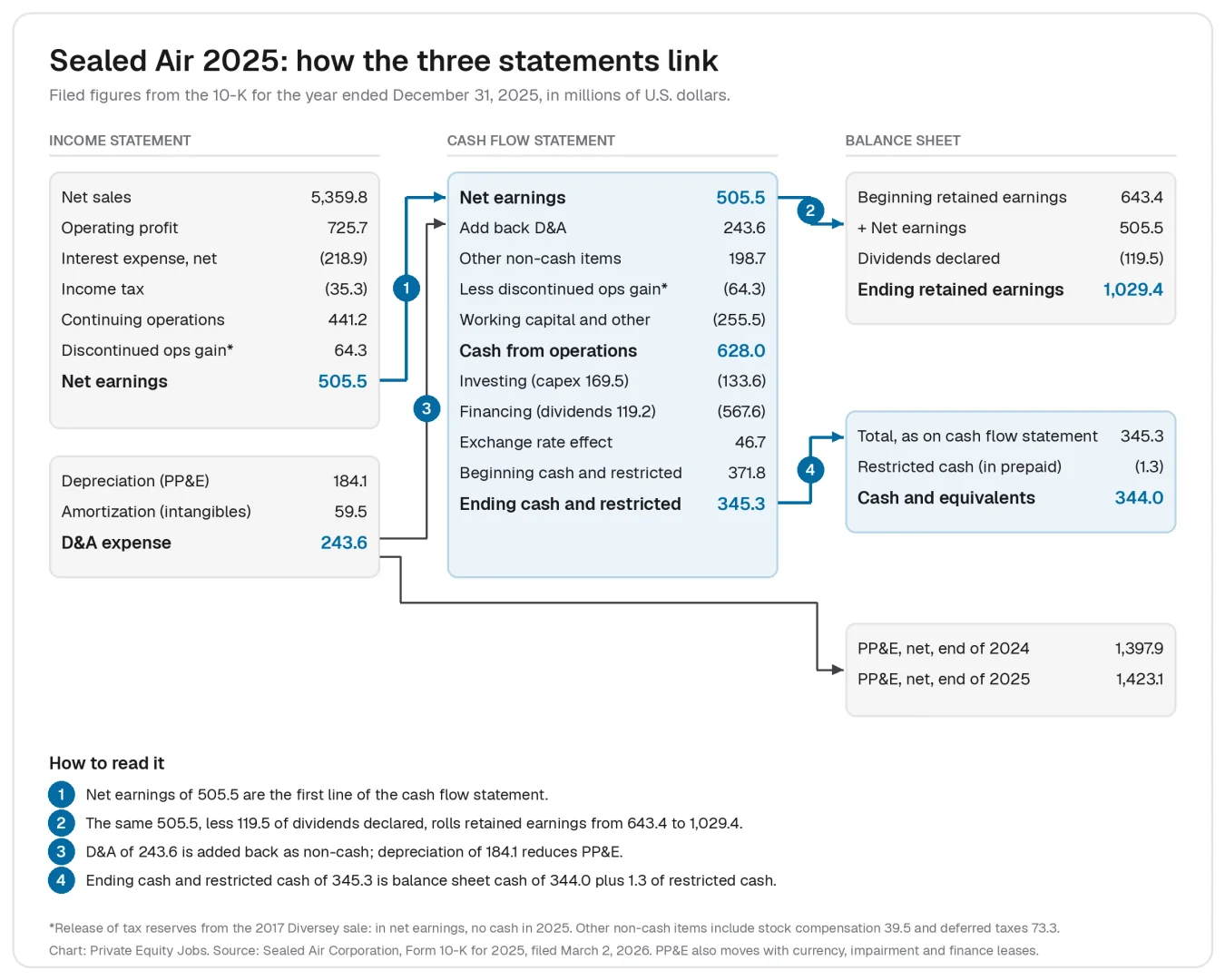
Retained earnings began 2025 at $643.4 million. Net earnings of $505.5 million added to them, and dividends declared of $119.5 million, or $0.80 a share, came out:
$643.4 + $505.5 − $119.5 = $1,029.4 million
That is the figure on the December 31, 2025 balance sheet, and it matches the statement of stockholders' equity to the decimal.
Net earnings to cash from operations
The operating section starts with the same $505.5 million and adds $378.0 million of non-cash items. Depreciation and amortization were $243.6 million: $184.1 million of depreciation on PP&E (the PP&E note) plus $59.5 million of amortization of intangible assets (a separate line on the income statement). Stock-based compensation added $39.5 million and deferred taxes $73.3 million. One item went the other way. The $64.3 million gain on discontinued operations came from reversing reserves for uncertain tax positions tied to the 2017 sale of the Diversey cleaning business. It raised net earnings but brought in no cash in 2025, so it is subtracted.
That subtotal, $883.5 million, is what the company's management discussion calls "a source of cash of $884 million." Working capital and other operating items then used $255.5 million, mostly through other assets and liabilities ($165.3 million), income taxes ($64.3 million) and lower accounts payable ($29.3 million). Cash from operations came to $628.0 million, or 1.24 times net earnings.
Cash flow statement to balance sheet cash
Investing used $133.6 million, mostly $169.5 million of capital expenditures, partly offset by $30.9 million from settling currency forward contracts. Financing used $567.6 million: the company repaid $383.0 million of long-term debt, cut short-term borrowings by $51.6 million, borrowed $15.4 million and paid $119.2 million of dividends. A weaker dollar raised the dollar value of cash held abroad by $46.7 million.
$371.8 + $628.0 − $133.6 − $567.6 + $46.7 = $345.3 million
The cash flow statement calls that figure "cash, cash equivalents, and restricted cash." The balance sheet shows cash and cash equivalents of $344.0 million. The other $1.3 million is cash the company collected on receivables it had sold under a new securitization program in December 2025. It belongs to the buyer of the receivables until passed on, so it sits in prepaid expenses and other current assets, with a matching liability. Note 2 of the 10-K reconciles the two figures. Cash still fell $26.5 million over the year. Operating cash flow less investing left $494.4 million, and debt repayment and dividends took $567.6 million.
The balance sheet balances
Total assets were $7,012.8 million at the end of 2025, equal to liabilities of $5,775.3 million plus equity of $1,237.5 million. Equity rose $613.0 million in the year. Net earnings less dividends explain $386.0 million of that. Currency translation, recorded in other comprehensive income, added $207.8 million without touching the income statement or the cash flow statement. Stock compensation, treasury shares contributed to the employee profit-sharing plan and a pension adjustment added the rest, net of a $40.3 million loss on hedging derivatives that also went through other comprehensive income.
Why a real filing does not tie line by line
Training models are built so that every balance sheet change appears once on the cash flow statement, which makes the cash flow statement look like a list of the changes in every balance sheet account except cash. Sealed Air's totals tie exactly, but several individual lines do not, and the reasons matter when reading a filing rather than building a model.
- Currency translation. Sealed Air sells in many currencies. When the dollar weakens, the dollar value of foreign receivables, inventory, PP&E and debt rises on the balance sheet without any cash moving. The cash flow statement reports flows at the exchange rates in effect when they happened, and the translation difference goes to other comprehensive income. That is why equity rose $207.8 million from translation alone.
- Reclassifications. Trade receivables rose $79.1 million on the balance sheet, yet the cash flow statement shows only a $2.8 million use of cash from receivables. The filing does not split the $76.3 million gap, but it discloses two causes that move the balance sheet line without moving operating cash: currency translation and the receivables securitization programs. Under Sealed Air's older U.S. program, which was accounted for as a borrowing, and under its European program, receivables pledged as collateral are carried in prepaid expenses and other current assets rather than in trade receivables. The company ended the U.S. program in December 2025, repaid its $50.0 million borrowing and replaced it with a program that sells receivables outright, so U.S. receivables are no longer moved into other current assets. A move between two balance sheet lines changes both accounts without any cash changing hands.
- Non-cash additions to assets. Beginning PP&E of $1,397.9 million, plus $169.5 million of capital expenditures, less $184.1 million of depreciation and a $24.4 million impairment, gives $1,358.9 million. The balance sheet shows $1,423.1 million. The $64.2 million difference is mostly currency translation, plus assets added without cash, such as $7.1 million of equipment acquired under new finance leases.
- Accrued versus paid. The income statement records interest expense, net of interest income, of $218.9 million. The supplemental cash flow data show $268.5 million of interest paid. Expense accrues by period and is reported net of interest income, while cash interest follows payment dates. Dividends declared were $119.5 million and dividends paid $119.2 million. Capital expenditures recorded but not yet paid were $32.4 million at year-end.
- Debt movements that are not cash. Total debt fell $394.2 million. The cash lines for borrowing and repaying debt net to a $419.2 million outflow. The difference comes from non-cash changes the debt note discloses, such as the amortization of discounts and issuance costs (the unamortized balance fell from $32 million to $22 million), new finance leases and the currency translation of euro-denominated debt, offset by $9.8 million of finance lease payments shown on a separate financing line.
- Non-cash gains. The $64.3 million gain on discontinued operations is in net income and removed from operating cash flow. A reader who stopped at net earnings would overstate the year's cash generation by that amount.
None of this means the statements disagree. The totals tie exactly, and the differences are disclosed in the notes. It means the shortcut "change in each balance sheet account equals its line on the cash flow statement" works for a single-currency model and fails for most real companies. In due diligence, a quality of earnings review explains these differences line by line.
How to answer "walk me through the three financial statements"
Bankers and private equity interviewers ask this question, often early in the technical part of a private equity interview, to see whether a candidate can explain the accounting in plain language and in order. A good answer takes 90 seconds to two minutes and stays on the major items: what each statement shows and how they connect.
A sample answer
"The three main financial statements are the income statement, the balance sheet and the cash flow statement. The income statement shows the company's revenue and expenses over a period and ends with net income, its accrual-based profit. The balance sheet shows assets, liabilities and shareholders' equity at one point in time, and assets always equal liabilities plus equity. The cash flow statement starts with net income, adds back non-cash expenses like depreciation and stock-based compensation, adjusts for changes in working capital to get cash from operations, and then adds cash from investing, such as capital expenditures, and cash from financing, such as debt and dividends, to get the net change in cash.
They connect in three places. Net income flows into retained earnings on the balance sheet and is the first line of the cash flow statement. Changes in balance sheet accounts like receivables, PP&E and debt drive the adjustments on the cash flow statement. And the ending cash on the cash flow statement becomes the cash balance on the balance sheet, which is what makes the balance sheet balance."
Answering "how are the three statements linked?"
When the question is about the links rather than the statements, lead with the connections and use an example:
"Net income from the income statement goes two places: retained earnings on the balance sheet, less any dividends, and the top of the cash flow statement. The cash flow statement then adjusts net income for non-cash items such as depreciation, which also reduces PP&E on the balance sheet, and for changes in working capital, which come from balance sheet accounts like receivables, inventory and payables. Investing and financing cash flows match changes in PP&E, debt and equity. The ending cash balance on the cash flow statement is the cash on the balance sheet. So if depreciation rises by $10 at a 25% tax rate, net income falls by $7.50, cash rises by $2.50 from the lower tax bill, PP&E falls by $10 and retained earnings fall by $7.50, and both sides of the balance sheet are down $7.50."
Which order to use
Interviewers accept two orders. The first, income statement, balance sheet, cash flow statement, explains each statement on its own before showing the cash flow statement as the bridge. The second, income statement, cash flow statement, balance sheet, follows the order in which a model is built, because the cash flow statement produces the ending cash the balance sheet needs. Either order works if the three links are stated clearly. Restricted cash and currency effects take time a two-minute answer does not have; they fit better in follow-up questions or in a discussion of a real company.
Open analyst and associate roles at private equity firms are listed on Private Equity Jobs, and the companies directory shows which firms are hiring.
Follow-up questions and answers
Interviewers follow the walk-through with a change to one line and ask the candidate to carry it through all three statements. State the tax rate first and keep the balance sheet check at the end. The answers below use a 25% tax rate and assume the item is deductible for tax in the same year unless noted.
Depreciation increases by $10. Income statement: pre-tax income falls $10, taxes fall $2.50, net income falls $7.50. Cash flow statement: net income down $7.50, depreciation added back $10, so cash from operations rises $2.50. Balance sheet: cash up $2.50, PP&E down $10, so assets fall $7.50; retained earnings fall $7.50. Balanced.
Why does cash go up if the company did not spend anything? Because depreciation reduces taxable income and the company pays $2.50 less in tax. The $10 itself is not a new outflow. The cash left when the asset was bought, and that purchase appeared in investing activities in an earlier period.
Inventory is written down by $100. Income statement: a $100 expense, net income down $75. Cash flow statement: net income down $75, the write-down added back as a non-cash charge, cash from operations up $25. Balance sheet: inventory down $100, cash up $25, assets down $75; retained earnings down $75. Cash rises because of the tax saving. If tax rules allow the deduction only when the goods are sold or scrapped, the $25 tax benefit is recorded as a deferred tax asset instead of cash. Net income still falls $75, cash does not change, and the $25 deferred tax asset balances the sheet. Sealed Air's cash flow statement shows this add-back as its own line, $22.7 million of provisions for inventory obsolescence in 2025.
A $10 receivable will not be collected. U.S. companies estimate expected credit losses in advance and carry receivables net of an allowance for them. Raising the allowance by $10 is a $10 expense, so net income falls $7.50. The cash flow statement adds the provision back as a non-cash charge, and cash rises $2.50 from the tax saving if the expense is deductible now. On the balance sheet, receivables net of the allowance fall $10, cash rises $2.50 and retained earnings fall $7.50. If the deduction waits until the debt is written off, a deferred tax asset takes the place of the cash, as with inventory. When the specific invoice is later written off, gross receivables and the allowance fall by the same amount, so net receivables, net income and cash do not change. Sealed Air charged $1.1 million to its allowance for credit losses in 2025 and wrote off $2.8 million of receivables against it, net of recoveries, according to the schedule of valuation accounts in its 10-K.
Net income increases by $100. The answer depends on the cause. If revenue of $133.33 is collected in cash, taxes rise $33.33 and net income rises $100; cash from operations and the balance sheet cash both rise $100, and retained earnings rise $100. If the same revenue is billed but not collected, receivables rise $133.33, cash falls $33.33 because the tax is still paid, and assets rise $100 to match retained earnings. Profit and cash moved in opposite directions.
Stock-based compensation of $10. Income statement: expense of $10, net income down $7.50. Cash flow statement: add back $10, cash up $2.50. Balance sheet: cash up $2.50; additional paid-in capital up $10 and retained earnings down $7.50, so equity is up $2.50.
The company buys $100 of equipment with $100 of new debt. No income statement effect at purchase. Cash flow statement: capital expenditures of $100 in investing and $100 of borrowing in financing, net zero. Balance sheet: PP&E up $100 and debt up $100. In later years depreciation and interest flow through the income statement.
The company issues $100 of debt at 8% and pays the interest. At issuance, cash and debt both rise $100. Over the year, interest expense of $8 reduces net income by $6, cash from operations falls $6, and cash falls $6 against a $6 fall in retained earnings. If the interest is paid in kind, the $8 is added back on the cash flow statement as non-cash, so cash rises $2 from the tax saving where the interest is deductible, debt rises $8, and retained earnings fall $6.
The company declares and pays a $20 dividend. No income statement effect. Financing outflow of $20. Cash and retained earnings both fall $20. If the dividend is declared but not yet paid, a $20 dividend payable liability replaces the cash outflow.
An expense of $10 is accrued but not paid. Net income falls $7.50. On the cash flow statement, the increase in accrued liabilities adds $10, so cash from operations rises $2.50 from the tax saving. Balance sheet: cash up $2.50, accrued liabilities up $10, retained earnings down $7.50.
The company acquires another business for $500 in cash. Investing outflow of $500. Cash falls $500, and the target's assets and liabilities are added to the balance sheet at fair value, with the excess over the net assets recorded as goodwill, following a purchase price allocation. Nothing hits the income statement at closing except transaction costs. From the next period, the acquired company's revenue, expenses and new amortization flow through.
Linking the statements in a three-statement model
A three-statement model projects the income statement, balance sheet and cash flow statement together so that a change in one assumption moves all three. It is the base for a discounted cash flow valuation, a merger model and a leveraged buyout (LBO) model, and longer LBO modeling tests ask candidates to build one under time pressure.
The build follows the same links:
- Enter historical statements for at least three years, checking that each year's balance sheet balances and that ending cash matches.
- Project the income statement from drivers: revenue growth, gross margin, operating expenses as a percentage of revenue, and tax rate.
- Build supporting schedules. A PP&E schedule rolls beginning PP&E forward with capital expenditures and depreciation. A working capital schedule projects receivables, inventory and payables from days outstanding or a percentage of revenue. A debt schedule tracks each tranche's beginning balance, mandatory and optional repayment, and interest.
- Build the cash flow statement from net income, the depreciation from the PP&E schedule, the change in each working capital account, capital expenditures, debt flows and dividends.
- Build the balance sheet with cash from the cash flow statement, PP&E and debt from their schedules, working capital from its schedule, and retained earnings from the roll-forward.
- Check that assets equal liabilities plus equity in every year. If they do not, the difference usually points to a balance sheet account whose change was not picked up on the cash flow statement, or a sign error.
Two features need care. Interest depends on the debt balance, and the debt balance depends on cash flow after interest, which creates a circular reference; modelers either calculate interest on the beginning balance or enable iterative calculation with a switch that can turn the circularity off. A revolving credit facility usually acts as the plug. When projected cash falls below a minimum, the model draws on the revolver, and when there is excess cash, it repays the revolver first. In a leveraged buyout, the same model sweeps excess cash to repay acquisition debt, and the sources and uses table sets the opening balance sheet.
What the three statements tell a buyer or lender
Each statement answers a different question in a deal, and none answers them all. The notes and management's discussion explain the numbers, and a buyer reads them alongside the statements. Sealed Air's 2025 statements show what a private equity buyer looks for in each.
- Earnings quality. Cash from operations of $628.0 million against net earnings of $505.5 million is a conversion ratio of 1.24 times. Against earnings from continuing operations of $441.2 million, which exclude the non-cash tax gain, it is 1.42 times. The higher figure is the one that reflects the business the buyer is acquiring.
- Free cash flow. Sealed Air defines free cash flow as cash from operations less capital expenditures: $628.0 million minus $169.5 million, or $458.5 million. That is the cash available to repay debt or pay owners before acquisitions.
- Debt service. Interest paid of $268.5 million took a large share of operating cash flow. Net debt, total debt of $4,009.7 million less cash of $344.0 million, was $3,665.7 million at the end of 2025. Lenders size a new capital structure against EBITDA and against free cash flow after interest.
- Equity value versus book value. At $42.15 a share on about 147.3 million shares outstanding, the equity was worth about $6.2 billion. Book equity on the balance sheet was $1.24 billion. Book value records historical cost and cumulative earnings; the price reflects expected cash flow, which is why buyers value companies with the methods in a valuation rather than with the balance sheet.
- Refinancing. The 8-K filed on the closing date reports that the company repaid its bank credit facility and its receivables securitization debt and redeemed or discharged six series of senior notes. In a buyout the debt on the target's balance sheet is usually refinanced, so the buyer reads the debt note to see what must be repaid and at what cost.
Analysts also compute ratios that combine the statements. In the table below, the current and quick ratios are Sealed Air's own figures from management's discussion, and the others are computed from the 2025 statements.
| Ratio | Calculation | Sealed Air 2025 |
|---|---|---|
| Operating margin | Operating profit ÷ net sales | 13.5% |
| Interest coverage | Operating profit ÷ interest expense, net | 3.3x |
| Net debt to adjusted EBITDA | (Total debt − cash) ÷ adjusted EBITDA | 3.2x |
| Current ratio | Current assets ÷ current liabilities | 0.9x (1.2x in 2024) |
| Quick ratio | (Current assets − inventories) ÷ current liabilities | 0.6x (0.7x in 2024) |
| Inventory turnover | Cost of sales ÷ average inventory | 5.2x |
| Return on assets | Net earnings ÷ average total assets | 7.2% |
| Return on equity | Net earnings ÷ average shareholders' equity | 54.3% |
| Liabilities to equity | Total liabilities ÷ shareholders' equity | 4.7x |
Two of these need the notes to read correctly. The current ratio fell below 1.0 mainly because $561 million of senior secured notes due in October 2026 came within a year of maturity and moved into current liabilities, according to management's discussion. Return on equity is high because book equity of $1.24 billion is small next to the $6.2 billion equity value at the offer price. Measured against that equity value, the same net earnings are a return of about 8 percent.
Frequently asked questions
What are the four types of financial statements?
The income statement, the balance sheet, the cash flow statement and the statement of stockholders' equity. U.S. annual reports also include a statement of comprehensive income, which some lists count as a fifth.
Which financial statement is the most important?
For judging whether a business can fund itself, the cash flow statement, because profit can rise while cash falls. For valuing a company, investors use all three: the income statement for margins, the balance sheet for debt and working capital, and the cash flow statement for conversion of profit to cash. If an interviewer asks for one statement to evaluate a company, the cash flow statement is the usual answer, with the reason.
What is the difference between the direct and indirect method?
The direct method lists cash received from customers and paid to suppliers and employees. The indirect method starts with net income and adjusts it. Both give the same cash from operations. The indirect method is far more common because it shows the link to net income, and a company that uses the direct method must still provide the indirect reconciliation.
Why is cash from operations different from net income?
Because net income includes non-cash expenses and gains and records revenue and costs when they are earned or incurred rather than when cash moves. Depreciation, stock-based compensation and changes in working capital are the usual differences.
Why does a company need a cash flow statement if it has an income statement?
Because the income statement can show a profit while receivables and inventory absorb all the cash a company generates. It also leaves out capital spending, borrowing, debt repayment and dividends.
What if the balance sheet does not balance in a model?
Check that ending cash from the cash flow statement feeds the balance sheet, that every balance sheet account that changes has a matching line on the cash flow statement with the right sign, and that retained earnings roll forward with net income and dividends. Compare the size of the imbalance with the year's line items; a difference equal to one item or twice one item usually points to a missing link or a reversed sign.
Sources
Sealed Air Corporation, annual report on Form 10-K for the fiscal year ended December 31, 2025, filed March 2, 2026: Consolidated Balance Sheets, Statements of Operations, Stockholders' Equity and Cash Flows; Note 2 (cash, cash equivalents and restricted cash); Note 4 (leases); Note 8 (property and equipment); Note 10 (accounts receivable securitization programs); Note 15 (debt); Management's Discussion and Analysis (free cash flow, net debt, discontinued operations). Sealed Air Corporation, definitive proxy statement (DEFM14A), filed January 23, 2026 (merger agreement of November 16, 2025; $42.15 per share). Sealed Air Corporation, Form 8-K reporting completion of the merger on April 9, 2026.
Related posts
Related posts
Valuation methods explained: the income, market and asset approaches, the methods bankers and private equity firms use, how to choose one, and Clearwater Analytics' $24.55 take-private valued by two banks with every method.
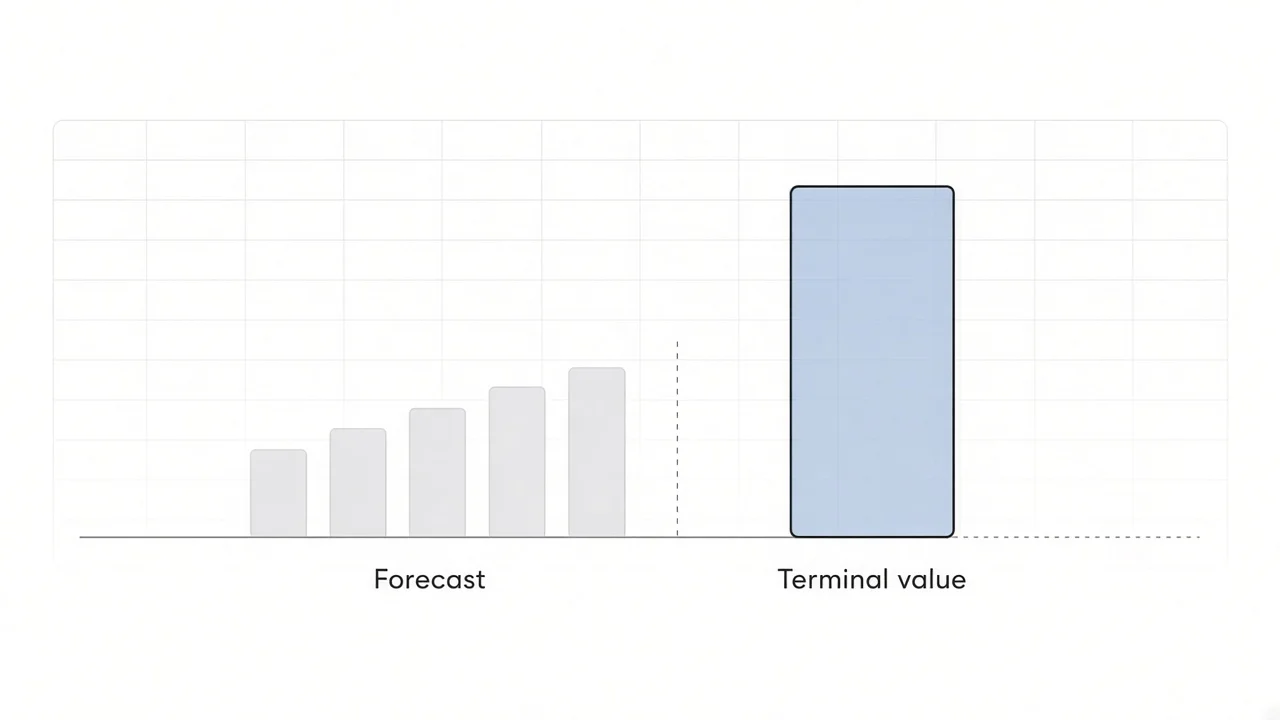
Terminal value is the value of a company's cash flows after the forecast. Both formulas, how to choose growth and the exit multiple, the cross-checks, and one bank's two filed DCFs of the same company.
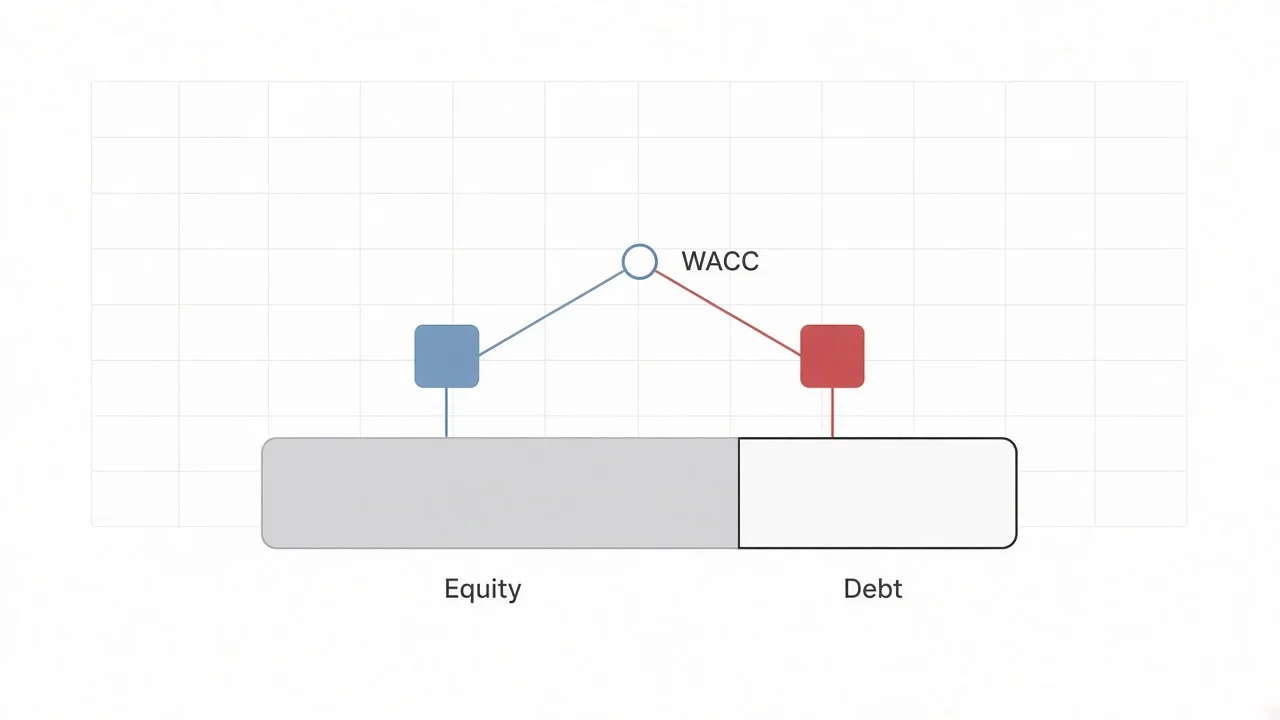
WACC is the blended return a company owes its lenders and shareholders. The formula, each input with 2026 data, and two banks' filed WACCs for the same company in the same week, rebuilt line by line.