LBO Modeling Test: How to Build the Model Under Time Pressure
A private equity modeling test checks whether you can turn a deal prompt into a correct, auditable LBO model before time runs out. Includes a 60- and 90-minute practice case with answers.

LBO Modeling Test: How to Build the Model Under Time Pressure
A private equity modeling test asks you to turn a deal prompt into a working leveraged buyout (LBO) model before the clock runs out. The model must show the purchase price, debt and equity funding, cash available to repay debt, and the sponsor's return at exit. A correct file also needs to be easy for another person to audit. The exercise tests execution under pressure more than financial theory.
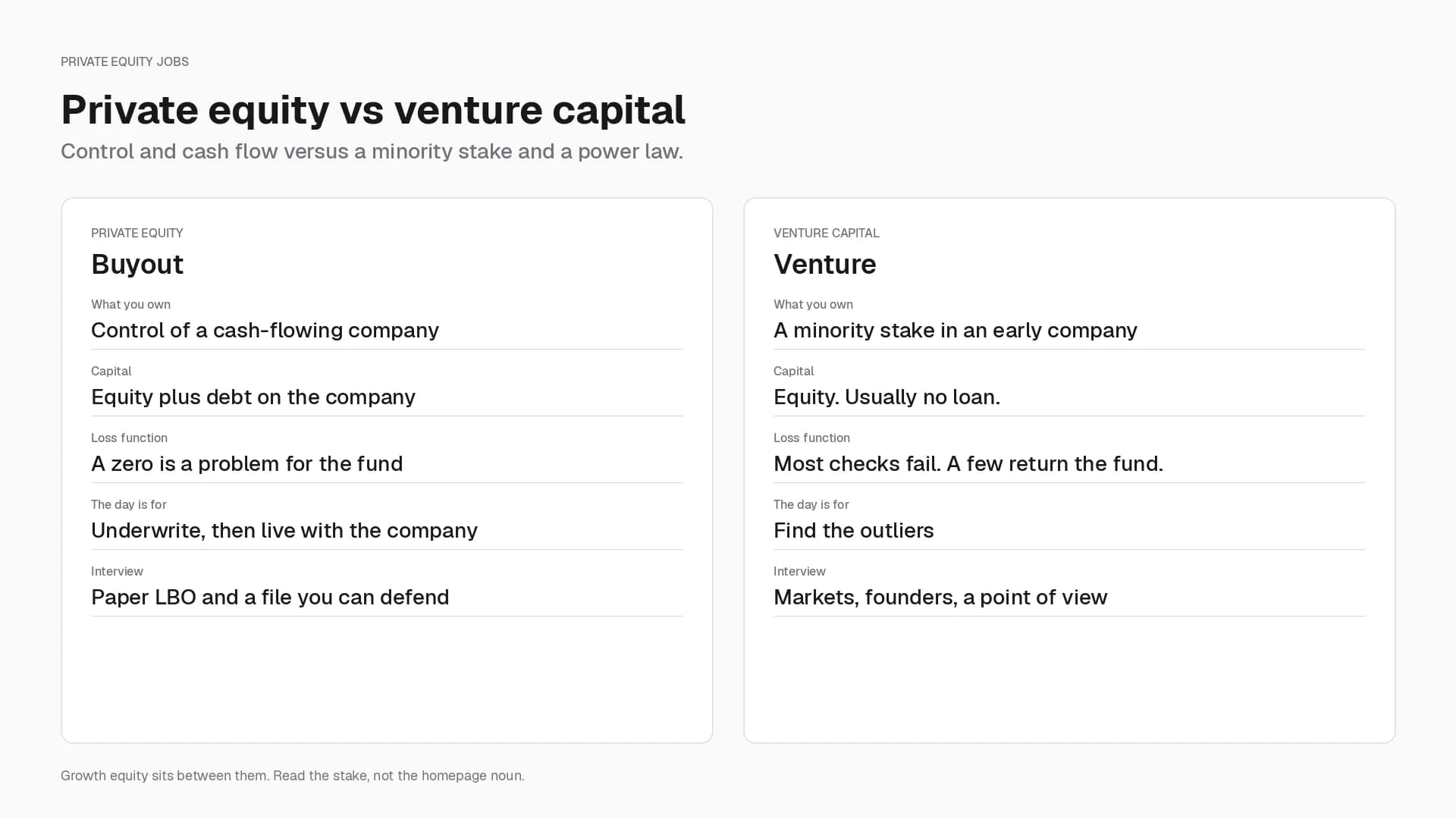
The usual Excel test is different from a paper LBO. A paper exercise reduces the deal to mental math. A timed Excel test requires formulas, debt mechanics, and a file that someone else can review. An open-ended case study goes further by asking whether the fund should buy the company. It may include research, an investment memo, and a presentation.
What an LBO modeling test measures
The test checks whether you can translate written instructions into a consistent model. Most prompts contain enough detail to calculate entry value, transaction funding, operating performance, debt balances, and exit proceeds. The difficulty is building those pieces in the right order while keeping every assumption visible.
A reviewer can learn more from a simple model that works than from an elaborate model with broken links. The file should answer four questions. How much equity does the sponsor invest? How much cash does the company produce after interest, taxes, capital expenditures, and working capital? How much debt remains at exit? What are the resulting internal rate of return (IRR) and multiple on invested capital (MOIC)?
The test also reveals how you work. Clear inputs, consistent signs, short formulas, and visible checks make the model auditable. Those habits matter in the private equity associate job because another associate, vice president, or investment committee member must be able to follow the analysis.
The test formats and what each one requires
Private equity firms use several versions of the Excel test. The time limit is a clue to scope, not a universal rule. The prompt controls what belongs in the file.
| Format | Typical scope | What usually matters most |
|---|---|---|
| 45 to 60 minutes | Entry assumptions, sources and uses, short operating forecast, free cash flow, simple debt schedule, exit returns | Finishing the core return calculation without overbuilding |
| 60 to 90 minutes | More operating detail, two or more debt tranches, cash sweep, sensitivity table, sometimes a partial balance sheet | Correct debt mechanics and a model another person can audit |
| 90 minutes to 3 hours | Integrated financial statements, purchase accounting, several debt tranches, management rollover, scenarios or sensitivities | Statement links, debt roll-forwards, balance checks, and instruction discipline |
| Take-home case | Model plus company research, investment thesis, risks, diligence questions, and recommendation | Investment judgment as well as model accuracy |
A template-based test may include more features because the structure is already present. A blank-sheet test usually asks for fewer schedules but puts more pressure on organization and Excel speed. Do not assume that a longer model is better. Build the schedules the prompt requests and the schedules needed to support them.
Read the prompt before you build
Use the first few minutes to mark the inputs, outputs, and special instructions. Separate entry assumptions, operating assumptions, financing terms, and exit assumptions. Then list the required outputs. If the prompt asks for a five-year IRR, a downside case, and an exit-multiple sensitivity, those items need space in the model before you start filling formulas.
Circle features that change the build. These may include management rollover, transaction fees, minimum cash, mandatory amortization, a cash sweep, floating-rate debt, paid-in-kind interest, or a revolver. Note whether interest uses beginning, ending, or average debt balances. Check whether the company is acquired cash-free and debt-free, whether existing debt is refinanced, and whether excess cash can repay debt.
Write down any missing assumption that prevents a calculation. Ask whether debt can be repaid early, how the cash sweep works, whether the exit multiple applies to the last twelve months or next twelve months of earnings before interest, taxes, depreciation, and amortization (EBITDA), and whether the return should include interim fees or dividends. If questions are not allowed, state a reasonable assumption in the input section. A visible assumption is easier to defend than a hidden guess.
The build order for a 60-minute test
A short test should reach returns as early as the prompt allows. The schedules have a natural dependency. Entry value determines funding. Operating performance determines free cash flow. Free cash flow changes debt. Debt and exit value determine equity proceeds.
Inputs and sources and uses
Put hardcoded assumptions in one block. Include the entry multiple, entry EBITDA, fees, minimum cash, debt amounts or leverage multiples, interest rates, tax rate, operating assumptions, holding period, and exit multiple. Use one color for inputs if the instructions permit formatting, but do not spend time decorating the file.
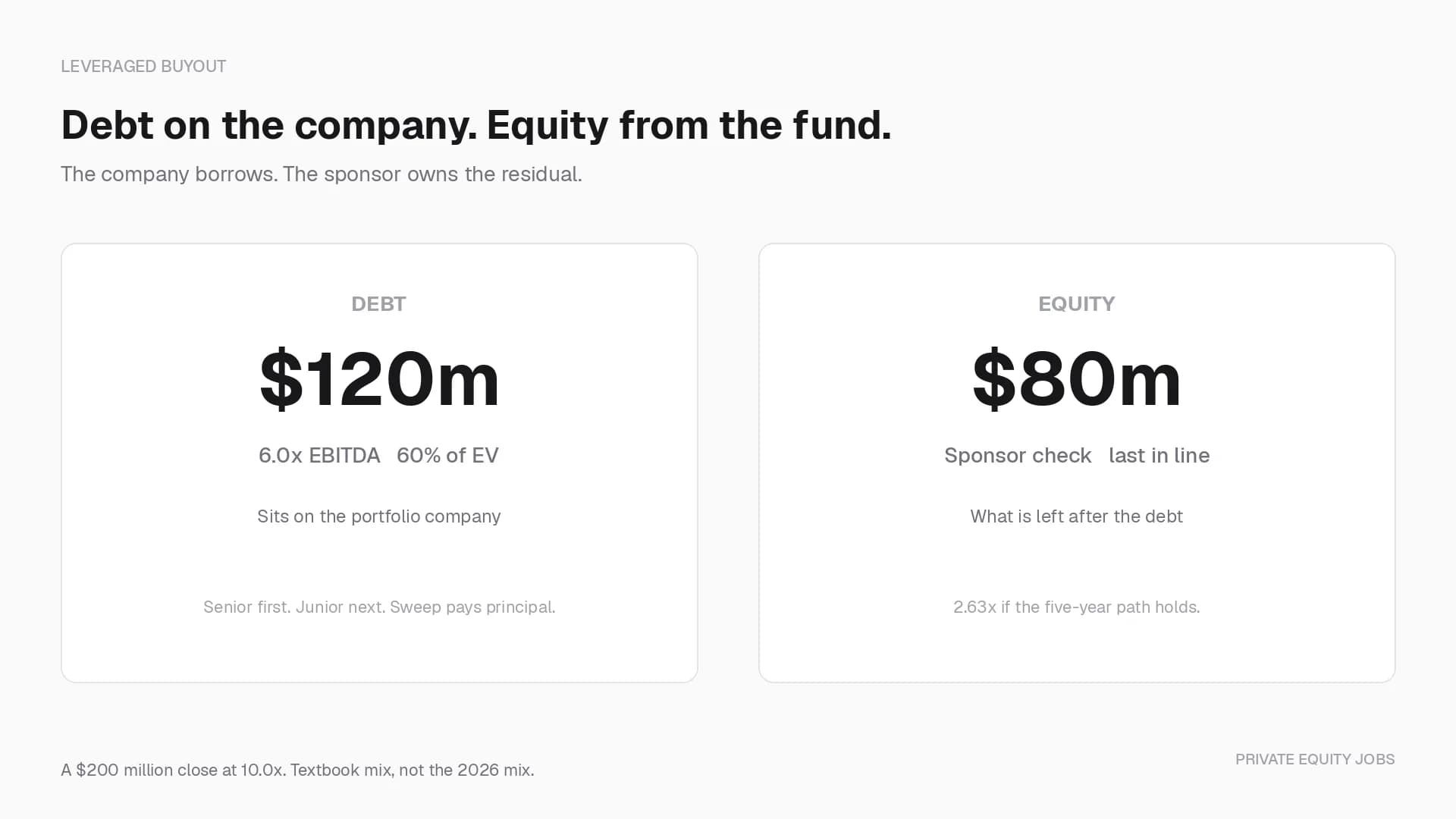
Calculate purchase enterprise value from entry EBITDA and the entry multiple. Bridge to equity purchase price when the target has existing cash or debt. The uses side normally includes the purchase price, refinanced debt, fees, and cash placed on the balance sheet. The sources side includes each debt tranche, management rollover if applicable, and sponsor equity as the balancing amount. Add a check that total sources equal total uses.
Operating forecast and free cash flow
Build only the operating detail needed to calculate cash. A short test may project revenue, EBITDA, depreciation and amortization, interest, taxes, capital expenditures, and the change in net working capital. A full balance sheet is unnecessary unless the prompt asks for one or the working-capital assumptions require it.
Bridge from EBITDA to cash available for debt repayment. Deduct cash interest, cash taxes, capital expenditures, and the increase in net working capital. Add back noncash charges only when they have already reduced earnings. Keep the tax calculation consistent with the prompt, especially when interest creates a tax shield or losses prevent current cash taxes.
Add a cash-flow check. If the model uses all excess cash to repay debt while holding a fixed minimum cash balance, ending cash should not grow until the repayable debt has been cleared. If it does, either the sweep is incomplete or the prompt permits cash accumulation.
Debt schedule
Model each tranche separately. Start with beginning principal, add drawings and paid-in-kind interest, deduct mandatory amortization and optional repayment, and arrive at ending principal. The optional repayment cannot exceed either available cash or the remaining repayable balance.
Debt priority matters. A revolver usually draws when cash is short and repays before term debt receives an optional sweep. Senior term debt may amortize and receive excess cash. Notes may be bullet instruments that remain outstanding until exit. Paid-in-kind interest increases principal instead of using current cash.
Interest can create a circular reference when cash flow repays debt and interest depends on the average debt balance. A short test may allow beginning-balance interest or provide a circularity switch. Follow the instruction. Do not introduce a circular model merely to look sophisticated.
Returns and sensitivities
Calculate exit enterprise value from exit EBITDA and the exit multiple. Subtract debt and add excess cash to reach exit equity value. Apply the sponsor's ownership after any management rollover or option dilution. Compare sponsor proceeds with sponsor equity invested to calculate MOIC, then use the dated or periodic cash flows required by the prompt to calculate IRR.
Check the direction of the answer. More debt at exit should reduce equity proceeds. A higher exit multiple should increase returns. A longer holding period should reduce IRR when the cash multiple is unchanged. A sensitivity table should improve as entry price falls or exit value rises. If these relationships run backward, review the signs and cell references before polishing the file.
If time is almost gone, preserve the chain from sources and uses to exit returns. A working simplified model is more useful than a detailed operating schedule that never reaches sponsor proceeds. Label any simplification so the reviewer knows what you assumed.
Practice case: Calder Filtration Systems
The case below is a PEJ practice prompt with invented numbers. It is not market data and it is not a live deal. Build it from a blank workbook. Time yourself. The 60-minute file is the core chain to sponsor returns. The extra 30 minutes adds fee amortization, a short income statement to net income, and a one-way exit-multiple sensitivity. Worked arithmetic and an answer key follow the prompt.
The prompt
A sponsor is evaluating a cash-free, debt-free buyout of Calder Filtration Systems, a privately held maker of industrial replacement filters. Existing debt is refinanced at close. There are no interim dividends. Build from a blank sheet.
Transaction assumptions:
| Item | Amount |
|---|---|
| LTM revenue | $250m |
| LTM EBITDA | $50m |
| Entry multiple | 8.0x LTM EBITDA |
| Hold | 5 years, exit at year-end |
| Exit multiple | 8.0x year-5 EBITDA |
| Financing fees (cash at close) | $10m |
| Minimum cash, funded at close | $10m |
Financing:
| Instrument | Amount | Terms |
|---|---|---|
| Term loan B | $200m (4.0x) | 8.0% cash interest on beginning principal; $10m mandatory amortization a year (5% of original); 100% cash sweep of excess cash after amortization; no prepayment penalty |
| Senior notes | $50m (1.0x) | 10.0% cash interest on beginning principal; bullet; not prepayable |
| Management rollover | $20m | New-company equity |
| Sponsor equity | Plug | Balancing source |
Operating forecast ($m):
| Y0 (LTM) | Y1 | Y2 | Y3 | Y4 | Y5 | |
|---|---|---|---|---|---|---|
| Revenue | 250 | 265 | 280 | 295 | 310 | 325 |
| EBITDA | 50 | 53 | 56 | 59 | 62 | 65 |
Other operating rules: depreciation and amortization $12m every year; capital expenditures $12m every year; net working capital is 10 percent of revenue, so the annual increase is $1.5m; tax rate 25 percent on earnings after interest and, in a 90-minute file, fee amortization. No net operating losses. All tax is cash tax. Interest uses beginning-of-year principal. Do not iterate average balances. Excess cash above the $10m minimum sweeps to the term loan. Ending cash stays at $10m until that loan is gone.
60-minute scope: entry enterprise value, sources and uses, free cash flow, the two-tranche debt schedule, exit equity, sponsor MOIC, and sponsor IRR. Treat the $10m of fees as a uses-side cash item. Do not amortize them. Skip the sensitivity table if you are short on time.
90-minute additions, same prompt: amortize the $10m of financing fees straight-line over five years ($2.0m a year). The charge is noncash and tax deductible. Add a short income statement from EBITDA to net income. Add a one-way sensitivity of IRR and MOIC to exit multiples of 7.0x, 8.0x, and 9.0x. Do not build purchase accounting, a revolver, or a full three-statement model unless those outputs are already done.
Return convention: cash out at close, cash in at the end of year 5. IRR equals MOIC to the power of one-fifth, minus one. Do not use a mid-year convention.
Required outputs
| Output | 60-minute file | 90-minute file |
|---|---|---|
| Entry enterprise value | Yes | Same formula |
| Sources and uses, with a sources-equal-uses check | Yes | Same table |
| Sponsor equity and ownership | Yes | Same ownership |
| Year-by-year free cash flow and ending term-loan balance | Yes | Same schedules, with the fee-amortization tax shield |
| Year-5 exit enterprise value, net debt, exit equity, sponsor proceeds | Yes | Same chain |
| Sponsor MOIC and IRR | Yes | Same formulas, slightly different numbers |
| Income statement to net income | Optional | Yes |
| Exit-multiple sensitivity (7.0x / 8.0x / 9.0x) | Skip if short | Yes |
60-minute worked build
Entry enterprise value is LTM EBITDA times the entry multiple: $50m × 8.0 = $400m.
| Uses | $m | Sources | $m |
|---|---|---|---|
| Equity purchase (enterprise value) | 400 | Term loan B | 200 |
| Financing fees | 10 | Senior notes | 50 |
| Cash to the balance sheet | 10 | Management rollover | 20 |
| Sponsor equity (plug) | 150 | ||
| Total uses | 420 | Total sources | 420 |
Total equity is $170m. The sponsor owns $150m / $170m, or 88.2 percent. Sources equal uses.
Year-1 interest is beginning term loan times 8.0 percent plus beginning notes times 10.0 percent: ($200m × 0.08) + ($50m × 0.10) = $21.0m. Taxable earnings are EBITDA minus depreciation minus interest: $53m − $12m − $21.0m = $20.0m. Cash tax is $20.0m × 25 percent = $5.0m. Free cash flow is $53m − $12m − $1.5m − $21.0m − $5.0m = $13.5m. Mandatory amortization takes $10.0m. The sweep takes the remaining $3.5m. The term loan ends year 1 at $186.5m. The notes stay at $50m.
| Year | EBITDA | Interest | Tax | Free cash flow | Mandatory | Sweep | Ending term loan |
|---|---|---|---|---|---|---|---|
| 1 | 53.00 | 21.00 | 5.00 | 13.50 | 10.00 | 3.50 | 186.50 |
| 2 | 56.00 | 19.92 | 6.02 | 16.56 | 10.00 | 6.56 | 169.94 |
| 3 | 59.00 | 18.60 | 7.10 | 19.80 | 10.00 | 9.80 | 150.14 |
| 4 | 62.00 | 17.01 | 8.25 | 23.24 | 10.00 | 13.24 | 126.89 |
| 5 | 65.00 | 15.15 | 9.46 | 26.89 | 10.00 | 16.89 | 100.01 |
The table keeps two decimals in the roll-forward. Year-5 term loan is $100.01m. Notes remain $50.00m. Cash remains $10.00m. Net debt is $140.01m.
Exit enterprise value is year-5 EBITDA times the exit multiple: $65m × 8.0 = $520m. Exit equity is $520m − $140.01m = $379.99m. Sponsor proceeds are $379.99m × 150 / 170 = $335.29m.
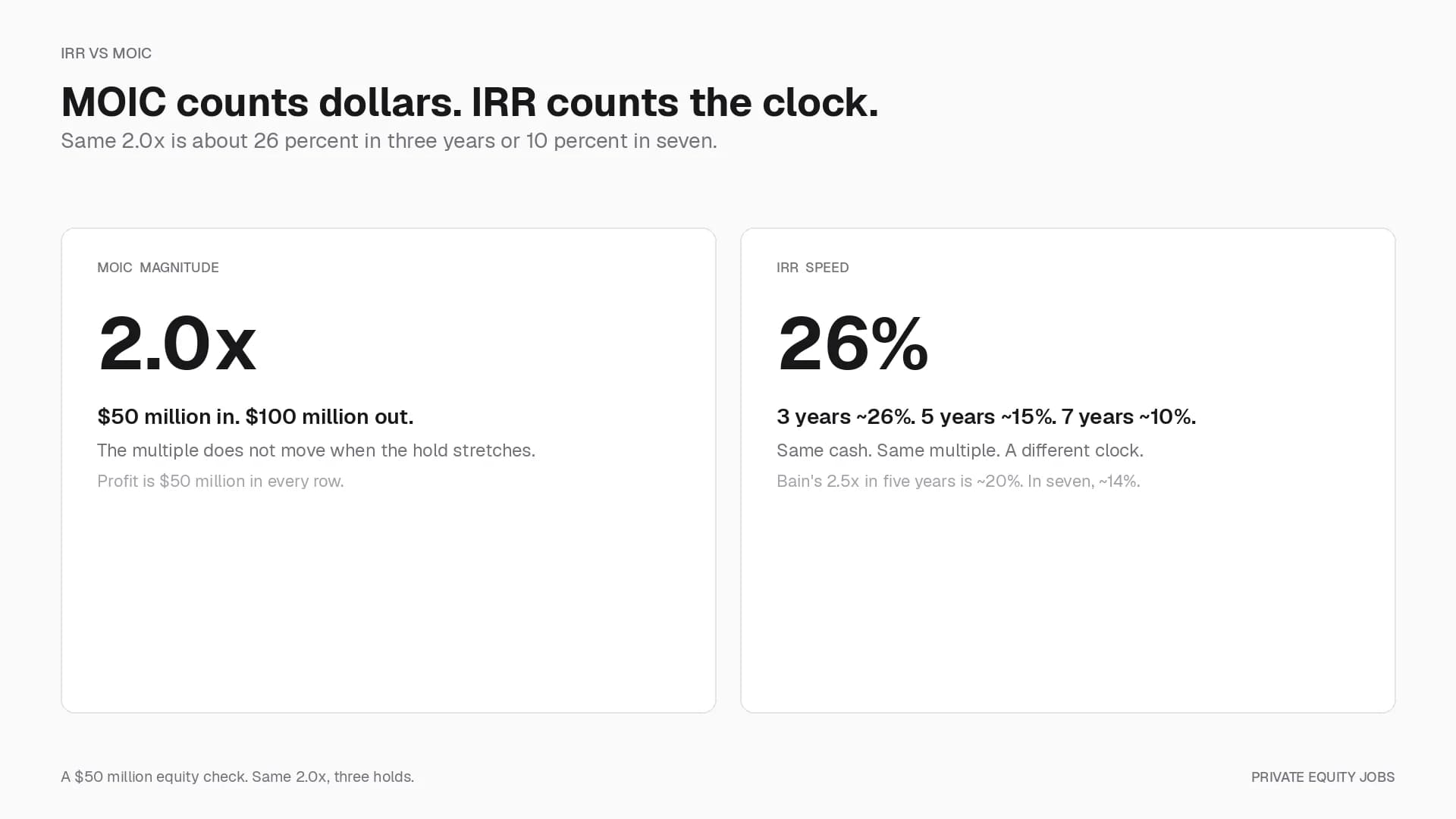
MOIC is $335.29m / $150m = 2.24x. IRR is 2.235 to the power of one-fifth, minus one, or 17.4 percent.
What the extra 30 minutes adds
The 90-minute file uses the same prompt. The extra work is the tax treatment of fees, a short income statement, and the sensitivity the prompt asked for. It is not a new deal, and it is not a three-statement model.
Amortize the $10m of financing fees at $2.0m a year. Subtract that charge when you compute taxable earnings. Do not subtract it again in free cash flow, because it is not cash. The tax shield raises free cash flow by 25 percent of $2.0m, or $0.5m, in a year with no other changes. Year-1 taxable earnings become $53m − $12m − $21.0m − $2.0m = $18.0m. Tax is $4.5m. Free cash flow is $53m − $12m − $1.5m − $21.0m − $4.5m = $14.0m. The extra $0.5m of sweep leaves the term loan at $186.0m after year 1.
| Year | EBITDA | Interest | Fee amort. | Tax | Net income | Free cash flow | Ending term loan |
|---|---|---|---|---|---|---|---|
| 1 | 53.00 | 21.00 | 2.00 | 4.50 | 13.50 | 14.00 | 186.00 |
| 2 | 56.00 | 19.88 | 2.00 | 5.53 | 16.59 | 17.09 | 168.91 |
| 3 | 59.00 | 18.51 | 2.00 | 6.62 | 19.87 | 20.37 | 148.54 |
| 4 | 62.00 | 16.88 | 2.00 | 7.78 | 23.34 | 23.84 | 124.71 |
| 5 | 65.00 | 14.98 | 2.00 | 9.01 | 27.02 | 27.52 | 97.19 |
Year-5 net debt is $97.19m + $50.00m − $10.00m = $137.19m. Exit enterprise value is still $520m. Exit equity is $382.81m. Sponsor proceeds are $382.81m × 150 / 170 = $337.77m. MOIC is 2.25x. IRR is 17.6 percent. The fee shield moves the rate by about 20 basis points. The interviewer asked for it anyway.
The 90-minute sensitivity holds the 90-minute debt path constant and changes only the exit multiple.
| Exit multiple | Exit EV ($m) | Exit equity ($m) | Sponsor proceeds ($m) | MOIC | IRR |
|---|---|---|---|---|---|
| 7.0x | 455 | 317.81 | 280.42 | 1.87x | 13.3% |
| 8.0x | 520 | 382.81 | 337.77 | 2.25x | 17.6% |
| 9.0x | 585 | 447.81 | 395.13 | 2.63x | 21.4% |
Returns rise as the exit multiple rises. If they do not, the sensitivity is wired to the wrong cells.
Answer key
| Output | 60-minute | 90-minute |
|---|---|---|
| Entry enterprise value | $400.00m | $400.00m |
| Total sources / uses | $420.00m | $420.00m |
| Sponsor equity invested | $150.00m | $150.00m |
| Sponsor ownership | 88.2% | 88.2% |
| Year-1 free cash flow | $13.50m | $14.00m |
| Year-5 ending term loan | $100.01m | $97.19m |
| Year-5 net debt | $140.01m | $137.19m |
| Exit enterprise value (8.0x) | $520.00m | $520.00m |
| Exit equity | $379.99m | $382.81m |
| Sponsor proceeds | $335.29m | $337.77m |
| MOIC | 2.24x | 2.25x |
| IRR | 17.4% | 17.6% |
A $0.1m difference in the year-5 term loan is a rounding difference, not a different model. These misses are larger than that, and they are wrong.
| Miss | 60-minute result | What broke |
|---|---|---|
| Drop the $1.5m working-capital drag | MOIC 2.29x, IRR 18.0% | Free cash flow and the sweep are too high every year |
| Give the sponsor 100% of exit equity | MOIC 2.53x, IRR 20.4% | Management owns $20m of the $170m |
| Omit the $10m of cash at exit | MOIC 2.18x, IRR 16.8% | Net debt is $10m too high |
| Apply 8.0x to year-4 EBITDA ($62m) | MOIC 2.09x, IRR 15.9% | The prompt exits on year-5 EBITDA |
| Sweep the notes | Same as the key on this case | Free cash flow never clears the term loan, so a notes sweep would not fire. The error still violates the prompt |
What changes in a 90-minute three-statement test
Calder's extra 30 minutes still sits on a cash-flow LBO. A standard three-statement exercise adds schedules because the balance sheet must close and the cash flow statement must explain the movement in cash and debt. The build still follows the same economic order, but more links sit between operations and returns.
Start with a pro forma closing balance sheet when the prompt includes purchase accounting. Remove the seller's cash and debt as instructed, add the new financing, write up assets where required, create deferred taxes if required, and use goodwill as the residual that makes the acquisition accounting work. Confirm that assets equal liabilities plus equity before forecasting.
Forecast the income statement, then the supporting schedules for working capital, capital expenditures and depreciation, financing fees, and debt. The cash flow statement should begin with net income, add back noncash charges, account for working capital and capital expenditures, and show financing flows. Link ending cash and debt to the balance sheet. Add a balance check for every forecast year.
Purchase price allocation, detailed goodwill, deferred tax liabilities, and a full depreciation waterfall belong in the model only when the prompt requires them. A 90-minute limit does not automatically require every feature. The safest interpretation is the narrowest model that answers every stated question and reconciles the required statements.
How interviewers grade the model
Reviewers usually start with the outputs and work backward. They check whether sources equal uses, whether the balance sheet balances when one is required, whether debt rolls forward correctly, and whether exit equity reconciles to enterprise value less net debt. They then test whether the return formulas use sponsor cash flows rather than total company equity.
Instruction discipline matters as much as formula skill. A candidate can lose credit by sweeping debt that the prompt says is not prepayable, forgetting paid-in-kind interest, using the wrong tax rate, or applying the exit multiple to the wrong year's EBITDA. A correct answer built from the wrong instructions is still wrong.
Auditability is the final part of the review. Inputs should not be buried inside formulas. Signs should be consistent. Each schedule should have a clear check. Formulas should run across periods in a predictable way. A reviewer should be able to change an assumption and see the effect flow through the model without repairing hardcoded outputs.
The model may be followed by a discussion. Be ready to explain the main return drivers, the largest risk, and the assumption you would test first. On Calder, the sponsor earns a mid-teens IRR at an unchanged 8.0x exit. The rate is more sensitive to the exit multiple than to the fee-amortization shield. A file can pass the mechanical screen without proving that the company is a good investment. The wider private equity interview still tests deal judgment, fit, and communication.
Errors that cost time and points
Overbuilding is the most common strategic error. A candidate starts a full three-statement model in a 60-minute test, adds purchase accounting that was not requested, and reaches the return calculation too late. The prompt defines the model. Extra schedules create more places for errors.
Sign errors are more mundane and just as damaging. Interest, capital expenditures, taxes, and debt repayments may appear as negative numbers in one schedule and positive uses of cash in another. Decide on a convention and use it throughout. Check that debt repayment lowers the ending balance and that higher debt lowers exit equity.
Hardcoded outputs make the file fragile. If sponsor equity, exit proceeds, or IRR has been typed rather than linked, the model stops responding when an assumption changes. Hardcodes belong in the input block. Calculated cells should contain formulas.
Candidates also lose time trying to eliminate every circular reference. If the instructions permit beginning-balance interest, use it. If the model requires average debt and a cash sweep, use a controlled circularity switch or the method specified in the prompt. A broken circular model is worse than a disclosed simplification.
Finally, do not submit without checking the obvious relationships. Sources must equal uses. The balance sheet must balance when required. Debt cannot fall below zero. Cash cannot breach the stated minimum. Returns should move in the expected direction when entry and exit assumptions change. On Calder, dropping working capital, ignoring the rollover, omitting cash at exit, or exiting on year-4 EBITDA each moves MOIC by several tenths. That is not rounding.
How to practice for the test
Begin without a timer. Build Calder from a blank workbook until every schedule reconciles and you can explain each formula. Rebuild the same exercise until the sequence is familiar, but do not memorize cell addresses or this company's answers.
Then change the prompt. Add a second sweep rule, replace cash-pay interest with part paid-in-kind interest, change the sweep percentage, remove the rollover, or require a closing balance sheet. The goal is to recognize dependencies, not reproduce one template.
Only then add the clock. Complete the 60-minute Calder file in 75 minutes, review the errors, and rebuild it before reducing the limit. Use the last five minutes of every attempt on the audit: sources and uses, debt balances, cash, return signs, and sensitivity direction.
Practice explaining the result aloud after the workbook is finished. State the entry equity, exit equity, MOIC, IRR, and the two assumptions that matter most. Then say what could break the return. This turns an Excel exercise into the investment discussion that often follows it.
Candidates who are still choosing firms can use the companies directory to distinguish buyout, growth, and credit investors, then browse open roles on Private Equity Jobs. Test format varies by firm, strategy, seniority, and recruiting process, so ask the recruiter what to expect rather than assuming every interview uses the same model.
Questions to ask before the timer starts
Clarify the deliverable before opening Excel. Ask whether the test begins from a blank workbook or a template, whether a full three-statement model is required, which years to forecast, and whether a presentation or written recommendation follows the file.
Confirm the financing mechanics. Ask which debt tranches can be repaid early, whether excess cash is swept, whether interest uses beginning or average balances, whether rates have floors, and whether a revolver is available. Confirm the minimum cash balance and the treatment of transaction and financing fees.
Finally, confirm the exit and return convention. Ask which year's EBITDA supports the exit value, whether the exit occurs at year-end, whether interim dividends or fees count as sponsor proceeds, and whether the return should be calculated for the sponsor alone or all equity holders. These questions do not show weakness. They prevent a model from answering a different question from the one the firm set.