

Equity research (ER) is the sell-side coverage seat inside an investment bank that follows public companies, builds and updates earnings models, publishes notes and ratings, and sits between management teams and institutional investors. The product is insight and access, not a closed deal fee. Research is a cost center that supports sales and trading and the bank's corporate relationships, with information barriers separating it from the investment banking division (IBD). Full-service and bulge bracket banks run the large franchises. Elite boutique investment banks generally do not.
For someone aiming at private equity, two facts matter more than the hours table. First, bank ER sits on the sell side next to IBD deal teams, but classic buyout associate classes still draw more densely from IBD coverage and sponsors seats than from research. Second, the natural ER exits run toward asset management, hedge funds, investor relations, and corporate finance or development more often than toward a standard mega-fund buyout class.
What equity research is
An institutional investor that owns or wants to own a public stock needs someone who follows the company every quarter, talks to management, models the earnings path, and can explain why the shares look cheap or expensive relative to peers. That someone, on the sell side, is the equity research team.
The visible product is the research report: an initiation of coverage, an earnings note, a sector deep dive, or a rating change (buy, hold, or sell). The less visible product is the relationship. Senior analysts spend much of their time with company executives and with the portfolio managers and analysts who pay for (or trade against) the research. Junior associates spend more of their time in the model, the filing, and the draft note.
Research makes money differently from IBD. Bankers earn fees when a deal closes. Research historically subsidized trading commissions by giving institutional clients free reports that encouraged them to trade with the bank. That model has partially shifted. In Europe, Markets in Financial Instruments Directive II (MiFID II) pushed more clients to pay for research directly. In the United States, research still sits next to markets and corporate relationships, but the economics are those of a cost center: the franchise pays for coverage because it supports sales, trading, and the bank's standing with issuers, not because each note has its own invoice that clears the desk.
Fixed income research is a sibling product. The work pattern (model, note, client call) is similar. The security is a bond or loan, not a stock. This page owns the equity seat.
What an equity research analyst does
Coverage is organized by sector or by region. A senior analyst (the external "Analyst" title at many banks) runs a book of roughly five to fifteen stocks with zero to a few associates. The book is the franchise. Ratings, models, and client access attach to that name.
A typical associate week mixes three kinds of work. First, the model: updating financial statements after earnings, refreshing forecasts, and keeping the valuation framework consistent with the senior thesis. Second, the written product: earnings notes, sector primers, and marketing slides the senior takes on the road. Third, the client and internal channel: answering portfolio-manager questions, briefing the bank's sales force after a print, and joining management meetings when invited.
Initiating coverage on a new name is the heavy lift. It means a full model, a long report, a rating, and a thesis the team will defend for quarters. Updating an existing name after earnings is faster but still public-facing: the note goes out under the analyst's name, and sales will ask for the punch line within minutes of the release.
The quality of the work is judged by clients and by the senior analyst, not by a deal closing. That is the main day-to-day difference from IBD. An IBD analyst can spend weeks on a pitch that never becomes a mandate. An ER associate sees whether the model was wrong, whether the call landed with sales, and whether the client called back, often the same week.
Equity research vs investment banking
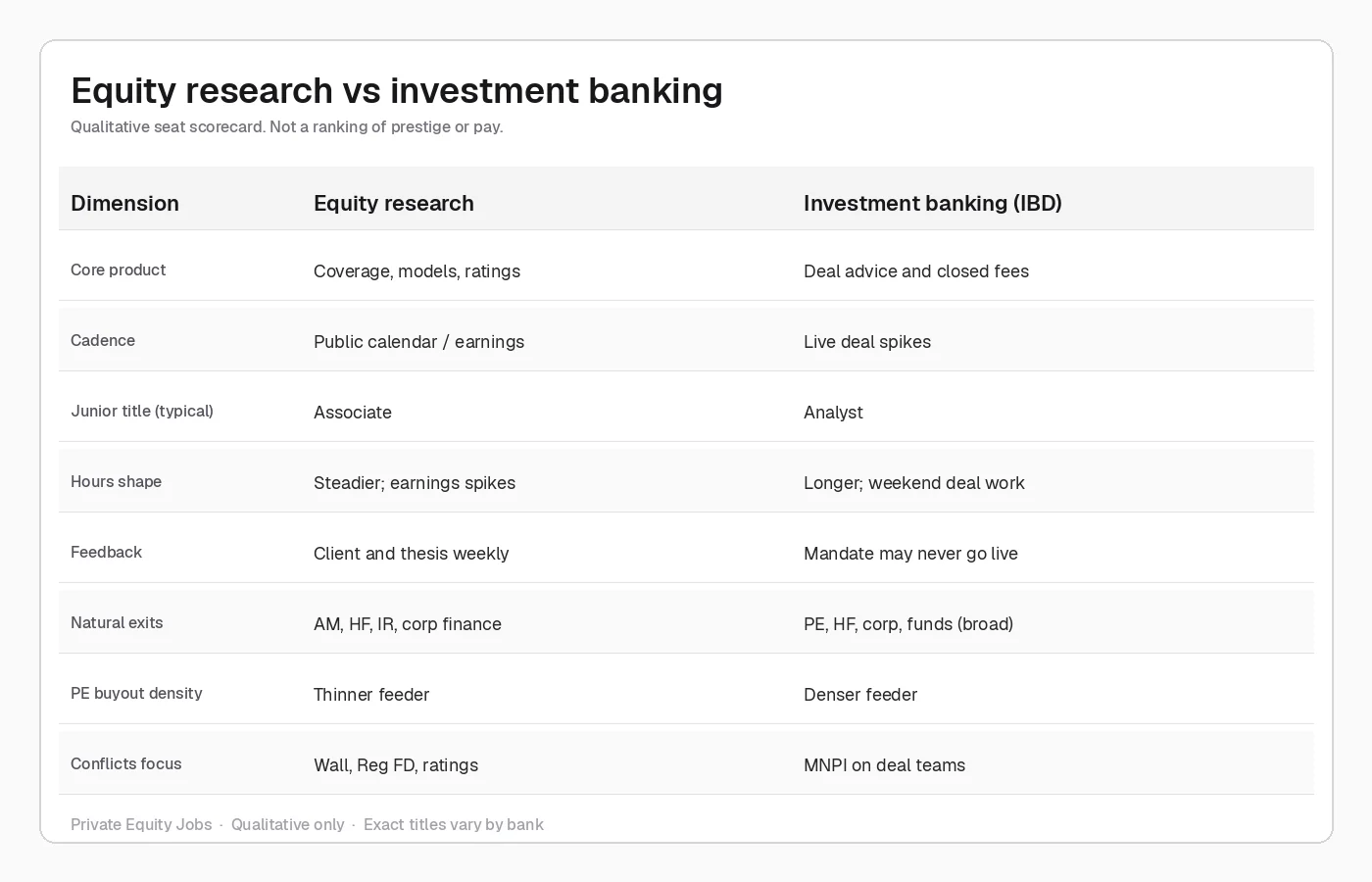
IBD bankers advise companies on mergers, acquisitions, and capital raising. The work is deal-based: pitches, process letters, diligence, and closings that can stretch for months. Hours follow live deals and can run late into the night and through weekends when a process is hot. Product groups such as restructuring investment banking still sit inside that deal cadence even when the client is distressed.
ER follows the public calendar. The desk is in before the open, busiest around earnings and during marketing trips, and usually lighter on weekends than a deal team on a live auction. Earnings season creates predictable spikes. It is not a promise of an easy job. Client calls, model rebuilds, and travel still fill the day.
The two divisions also sit on opposite sides of the bank's information barrier. IBD deal teams hold material nonpublic information about clients' mergers and financings. Research sits on the public side and must not receive that information for use in published views. Section 15(g) of the Securities Exchange Act of 1934 requires broker-dealers to keep written policies designed to prevent misuse of material nonpublic information. The wall is not a metaphor for culture. It is a compliance structure that shapes what a junior can see and say.
Skill overlap is real but thinner than outsiders assume. Both seats use Excel, accounting, and valuation. IBD builds process, client-company storytelling, and transaction mechanics that private equity screens for. ER builds sector depth, public-market forecasting, and a published track record that long-only and hedge-fund investors screen for. Moving from ER into classic buyout private equity is possible but less common than from strong IBD seats. Moving from ER into a public-markets buy-side seat is the natural adjacency.
The comparison people type into Google ("equity research investment banking") is usually a seat decision, not a business-model essay. The business-model contrast between buyouts and banks lives on private equity vs investment banking. This page owns the ER seat and the ER-versus-IBD contrast.
Hierarchy and titles
Title language in ER differs from IBD, which confuses candidates.
In many U.S. banks, the entry-level seat out of undergrad is Associate. The senior coverage person whose name is on the report is the Analyst (sometimes Senior Analyst). Above that sit Managing Director-level analysts who run large books, and research management (Director of Research and similar titles) who hire, budget, and set policy. Internally, banks still use familiar ranks (vice president, director, managing director) for pay bands and promotion. Externally, clients know the Analyst who covers the stock.
A typical coverage group is small: one senior Analyst and roughly two to four Associates. Promotion inside the group means more client exposure, more of the thesis, and eventually a book of your own. It does not mean leaving modeling behind the way an IBD vice president leaves some analyst chores. Senior ER still lives in the model and the note.
IBD's ladder (analyst, associate, vice president, director, managing director) is more standardized for juniors and more often includes a pre-MBA and post-MBA split. ER is flatter and more book-centric. A strong Director-level Analyst in research can be paid like a more senior banker because pay follows franchise value and rankings, not only title.
How people get hired
Most full-time junior ER seats at large U.S. banks still come from summer programs or from lateral hiring when a group needs an Associate. Openings appear more randomly than in IBD's large analyst classes. Group size is smaller, so fewer internship and full-time spots exist in a given year.
Resume screens look for accounting strength, writing samples or demonstrated writing skill, and concrete interest in public markets or a sector. Interviews test modeling, accounting, and a stock pitch (one or two names the candidate can defend). Networking helps get a resume read. Cold-calling a senior Analyst during earnings week is a fast way to be ignored.
The Chartered Financial Analyst (CFA) program is common among people who stay in research or move to the buy side. It is not a substitute for getting hired. Many juniors start the CFA after they land the seat. An MBA is less central to ER promotion than to some IBD associate paths, though some people use an MBA to switch into banking or to reset.
In the United States, people who prepare publicly disseminated equity research for a FINRA member firm generally need Research Analyst registration. That means passing the Securities Industry Essentials exam and the Series 86 and Series 87 exams (FINRA Rule 1220(b)(6)), with firm sponsorship. Candidates who have passed CFA Level I and Level II may request an exemption from the Series 86. The exams are employer-sponsored after the hire, not a precondition for applying.
Hours and lifestyle
Practitioner guides put junior ER in a roughly 55-to-70-hour week in normal periods, with earnings-season spikes that can push into the upper 70s or low 80s. Wall Street Prep describes associates arriving around 7 a.m. and leaving between 7 p.m. and 9 p.m. Mergers & Inquisitions contrasts that with IBD analyst weeks that often start above 80 hours and fall toward about 60 only with seniority. Weekend work is less common in ER than on a live IBD deal, which makes it easier to shut off outside earnings weeks.
The lifestyle edge is relative, not absolute. Senior Analysts travel for marketing, host client calls early and late across time zones, and still follow the tape. Hours do not automatically shrink with title the way some IBD seats do after the analyst years. Treat "better lifestyle" as fewer unpredictable deal weekends, not as a short desk.
Pay shape
Junior ER pay at large U.S. banks often starts on the same base as junior IBD pay, with all-in usually trailing IBD because research bonus pools are smaller. Bonus becomes more tightly tied to the group's franchise and individual contribution as titles rise. Published figures move every cycle. Use dated sources; do not treat forum screenshots as primary.
Mergers & Inquisitions puts starting bases just above $100,000, advancing toward roughly $200,000 and then toward $400,000 to $500,000 near the top of the Analyst ranks, with some Managing Director-level Analysts earning $1 million or more when the franchise is strong. Wall Street Mastermind's July 2026 side-by-side puts first-year ER all-in roughly in the $115,000 to $160,000 range (about $85,000 to $100,000 base plus bonus) and senior Analyst all-in from the mid-hundreds into seven figures at the top. Wall Street Prep notes that large banks often start IBD analysts and ER associates on the same base, while research bonus pools are constrained because the department is a cost center rather than a direct fee engine.
Over a long career, IBD's upside from deal fees and larger bonus pools is usually wider. ER's upside concentrates in ranked senior Analysts with valuable books. Hours-adjusted, many people still prefer ER even when headline all-in trails IBD. That preference is personal. It is not a rule.
Conflicts of interest and research rules
Research sits next to banking and next to trading. That adjacency is why conflicts matter more here than in a pure advisory boutique.
The Chinese wall (information barrier) separates research from IBD so that deal-side material nonpublic information does not flow into published ratings. Research may still help the bank maintain corporate relationships in a compliance-approved way, and Wall Street Prep notes that despite the wall, research remains part of how banks stay close to issuers who later hire underwriters. On rare occasions a research analyst can be brought over the wall to help on a specific deal involving a covered name; that temporary access is compliance-gated and does not make equity research a deal seat. Juniors should treat the wall as a daily constraint: what you can see, what you can say on a recorded line, and what must wait for public disclosure.
Regulation Fair Disclosure (Reg FD) is the SEC rule that generally requires public companies to disclose material information to all investors at the same time, not selectively to favored analysts. It changed how management communicates. Private one-on-one "guidance" that was once common became a compliance risk. Analysts still meet management. They do it under rules that push material updates into public channels.
The Global Research Analyst Settlement (SEC enforcement actions announced in 2003 against leading Wall Street firms) addressed conflicts from the late-1990s boom, when banking pressures warped research. The firms paid $875 million in penalties and disgorgement and agreed to structural reforms that separated research from investment banking more sharply, including limits on how research analysts could be compensated from banking revenue. Research bonuses today are supposed to come from a bonus pool tied to factors such as trading activity around recommendations, the quality of the calls, firm profitability, and buy-side rankings, not from a cut of underwriting fees.
For a candidate, the practical point is simple. ER is not a quieter IBD. It is a regulated publishing and client-markets seat whose independence rules exist because the bank also sells banking and trading. If that tension sounds intolerable, prefer a role farther from the wall. If it sounds like the price of sitting between companies and investors, ER is built for that.
Exit opportunities from equity research
Exits from bank ER run mostly to other investing and markets-adjacent seats.
Asset management (long-only). Mutual funds and other long-only managers hire people who already follow sectors, write theses, and talk to management. This is one of the cleanest ERadjacencies. The vehicle contrast with buyouts lives on private equity vs asset management.
Hedge funds. Long/short equity and related public-markets funds hire from coverage teams that know the same names. Competition is high. Many associates strengthen their profile with the CFA and with a visible track record on the notes they helped produce. The vehicle contrast with buyouts lives on private equity vs hedge fund.
Investor relations. Public companies hire IR officers who can speak the language of the sell side and the buy side. Former associates who liked the company dialogue more than the rating pressure often land here.
Corporate finance and corporate development. Modeling, sector knowledge, and public-market fluency transfer into corporate finance teams and into corporate development seats that evaluate acquisitions and capital structure. This path is more company-side than fund-side.
Internal moves. Some people lateral into IBD (especially at the associate level, sometimes after an MBA) or into sales that cover the same accounts. The modeling skills transfer. The hours and process skills of live deals do not arrive automatically.
Classic buyout private equity associate classes still draw most heavily from IBD. Most investment banking exit opportunities into buyouts run through coverage, sponsors, and related product groups. ER alumni do reach private equity, especially when the story includes sector depth, transaction exposure, or a later banking stop. Treat PE as a possible later move with a story, not as the default outcome of an ER associate program. A dedicated "equity research to private equity" path page is not the job of this URL.
What is changing the seat
Three forces are reshaping sell-side equity research: regulation and economics, headcount and coverage models, and AI.
Regulation and economics. MiFID II in Europe and ongoing U.S. pressure on research budgets pushed banks to charge more directly for research and to cut low-value coverage. Groups that cannot attract clients or support the franchise get smaller. The cost-center logic gets sharper when markets revenue is weak.
Coverage models. Some banks experiment with more generalist junior roles and broader sector umbrellas so fewer people cover more names. Practitioner chatter in 2026 describes initiation and model-update work compressing when teams adopt AI drafting and spreadsheet tools. That is color from desks, not a census. Deep sector franchises still sell access and judgment that a generic note cannot.
AI. Large language models are better today at drafting notes, summarizing filings, and updating existing model templates than at inventing a new thesis or running a live client franchise. Mergers & Inquisitions' AI section makes the same point: banks will likely get more done with fewer Associates on update grunt work; the senior Analyst's relationships and judgment are harder to automate. Treat "AI ends equity research" as a slogan. Treat "junior update tasks compress" as the mechanism that should change how a candidate prepares.
The seat that remains valuable is the one that owns a real book, a real client list, and a view the buy side will pay attention to. The seat that shrinks first is pure retyping and template maintenance.
When equity research is the better seat
ER is the better first seat when you want public-markets depth, sector specialization, a published track record, and a path toward asset management, hedge funds, investor relations, or corporate finance. It fits people who like writing and modeling more than process management, and who prefer a calendar driven by earnings and marketing over a calendar driven by live deal spikes.
IBD is the better first seat when you want transaction process skills, company-side advisory work, and the densest feeder path into classic buyout private equity. It fits people who can tolerate unpredictable deal hours for two or three years in exchange for a wider exit menu.
ER is a poor first seat if the only goal is a standard on-cycle buyout associate offer at a mega-fund. Placement density for that outcome sits on strong IBD seats. Preferring research work and public-markets exits is a good reason to choose ER. Choosing ER as a stealth PE path is usually a bad plan.
Common questions
Is equity research the same as investment banking?
No. Both sit inside a bank, and both appear under broad "investment bank" brands. IBD advises on deals. ER covers public companies and publishes research for institutional investors. Hours, skills, conflicts, and exits differ.
Do elite boutiques have equity research?
Generally no. Elite boutiques are advisory firms. Full sell-side equity research franchises sit at full-service and bulge bracket banks (and at some regional or specialist firms).
How many hours do equity research associates work?
Expect roughly 55 to 70 hours in normal weeks, with earnings-season spikes that can push higher. Weekend work is less common than on a live IBD deal. Treat the lifestyle edge as relative to deal teams, not as a short desk.
Do you need the CFA for equity research?
No to get hired. Yes often to stay competitive for senior research or buy-side seats. Many juniors start the CFA after they join. CFA Level I and II can support a Series 86 exemption under FINRA rules.
Can you move from equity research to private equity?
Sometimes, especially with strong sector depth or a later banking stop. Classic mega-fund buyout hiring still prefers strong IBD paths. Plan accordingly and use the live break-in and IB-exits pages rather than expecting a dedicated ER-to-PE URL.
Can you switch between equity research and investment banking?
IBD to ER is the more common lateral because modeling transfers and banks hire research when books need people. ER to IBD happens, often at associate level and sometimes after an MBA, but it is less common because deal-process skills and hours tolerance still have to be proven.
Is equity research dying because of AI?
Junior update and drafting tasks are compressing. Senior coverage franchises that own client relationships and original views are not the same task. Judge a specific group and book, not the industry slogan.
Sources
- Mergers & Inquisitions, "Equity Research vs. Investment Banking: Careers, Compensation, Exits, and AI/Automation Risk" (https://mergersandinquisitions.com/equity-research-vs-investment-banking/).
- Mergers & Inquisitions, "Equity Research" hub (https://mergersandinquisitions.com/equity-research/).
- Wall Street Prep, "Investment Banking vs. Equity Research" (https://www.wallstreetprep.com/knowledge/investment-banking-vs-equity-research/).
- Investopedia, Elvis Picardo, "Equity Research vs. Investment Banking: Key Career Differences" (https://www.investopedia.com/articles/personal-finance/082615/careers-equity-research-vs-investment-banking.asp), updated 3 March 2026 (conflicts section; Global Research Analyst Settlement $875 million figure; hours FAQ).
- Wall Street Mastermind, "Equity Research vs Investment Banking: Key Differences Explained" (https://wallstmastermind.com/equity-research-vs-investment-banking-2/), 5 July 2026 (side-by-side compensation ranges).
- FINRA, "Series 86 and 87: Research Analyst Exams" (https://www.finra.org/registration-exams-ce/qualification-exams/series86-87); FINRA Rule 1220(b)(6); Securities Industry Essentials exam.
- Securities Exchange Act of 1934, Section 15(g) (15 U.S.C. 78o(g)), on policies to prevent misuse of material nonpublic information.
- U.S. Securities and Exchange Commission, Regulation FD (17 C.F.R. 243.100 to 243.103); Global Research Analyst Settlement materials (2003 enforcement actions and structural reforms).
- Private Equity Jobs, Buy side vs sell side, Bulge bracket banks, Elite boutique investment banks, Investment banking exit opportunities, Restructuring investment banking, Sales and trading, Private equity vs investment banking, Private equity vs hedge fund, Private equity vs asset management, How to break into private equity, What is private equity.
Related posts
Related posts

Sales and trading is the markets division that pitches ideas and makes markets for institutional clients. How desks and roles work, how it differs from investment banking, and where the seat leads.

Restructuring investment banking advises distressed companies and their creditors on capital-structure fixes, from out-of-court deals to Chapter 11. How the seat differs from M&A, which firms dominate, and when RX is the wrong path to buyout PE.

A clear map of investment banking exit opportunities, what each path actually trades, and how bank type and timing shape the odds.