

Investment banking exit opportunities are the roles analysts and early associates move into after a few years on a deal team: private equity, hedge funds and asset management, growth equity and venture capital, private credit, corporate development and other in-house finance seats, startups and operating roles, a full-time MBA, or a promotion that keeps them in banking. Private equity is the most common target for analysts leaving the desk. Other paths open as well, and for many people private equity is a poor fit.
The bank and group you sit in still shape the private equity odds. Analysts at bulge bracket banks and elite boutique investment banks see more mega-fund coverage than peers at smaller firms, and industry groups that work leveraged buyouts transfer more cleanly than pure equity capital markets. Those other paths are real career options. Private credit has become a mainstream hire from leveraged finance and restructuring. Corporate development pays less than top buy-side seats and often buys back evenings. Staying for the associate years is a legitimate plan for people who like live deals and the path to managing director.
What investment banking exit opportunities are
An exit opportunity is a next job that uses the skills and résumé signal of investment banking without requiring you to remain an adviser for life. Most of the paths people mean when they say "exits" sit on the buy side: funds that invest capital rather than sell advice. Others keep you in deals inside one company, or move you into operating work that centers on the company's product instead of selling advisory fees.
Not every move is an exit. Switching groups inside the same bank, joining another bank's coverage team, or taking an equity research seat can be a career change without leaving the sell-side map. "Exit" does not mean the banking years were a write-off. Employers hire former analysts because two years of live models, process management, and client pressure are hard to fake. The question is which next seat wants that training, and which next seat wants a different personality than banking selected for.
The obsession with exits is strongest in the United States among undergraduate hires on two-year analyst programs. In markets where banking is more often a long career, the same skills still transfer, but the social pressure to leave by year three is weaker.
Why the analyst seat opens doors
Investment banking packs deal mechanics into a short window. A first-year analyst builds models that support live mergers, financings, or restructurings, sits in diligence workstreams, and learns how senior bankers and clients argue about price, structure, and timing. Private equity firms, credit funds, corporate development teams, and many startups treat that combination as proof someone can carry a process under deadline.
A common recruiting pitch says you endure terrible hours for two or three years, then land a buy-side seat with better pay, better hours, and more interesting work. Parts of that story are sometimes true. Mega-fund private equity can pay more over a career once carried interest matters, and corporate development usually runs closer to a corporate calendar than a pitch-driven bank week. Other parts fail often. Junior private equity can feel like banking with a different logo. Hedge fund hours follow market moves instead of deal calendars. And the people who dislike financial analysis in banking usually dislike it in investing roles too.
Bank type and city still matter for the most selective seats. Mega-fund associate hiring concentrates on New York, with meaningful pipelines in London and Hong Kong, and it overweights analysts from large advisory platforms. Middle-market private equity and many corporate roles cast a wider net. People aiming at those mega-fund seats still have to clear private equity recruiting: on-cycle versus off-cycle timing, headhunters, and interviews.
Private equity
Private equity is the most discussed exit because the modeling, diligence, and live-deal process look a lot like banking, while the job flips from adviser to principal. Associates help evaluate acquisitions, build leveraged buyout models, run diligence, and support portfolio companies after closing. The same modeling language appears, but the question changes from "how do we sell this deal" to "what breaks if we own this company for five years."
A leveraged buyout is the classic product: buy a company mostly with debt, improve it, and sell or refinance later. Not every private equity seat is a buyout seat. Some funds specialize in carve-outs, take-privates, or sector theses. What they share is principal risk. Your recommendation can put the fund's capital behind a price.
Fund size changes the day. Mega-funds run large, competitive processes and hire through structured on-cycle recruiting that can start early in an analyst program for seats that begin more than a year later. Middle-market private equity often means smaller deal teams, more sourcing, and recruiting that moves in waves through the year rather than one compressed cycle. Both can be excellent seats. Mega-fund and middle-market seats train associates differently.
Claims about junior private equity hours and pay are often exaggerated upward and downward. Junior private equity is still a deadline business when a live deal is open. Carry is the long-term economic difference, and it usually matters far more at senior levels than in the first associate years. The private equity associate seat is the typical landing spot from banking; the LBO modeling test and private equity interview questions are what the interviews actually test. Former consultants more often land portfolio-operations or value-creation seats than deal-team associate roles; former bankers more often fill the deal-team pipelines. Day-to-day differences between ownership work and advisory work are the private equity vs investment banking contrast. For open associate seats after you know which fund size you want, browse listings on Private Equity Jobs and the companies directory.
Hedge funds and asset management
Hedge funds and traditional asset managers invest mainly in public securities or liquid markets. That is a different job from buying whole companies. A long/short equity analyst spends the week on company research, earnings models, and position sizing. Macro and credit strategies ask for rates, sectors, or capital-structure views rather than a full buyout model. Compensation can swing hard with fund performance. The intellectual loop is continuous: markets mark the book every day.
Banking helps most when the analyst already thinks like an investor. Deal experience alone rarely substitutes for a point of view on stocks, credit, or a sector. Strategies that hire from banking include long/short equity, event-driven work around mergers and restructurings, and credit or distressed funds that value capital-structure fluency. Passive-heavy decades have pressured some classic hedge fund fee models, but strong funds still hire. The people who thrive usually wanted markets more than they wanted a deal process.
Moving from private equity into a hedge fund later is generally easier than the reverse for people who want public markets, because private company diligence reads as serious underwriting. Moving from a hedge fund into buyout private equity is harder without a private-markets story. That asymmetry matters if you are choosing a first exit and want to keep doors open.
Asset management seats at long-only firms are typically steadier and less tournament-like than hedge funds, with different bonus math. Family offices can resemble either private equity or public markets depending on the family's mandate, often with fewer people and less formal recruiting. The private equity vs hedge fund and private equity vs asset management distinctions are the vehicle contrasts behind those choices.
Growth equity and venture capital
Growth equity and venture capital both buy ownership in private companies, usually without the heavy leverage of a classic buyout. Growth investors typically take minority stakes in companies that already have revenue and a scaling motion. Venture capital focuses earlier, where the product, market, and team matter more than a polished three-statement model.
Former bankers land more often in growth equity than in early-stage venture, because the diligence still needs financial rigor and the companies look more like banking clients. Early-stage venture hiring favors operators, founders, and people with deep domain networks. A technology, healthcare, or consumer coverage background helps when it comes with real sector judgment beyond pitch-book fluency. Pay and hours are usually lighter than mega-fund private equity at the junior level, and the partnership track at many venture firms is narrower.
Growth equity is a different underwriting problem with different influence after the check clears. The private equity vs venture capital line, and the buyout-versus-growth split inside types of private equity, are the definitions behind that choice.
Private credit
Private credit and direct lending funds provide loans to companies outside the traditional bank-syndicated market, often to private equity sponsors financing buyouts or to companies that want a single relationship lender. The work sits closer to credit underwriting and documentation than to equity storytelling. Associates model downside cases, review covenants, and live inside capital structures.
Private credit still appears less often than private equity in exit conversations, even though it has absorbed a large share of junior talent from leveraged finance, financial sponsors, and restructuring groups. Bankers who already speak debt, sponsors, and workout language transfer cleanly. Coverage analysts without credit reps can still move, but they are learning a new product as well as a new firm.
Hours vary by shop. Some direct lenders run closer to a steady institutional credit schedule. Others sit on sponsor timelines and work past midnight when a deal is live. Across the class, the load is less uniformly heavy than classic investment banking, but a lender that finances sponsor buyouts will follow the sponsor's deal calendar.
Private credit is a principal seat in credit underwriting. Some shops are calmer than banking; others match sponsor deal hours. People who want equity ownership economics and company-building exposure will still prefer buyouts or growth. People who like asymmetric downside work and contractual protections often prefer credit.
Corporate development and in-house finance
Corporate development is the internal mergers and acquisitions team at a company. Former bankers evaluate targets, run processes, hire outside advisers on large deals, and help integrate what closes. The skill overlap with banking is obvious. The calendar is usually kinder than a sell-side pitch week, though active acquirers still surge.
Pay is typically below top buy-side all-in compensation and above ordinary corporate finance roles, with equity that depends on the employer. The career caveat is real: many companies do not have a deep corporate development ladder to the executive suite. Chief financial officer seats more often come from controllership, FP&A, or operating finance than from a pure deal team. Over a longer horizon, relatively few operators who reach general-manager or C-suite seats started on an investment banking desk; banking alumni more often stay in finance functions such as vice president of finance or CFO tracks that still run through operating finance, or they climb to managing director inside a bank where the economics of a strong platform remain competitive. Ask what successful people in that team did next before treating the seat as an executive pipeline.
Corporate development is harder to reverse into mega-fund private equity than a banking seat is. Funds that want recent deal reps and modeling sharpness often prefer candidates still on the sell side or already in private equity. Treat the move as a career pivot toward industry and lifestyle. Mega-fund associate hiring still prefers recent sell-side or private equity seats. Boomeranging back into a banking seat after corporate development, a startup finance role, or another detour is more common than landing a mega-fund associate seat after years away; banks still hire proven deal talent laterally when groups need capacity.
Nearby titles get blurred in job posts and recruiting chatter. Corporate development is internal mergers and acquisitions. Corporate strategy is usually staff strategy work for a CEO or business unit, closer to what management consultants do inside the company, and it may involve little live deal execution. Strategic finance is a broad label that can mean FP&A partnered with a business unit, a hybrid finance-and-strategy seat, or occasionally real transaction work; read the posting to see which. FP&A builds budgets and forecasts with business units. Consulting is a less common direct jump from banking than the reverse path, and it belongs in the decision only if you want that apprenticeship. Pay, pace, and influence relative to a fund seat are the private equity vs corporate development contrast.
Startups and operating roles
Some analysts leave for startups or operating seats because they want a product, a market, or a team more than they want another model. Later-stage companies with real finance needs can use banking skills immediately in finance, business operations, or chief-of-staff work. Early-stage companies usually need builders and sellers first. A former analyst who joins too early without an operating craft can end up as expensive overhead.
Product management attracts bankers and rarely hires them straight from the desk. The transfer that works more often is an intermediate seat in finance, operations, or partnerships inside the company, then a move toward product once the person knows the business. Large technology firms also hire former bankers into corporate development, FP&A, and business operations. Those roles look more like corporate jobs than like venture investing.
Entrepreneurship is the highest-variance path on the list. Banking teaches process and financial language. It does not teach product-market fit. People who leave to found companies should treat the mega-fund associate path as largely closed for a while; returning to a classic mega-fund seat after years away is hard. Some people do return to banking later from a startup finance or growth seat in an industry they covered, which is a different door from buy-side recruiting.
Family offices belong nearby on the map. Some hire former bankers to underwrite private deals or public portfolios for one family. The work can look like a small private equity or hedge fund seat with less formal process and less portable brand. Fit depends entirely on the family's mandate and the professionals already there.
Business school or staying in banking
A full-time MBA can reset industry, geography, or function. It is most useful when you need a credentialed switch that banking alone will not buy: into certain strategy seats, some venture paths, or a new industry where you lack a story. It is expensive in tuition and in two years of forgone compensation. Many private equity firms that hire pre-MBA associates no longer treat a top MBA as mandatory for every promote, which raises the bar on why you would pause a strong seat to go.
Staying in banking for the associate years is a legitimate exit from the analyst program. Some people like live deal flow, client work, and the path to vice president and managing director. Elite boutiques that pay senior bankers heavily in cash, and groups with strong cultures, keep more analysts than the internet stereotype suggests. Staying also preserves optionality: associates still leave for corporate development, credit, and some funds, though mega-fund private equity becomes harder if you never left and never did a pre-MBA associate seat.
Shame about missing on-cycle is a weak reason to stay. Fit with the work, trust in the people above you, and a clear-eyed view of buy-side risk are stronger ones. Funds can shrink or pause hiring. A productive banking seat compounds skills and savings while you decide.
How to choose an exit and when to move
Start with the work you want to spend your weeks doing. Brand on a résumé is a weaker filter.
If you want to own investment decisions on whole companies, private equity or growth equity is the coherent path. If you want markets and a continuous scoreboard, look at hedge funds or public credit. If you want debt underwriting and sponsor relationships, private credit fits better than forcing an equity seat. If you want deals inside one company with a more corporate life, corporate development is the honest trade. If you want to build or operate, take an operating seat only where your skills match the company's stage. If you still like advising and the economics of a strong platform, stay.
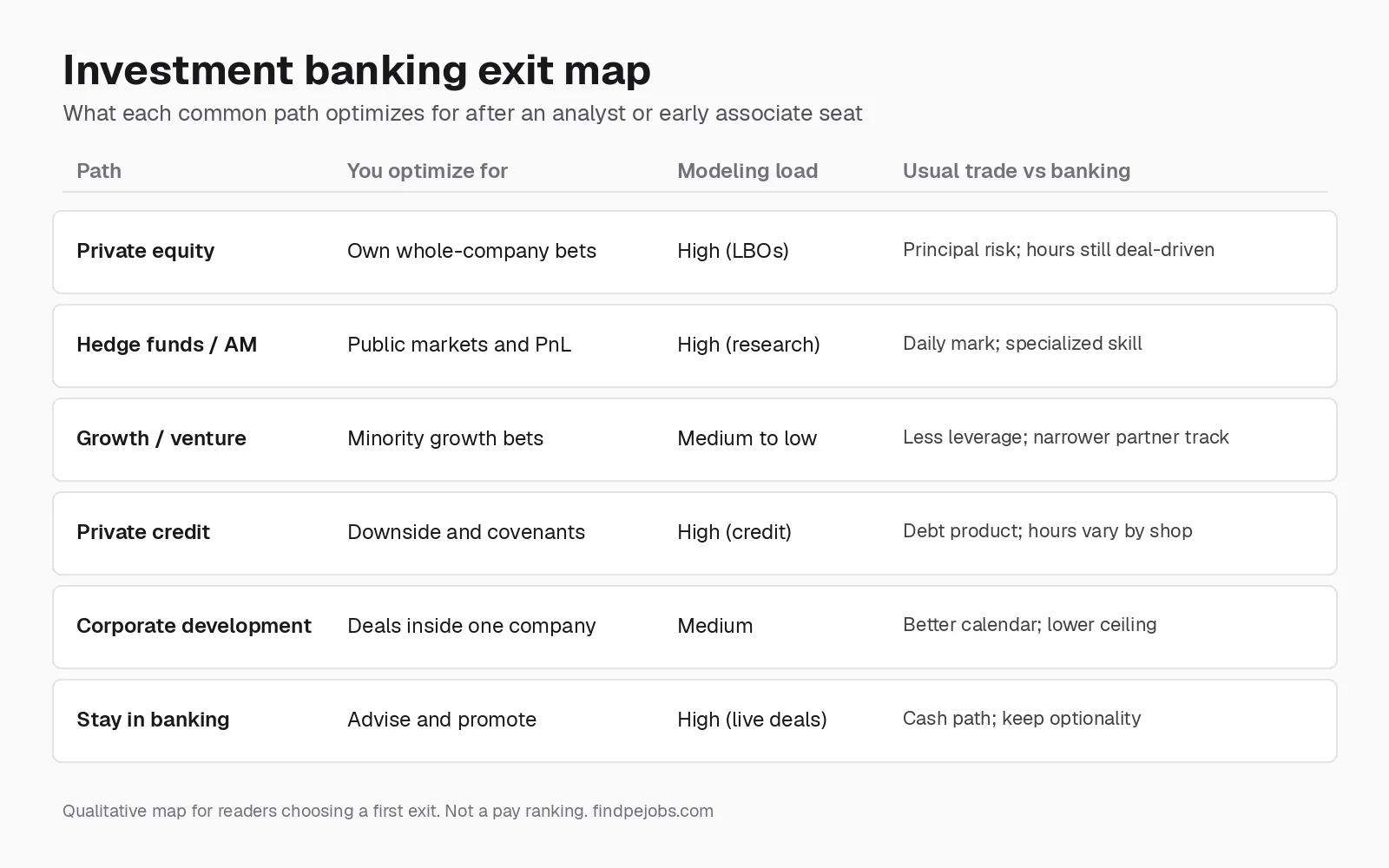
Let bank type shape which seats you aim at first. Bulge bracket and elite boutique analysts have denser mega-fund pipelines. Middle-market and regional bankers still exit, usually into middle-market funds, corporate roles, credit, and smaller partnerships, often with more self-directed networking. Group matters as much as logo. Financial sponsors, mergers and acquisitions, leveraged finance, and restructuring map cleanly onto buy-side equity and credit hiring. Leveraged finance and restructuring feed private credit especially well. Healthcare and life sciences coverage often maps to sector buy-side seats, pharmacy benefit managers and related operators, venture capital, and public equity in that industry. Project finance and infrastructure coverage maps toward infrastructure funds. Real estate coverage maps toward REITs, developers, and real estate private equity. Equity capital markets and debt capital markets give thinner deal stories for classic buyout interviews. Financial institutions groups can pigeonhole you into FIG-focused funds unless you want that specialty.
Seniority changes the odds. Analysts have the widest mobility. Associates are often treated as more expensive to retrain for mega-fund private equity unless they already have buy-side experience, and they land more often in corporate development, credit, lateral banking moves, or post-MBA searches. The usual timing window for a planned analyst exit is still around two to three years in seat, because that is when the résumé shows reps and the person is still junior enough to retrain. On-cycle private equity recruiting can start much earlier than that window feels, which is why people who want those seats prepare before they feel ready. Practitioner chatter in 2025 and 2026 has described on-cycle timing shifting and junior private equity hiring softening when portfolio exits slow; treat those as demand signals to re-check in the year you recruit.
Positioning is mostly group choice, deal ownership you can describe, and relationships in the target channel. Headhunters matter for large private equity searches. Corporate development and many credit seats still hire through network and direct applications. If you cannot explain why a week in the new seat is better for you than a week in banking, you are chasing a label. Once you are already inside a fund, promotion follows the private equity career path from associate onward.
Common questions
What jobs can you do after investment banking? Private equity, hedge funds, asset management, growth equity, venture capital, private credit, corporate development, in-house finance and strategy, startups and operating roles, an MBA, or a continued banking career. Equity research, private wealth, and family offices appear less often but are real for the right profile.
Which exit pays the most? Senior private equity and top hedge fund seats have the highest ceilings once performance and carry or profit share matter. Junior all-in pay is closer across banking, private equity, and credit than marketing charts imply, and corporate roles usually trade cash for hours. There is no single ranking that survives fund, year, and level.
Do you get better work-life balance after banking? Often in corporate development, many in-house finance seats, some credit shops, and some growth or venture roles. Not reliably in mega-fund private equity or in hedge funds that run concentrated books. Ask about live-deal hours at the specific team rather than trusting an asset-class average.
Do you need an MBA to leave banking? No for many private equity, credit, corporate development, and hedge fund seats hired from the analyst program. Yes when you need a structured switch the résumé cannot explain alone, or when a target employer still filters that way.
Is private credit just backup private equity? No. It is a different product with different skills and economics. Bankers from leveraged finance and restructuring are often preferred because they already speak debt and workout language.
Can you exit well from a middle-market or non-target bank? Yes, especially into middle-market funds, corporate development, credit, and smaller partnerships. Mega-fund odds are lower and the search is more self-directed.
Sources
- Private Equity Jobs pages linked in the body for definitions and process depth owned on those URLs.
- Practitioner posts used only for demand and culture color (not pay surveys): @BoringBiz_ (exit menu framing, July 2024); @BoringBiz_ (reasons colleagues stay in banking, April 2026); @BoringBiz_ (junior PE hiring soft on slower portfolio exits, September 2026, anecdotal); @WallStreetOasis (corporate development as a discussed exit, August 2025); @brandonintheair (corporate development hiring from banking, May 2025).
- Other public explainers were opened for section coverage only; none is cited as a primary source for numbers.
Related posts

Elite boutique investment banks are independent advisers that work on deals as large as the bulge brackets' without lending or trading: Evercore, Lazard, Centerview, PJT Partners, Moelis, Perella Weinberg, and Qatalyst. Their 2025 revenue and pay from annual filings, how they differ from bulge brackets and middle-market banks, and which place analysts into private equity.

Bulge bracket banks are the largest global investment banks: JPMorgan Chase, Goldman Sachs, Morgan Stanley, Bank of America, Citigroup, and Barclays, with Deutsche Bank and UBS on the border. The 2026 list with filed revenue, how they compare with elite boutiques and middle-market banks, what each does for private equity firms, and which banks place analysts at the largest buyout funds.

Buy-side firms such as private equity funds invest capital for a return, and sell-side banks are paid fees and commissions to arrange the deals and trades. Which firms sit on each side, how each is paid, how research and licensing differ, and how careers move from banking into private equity.