

Sales and trading (S&T) is the markets division of an investment bank that pitches trade ideas to institutional clients and executes or makes markets in securities, earning commissions, fees, and bid-ask spreads. The floor is organized by product (equities; fixed income, currencies, and commodities (FICC)) and by role (salesperson, trader, sales trader, structurer, quant). After the Volcker Rule, bank desks are built around client flow and market-making. Standalone proprietary books largely left the banks. Full-service and bulge bracket banks run the large franchises. Elite boutique investment banks generally do not.
For someone aiming at private equity, two facts matter more than the hours table. First, bank S&T sits on the sell side next to investment banking division (IBD) deal teams, but the skill set and placement density point toward hedge funds, prop shops, electronic trading, and financing seats rather than classic buyout associate classes. Second, quarterly bank headlines that say "equities sales and trading" or "FICC sales and trading" measure franchise revenue. They are not a day-in-the-life of an analyst.
What sales and trading is
An institutional client that wants to buy or sell a large block of stock, a package of bonds, a rate hedge, or a currency position rarely does it the way a retail account buys 100 shares. Size moves prices. Some products have no deep public exchange. The client wants a known price, fast, from a counterparty with balance sheet, inventory, and risk systems. That counterparty is the bank markets desk.
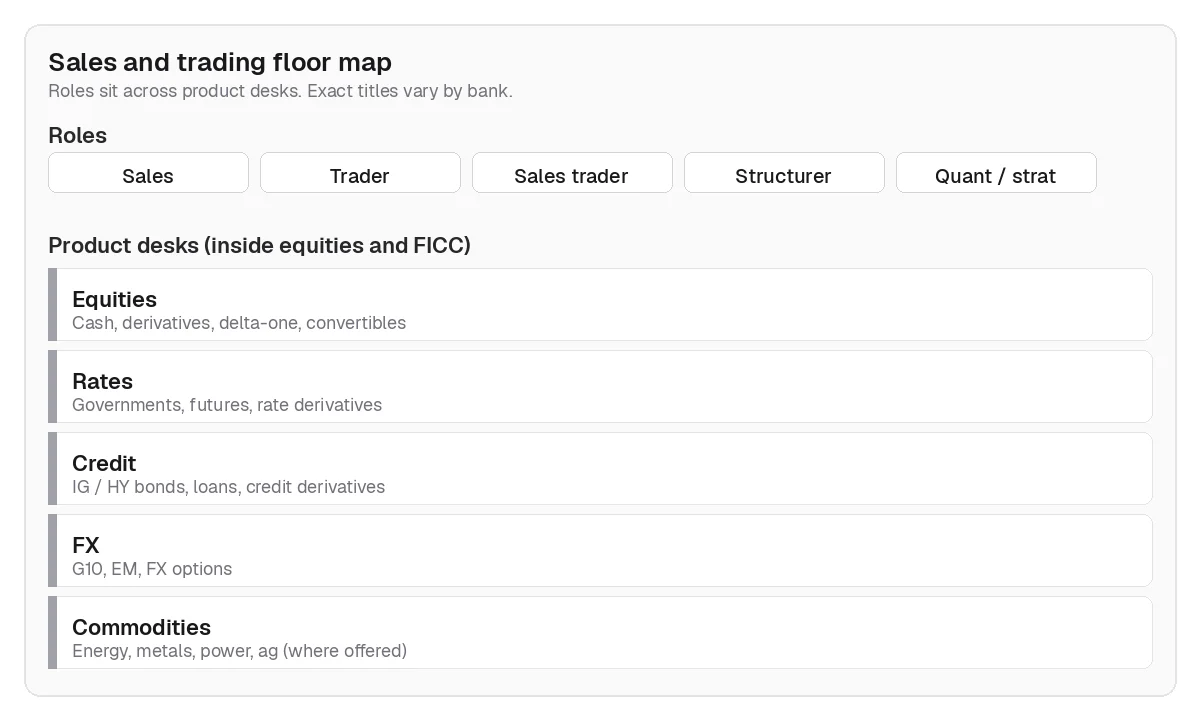
Salespeople own the client relationship. They cover hedge funds, asset managers, insurers, pension plans, corporations, or other banks by product and by account list. They bring the client color, research, and a reason to trade with that bank rather than the next one. Traders set prices, take the other side when the desk is principal, route agency orders when the desk is an agent, and manage the inventory and hedges that sit on the book after the client is done. Structurers design and price complex packages when a vanilla product will not do the job. Quants and "strats" build the pricing, risk, and electronic platforms that keep the desk competitive.
The desk makes money in three linked ways. It clips a bid-ask spread or commission on facilitating client flow. It earns fees on structured or financing transactions. It takes residual principal risk on inventory that cannot be hedged perfectly the moment the trade prints. Liquid products (cash equities, major FX, on-the-run Treasuries) have tight spreads and high automation. Illiquid or complex products (many credit instruments, bespoke derivatives, some commodities) have wider spreads, slower conversations, and more human judgment. More flow usually means more information and more chance to earn those economics, which is why desks fight for share of wallet.
Market-making is not the same as day-trading a personal account, and it is not the same as a hedge fund that only risks its own capital. The bank desk exists first to serve clients. Profit and loss (P&L) still moves every day with the book. That tension is the job.
Roles on the floor
Sales. The salesperson is the client-facing seat. Coverage is usually split by product (equity derivatives, rates, credit, FX) and by client type (hedge funds versus "real money" long-only managers, corporates, or insurers). The work is relationship, idea generation, and getting the client to trade with your desk. Senior salespeople earn a cut of the revenue their accounts generate. They do not typically carry a trading book after the trade is done.
Trader. The trader makes markets and manages risk. Clients arrive through sales (or through electronic channels). The trader shows a price, decides whether to take the risk, hedges what can be hedged, and lives with what cannot. Mental math, product knowledge, and composure when the book is wrong matter more than a long PowerPoint. Unlike most IBD seats, the trader sees a P&L that updates with the market.
Sales trader. Some desks combine relationship and execution in one seat, especially in cash equities and parts of listed derivatives. The sales trader talks to the client and works the order without always handing every ticket to a separate market-maker. Sales traders usually take the smaller and simpler tickets, such as vanilla rate swaps for smaller clients or routine cash equity orders. A larger or more complex trade still goes to a dedicated trader, and on some desks the sales trader's fills land in a central risk book rather than a personal one. Titles and exact splits differ by bank.
Structurer. On complex desks (equity derivatives, credit derivatives, structured rates, some commodities), a structurer designs the payoff, prices it with the quant tools, and works with sales to explain it to the client and with trading to risk-manage it. The seat sits between sales relationship skills and trader/quant technical depth.
Quant / strat. Quants maintain pricing models, risk systems, and electronic or algorithmic trading platforms. Cash equities and FX already run heavily through code. Credit and bespoke derivatives still need models that a human trader and structurer can trust. Quant hiring is usually a separate pipeline from the generalist S&T analyst program, closer to a technical interview than a markets "fit" chat.
Research (equity research, credit research, strategy) often sits near the floor and feeds ideas to sales and to clients. It is adjacent, not identical, to the S&T P&L seats. Summer programs sometimes rotate through research; the full-time research track is usually hired on its own path.
Desks and products
Large banks split markets into equities and FICC, then into narrower desks.
Equities. Cash equities trade single-name stocks in institutional size. Much of the routine flow is electronic; humans still handle large, sensitive, or awkward orders. Equity derivatives cover listed and OTC options and related structures. Delta-one products (swaps, forwards, and other instruments that move roughly one-for-one with the underlying) and convertible bonds often sit under the equities umbrella because their risk is equity-linked.
Fixed income (inside FICC). Rates desks trade government bonds, futures, and interest-rate derivatives. Credit desks trade investment-grade and high-yield corporate bonds, loans, and credit derivatives. Securitized products cover mortgage-backed and asset-backed securities. Municipals cover tax-exempt issuance. Distressed and specialized credit desks exist at banks that still run them. Balance-sheet-heavy credit books favor banks with large balance sheets; rates and liquid government products are less capital intensive.
Currencies (FX). G10 and emerging-market FX, plus FX options, are classic flow businesses with heavy electronification. Corporate and investor hedging still needs sales coverage and traders who can warehouse residual risk.
Commodities. Oil, gas, power, metals, and agriculture appear at banks that kept a commodities franchise. Not every bulge bracket runs a full commodities suite. Where the franchise exists, structuring and physical or logistics adjacency can matter as much as screen trading.
Financing and prime-brokerage-adjacent activity often sits near markets even when the organization chart puts it in a neighboring box. Securities financing, stock loan, and some structured financing desks are part of how the franchise monetizes client relationships. They are not the same product as leveraged finance capital markets inside IBD.
Desk culture varies more than industry-group culture in M&A. A Treasury flow book and a CLO conversation desk do not feel like the same job. Choosing a product is part of choosing the seat.
How trades are done after Volcker
Bank trades follow four patterns.
Flow (principal market-making). The bank is principal. The client wants to buy or sell; the trader shows a two-way market, takes the other side, and earns a spread while managing the resulting inventory. Most voice and hybrid fixed-income and many derivative trades look like this.
Agency. The bank routes the order to an exchange or other venue and earns a commission. The bank takes little or no principal risk. Cash equities and many listed futures fit this pattern when the desk is not warehousing the position.
Electronic. Clients trade on a bank platform or through algorithms with little or no phone call. Humans still build the platform, watch risk, and cover clients. The "trader" seat on highly electronic products often looks more like risk oversight and tooling than yelling into a turret.
Proprietary. The desk risks the firm's capital for its own account with no client facilitation mandate. In the United States, the Volcker Rule generally restricts banking entities from proprietary trading while allowing underwriting, market-making-related activity, risk-mitigating hedging, trading in certain government obligations, and acting as agent, broker, or custodian, subject to compliance limits. The market-making exemption ties a desk's inventory to the reasonably expected near-term demand of clients, customers, and counterparties. Compliance monitors that limit, so a trader whose position in a bond jumps far above the size the desk normally carries for client flow should expect to explain why. Banks shut or spun out most pure prop desks after the crisis-era rules. What remains on the bank floor is client franchise trading with residual principal risk, not an internal hedge fund with a blank mandate.
Undergrads often confuse three different seats. Bank S&T is client market-making under Volcker-style constraints. A prop trading firm (or a prop desk that left a bank) risks its own book without a bank client franchise. A hedge fund is a buy-side vehicle that invests client or partner capital under its own strategy. Non-bank liquidity providers such as Jane Street and Citadel Securities sit in a fourth industry category: principal market-makers that compete with bank desks for flow without being the client's full-service bank. Regulation, capital, and client coverage differ across all four. The labels are not interchangeable.
Which banks run real markets seats
Real multi-asset S&T seats concentrate at full-service banks with markets franchises: the U.S. bulge brackets and a short list of global peers with large FICC or equities platforms. Those banks have the client lists, the balance sheet, the technology budget, and the compliance infrastructure to make markets across products. Within that set, franchises are not identical. Some houses are known for equities, others for rates or credit, others for commodities or FX. League tables of estimated flow exist in the trade press and in practitioner guides. They are directional. A smaller desk at a strong brand can still place well; a top-ranked product at a weak desk culture can still be a bad seat.
Elite boutique investment banks are built around M&A and restructuring advice. They generally do not run institutional S&T floors. Middle-market and advisory-focused firms may have limited capital-markets distribution; that is not the same as a full equities and FICC division. Candidates who want markets work should not assume every famous banking brand has a trading floor.
Regional and non-U.S. national banks can be the right platform in their home market. The hiring map is local. The product map is still sales, trading, and risk around client flow.
Sales and trading vs investment banking
IBD bankers advise companies on mergers, acquisitions, and capital raising. The work is deal-based: pitches, models, process letters, diligence, and closings that can stretch for months. Hours follow live deals and can run late into the night and through weekends when a process is hot.
S&T follows the market calendar. The desk is in before the open, busiest while the market is open, and usually lighter after the close than a deal team on a live auction. Desks in less liquid products, which do not follow an exchange open and close, can run later, and sales seats add client dinners and events in the evening. It is not a promise of an easy job. P&L stress and client coverage still fill the day.
The two divisions also sit on opposite sides of the bank's information barrier. IBD deal teams hold material nonpublic information about clients' mergers and financings. Salespeople and traders sit on the public side and must not receive it, and Section 15(g) of the Securities Exchange Act of 1934 requires broker-dealers to keep written policies designed to prevent its misuse.
The sharper contrast is the feedback loop. A trader or salesperson sees whether the price was right, whether the client traded, and how the book behaved, often the same day. An IBD analyst can work for weeks on a pitch that never becomes a live mandate. Candidates who want a fast markets scoreboard and a product specialization tend to prefer S&T. Candidates who want company-side advisory work, sponsor coverage, and the classic buyout feeder path tend to prefer IBD coverage, sponsors, or related product groups.
Skill overlap is thinner than outsiders assume. Both seats use Excel, both care about markets, and both sit inside a bank. IBD builds accounting, valuation, and process skills that private equity screens for. S&T builds product, risk, and client-markets skills that hedge funds, prop firms, and electronic trading teams screen for. Moving from S&T into classic buyout private equity is possible but uncommon relative to strong IBD seats. Moving from S&T into a markets buy-side seat is the natural adjacency.
How people get hired
Most full-time junior seats in U.S. bank S&T still come from summer analyst classes. Sales and Trading Prep puts the split at roughly 90 percent summer conversions to 10 percent direct full-time hires at most major banks. Recruiting timing tracks the broader investment-banking calendar: applications, online assessments or HireVue screens, then a superday (or regional equivalent) with multiple short interviews, often three back to back with associates and junior vice presidents.
Resume screens look for earlier finance internships and concrete evidence of markets interest. Interviews test markets interest, mental math, product curiosity, and fit. Candidates are expected to name desks they care about (rates, credit, equity derivatives, FX) with a reason, not only "I like trading." Programming and probability questions show up more for trading and quant tracks than for pure sales. Brainteasers appear more often than in pure M&A interviews. Networking still helps get a resume read, but cold-calling a trader during market hours is a fast way to be ignored.
Rotational summers (desk rotations across products) are common at some banks. Others place interns closer to a desk early. Either way, desk preference at conversion time matters. The product you land on shapes skills, hours texture, and exits more than the bank logo alone.
Quant and strat roles often recruit through a separate technical process. Candidates with strong math, physics, or computer science backgrounds should not assume the generalist S&T HireVue is the only path.
No specific degree is required, but junior classes lean toward economics, mathematics, and other quantitative subjects. eFinancialCareers found that recent sales and trading junior hires at JPMorgan and Bank of America came mainly from economics and the sciences, particularly mathematics, and banks now push traders to learn Python. In the United States, salespeople and traders at a broker-dealer must also register with the Financial Industry Regulatory Authority (FINRA). The Securities Industry Essentials exam is the corequisite; salespeople typically add the Series 7, and equity traders the Series 57 (Securities Trader Representative). The employing firm sponsors those exams after the hire, so candidates do not sit them before applying.
Pay shape
Junior S&T pay at large U.S. banks sits in the same broad all-in neighborhood as junior IBD pay, with bonus more tightly tied to desk and individual performance as titles rise. Published figures move every cycle. Use dated sources; do not treat forum screenshots as primary.
Wall Street Prep's sales and trading guide (updated 28 November 2023) put a typical major-bank S&T analyst starting base at $85,000 with a $50,000 to $80,000 bonus. Sales and Trading Prep's ranges for a top U.S. bulge bracket in New York (updated 22 July 2025) start first-year analysts at $85,000 to $90,000 base with a $25,000 to $50,000 bonus, and first-year associates at $115,000 to $135,000 base with a $35,000 to $100,000 bonus. The bonus band widens with seniority because the desk head can attribute more of the desk's results to the individual.
eFinancialCareers' 2026 Compensation & Lifestyle Report, a survey of finance professionals, put average global sales and trading total compensation at about $100,000 for analysts, $200,000 for associates, $460,000 for vice presidents, and $840,000 for managing directors. In the same survey, sales and trading was the best-paid banking function for 2025, with average total compensation up 13 percent on the year and managing director pay up 12.5 percent to $837,000. Those are self-reported averages across cities and banks, not an offer letter. CFA Institute's 2019 compensation study of charterholders and members reported a typical global total compensation of $165,000 for trading roles ($108,000 base). That CFA figure is a cross-sectional member survey, not a Wall Street analyst offer letter, and it is dated 2019.
The title ladder looks like the rest of the bank: analyst, associate, vice president, director or executive director, and managing director. Unlike the IBD pre-MBA and post-MBA split, S&T promotes analysts to associate internally without an MBA, traditionally after three years and sometimes after two. eFinancialCareers estimates about eight years to reach director. At the top, some managing directors keep producing revenue while others move into desk management, which trades a share of upside for steadier pay. Junior seats are rarely cut for performance alone. From vice president upward, a single weak year can cost the seat.
Senior pay varies more than in IBD because variable compensation tracks desk P&L and personal production. Strong years on a strong desk pay very well. Weak years or a shrinking product pay less. Hours-adjusted, many people still prefer S&T to IBD even when headline all-in is similar. That preference is personal. It is not a rule.
Exit opportunities from sales and trading
Exits from bank S&T run mostly to other markets seats, and they get harder with tenure. People who want to leave markets for something else usually decide within the first year or two.
Hedge funds and other buy-side markets seats. Equity, credit, macro, and relative-value funds hire from desks that trade the same products. Salespeople with deep account relationships also move into investor-relations-adjacent or capital-introduction roles, though pure investing seats usually prefer trading or research backgrounds.
Prop trading firms. Discretionary and systematic prop shops hire people who have already managed risk or who can pass a prop interview process. Bank flow experience helps; it is not identical to prop culture or capital structure.
Electronic trading, quant trading, and trading technology. Candidates who spent junior years on electronic products, tools, or strat work can move toward non-bank market-makers, trading tech firms, or bank e-trading leadership tracks.
Financing, securities services, and related markets seats. Stock loan, securities financing, and some structured financing roles sit near the franchise and absorb people who know how institutional clients actually trade and finance positions.
Other corporate sales or markets-adjacent roles. Sales skills transfer outside banking more cleanly than pure trading P&L skills. Trading skills transfer best to other trading seats.
Classic buyout private equity associate classes still draw most heavily from IBD (especially M&A, sponsors coverage, and related product groups). Most investment banking exit opportunities into buyouts run through those deal teams. S&T alumni do show up in private credit, special situations, and markets-heavy investing seats more often than in vanilla mega-fund buyout classes. Treat PE as a possible later move with a story, not as the default outcome of an S&T analyst program.
When the seat is a poor fit
S&T is a poor first seat if the only goal is a standard on-cycle buyout associate offer at a mega-fund. Placement density for that outcome sits on strong IBD coverage and product groups, not on the trading floor. Preferring markets work, faster feedback, and a product specialty is a good reason to choose S&T. Choosing S&T as a stealth PE path is usually a bad plan.
It is also a poor fit if you dislike P&L accountability, do not care about a specific product, or want company-side advisory storytelling more than client markets flow. Sales and trading draw on different skills, and desk mismatches are common when candidates chase a hot product they cannot explain.
It is a strong fit if you want institutional markets depth, can live with a daily scoreboard, and see hedge funds, prop, e-trading, or financing as success rather than as consolation prizes.
What is changing the franchise
Two forces are reshaping bank markets divisions: electronification and non-bank competition. A third, AI, is starting to change junior work.
Electronification. Cash equities and much of FX already run through platforms and algorithms. Voice matters more where products are complex, illiquid, or relationship-driven (much of credit, bespoke derivatives, large sensitive blocks). Automation removed low-complexity tickets. It did not remove the need for sales coverage or for humans who manage risk that cannot be perfectly hedged. At Goldman Sachs, the U.S. cash equities desk in New York employed 600 traders in 2000; by early 2017 it had two, with automated trading supported by about 200 engineers, according to Marty Chavez, then deputy chief financial officer, as reported by MIT Technology Review.
Electronification is not a one-way trend. Coalition Greenwich data show U.S. Treasury electronic trading fell from 59 percent of volume in 2024 to 55 percent in 2025, which the firm attributed to more voice-executed package trades combining bonds with swaps and futures. In foreign exchange, the Bank for International Settlements' April 2025 Triennial Survey found electronic execution at 59 percent of turnover, virtually unchanged since the 2022 survey, with voice still used for large spot trades and bespoke derivatives.
Non-bank liquidity providers. Firms such as Jane Street and Citadel Securities compete with banks for principal market-making in equities and other liquid products. Boston Consulting Group's Corporate and Investment Banking Report 2025 (14 October 2025) projects that non-bank financial institutions will account for 30 percent of global trading activity by 2030; Bloomberg's coverage of the report put their current share at about one-fifth of global trading revenue. Jane Street alone handled about 10 percent of U.S. equity market volume in 2024, on net revenue of $20.5 billion, according to Global Trading. Banks still win where clients want a full-service relationship, financing, research, and balance sheet across products. They lose pure commoditized flow when a non-bank is sharper on price and speed.
AI. eFinancialCareers reports that AI tools are taking over the administrative work that used to train juniors: client onboarding, report compilation, and news collation. The same report describes AI pricing models reaching less liquid products such as high-yield credit, where price data are patchy. BCG's 2025 report names FICC and equities trading as the businesses that gain most from AI-led automation. For a junior, the exposed tasks are the ones that do not involve a client conversation or a risk decision.
Regulation after the financial crisis (Volcker-style prop limits, capital and liquidity rules) pushed banks to allocate balance sheet to products and clients that clear internal hurdles. That is one reason franchises specialize and why credit-heavy books cluster at large-balance-sheet banks. Private credit's growth also changes which financing conversations happen inside banks versus outside them.
Bank markets divisions now employ fewer people in commoditized voice products, run more electronically, and face non-bank competitors on liquid flow. They still need people where products are complex, illiquid, or relationship-driven, so candidates should judge a specific desk and product rather than the trading floor as a whole.
Common questions
Is sales and trading the same as investment banking?
No. Both sit inside a bank, and both appear under broad "investment bank" brands. IBD advises on deals. S&T makes markets and executes for institutional clients. Hours, skills, and exits differ.
Do elite boutiques have sales and trading?
Generally no. Elite boutiques are advisory firms. Markets seats sit at full-service and bulge bracket banks (and at some regional or specialist dealers).
Is proprietary trading still a bank job?
Pure prop desks are largely gone from U.S. banks under the Volcker Rule. Bank traders still take principal risk as part of market-making and inventory management. Prop firms outside banks are a different employer set.
How many hours do analysts work?
Expect a market-day shape: early start, intense open-to-close window, fewer routine midnight pitches than IBD. Live events, month-end, and desk-specific rhythms still create long days. Treat "better lifestyle" as relative to deal teams, not as a short desk.
Can you move from sales and trading to private equity?
Sometimes, especially toward private credit, special situations, or markets-heavy seats. Classic mega-fund buyout hiring still prefers strong IBD paths. Plan accordingly.
Sales or trading?
Sales owns clients and revenue from their flow. Trading owns prices and the book. Sales traders blend both on some products. Choose based on the work you want to do every day, not on which title sounds more senior.
Does a summer internship matter?
Yes. Most full-time junior seats convert from summers. Full-time hiring without a summer is the narrower door.
Sources
- Mergers & Inquisitions, "Sales & Trading (S&T)" (https://mergersandinquisitions.com/sales-trading/).
- Sales and Trading Prep, "Sales and Trading in 2025: Overview, Desks, and the Interview Process" (https://salesandtrading.org/blogs/st/sales-and-trading-101), updated 22 July 2025.
- Wall Street Prep, "Sales and Trading Guide" (https://www.wallstreetprep.com/knowledge/the-ultimate-guide-to-sales-and-trading/), updated 28 November 2023 (analyst base $85,000; bonus $50,000 to $80,000).
- CFA Institute, "A career in sales and trading" (https://www.cfainstitute.org/programs/cfa-program/careers/sales-and-trading), including 2019 CFA Institute compensation study figures for trading roles (typical global total $165,000; base $108,000).
- eFinancialCareers, "What is sales & trading and what do salespeople & traders do?" by Daniel Davies and Zeno Toulon (https://www.efinancialcareers.com/news/how-do-you-get-a-job-in-sales-and-trading-in-a-bank), 27 July 2026, citing the eFinancialCareers 2026 Compensation & Lifestyle Report (analyst about $100,000; associate about $200,000; vice president about $460,000; managing director about $840,000; about eight years to director).
- eFinancialCareers, "Traders enjoyed big bonus increases after a strong 2025" by Zeno Toulon (https://www.efinancialcareers.com/news/sales-trading-pay), 27 April 2026 (sales and trading total compensation up 13 percent; managing director total $837,000).
- Sales and Trading Prep, "What is a Sales Trader? Here's What You Need to Know" (https://salesandtrading.org/blogs/st/what-is-a-sales-trader), updated 6 July 2023.
- Nanette Byrnes, "As Goldman Embraces Automation, Even the Masters of the Universe Are Threatened," MIT Technology Review (https://www.technologyreview.com/2017/02/07/154141/as-goldman-embraces-automation-even-the-masters-of-the-universe-are-threatened/), 7 February 2017 (600 cash equities traders in 2000; two in 2017; about 200 engineers).
- Crisil Coalition Greenwich, "U.S. Treasury trading in 2025 by the numbers" (https://www.greenwich.com/market-structure-technology/us-treasury-trading-2025-numbers), 3 February 2026; figures as reported by The DESK, "US Treasury e-trading declined in 2025" (https://www.fi-desk.com/us-treasury-etrading-declined-in-2025/), 5 February 2026 (electronic share 59 percent in 2024, 55 percent in 2025).
- Bank for International Settlements, "The FX trade execution landscape through the prism of the 2025 BIS Triennial Survey," BIS Quarterly Review (https://www.bis.org/publ/qtrpdf/r_qt2512v.htm), 8 December 2025 (electronic execution 59 percent of turnover in April 2025).
- Boston Consulting Group, "Non-Bank Players Set to Claim One-Fifth of Corporate and Investment Banking Revenues by 2030" (https://www.bcg.com/press/14october2025-non-bank-players-set-to-claim-one-fifth-of-corporate-and-investment-banking-revenues-by-2030-reshaping-the-future-of-capital-markets), 14 October 2025, on the Corporate and Investment Banking Report 2025; Bloomberg, "Jane Street-Led Bank Rivals Poised to Take 30% Trading Share" (https://www.bloomberg.com/news/articles/2025-10-24/jane-street-led-bank-rivals-to-take-30-trading-share-bcg-says), 24 October 2025.
- Global Trading, "Jane Street took 10% of US equity market in 2024" (https://www.globaltrading.net/jane-street-took-10-of-of-us-equity-market-in-2024/), 24 April 2025.
- FINRA, "Series 57: Securities Trader Representative Exam" (https://www.finra.org/registration-exams-ce/qualification-exams/series57); Securities Exchange Act of 1934, Section 15(g) (15 U.S.C. 78o(g)), on policies to prevent misuse of material nonpublic information.
- Wikipedia, "Sales and trading" (https://en.wikipedia.org/wiki/Sales_and_trading), Volcker Rule summary and references to CFTC final rules and OCC Volcker implementation FAQs.
- Board of Governors of the Federal Reserve System / interagency Volcker Rule materials (final rule implementing section 13 of the Bank Holding Company Act); OCC, "Volcker Rule Implementation Frequently Asked Questions" (https://www.occ.gov/topics/supervision-and-examination/capital-markets/financial-markets/trading-activity/volcker-rule-implementation-frequently-asked-questions.html).
- Private Equity Jobs, Buy side vs sell side, Bulge bracket banks, Elite boutique investment banks, Investment banking exit opportunities, Restructuring investment banking, Private equity vs investment banking, Private equity vs hedge fund, How to break into private equity, What is private equity.
Related posts
Related posts

Restructuring investment banking advises distressed companies and their creditors on capital-structure fixes, from out-of-court deals to Chapter 11. How the seat differs from M&A, which firms dominate, and when RX is the wrong path to buyout PE.

A clear map of investment banking exit opportunities, what each path actually trades, and how bank type and timing shape the odds.

Elite boutique investment banks are independent advisers that work on deals as large as the bulge brackets' without lending or trading: Evercore, Lazard, Centerview, PJT Partners, Moelis, Perella Weinberg, and Qatalyst. Their 2025 revenue and pay from annual filings, how they differ from bulge brackets and middle-market banks, and which place analysts into private equity.