

Restructuring investment banking (RX) is the product group that advises companies that cannot service their debt, or the creditors of those companies, on changing the capital structure so the business can keep operating. The work covers out-of-court amendments and exchanges, Chapter 11 reorganizations, liability-management transactions, and sales of assets or of the company itself under stress. The same firm rarely advises both sides on one deal. Elite boutiques and specialist houses such as Houlihan Lokey win most of the large mandates; bulge bracket banks run restructuring groups too, but they do not dominate the product the way they dominate underwriting.
For someone aiming at private equity, the group matters for two reasons that the career guides rarely put in one place. First, sponsor-backed companies with heavy leverage are frequent clients, and private credit funds sit on the creditor side of many of those capital structures. Second, RX is a strong feeder into private credit, special situations, and distressed investing, and a weaker feeder into classic buyout associate seats than mergers and acquisitions (M&A) coverage at the same banks.
What restructuring investment banking is
A restructuring banker is hired when a company's capital structure no longer fits the cash the business can produce. The company may still be paying interest and looking solvent on an accounting basis, or it may already have missed a payment, breached a covenant, or filed for bankruptcy protection. The banker's job is not to "maximize value" in the M&A sense of pushing a sale price as high as possible. The job is to find a capital structure that the business can carry, that creditors will accept, and that can be implemented under the documents and, when needed, under the U.S. Bankruptcy Code.
Two sides appear on almost every live situation. The debtor is the company (or sometimes a government or municipal issuer). The creditors are banks, bondholders, term-loan lenders, mezzanine holders, and, increasingly, private credit funds that hold direct loans. One restructuring team advises the debtor. A different team, often at a different firm, advises a creditor class or an ad hoc group of creditors. Equity holders sit at the bottom of the stack and rarely hire their own restructuring bank unless a sponsor is injecting new capital as part of the solution.
Career writers often sort companies into stressed, distressed, and bankrupt. Stressed means the company can still pay interest but faces a maturity, a liquidity squeeze, or a path that will break covenants. Distressed means a default, a covenant breach, or trading levels that imply the market already prices a workout. Bankrupt means a Chapter 7 liquidation or Chapter 11 reorganization is underway. The labels are useful in interviews. On a live mandate the team cares more about the next liquidity event, the documents, and which class of creditors is "in the money."
What causes stress and distress
Three kinds of pressure show up again and again. Industry disruption cuts revenue or margins faster than the debt stack can be refinanced (a retailer losing share to e-commerce, a media company losing subscribers). A macro shock (rates, commodity prices, a pandemic, a funding freeze) hits a sector that borrowed when credit was cheap. Poor decisions inside the company (an acquisition that does not earn its keep, a working-capital cycle that worsens, a dividend or share repurchase that strips cash) leave less runway than the covenants assume.
A catalyst usually turns stress into a live restructuring discussion. Common catalysts are a missed interest or principal payment, a covenant breach on leverage or interest coverage, a ratings downgrade that closes the refinancing window, a revolver that is nearly fully drawn, or a bond or loan maturity that the company cannot roll. Senior bankers keep screens of issuers whose capital structures look fragile long before a filing. Getting hired early is part of the product: an out-of-court deal is cheaper and more flexible than a free-fall Chapter 11, and the firm that arrives first often wins the debtor mandate.
For leveraged buyout issuers, the same pattern often starts with a capital structure built when rates were lower and exit multiples looked higher. When the hold period stretches and refinancing markets tighten, the portfolio company and its sponsor face the same maturity walls and covenant tests as any other leveraged issuer. The sponsor is not a bystander. It sits on the equity, controls the board in many cases, and becomes a counterparty in the negotiation that creditors and their advisers treat as part of the deal.
Debtor-side and creditor-side mandates
On a debtor mandate the restructuring team works for the company. It builds a view of debt capacity, runs valuation and liquidity analysis, maps options the documents allow, and helps management negotiate with creditors. The team often helps raise new money (including debtor-in-possession financing in court) and may run a sale process for assets or for the whole company. Fee economics usually favor the debtor side: retainers plus a success fee often scale off a large base of debt face value, and add-on fees for capital raises and sales can stack on top.
On a creditor mandate the team works for a class of lenders or an ad hoc group. The job is to test the company's plan, challenge soft assumptions, and improve recoveries for that class. Creditor clients are usually sophisticated. They already understand workouts. They hire a bank to dig into the model, to run a process while the holders stay unrestricted and able to trade, and to coordinate a group that would otherwise fragment. Creditor fees are typically smaller per mandate because they scale off one class of claims rather than the whole stack, but there are more creditor classes to pitch.
The fulcrum security is the layer in the capital structure where enterprise value "breaks." Senior claims above it are expected to recover in full in the base case. Claims below it are expected to recover little or nothing, unless seniors consent to share. Owners of the fulcrum paper often end up with most of the equity of the reorganized company, which is why creditor groups fight to be treated as the fulcrum and why valuation fights dominate many cases.
Private credit changes the creditor picture without changing the mandate logic. A single direct lender or a small club can be easier to bring to the table than a diffuse bondholder class, or harder if that lender's documents and intercreditor rights are tight. Either way, the restructuring banker on the creditor side is often advising a private credit fund rather than a syndicated bank group. That is one reason RX experience transfers cleanly into private credit seats later.
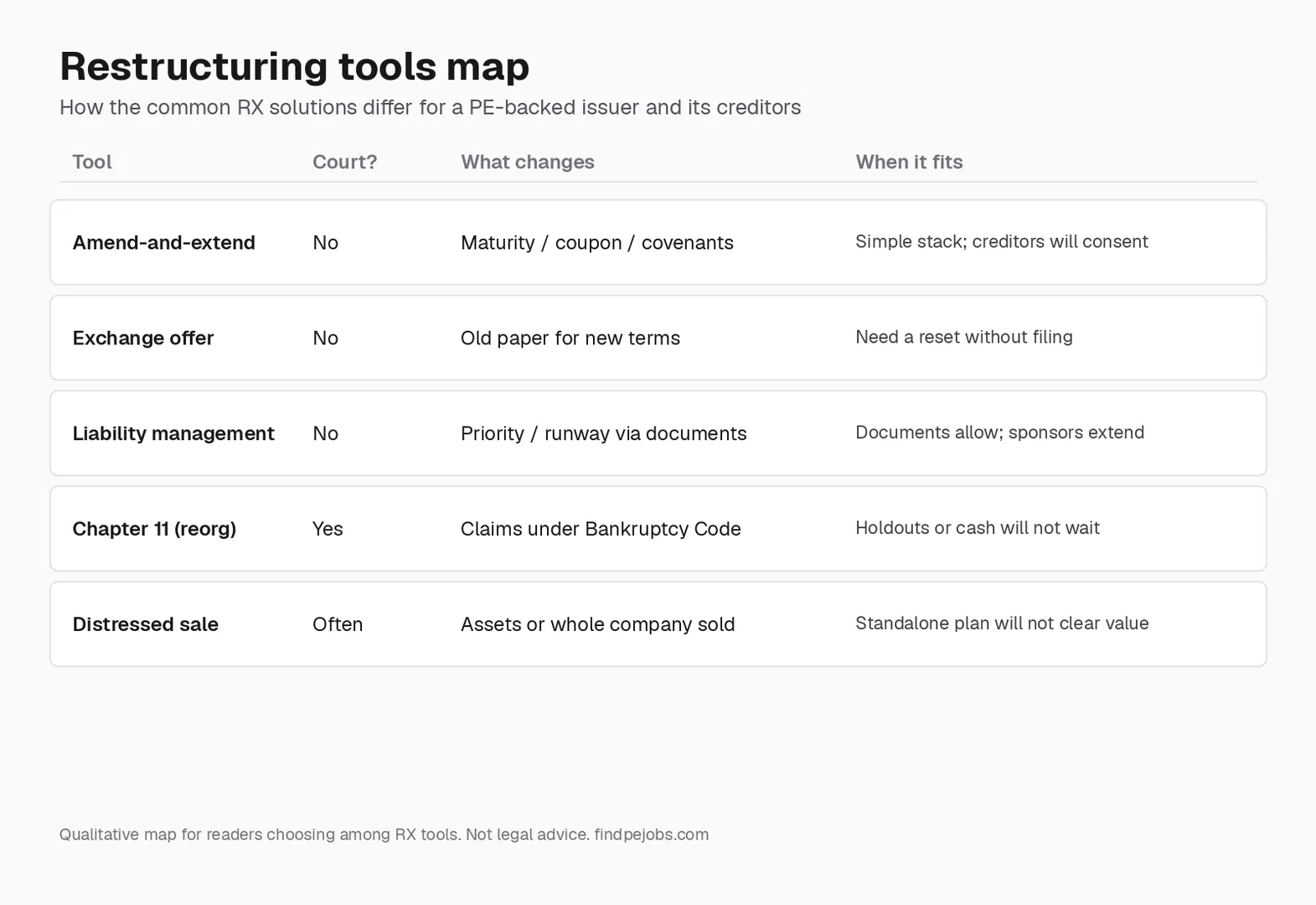
Solutions: out-of-court, Chapter 11, liability management, and distressed sales
Out-of-court restructuring is negotiation without a bankruptcy filing. Tools include amend-and-extend (push a maturity out, often for a higher coupon or tighter covenants elsewhere), exchange offers (swap old paper for new paper with different terms), and consensual amendments that reset covenants or add collateral. Out-of-court deals are faster and cheaper when the capital structure is simple and the required creditors will consent. They fail when holdouts block the vote or when the documents do not allow the fix the company needs.
Chapter 11 is the court-supervised reorganization path in the United States. The company usually keeps operating, proposes a plan of reorganization, and uses the Bankruptcy Code's voting and cram-down mechanics when consensus is incomplete. Pre-packaged or pre-arranged cases, where key creditors have already agreed, can move quickly. Free-fall cases, where parties arrive in court without a deal, burn cash and time. Chapter 7 is liquidation: assets are sold and proceeds follow priority. Restructuring bankers appear more often in Chapter 11 and in sales inside bankruptcy than in pure liquidations.
Liability management sits between "everything is fine" and a full restructuring. The company uses what its credit agreements still allow (drop-downs, uptiers, exchanges, priming structures, and other document-driven moves) to extend runway or reshape priority. Sponsors of leveraged portfolio companies have used these tools heavily in the rate-reset cycle since 2022. Creditors who lose priority call the same trades aggressive. Restructuring teams show up on both sides of those fights: sometimes to design the transaction, sometimes to block or renegotiate it.
Distressed M&A is a sale under time pressure. The company may sell non-core assets to raise cash, or sell itself because a standalone reorganization will not clear enough value. Inside Chapter 11, section 363 sales and plan sales have their own procedures, including stalking-horse bids and auction mechanics. The restructuring bank on the debtor side runs a compressed process. Creditor advisers scrub the price and the use of proceeds.
Valuation, the waterfall, and recovery analysis
Standard valuation tools still apply: comparable companies, precedent transactions, and discounted cash flow. Distressed work adds adjustments. Near-term cash may be weaker than a clean historical average. Working capital may be harder to collect. One-time costs (advisers, plant closures, contract rejects) need a clear treatment. Equity value is often a thin or zero residual, so enterprise-value methods matter more than price-to-earnings stories. Liquidation analysis asks what each asset class would fetch in a forced sale, with recovery factors that treat cash near face value and goodwill at zero.
The capital-structure waterfall applies absolute priority. Secured claims are paid from collateral value before unsecured claims. Unsecured claims come before equity. Junior classes do not receive value until seniors are paid in full, unless the seniors agree otherwise. Recovery analysis asks what each class receives under different enterprise values at emergence or under different sale prices. If total debt face is $800 million and the reorganized firm is worth $500 million, seniors may be close to whole while juniors take new equity or cents on the dollar. Change the exit multiple or the EBITDA case and the fulcrum security can move up or down the stack, which is why valuation fights are not academic.
Liquidity analysis sits beside valuation. A thirteen-week cash flow view (or a monthly view) shows when the company runs out of cash, when it must draw the revolver, and when a maturity forces a decision. That calendar often drives whether the company can stay out of court. Junior bankers spend a large share of the job maintaining the model, the claim register, and the recovery grid as negotiations move. They also read credit agreements and indentures to see which amendments need which votes, and which collateral or guarantee leaks a liability-management idea depends on.
Those tools are enough to understand the seat and to read a pitch. A full modeling course and the worked examples in longer career guides go further on DIP financing, thirteen-week cash flows, and interview drills.
How restructuring differs from M&A banking
M&A deal flow rises when confidence is high, credit is available, and boards are willing to sell or buy. Restructuring deal flow rises when those conditions fail: recessions, sector collapses, and refinancing freezes. That counter-cyclical pattern is why RX groups were busy in 2008-2009 and again in 2020, and why they stay busy when leveraged credit weakens even if headline M&A is soft.
The client temperament differs too. M&A clients are usually healthy companies choosing among growth options. RX clients are companies fighting for survival or creditors fighting over recoveries. Negotiations are adversarial by design, even when everyone prefers a going-concern outcome. Deadlines come from cash, from forbearance expirations, and from court calendars, not only from auction timelines.
The technical stack is heavier on credit documents, bankruptcy procedure, and intercreditor rights. An M&A analyst who has never read an indenture is learning a new language in RX. An RX analyst who has never run a sell-side auction is learning a different language in M&A. Both seats build models under deadline. They do not build the same instincts.
Which firms dominate restructuring
Large restructuring mandates concentrate at specialist firms rather than at the full-service banks that dominate bond underwriting. Houlihan Lokey runs the largest restructuring practice. On the LSEG 2025 global distressed-debt and bankruptcy restructuring ranking that Houlihan Lokey publishes on its Financial Restructuring page, it advised on 83 deals, ahead of PJT Partners (55), Lazard (50), Rothschild & Co (44), and Evercore (33). Those are deal counts. A small creditor-group mandate counts the same as a large debtor case, and many out-of-court deals are never tracked, so the table measures activity rather than fees. Among elite boutique investment banks, PJT Partners' Restructuring and Special Situations group, Lazard, Moelis & Company, Evercore, and Perella Weinberg are regular advisers on large debtor and creditor situations. Rothschild & Co is strongest in Europe. Ducera, Guggenheim Securities, Jefferies, and other restructuring teams compete on selected cases.
Bulge bracket banks are thinner in this product. Some run small restructuring or liability-management teams, and the large banks appear often as lenders of new money, DIP loans, and exit financing. They are less often the lead adviser on a pure financial-restructuring assignment because the same bank has frequently lent to the company, underwritten its bonds, or traded its debt, and that relationship conflicts with advising either the debtor or its creditors. That is the reverse of equity underwriting, where the bulge brackets dominate.
Firm lists move with cycles and with rainmaker teams. For a PE-path reader, placement matters more than a league table. In mega-fund associate hiring from the 2020 to 2025 analyst classes, buyout funds took Evercore analysts overwhelmingly from its M&A group and only occasionally from Evercore restructuring. Credit and special-situations funds lean the other way and hire heavily from RX and leveraged finance. Choosing the firm and the group together matters more than choosing "boutique" as a brand.
Getting hired into restructuring
Restructuring analyst and associate classes are small. Many candidates treat RX as a trophy seat after reading that it is "more interesting" or "better in a downturn," which raises competition without raising the number of chairs. On-cycle investment banking recruiting still feeds most undergraduate seats. Some groups also hire off-cycle when a mandate wave hits, and some look seriously at candidates with credit, legal, or restructuring internship experience that a generalist M&A resume lacks.
Lateral hiring into top RX groups is hard without directly relevant credit or restructuring work. Coverage bankers who want to switch mid-program usually need a live story (a distressed client, a liability-management deal, a credit internship) rather than a preference stated in an email. Boutique RX teams hire fewer people than a bulge bracket industry group, so each open seat draws applicants who have already self-selected hard.
Interviews test more than standard LBO and accounting questions. Expect absolute priority, fulcrum security, the difference between Chapter 11 and out-of-court, what a thirteen-week cash flow is for, and a view on a real stressed capital structure. Coming in with one issuer you have actually mapped (cap table, maturities, where value breaks) beats claiming you "like complex situations." Networking matters more than in large generalist pools because the community is smaller and senior bankers remember thoughtful outreach. Reading a definition is not interview preparation. Dedicated guides and question banks cover the drills.
At some firms the choice is not a separate application. Moelis is known for staffing analysts as generalists across M&A and restructuring work, and at some banks with restructuring practices specialization starts at associate or vice president level. Ask how a group staffs juniors before treating an offer as an RX seat.
Law-school hires and dual-degree candidates appear more often in RX than in pure M&A because the work sits on the Bankruptcy Code. That path is real and still narrow. For most undergraduates, the entry door remains a banking analyst seat in a restructuring group or a credit-heavy product group such as leveraged finance at a firm that still runs that desk.
Pay, hours, and lifestyle
At analyst and associate level, pay in RX sits in the same all-in bands as M&A at the same firm, so the filing-based elite boutique pay figures apply to RX groups at those firms. Senior pay swings more. Restructuring managing directors can out-earn M&A peers in a default cycle and lag them in quiet years, because bonuses follow mandate volume. Public career sites publish wide ranges that mix cities, firm types, and boom years. Treat round numbers on forums as gossip unless a filing or a named comp survey backs them. What is structural is fee timing: restructuring success fees arrive when deals close, so quiet credit years and busy credit years feel different inside the same group. Debtor mandates usually pay the bank more than creditor mandates on a like-for-like situation, which is why firms pitch debtor work hard when they can take it without a conflict.
Hours follow urgency. A company that will miss payroll, breach a forbearance, or hit a confirmation deadline does not wait for a calm calendar. Live court processes and exchange launches produce weeks that look like peak M&A. Restructuring teams are small, so junior hours are often longer than in M&A groups at the same bank, not shorter. Between mandates the pace can ease, but that lull is not a promise. Junior staff still build screens, refresh models, and staff multiple live workstreams when the group is busy. People who want predictable evenings usually leave banking rather than "choose RX for lifestyle."
Exit opportunities from restructuring
The cleanest buy-side exits from RX are private credit, special situations, and distressed debt funds. Those seats want people who already read credit agreements, argue about recoveries, and have sat through a workout. Among investment banking exit opportunities, private credit is now a mainstream hire from leveraged finance and restructuring. On the credit and special-situations route to break into private equity, the feeder is leveraged finance and RX, not a coverage group rebranded as credit.
Classic buyout private equity still hires RX analysts, especially at middle-market funds that see stressed sellers and complex structures. Mega-fund on-cycle pipelines still skew toward M&A and financial sponsors coverage. Someone whose only goal is a mega-fund buyout seat usually gets worse odds in RX than in a top M&A seat at the same firm, holding school and year fixed.
Other paths include staying on the advisory ladder to managing director, moving to a turnaround consulting firm, or joining a claims-trading or distressed trading desk. The exits that are harder from RX are the ones aimed at healthy companies. Corporate development teams rarely need a restructuring skill set, so an analyst who wants a corporate seat or a lighter schedule usually has an easier path from M&A or a coverage group. Distressed hedge funds hire people who can underwrite capital structure as an investment, not only as an advisory process. Living through a real Chapter 11 negotiation, including the sponsor fight on a PE-backed issuer, is the experience those desks underwrite when they hire. It is not a placement guarantee.
When restructuring is the wrong seat for buyout private equity
RX is a strong seat if you want credit, special situations, or distressed work, or if you want advisory work that mixes law, negotiation, and capital structure. It is a strong seat if you are choosing among banking groups and you care more about that craft than about maximizing mega-fund buyout odds.
RX is the wrong primary plan if your target is a classic buyout associate seat at a large fund and you are picking among offers that include a strong M&A or financial sponsors seat. Placement patterns still favor those M&A seats for mega-fund hiring. RX will not bar you from every buyout process, and middle-market funds hire from it. Using RX as a stealth buyout path, while telling interviewers you love bankruptcy for its own sake, is a common way to fail both recruiting processes.
RX is also a poor fit if you dislike adversarial negotiation, legal detail, or models that exist to allocate pain across a waterfall. The work is intellectually hard. It is not "M&A with better hours," and it is not a macro bet that a recession will make your career easy. Downturns bring mandates. They also bring fee risk when companies liquidate and success fees shrink.
If you want ownership of companies through a fund, learn what private equity associates actually do and recruit for that seat on purpose. If you want to advise through distress, take RX on purpose. The mistake is treating the group as a generic prestige ticket.
Common questions
Is restructuring investment banking the same as turnaround consulting?
No. Turnaround consultants focus on operations, cash, and management process inside the company. Restructuring investment banks focus on the capital structure, the creditors, and the transaction that changes claims. Live situations often use both.
Do bulge bracket banks do restructuring?
Some do, through smaller restructuring or liability-management teams, and the large banks often provide new financing in restructurings. Their lending and underwriting relationships with the company or its creditors create conflicts, so Houlihan Lokey and the major elite boutiques appear more often at the top of financial-restructuring league tables.
Is Houlihan Lokey an elite boutique?
By the usual elite boutique test focused on large M&A advice without lending, Houlihan Lokey is usually classed as a strong middle-market and restructuring specialist rather than as one of the core seven elite boutiques. Its restructuring group competes directly with those firms on large cases.
Does restructuring help you get into private equity?
It helps most for private credit, special situations, and distressed seats. It helps less, on average, for mega-fund buyout seats than a top M&A seat. Middle-market buyout hiring is more flexible.
What is liability management?
It is a set of transactions that reshape a company's liabilities using rights already in the credit documents, often to extend runway or change priority, without a full traditional restructuring. Amend-and-extend and certain exchanges sit in the same family of tools. Creditors who lose out litigate or negotiate hard.
Should I join RX only because a recession is coming?
No. Classes are small every year. Counter-cyclical mandate flow is real. So is competition from everyone else who read the same headline. Choose the work, not the macro bet.
Sources
- Mergers & Inquisitions, "Restructuring Investment Banking" (https://mergersandinquisitions.com/restructuring-investment-banking/).
- Restructuring Interviews, "Restructuring Investment Banking: Everything You Need to Know" (https://restructuringinterviews.com/blogs/restructuring/restructuring-investment-banking-101), updated 7 March 2023.
- Wall Street Prep, "Restructuring Investment Banking (RX)" (https://www.wallstreetprep.com/knowledge/financial-restructuring-investment-banking-product-group-overview/).
- Wall Street Mastermind, "Restructuring Investment Banking: What It Is and How to Get In" (https://wallstmastermind.com/restructuring-investment-banking/), 12 April 2026.
- Corporate Finance Institute, "Restructuring Investment Banking: The Ins and Outs" (https://corporatefinanceinstitute.com/resources/valuation/restructuring-investment-banking/).
- Houlihan Lokey, Financial Restructuring (https://hl.com/services/financial-restructuring/), accessed 14 October 2026, including LSEG 2025 distressed-debt rankings cited on that page (HL 83 deals, PJT Partners 55, Lazard 50, Rothschild & Co 44, Evercore 33).
- Private Equity Jobs, Elite boutique investment banks, Bulge bracket banks, Investment banking exit opportunities, How to break into private equity, What is an LBO, Private equity hold period, What is private equity.
Related posts
Related posts

A clear map of investment banking exit opportunities, what each path actually trades, and how bank type and timing shape the odds.

Elite boutique investment banks are independent advisers that work on deals as large as the bulge brackets' without lending or trading: Evercore, Lazard, Centerview, PJT Partners, Moelis, Perella Weinberg, and Qatalyst. Their 2025 revenue and pay from annual filings, how they differ from bulge brackets and middle-market banks, and which place analysts into private equity.

Bulge bracket banks are the largest global investment banks: JPMorgan Chase, Goldman Sachs, Morgan Stanley, Bank of America, Citigroup, and Barclays, with Deutsche Bank and UBS on the border. The 2026 list with filed revenue, how they compare with elite boutiques and middle-market banks, what each does for private equity firms, and which banks place analysts at the largest buyout funds.