

Middle-market investment banks advise on the sale, purchase, and financing of companies worth tens of millions to about $2bn. Most of those companies are private, and many are owned by private equity firms. The best-known US names are Houlihan Lokey, Piper Sandler, Raymond James, Stifel, William Blair, Lincoln International, Baird, and Harris Williams. In the first half of 2026, Houlihan Lokey advised on 153 US mid-market deals in LSEG's league table, more than twice as many as Piper Sandler in second place with 73.
The work uses the same tools as any investment bank: valuation, marketing documents, buyer outreach, and negotiation. The difference is the client and the fee. Lincoln International told investors in its May 2026 prospectus that its mergers and acquisitions (M&A) practice "most frequently" represents private equity firms selling their portfolio companies, and that the "vast majority" of its advisory revenue is a success fee paid when a deal closes. That client base and that fee shape the training, the pay, and the exits from these banks.
What a middle-market investment bank is
A middle-market investment bank is a securities firm whose advisory business is built around mid-sized companies, most of them private. Houlihan Lokey, the largest by deal count, describes the segment in its annual report for the year to 31 March 2026: "A majority of our engagements relate to mid-cap transactions, which we believe is an attractive segment that is underserved by bulge-bracket investment banks."
The products are sell-side M&A (running the sale of a company for its owner), buy-side M&A (helping a buyer find and win a target), private placements of debt and equity, restructuring advice, and valuation work such as fairness opinions. Two business models sit under the label. Advisory-only firms such as Houlihan Lokey, Lincoln International, and Harris Williams earn nearly all their revenue from advice. Houlihan Lokey's filing says, "We do not engage in any lending, securities sales and trading, or investment research that might conflict with our clients' interests." Full-service firms such as Piper Sandler, Raymond James, Stifel, Baird, and William Blair also underwrite stock offerings, trade with institutional investors, and publish equity research on smaller public companies. Piper Sandler's research analysts cover about 840 companies, according to its 2025 annual report.
Most of the large firms are based outside New York. Houlihan Lokey's headquarters are in Los Angeles, Lincoln International's in Chicago, Piper Sandler's in Minneapolis, Raymond James's in St. Petersburg, Florida, Stifel's in St. Louis, Baird's in Milwaukee, and Harris Williams's in Richmond, Virginia.
"Middle-market banking" means something different at a commercial bank. There it describes loans, cash management, and other banking services for mid-sized companies. Wells Fargo's Commercial Bank, for example, serves companies with $25m to $2bn of annual revenue and passes larger ones to its Corporate & Investment Banking unit. A middle-market investment bank is paid to advise on transactions, not to lend. Some large banks run both businesses side by side. JPMorgan says its mid-cap investment bankers partner with its commercial bank to cover the same clients.
How big a middle-market deal is
No regulator or exchange defines the middle market. Each data vendor and each bank draws the line around its own business, so a $700m sale counts as middle market for PitchBook but falls outside LSEG's mid-market tables. The definitions in current use:
| Source | Middle-market range | What the range describes |
|---|---|---|
| LSEG Deals Intelligence | Up to $500m, plus deals with no disclosed value | Mid-market M&A league tables |
| PitchBook | $25m to $1bn | US private equity buyouts |
| Houlihan Lokey | Companies under $1bn | Its claim to sell more of them than any competitor |
| Lincoln International | $250m to $2bn | The "private market transactions" it focuses on |
| JPMorgan Mid-Cap Investment Banking | Under $2bn of enterprise value | Its US and Canadian clients |
| Wells Fargo Commercial Bank | $25m to $2bn of annual revenue | Lending clients, measured by revenue rather than deal value |
The typical deal sits well inside those ranges. PitchBook's Q2 2026 US PE Middle Market Report puts the median value of a middle-market private equity deal at $179m in 2025 and $151.9m in the first half of 2026. By its count, the middle market accounted for 67.8 percent of US buyouts and 61.9 percent of buyout value in the second quarter of 2026.
Bankers call the smaller end of the range the lower middle market and the larger end the upper middle market. Neither term has a fixed cutoff. Lincoln International's $250m to $2bn focus is an example of a firm working at the upper end.
The lower edge has a legal marker. Since 29 March 2023, Section 15(b)(13) of the Securities Exchange Act has let an "M&A broker" advise on the sale of an "eligible privately held company" without registering with the Securities and Exchange Commission (SEC) as a broker-dealer. A company qualifies if, in the fiscal year before the broker is hired, its earnings before interest, taxes, depreciation, and amortization were under $25m, its gross revenue was under $250m, or both. The exempt broker cannot hold the money or securities that change hands in the deal, cannot provide the financing, and cannot work on public offerings. Banks that advise on larger deals or raise capital work through registered broker-dealers. Houlihan Lokey's US business runs through Houlihan Lokey Capital, and Harris Williams is a member of the Financial Industry Regulatory Authority (FINRA).
The middle-market investment banks
The table lists the firms most often called middle-market banks in the United States, with the most recent scale figure each one reports and its US mid-market deal count in LSEG's first-half 2026 table. Jefferies is included because it competes for the same deals, though it is larger than the rest of the group and has a lending arm.
| Firm | Ownership | Latest reported scale | US mid-market deals, first half 2026 (LSEG) |
|---|---|---|---|
| Houlihan Lokey | Public (NYSE: HLI) | Corporate finance revenue of $1.74bn and 644 closed corporate finance deals, year to March 2026 | 153 |
| Piper Sandler | Public (NYSE: PIPR) | Advisory revenue of $1.04bn and 250 completed M&A and restructuring deals in 2025 | 73 |
| Raymond James | Public (NYSE: RJF) | M&A and advisory revenue of $623m, year to September 2025 | 63 |
| Jefferies | Public (NYSE: JEF) | Advisory revenue of $2.15bn, year to November 2025 | 59 |
| Stifel, including Keefe, Bruyette & Woods | Public (NYSE: SF) | Advisory revenue of $722.0m in 2025 | 49 |
| William Blair | Private | More than 925 M&A deals worth about $583bn since June 2021 | 49 |
| Lincoln International | Public since May 2026 (NYSE: LCLN) | 321 advisory transactions in 2025 | 47 |
| Baird | Private, with 81% of employees as shareholders | 203 advisory and financing transactions worth $106bn in 2025 | 38 |
| Harris Williams | Owned by PNC Bank | M&A and private capital advisory | 28 |
Revenue lines are not like for like. Each firm reports advisory revenue in its own way and on its own fiscal year, so the table is a guide to scale, not a ranking.
Houlihan Lokey is the largest middle-market bank by deal count and says it sells more companies worth under $1bn than any competitor, citing LSEG data. It has three businesses. Corporate finance, which covers M&A and capital raising, earned $1.74bn in the year to March 2026 and closed 644 transactions. Financial restructuring earned $529m on 143 deals. Financial and valuation advisory, which includes fairness opinions and portfolio valuations for funds, earned $344m from 2,519 fee events. The firm reports more than 1,900 financial professionals in more than 30 offices.
Lincoln International went public on the New York Stock Exchange in May 2026 at $20 a share. Its prospectus says it focuses on private deals between $250m and $2bn and covers more than 1,000 private equity firms that own more than 18,500 portfolio companies. It closed 321 advisory transactions in 2025, up from 273, with about 1,400 professionals including 159 managing directors.
Piper Sandler describes its banking business as "primarily focusing on middle-market clients" in sectors such as healthcare, financial services, industrials, energy, consumer, and technology. Advisory revenue rose to $1.04bn in 2025 from $808.7m, on 250 completed M&A and restructuring deals and 335 advisory transactions in total. It also underwrites stock and bond offerings and runs equity sales, trading, and research.
Raymond James runs its investment bank inside a financial group that also includes wealth management and a bank, and the parent is regulated by the Federal Reserve as a bank holding company. The Capital Markets segment covers investment banking, institutional sales, trading, and equity research. M&A and advisory revenue was $623m in the year to September 2025, up from $521m, and Raymond James added 22 US mid-market deals year over year in LSEG's first-half 2026 table, the largest gain among the top 10.
Stifel owns Keefe, Bruyette & Woods, and LSEG ranks the two together. Stifel's advisory revenue rose 25.0 percent to $722.0m in 2025. Like Raymond James, Stifel also owns retail brokerage businesses and two banks, Stifel Bank & Trust and Stifel Bank.
William Blair is privately held and publishes equity research alongside its banking work. Its M&A group reports more than 925 completed transactions worth about $583bn from June 2021 to June 2026.
Baird, founded in 1919, is private and employee-owned. Its 2025 annual report says 81 percent of its associates are shareholders and that the firm completed 203 advisory and financing transactions worth $106bn in 2025, its third-best year. Open roles and firm details are on the Baird company page.
Harris Williams is a wholly owned subsidiary of PNC Bank, according to its 2025 financial report to the SEC. It advises on M&A and private capital raising. Its public SEC filing is a balance sheet, so its revenue is not disclosed. LSEG credits it with 28 US mid-market deals in the first half of 2026. Its postings are on the Harris Williams company page.
Jefferies earned $2.15bn of advisory revenue in the year to November 2025. It sits between the middle-market banks and the largest global banks, with a New York headquarters, a trading business, and a lending arm. Jefferies Finance, a joint venture with MassMutual, underwrites senior secured loans.
Other firms with meaningful US mid-market counts in the first half of 2026 include Kroll, which LSEG lists as Duff & Phelps, A Kroll Business (23 deals), Guggenheim (23), and Perella Weinberg (20).
Middle-market league tables, and what they count
League tables are the main public evidence of which firms are busiest. LSEG's Mid-Market M&A Review for the first half of 2026 ranks advisers on deals worth up to $500m announced from 1 January to 30 June 2026. The chart shows the top 18 advisers on deals with a US target, by number of deals.
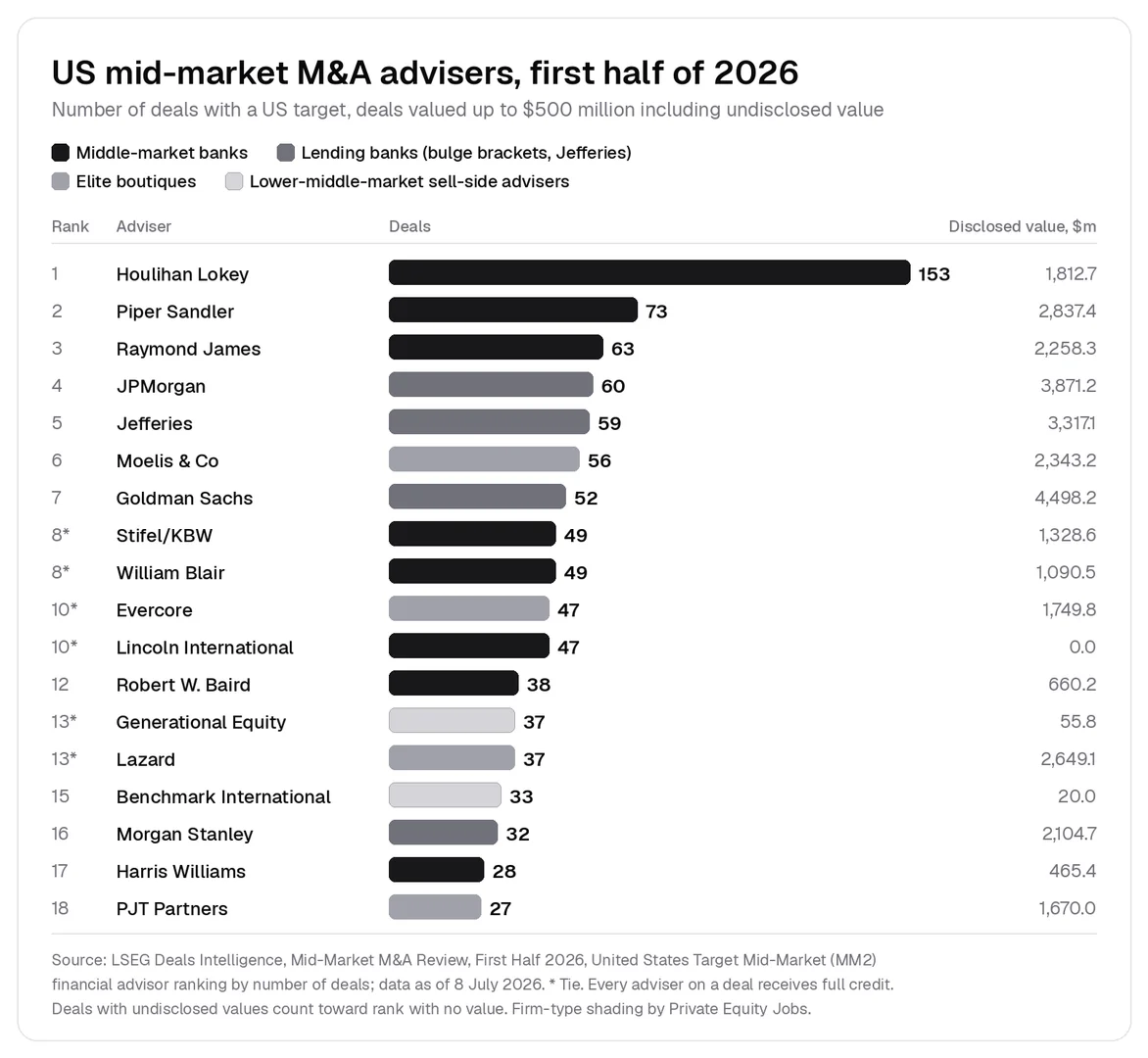
Four rules in LSEG's methodology change how the table reads:
- Every adviser on a deal receives full credit, so a sale with three banks on it adds one deal to each of them.
- Deals with no disclosed value count toward rank, but add nothing to the value column. That is why Lincoln International shows 47 deals and $0.0m.
- The tables include more than mergers. Repurchases, spin-offs, self-tenders, minority stakes, and debt restructurings also count.
- The table counts announced deals, so a sale signed in June counts in the first half even if it closes months later.
Houlihan Lokey's lead is large, with 153 deals against 73 for second place. Middle-market banks take six of the 11 places in the top 10, counting the tie for 10th, but JPMorgan, Jefferies, and Goldman Sachs are also there, and Goldman's 52 deals carry the highest disclosed value among the top 18 at $4.5bn. Elite boutiques compete in the band as well, with Moelis at sixth on 56 deals and Evercore, Lazard, and PJT Partners all in the top 18.
The table also moves quickly. Generational Equity, an adviser to owners of small private companies, ranked second in the first half of 2025 and fell to 13th in the first half of 2026 with 39 fewer deals than a year earlier. Lincoln International and Baird each had eight fewer. Raymond James and Piper Sandler each added more than 20.
The market behind the table shrank by count and grew by value. LSEG recorded about 5,600 US mid-market deals worth $128.6bn in the first half of 2026, against about 6,700 deals worth $121.3bn a year earlier. Worldwide, mid-market deal value rose 15 percent to $467.1bn while the number of deals fell to a six-year low.
Other vendors produce different winners. Lincoln International's prospectus cites Mergermarket, which ranked it second among sell-side advisers on private equity deals worldwide over the three years to 31 December 2025. Houlihan Lokey cites LSEG. A firm's ranking claim is only as useful as the vendor, region, size band, deal side, and period behind it, and a claim that leaves one out is hard to check.
Who else works on middle-market deals
A middle-market company that hires an adviser may choose a bank on the list above, the mid-cap group of a large bank, an accounting firm's corporate finance arm, or a smaller adviser that works only for business owners. Each of these shows up in LSEG's tables.
Mid-cap groups at large banks
Several of the largest banks run separate teams for mid-sized clients. JPMorgan's Mid-Cap Investment Banking group lists more than 350 bankers, seven industry teams, more than 50 subsectors, and 14 US offices, serving US and Canadian companies valued at under $2bn. It reports more than 50 mid-cap M&A bankers and more than 60 bankers who cover private equity firms. JPMorgan ranked fourth by US mid-market deal count in the first half of 2026 with 60 deals. These groups can offer loans and other products of bulge bracket banks alongside advice, which advisory-only firms cannot. Canadian banks with US investment banking arms compete for the same deals. BMO Capital Markets and TD Securities each had 20 US mid-market deals in LSEG's first-half 2026 table.
Accounting firms
In LSEG's worldwide first-half 2026 table, accounting firms lead the mid-market count. PwC ranked first with 270 deals, ahead of Houlihan Lokey's 235. EY was fifth with 130, Deloitte sixth with 120, Baker Tilly tied for seventh with 111, and KPMG 13th with 91. None of the accounting firms made the top 18 in the US table, which investment banks fill.
Business brokers and small advisers
Below the middle market, owner-run companies are often sold by business brokers and smaller M&A advisers. Generational Equity and Benchmark International, both in LSEG's US top 15 by count, reported only $55.8m and $20.0m of disclosed value across 37 and 33 deals, a sign that most of their transactions are small or carry no public price. The M&A broker exemption in the Securities Exchange Act lets advisers in this tier work without a broker-dealer registration when the company is below the $25m earnings or $250m revenue test.
The sale processes differ. Steve Wiesner, who says he spent 20 years in investment banking and middle-market private equity, wrote on X in December 2025 that buyers of small businesses can do well because those auctions "aren't generally like a Lincoln, Piper, Houlihan, or other MM sell-side." The difference he points to is competition among buyers. A bank that covers more than 1,000 private equity firms, as Lincoln International says it does, can put a company in front of many of them at once.
Middle-market banks vs bulge brackets and elite boutiques
The three groups overlap on deal size, as the LSEG table shows, but differ in what they sell and to whom.
| Feature | Middle-market banks | Bulge-bracket banks | Elite boutiques |
|---|---|---|---|
| Usual deal size | Under $2bn, mostly private companies | All sizes, including the largest deals | Large public-company deals and some mid-market work |
| Main clients | Private equity firms and private owners | Large public companies, governments, and institutions | Public-company boards and large private equity firms |
| Products | Advice, plus underwriting, research, and trading at full-service firms | Advice, lending, underwriting, trading, and research | Advice, restructuring, and capital advisory |
| Lending | Not at advisory-only firms; Raymond James and Stifel own banks | Yes | No |
| Examples | Houlihan Lokey, Lincoln International, Piper Sandler, William Blair | JPMorgan, Goldman Sachs, Morgan Stanley | Evercore, Lazard, Moelis, PJT Partners |
For a job seeker, the client matters most. At a middle-market bank, the client is usually a private equity firm selling a portfolio company, or a founder or family selling a business. At a large bank or one of the elite boutique investment banks, the client list includes far more public companies and their boards.
What middle-market banks do and how they get paid
Most middle-market bank revenue comes from selling companies. Lincoln International says its M&A practice is "largely oriented towards sell-side advisory," most often for private equity firms selling portfolio companies to corporate or private equity buyers. Houlihan Lokey describes its M&A business as primarily sell-side and buy-side engagements and calls itself one of the most prolific sell-side advisers.
A sell-side process follows a set sequence. The bank values the company, writes a short anonymous teaser and a longer confidential information memorandum, and builds a list of possible buyers. Interested buyers sign confidentiality agreements and submit first-round indications of interest. A shorter list meets management, works through the data room, and submits final bids with a marked-up purchase agreement. The bank then negotiates price and terms with the leading bidders until one signs. Junior bankers build most of the model, the memorandum, the buyer list, and the data room. Senior bankers win the mandate and run the negotiation.
Buy-side work is steady in the middle market because private equity firms buy many smaller companies to combine with ones they already own. PitchBook counted add-on acquisitions as 64.8 percent of US middle-market private equity deals in its second-quarter 2026 report, down from 67.7 percent a year earlier. A bank that sells a company for a private equity firm is often hired by the same firm to find add-ons or to sell the next portfolio company. Lincoln International reports that, excluding its MarshBerry business, 57 percent of its 2025 advisory transactions were for repeat clients.
The other products fill in around M&A:
- Capital raising. Banks place debt and equity privately with lenders and funds, and full-service firms underwrite public offerings for smaller companies.
- Restructuring. Advice to companies that cannot meet their debts, or to their lenders, on refinancing, sales, and bankruptcy.
- Valuation and opinions. Fairness opinions for boards and quarterly portfolio valuations for private equity funds produce steady fees that do not depend on a sale closing. Lincoln International says this business valued about 32 percent of US private-equity-backed companies in 2025.
The fee structure follows the work. "The vast majority of our Investment Banking Advisory revenues consist of a success fee from completing each assignment," Lincoln's prospectus says. If a deal does not close, the bank usually collects only its expenses and, "in some cases, a modest retainer." Raymond James's annual report says its M&A fees are "typically received upfront, as non-refundable retainer fees, and/or upon completion of a transaction as a success fee."
Dividing reported revenue by completed deals gives a rough average fee. Houlihan Lokey's corporate finance revenue of $1.74bn over 644 closed transactions works out to about $2.7m a deal in the year to March 2026. Piper Sandler's $1.04bn of advisory revenue over 335 completed advisory transactions in 2025 works out to about $3.1m. Both figures include capital-raising work and retainers on deals that did not close, so they are averages, not quotes.
Working at a middle-market bank
The title ladder is the same as at any investment bank: analyst, associate, vice president, director, and managing director. Houlihan Lokey says its junior bankers come mainly from "leading undergraduate and graduate programs," supplemented by experienced hires. Teams are organized by industry, such as healthcare or industrials, and by product, such as M&A, capital markets, or restructuring. Several banks also run groups that cover private equity firms as clients. JPMorgan's mid-cap group lists more than 60 such bankers, and a current Harris Williams posting is for its financial sponsor coverage team.
Deal flow per senior banker is a useful measure of how busy a seat is. Houlihan Lokey closed 644 corporate finance transactions in the year to March 2026 with 251 corporate finance managing directors, or about 2.6 closed deals per managing director. Lincoln International closed 321 advisory transactions in 2025 with 159 managing directors, or about two each. A managing director usually runs several mandates at once, so an analyst can sit on several live processes, each at a different stage.
No middle-market bank publishes hours. Brian DeChesare, founder of the training firm Mergers & Inquisitions, estimates that analysts at middle-market banks work 65 to 75 hours a week, against 80 or more at the largest banks, and says the number depends heavily on the group and the city. Within a group, the hours follow the sale calendar. Work peaks when a memorandum is due, when management presentations are scheduled, and in the days before first-round and final bids, because a success fee depends on hitting those dates. Hours ease when a process stalls or a group has fewer live mandates. Asking a team how many live sell-sides each analyst carries gives a better read than any average.
The firms differ in how long people stay. Lincoln International reports about 80 percent employee retention since 2020, an 80 percent acceptance rate among junior bankers offered direct promotion since 2015, and that about 43 percent of its US managing directors were promoted from within. Houlihan Lokey says its cash and equity awards exist "to attract, motivate, and retain" its people, and its equity awards generally vest over four years.
Location is part of the choice. Middle-market banks hire in many cities outside New York. Houlihan Lokey's current analyst postings include Atlanta and Los Angeles, Harris Williams hires in Richmond, and JPMorgan's mid-cap group lists 14 US offices.
Pay at middle-market banks
Base salaries are now visible in job postings. Houlihan Lokey, William Blair, Harris Williams, and Lincoln International all list base pay or base ranges on current US postings, checked on 18 October 2026:
| Firm | Role | Location | Posted base salary |
|---|---|---|---|
| Houlihan Lokey | Financial analyst, Class of 2027 | Atlanta | $110,000 |
| Houlihan Lokey | Analyst, lateral | New York | $120,000 to $130,000 |
| Houlihan Lokey | Senior analyst | Los Angeles | $110,000 to $130,000 |
| Houlihan Lokey | Associate | New York | $175,000 to $225,000 |
| Houlihan Lokey | Vice president | New York | $250,000 |
| William Blair | Analyst, biotechnology | Chicago or New York | $115,000 |
| William Blair | 2027 full-time MBA associate | Six US offices, including Atlanta and Chicago | $175,000 |
| Harris Williams | Experienced M&A associate | New York | $175,000 to $225,000 |
| Harris Williams | Financial sponsor coverage associate | Richmond | $175,000 to $200,000 |
| Harris Williams | 2027 M&A summer associate | Richmond | $175,000 annualized |
| Lincoln International | Industrials M&A associate | Los Angeles | $175,000 to $225,000 |
Analyst base pay in these postings starts at $110,000 to $115,000, and a lateral analyst in New York is posted at up to $130,000. Associate base pay starts at $175,000, with ranges up to $225,000 for experienced hires. The numbers barely change between Atlanta, Richmond, Los Angeles, and New York. DeChesare writes that junior pay at middle-market banks is not much different from pay at larger banks, though it trails what many elite boutiques pay, and that the gap widens with seniority because the deals are smaller.
The posting is only part of the pay. Bonuses are discretionary and are not posted. Houlihan Lokey's annual report says its cash bonuses are accrued monthly and "generally paid in the first quarter of each fiscal year," which for Houlihan Lokey runs from April to June, and that a portion "is deferred and paid in the third quarter." Part of the annual bonus can be paid in stock. Houlihan Lokey says junior pay is "tested against prevailing market compensation for bankers at similar levels," and its total compensation expense equaled 64 percent of revenue in each of its last two fiscal years.
Ownership changes what senior pay looks like. Bankers at public firms such as Houlihan Lokey, Piper Sandler, and Lincoln International receive listed stock. At Baird, which is employee-owned, 81 percent of associates are shareholders. Harris Williams bankers work for a subsidiary of PNC, a listed bank. Lincoln International's client revenue per managing director, a measure of how much business each senior banker brings in, was about $4.9m in 2025, up from $3.9m in 2024.
Open banking and private equity roles, many with posted pay, are listed on the Private Equity Jobs board.
How middle-market banks hire
Analyst hiring runs mostly through summer internships that lead to full-time offers. Houlihan Lokey's posting for an Atlanta financial analyst in the Class of 2027 says the "ideal candidate will have prior investment banking internship experience" and requires undergraduate coursework in accounting and finance. The analyst's listed duties are to analyze company financials, value companies "using traditional valuation methodologies," and prepare "confidential offering memorandums, management presentations, buyers lists, marketing pitches, and other presentations."
Competition for these seats is somewhat lower than at the largest banks. DeChesare calls middle-market banks a realistic entry point for students who start recruiting late and for career changers, who can win internships or lateral offers there when larger banks are out of reach.
Smaller banks recruit the same way on a smaller scale. Brown Gibbons Lang & Company is running a four-part webinar series for students starting 28 October 2026 and an information session at Ohio State University on 4 November 2026.
Associates arrive two ways. Business-school students join through a summer associate program, such as Harris Williams's 2027 M&A summer associate role in Richmond, or a full-time MBA associate offer, such as William Blair's 2027 class. Experienced hires join laterally. Lincoln International says it recruits "both on university campuses and laterally within the industry," and Houlihan Lokey's current lateral postings run from analyst and senior analyst to associate and vice president.
Hiring is usually by group and city. A posting names the industry or product team and the office, so a candidate applies to Houlihan Lokey's business services group in Atlanta or Lincoln International's industrials team in Los Angeles rather than to the firm as a whole. The qualifications in the Houlihan Lokey posting show what interviews test: accounting and finance coursework, "a fundamental understanding of valuation theory, methodologies, and applications," and Excel and PowerPoint skills.
Once hired, bankers at these firms register with FINRA. FINRA's Series 79 investment banking representative registration requires passing both the Securities Industry Essentials exam and the Series 79, which covers data analysis, financings, and M&A. Only a member firm can sponsor a candidate for the Series 79, so new hires take it after joining.
Exit opportunities from middle-market banks
A middle-market bank puts junior bankers in daily contact with private equity firms, because so much of the work is selling companies for them or helping them buy add-ons. That exposure is the main reason the seat leads to middle-market private equity, which accounted for 67.8 percent of US buyouts by count in the second quarter of 2026, according to PitchBook. An analyst who has built a buyer list of private equity firms and read their bids has seen how those firms value companies, structure offers, and decide what to pay.
The common next steps are:
- Private equity, usually at funds buying companies in the same size range the bank sells.
- A move to a larger bank or an elite boutique, for bankers who want larger deals.
- Corporate development at a company that buys businesses regularly, where the M&A process skills carry over directly.
- Private credit and direct lending funds, which lend to many of the same private-equity-owned companies.
- Promotion inside the bank, which most juniors offered it at Lincoln International have accepted.
The trade-off is deal size. An analyst who wants to work on multibillion-dollar public-company deals will see few of them at a middle-market bank. Middle-market analysts recruit for private equity alongside analysts from the largest banks and elite boutiques. DeChesare describes offers from the largest buyout funds and upper-middle-market firms as "extremely difficult" to win from a middle-market bank, and treats smaller private equity firms as the more realistic target. What a middle-market analyst can show is a record of sale processes run for the kind of funds that are hiring, often in the fund's own industry. The same seat also opens the other investment banking exit opportunities, from corporate development to hedge funds.
How to compare middle-market bank offers
Two offers from middle-market banks can lead to different jobs. These questions separate them, along with where to find each answer:
| Question | Where to check |
|---|---|
| How much of the group's work is sell-side for private equity firms? | The firm's annual report or prospectus, its published deal list, and the group's recent announcements |
| How many deals did the group close last year, and with how many managing directors? | Firm-wide counts in the annual report; ask the group for its own |
| Which industry or product group, and which office? | The posting and offer letter |
| Advisory-only or full-service? | The annual report's business segments. Full-service firms also run research, trading, and underwriting |
| How is the bonus paid? | The compensation note in the annual report. Houlihan Lokey defers part of the cash bonus and pays part in stock |
| Who owns the firm? | Public, employee-owned, or bank-owned, which changes what senior pay is paid in |
| What does the firm's league-table claim measure? | The footnote, which should name the vendor, region, size band, deal side, and period |
Base salary rarely separates offers between these firms, as the posted ranges show. Deal flow, group, and the private equity firms the group works with each day usually matter more for the next job.
Common questions
What is middle-market investment banking?
Middle-market investment banking is advice on M&A, capital raising, and restructuring for companies worth tens of millions to about $2bn, most of them private. The clients are mostly private equity firms and private owners. Most of the revenue comes from success fees on completed deals.
What is mid-cap investment banking?
Mid-cap investment banking is another name for the same work, used mostly by large banks for their teams that cover smaller companies. JPMorgan's mid-cap group serves US and Canadian companies valued at under $2bn.
Is Wells Fargo a middle-market investment bank?
Not in the usual sense. Wells Fargo is a large commercial and investment bank, and its "middle market" business is its Commercial Bank, which lends to and provides banking services for companies with $25m to $2bn of annual revenue. Wells Fargo is not one of the advisory-focused middle-market banks.
Is Goldman Sachs middle market?
No. Goldman Sachs is a bulge-bracket bank that lends, trades, and advises on the largest transactions. It does advise on mid-sized deals. It ranked seventh by number of US mid-market deals in LSEG's first-half 2026 table, and its 52 deals carried $4.5bn of disclosed value, the most among the top 18.
Is Houlihan Lokey a middle-market bank?
Yes. Houlihan Lokey is the largest middle-market bank by deal count, with 153 US mid-market deals in the first half of 2026 in LSEG's table. Its annual report says most of its engagements are mid-cap transactions.
How many middle-market investment banks are there?
There is no official count. In LSEG's first-half 2026 table of US mid-market deals, 18 advisers worked on more than 25 deals each. Eight of them were the middle-market banks profiled above. The rest were bulge-bracket banks, Jefferies, elite boutiques, and two advisers to owners of small companies.
Can you get into private equity from a middle-market bank?
Yes. Middle-market banks sell companies for private equity firms and help them buy add-ons, so analysts and associates work with the funds that later hire them. Those funds are mostly middle-market buyout firms.
Sources
- LSEG Deals Intelligence, Mid-Market Mergers & Acquisitions Review, First Half 2026, Financial Advisors, data as of 8 July 2026.
- Houlihan Lokey, Form 10-K for the fiscal year ended 31 March 2026.
- Lincoln International, final prospectus (Form 424(b)(4)), 19 May 2026.
- Piper Sandler, Form 10-K for 2025; Raymond James Financial, Form 10-K for the fiscal year ended 30 September 2025; Stifel Financial, Form 10-K for 2025; Jefferies Financial Group, Form 10-K for the fiscal year ended 30 November 2025.
- Harris Williams LLC, consolidated statement of financial condition (Form X-17A-5), 31 December 2025.
- Robert W. Baird & Co., 2025 Annual Report.
- William Blair, Mergers and Acquisitions practice page, data as of 30 June 2026.
- JPMorgan, Mid-Cap Investment Banking page; Wells Fargo, Commercial Banking industry page.
- PitchBook, Q2 2026 US PE Middle Market Report, data as of 30 June 2026.
- Securities Exchange Act of 1934, Section 15(b)(13) (15 U.S.C. 78o(b)(13)), as added by the Consolidated Appropriations Act, 2023.
- FINRA, Series 79 Investment Banking Representative Exam.
- Job postings from Houlihan Lokey, William Blair, Harris Williams, and Lincoln International, checked 18 October 2026.
- Steve Wiesner, post on X, 21 December 2025.
Related posts
Related posts

Equity research covers public companies, publishes ratings, and sits between management and investors. How the seat differs from IBD on hours, conflicts, pay shape, AI pressure, and exits to AM, hedge funds, IR, and corporate finance.

Sales and trading is the markets division that pitches ideas and makes markets for institutional clients. How desks and roles work, how it differs from investment banking, and where the seat leads.

Restructuring investment banking advises distressed companies and their creditors on capital-structure fixes, from out-of-court deals to Chapter 11. How the seat differs from M&A, which firms dominate, and when RX is the wrong path to buyout PE.