What Is Private Equity
Private equity is not a private-stock vibe. It is a closed-end partnership. Limited partners commit capital. The general partner calls it, buys companies, tries to improve them, and sells. Then 2026 deal math, and where the job actually sits.
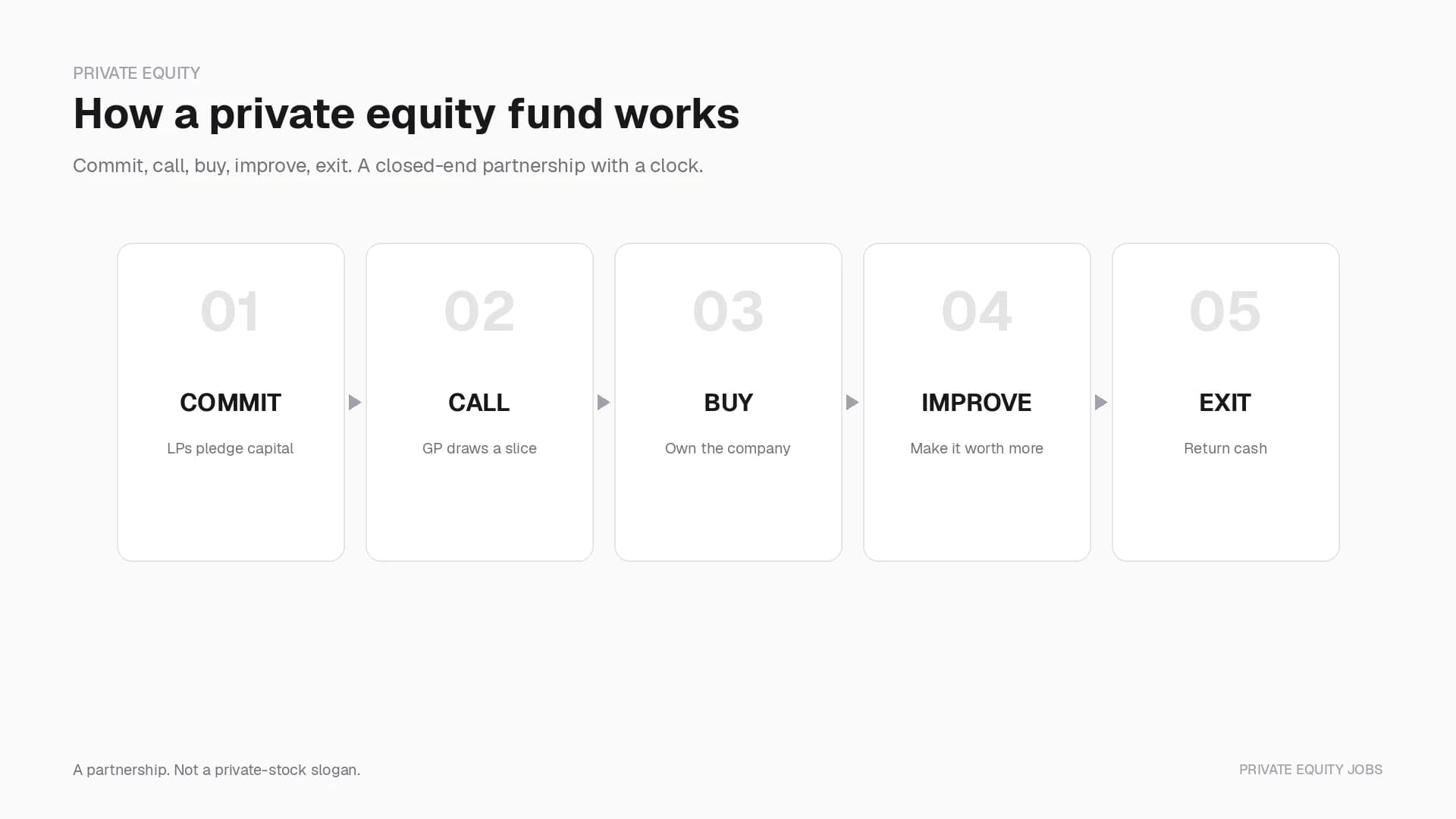
Private equity is a closed-end ownership fund. Limited partners commit capital. The general partner calls it, buys companies, tries to improve them, and sells. The fund has a clock, usually about ten years. That is the business. It is not a slogan about "investing in private companies." Public companies go private in buyouts. Private companies raise ordinary bank debt. The distinction is the partnership: a pool with a life, a call schedule, and an exit that has to return cash to the people who committed.
The Private Equity Glossary is the dictionary. This page is the hub. How the fund works, how the firm gets paid, what 2026 deal math looks like, and where the job sits. How to Break Into Private Equity is the entry path. Private Equity Career Path is the ladder after a seat exists. Private Equity vs Investment Banking is fee versus ownership.
How a private equity fund works
A private equity firm is the general partner (GP). The people who put up the money are limited partners (LPs): pensions, endowments, sovereign wealth funds, insurers, family offices. The Institutional Limited Partners Association's Private Equity 101 puts the legal cut in one sentence. Like shareholders in a corporation, LPs have limited liability to the extent of their investment and have no management authority. They do not run the companies. The GP does.
The firm does not take the money at the close of fundraising. It takes a signature. Committed capital is a promise, not a wire. An LP who commits $20 million still has the $20 million. When the GP has a use (a signed purchase, a fee, an expense), it issues a capital call. The LP wires that slice. Dry powder is that uncalled remainder, not a pile of cash sitting in the GP's account. If the first call is $3 million for a signed purchase, $17 million is still uncalled and still at the LP. The common error is to treat the fundraising close as the moment the money moves, as if LPs invested upfront. They did not. They signed. Cash moves later, in installments, when a call arrives.
The GP calls in slices because a use has shown up: a signed purchase, a fee, an expense. Unused commitment stays with the LP until the next notice. The GP is paid to call that capital, own companies, and either invest the fund or give LPs the cash back. That deployment clock is the job.
The life of a private equity fund
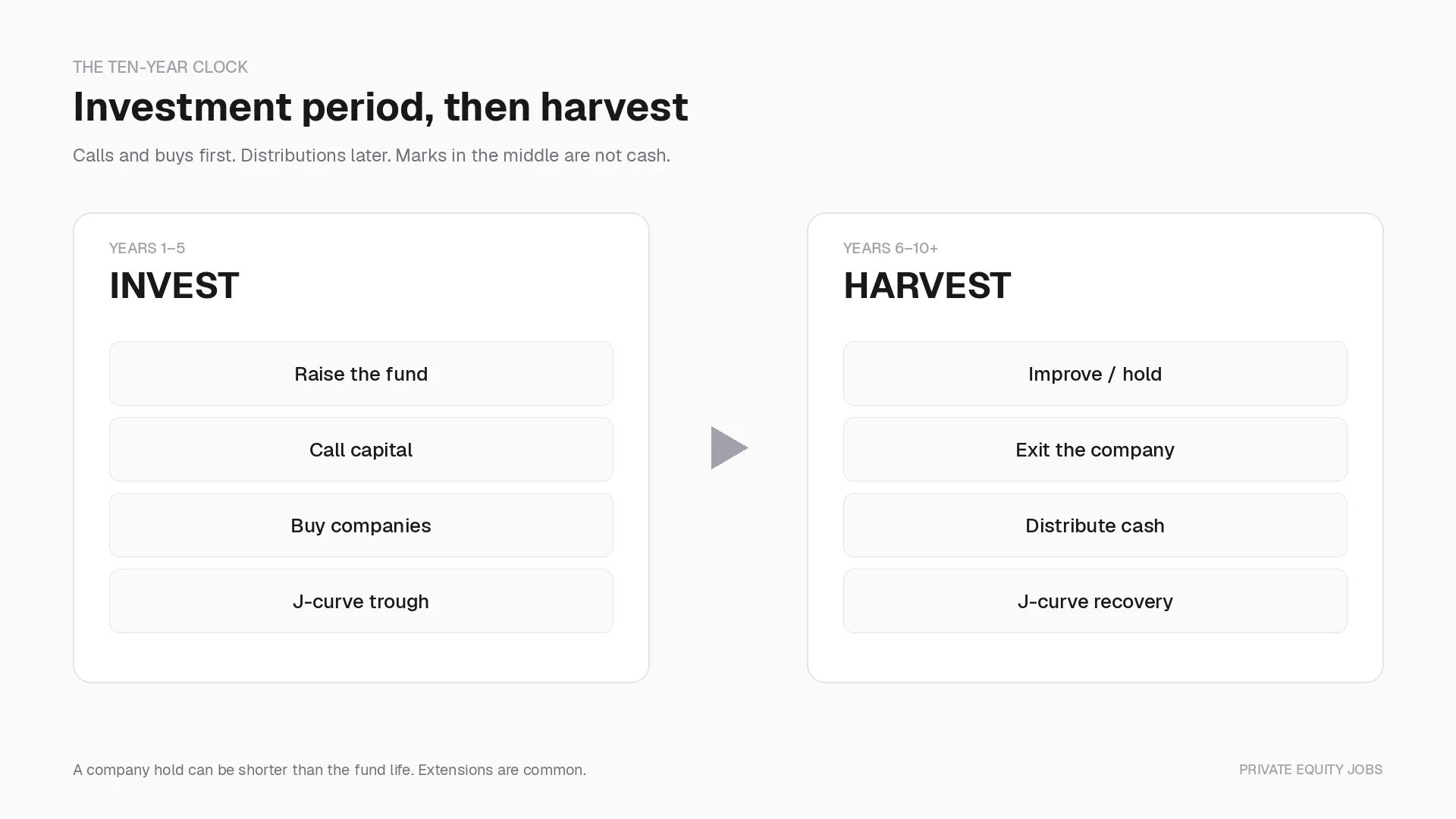
A classic drawdown fund is raised for about ten years, often with one- or two-year extensions written into the documents. The first half is the investment period, roughly years 1–5: the GP calls capital and buys. The second half is harvest, years 6–10+: improve, hold, exit, distribute. Portfolio construction, value creation, and harvest are the same clock in three names. Value creation is not a third religion. It is what happens while you own the company.
The hold on a company is not the same as the life of the fund. A business bought in year 3 and sold in year 10 is a seven-year hold inside a ten-year vehicle. That gap is why harvest can slip, and why extensions get used.
The J-curve is the cash-flow shape of that clock, not a performance slogan. The trough of the J is the investment period. Cash goes out (management fees and purchase prices) before anything has been sold, so the LP's net cash position is negative. The stick of the J is harvest. Companies exit and the fund writes checks back. If the exits work, those distributions pull the curve up through zero and into profit.
An interim mark that says the portfolio is up 1.4x is not a distribution. Marks in the middle are not cash. An LP cannot redeem the way a mutual-fund holder can. Illiquidity is the product, not a bug. Secondaries exist because someone needs out before the clock ends.
How private equity firms get paid
Two streams.
The management fee is charged on committed capital during the investment period, and often steps down later as the base shifts toward invested capital. Classically it is about 2 percent. Bain & Company's 17th Global Private Equity Report (released 23 February 2026), citing Preqin in the accompanying Welcome to a New Era in Private Equity essay, puts the average buyout management fee at 1.6 percent in 2025. The fee keeps the lights on. It is not the reason people want to be GPs.
Carried interest is. Carry is not a 20 percent tax on the company. It is a residual after a distribution waterfall. A common order:
- Return of capital. LPs get contributed capital back.
- Preferred return. Often 8 percent, the hurdle the GP has to clear before carry starts.
- Catch-up. The GP catches up to the agreed split.
- 80/20. Remaining profits split, classically 80 to LPs and 20 to the GP.
A worked close, using a one-year simplification (the real preferred return compounds on contributed capital over time). LPs have contributed $5 million. The fund distributes $6 million. Profit is $1 million.
| Step | Paid to | Amount |
|---|---|---|
| Return of capital | LPs | $5,000,000 |
| Preferred return (8 percent of $5 million) | LPs | $400,000 |
| Catch-up (GP reaches 20 percent of profits so far) | GP | $100,000 |
| Remaining 80/20 | LPs $400,000, GP $100,000 | $500,000 |
| Close | LPs $5,800,000, GP $200,000 | $6,000,000 |
After return of capital, $1 million of profit is left. The first $400,000 of that profit is the 8 percent preferred return, and it goes to LPs. The GP then takes the next $100,000 as catch-up, so it now has 20 percent of the $500,000 of profits paid so far. The last $500,000 splits 80/20. LPs end at $5,800,000 ($5 million of capital back plus $800,000 of gain). The GP ends at $200,000, which is 20 percent of the $1 million profit. That $200,000 is carry. It is not 20 percent of the company's EBITDA.
European waterfalls wait until the whole fund has returned capital. American waterfalls can pay carry deal by deal, with a later clawback if the vintage fails. Either way, carry is delayed, vested, and path-dependent. A junior associate does not take it home this bonus cycle.
The U.S. Securities and Exchange Commission's Investor.gov page on private equity funds names the conflict that sits next to those two streams. Portfolio companies may also pay the firm for monitoring, and affiliates may sell services to the fund or the company. Advisers have to disclose those conflicts. The fee on the fund and the fee on the company are not the same invoice.
Types of private equity strategies
Three strategies do most of the work. Inside a buyout, the deal can be an overhaul of a whole company, a break-up of the pieces, or a carve-out of a division.
Buyout is control. The fund buys a majority (or all) of a company, often with leverage on the company's balance sheet: a leveraged buyout. The underwrite is cash flow, the hold is years, and the exit has to return capital to LPs who already waited.
An overhaul buys the whole company, public or private, and tries to make the operations worth more. A public-to-private is the listed version of that. On 12 March 2023, Qualtrics announced an all-cash take-private by Silver Lake and CPP Investments valuing the company at about $12.5 billion ($18.15 a share), including the entirety of SAP's majority stake. A carve-out buys a division a parent no longer wants to own and stands it up on its own. On 3 March 2014, Tyco agreed to sell its South Korean security business (ADT Korea) to Carlyle for about $1.93 billion. A break-up buys a company to sell the pieces separately, on the thesis that the parts are worth more than the whole.
Growth equity is later-stage capital, usually minority or shared control, less leverage, more founder dynamics. The model is still ownership. The machinery is less classic LBO.
Venture capital is minority capital into early companies, with a loss function in which most investments fail and a few return the fund. They are all private. They are not the same job.
Secondaries are a liquidity path, not a fourth religion. An LP sells a fund interest. A GP runs a continuation vehicle so some LPs can cash out while the firm keeps the asset. Both exist because the ten-year clock is real.
Mezzanine, distressed, and royalty strategies exist. They are not what this page is for.
How private equity creates value
The operating loop is buy, improve, and sell at a higher equity value. The fund buys a company, or takes a public company private. It tries to make the equity worth more. It sells to a strategic buyer, another fund, or the public market.
Leverage sits on the company, not on the fund. A simple sketch: the fund buys a $100 million company with $40 million of equity and $60 million of debt. The $60 million is borrowed in the company's name. The portfolio company owes it. The fund's LPs put up the $40 million (plus fees). If the equity later sells for $80 million after the debt is refinanced or repaid, the fund made money on $40 million, not on $100 million. If cash flow cannot service the $60 million, the company is the one in distress. Bankruptcy is a path when the underwrite was wrong. It is not the model. The folklore that private equity "improves" a company so it can later fail under the debt is backwards. The debt is a tool on the company's balance sheet. It is not a plan to blow the company up.
Value comes from more than multiple expansion. The operating list is short and specific: strengthen the management team, buy add-on businesses that make a platform larger, reshape strategy, launch products, tighten operations that were slack, and run a financial plan that grows free cash flow and pays down debt. In the 2010s, rising multiples did a lot of the work. In 2026 they do less, which is why the next section is the job.
Private equity in 2026
The Bain report is the scoreboard.
2025 global buyout deal value, excluding add-ons, rose 44 percent to $904 billion. Buyout-backed exit value rose 47 percent to $717 billion. Both were the second-highest on record. Thirteen deals above $10 billion accounted for 30 percent of deal value. Buyout dry powder sat at $1.3 trillion. Holding periods at exit hovered around seven years, against five to six from 2010 to 2021. Distributions to LPs as a share of NAV stayed below 15 percent for a fourth consecutive year, about 14 percent in 2025. DPI is the related ratio of cash distributed to capital paid in; both have been weak. The industry sat on 32,000 unsold companies and $3.8 trillion of unrealized value. Buyout fundraising fell 16 percent to $395 billion.
The recovery was real and narrow. The math underneath it is Bain's rule of thumb: "12 is the new 5." In the 2010s, roughly 5 percent annual EBITDA growth could underwrite a target 2.5x MOIC / about 20 percent IRR over five years. With borrowing costs in the 8–9 percent range, leverage closer to 30–40 percent, and stagnant multiples, typical deals now need something closer to 10–12 percent annual EBITDA growth for the same return.
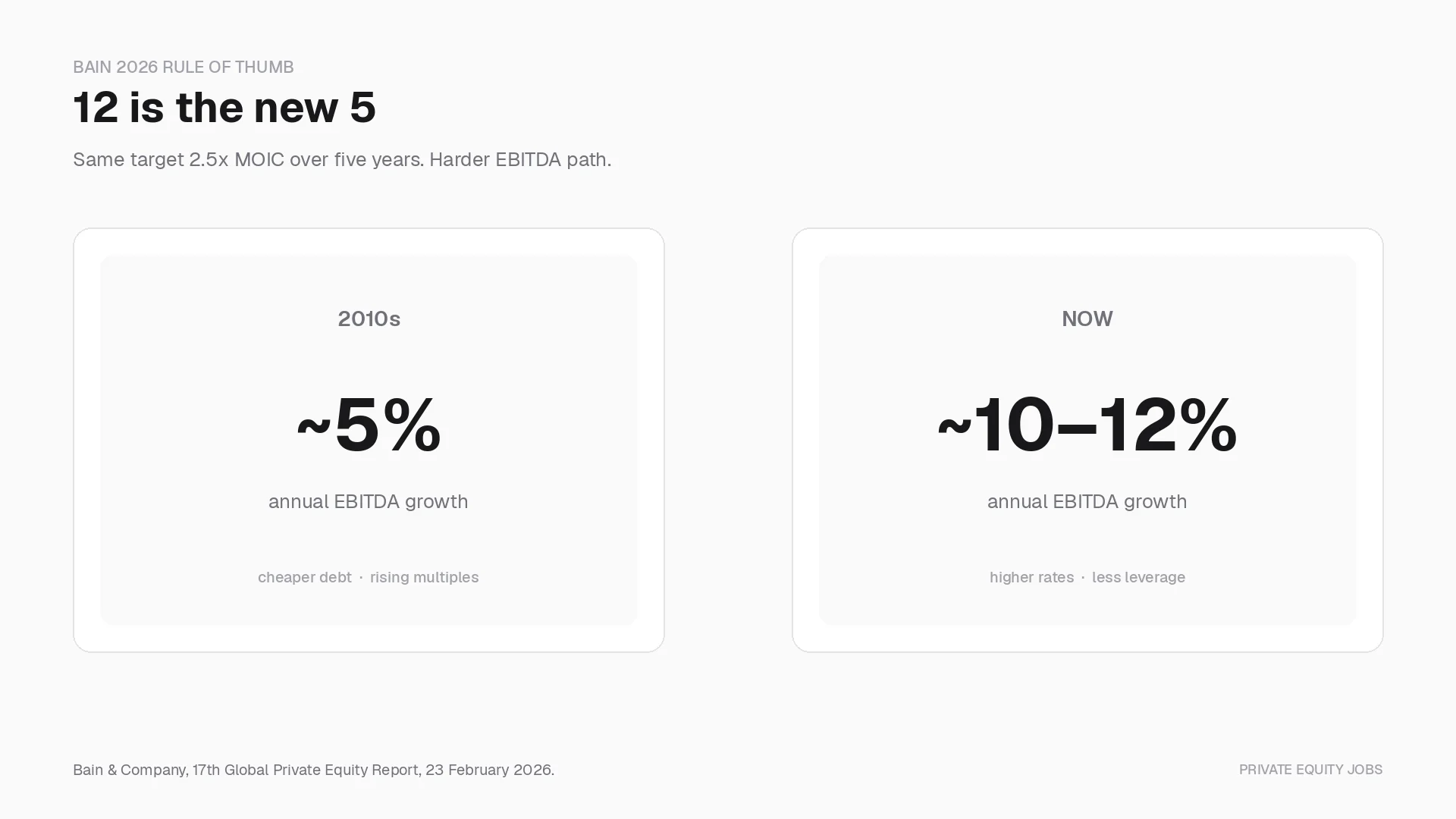
That is why diligence has to change. Too often it is defensive: confirm the CIM, build a case conservative enough for a lender and aggressive enough for a "good enough" return. In a world where 12 is the new 5, good enough does not cut it. What the Bain report wants is full-potential diligence (revenue, operations, technology) so you know what the asset can be worth, not only what the book says it is. For someone who wants the seat, that is the job now: find the 10–12 percent path, not assume the multiple will do the work.
Private equity vs public equity, venture capital, and hedge funds
Public equity is liquid and disclosed. You can sell tomorrow. The company reports every quarter. Private equity's edge is independence from that grind. The price is the lockup. You cannot redeem. You wait for an exit, or you sell the fund interest in the secondaries market.
Venture capital is minority early capital with a different loss function. Most investments fail. A few have to return the fund. If you mean venture, say venture. If you mean owning a cash-flowing business with debt, you are on the buyout side of this page.
Hedge funds trade liquid securities on a shorter clock. They mark to market. Redemptions are usually periodic, not a ten-year wait. The overlap is "private" as a marketing word, not as a partnership.
| Public equity | Private equity (buyout) | Venture capital | Hedge funds | |
|---|---|---|---|---|
| What you own | A listed share you can sell tomorrow | Control of a company, for years | A minority stake in an early company | A position in a liquid security |
| Clock | The quarter | The fund life, about ten years | The fund life; most bets fail | Weeks to a few years |
| How you get out | The market | An exit, or a secondary | An exit, if one arrives | A redemption or a trade |
| What the day is for | Price and disclosure | Underwrite, then live with the company | Find the few that return the fund | Trade and mark |
Fee versus ownership (the bank that sells a process versus the fund that lives with the company) lives in the PE vs IB essay. This page does not rewrite it.
What this page is not: a catalog of ways for retail investors to get exposure. Listed GP stocks, evergreen vehicles, tender funds, and funds of funds exist. They are products. They are not the closed-end partnership this page explains. If you are shopping those, you are on a different query.
Working in private equity
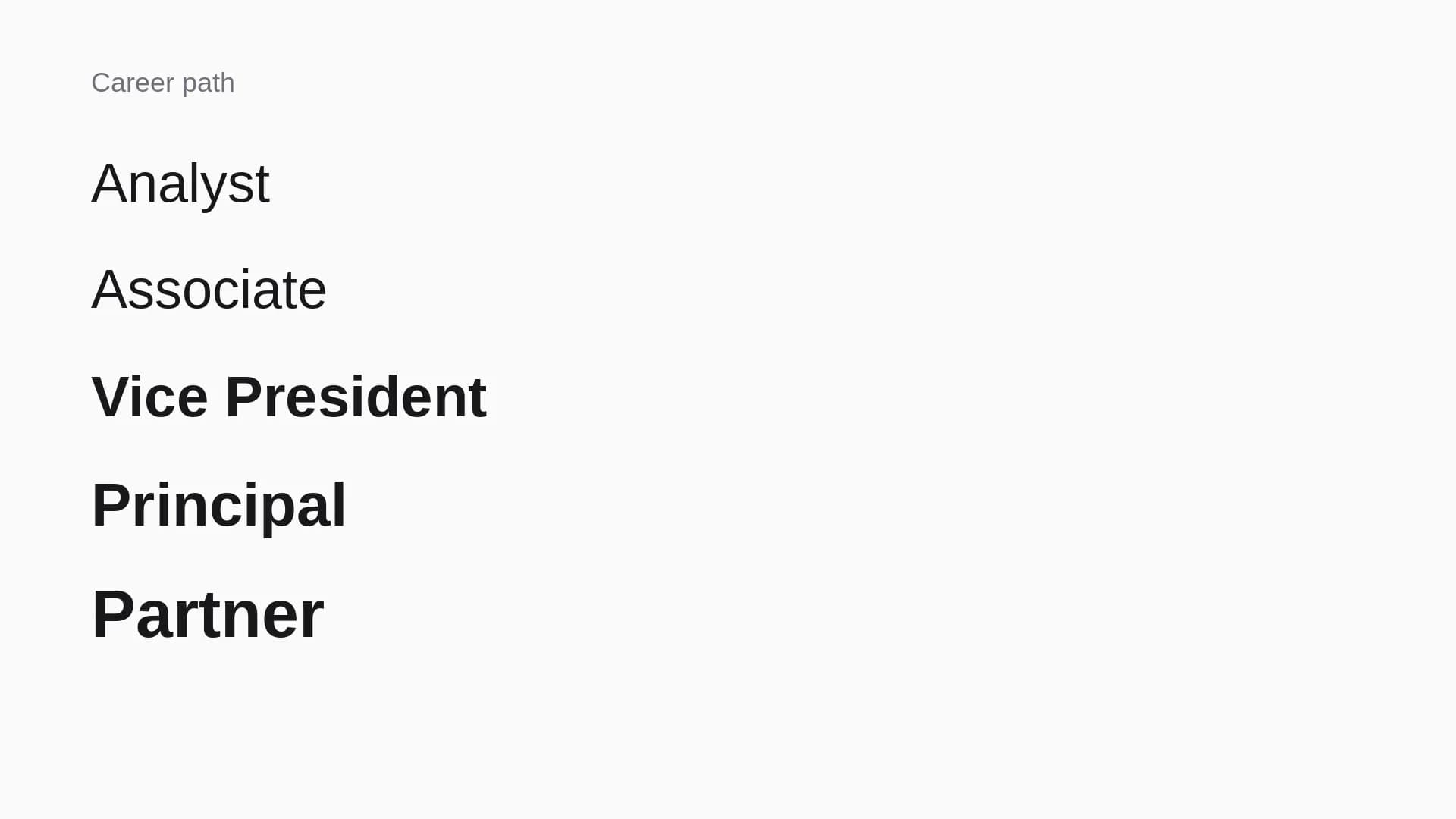
The seat you want sits on the GP. Associates, vice presidents, principals, and partners work at the firm that calls the capital and owns the companies. They are not LPs, and they are not the bankers who ran the auction. The day is for underwriting and then living with the company. When the deal closes, the job starts.
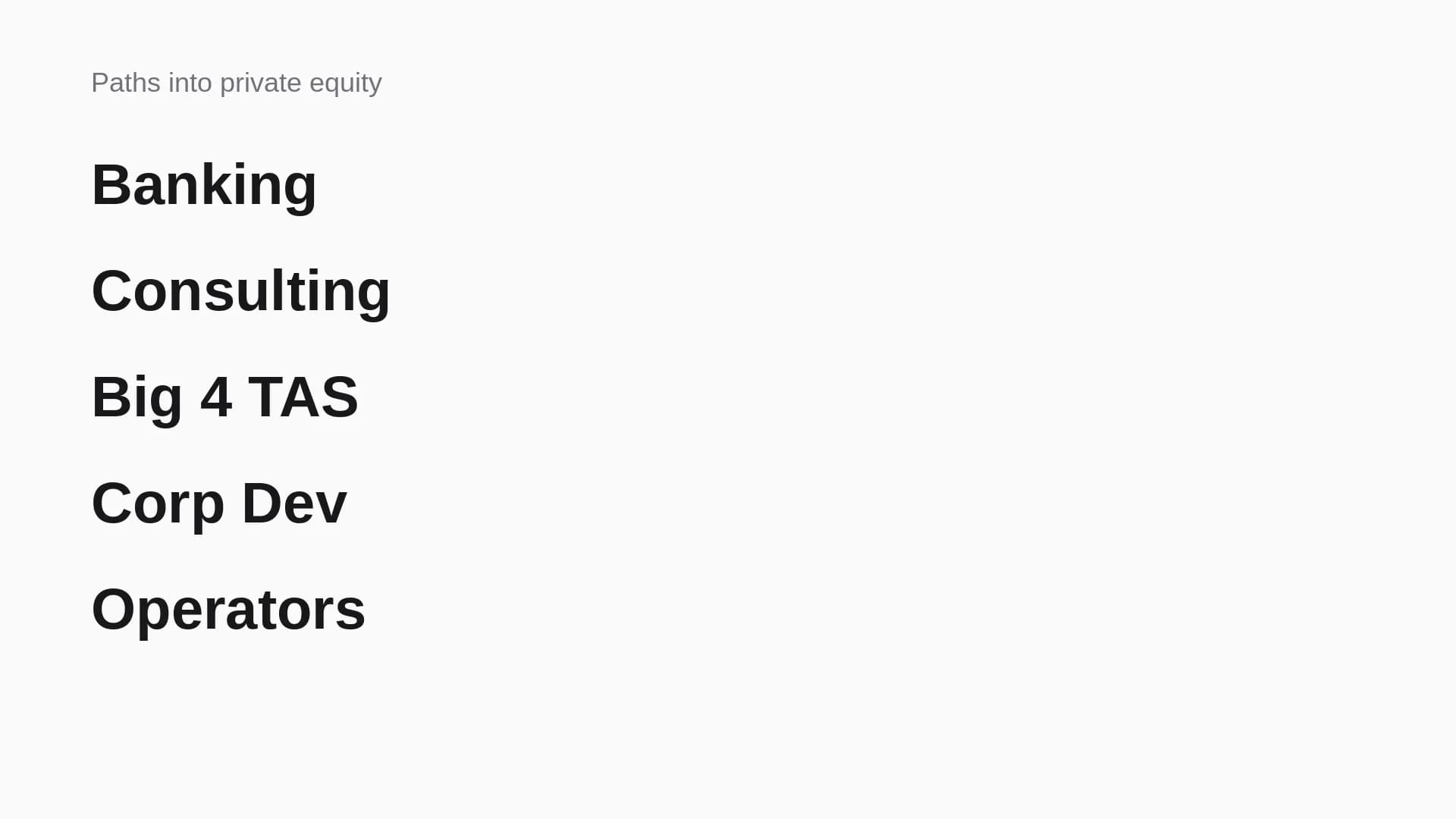
If you need the first door (on-cycle, headhunters, the paper LBO), use the break-in guide. If you already have a seat and need the ladder, the MBA fork, and promotion math, use the career-path essay. If you are choosing between a bank and a fund, use the PE vs IB essay. When you are ready to look at live investing seats, start on Private Equity Jobs and research the GP on the companies directory.
Common questions
What is a capital call?
A notice from the GP that a slice of committed capital is due. The LP wires that amount for a deal, fees, or expenses. The rest stays uncalled (dry powder) until the next notice.
What is 2-and-20?
A shorthand for the two streams: a management fee classically around 2 percent of commitments, and carried interest classically around 20 percent of profits after capital is returned and a hurdle is cleared. The 2025 buyout average fee is 1.6 percent. In the worked close above, LPs put in $5 million, the fund distributed $6 million, and the GP's $200,000 was 20 percent of the $1 million profit, paid only after capital back, the 8 percent preferred return, and catch-up. Carry is a waterfall residual, not a 20 percent tax on the company.
Is private equity the same as venture capital?
No. Buyout private equity is usually control, leverage, and cash-flow underwriting. Venture is minority early capital with a different loss function. Growth equity sits between them.
How do you invest versus how do you get hired?
Investing as an LP is a commitment of capital, usually reserved for institutions and qualified purchasers. Getting hired is a seat on the GP. This page is the mechanism. The break-in guide is the door. The board is where the seats are listed.
Sources
Bain & Company, 17th Global Private Equity Report, 23 February 2026, and Welcome to a New Era in Private Equity. Institutional Limited Partners Association, Private Equity 101. U.S. Securities and Exchange Commission, Investor.gov, Private Equity Funds. Deal facts in the strategies section are from the Qualtrics company release of 12 March 2023 (Silver Lake and CPP Investments take-private) and the Tyco release of 3 March 2014 (sale of ADT Korea to Carlyle).
Next step
You now have the partnership in order: commit, call, buy, improve, exit, on a clock, for a fee and carry. Keep the glossary open for the words. Use the break-in guide, the career-path essay, or the PE vs IB essay for the next problem you actually have. Browse investing seats on the board, research GPs on the companies directory, and turn on alerts at sign-up.