Carried Interest
Carried interest is the general partner's share of a private equity fund's profits, classically 20 percent, paid after limited partners have their capital back and, on most buyout funds, a preferred return.

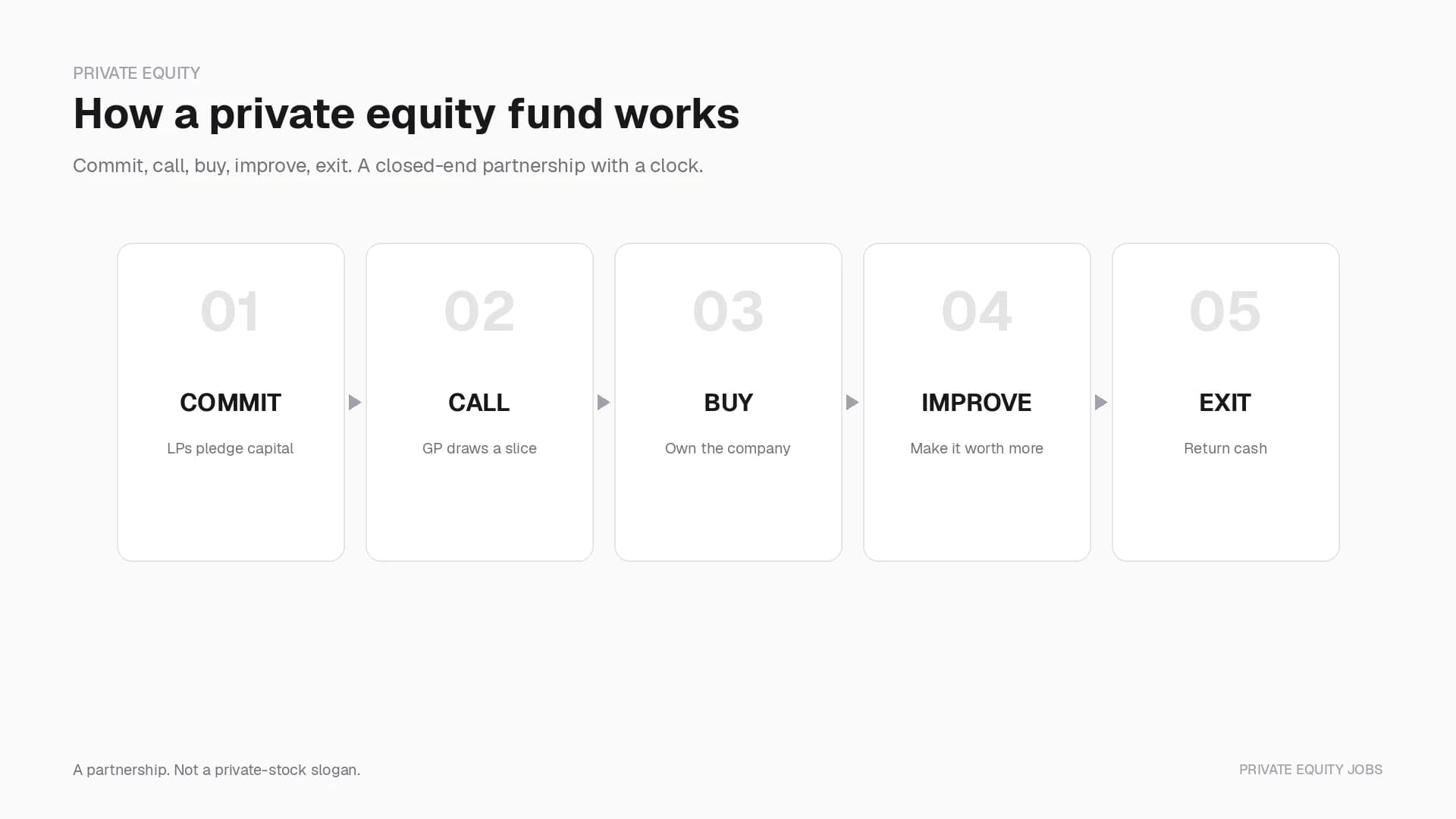
Carried interest is the general partner's share of a private equity fund's profits. Classically it is 20 percent of those profits, and it is paid only after limited partners (LPs) have their contributed capital back and, on most buyout funds, a preferred return. It is not a 20 percent charge on the company's earnings. It is a residual at the bottom of a distribution waterfall.
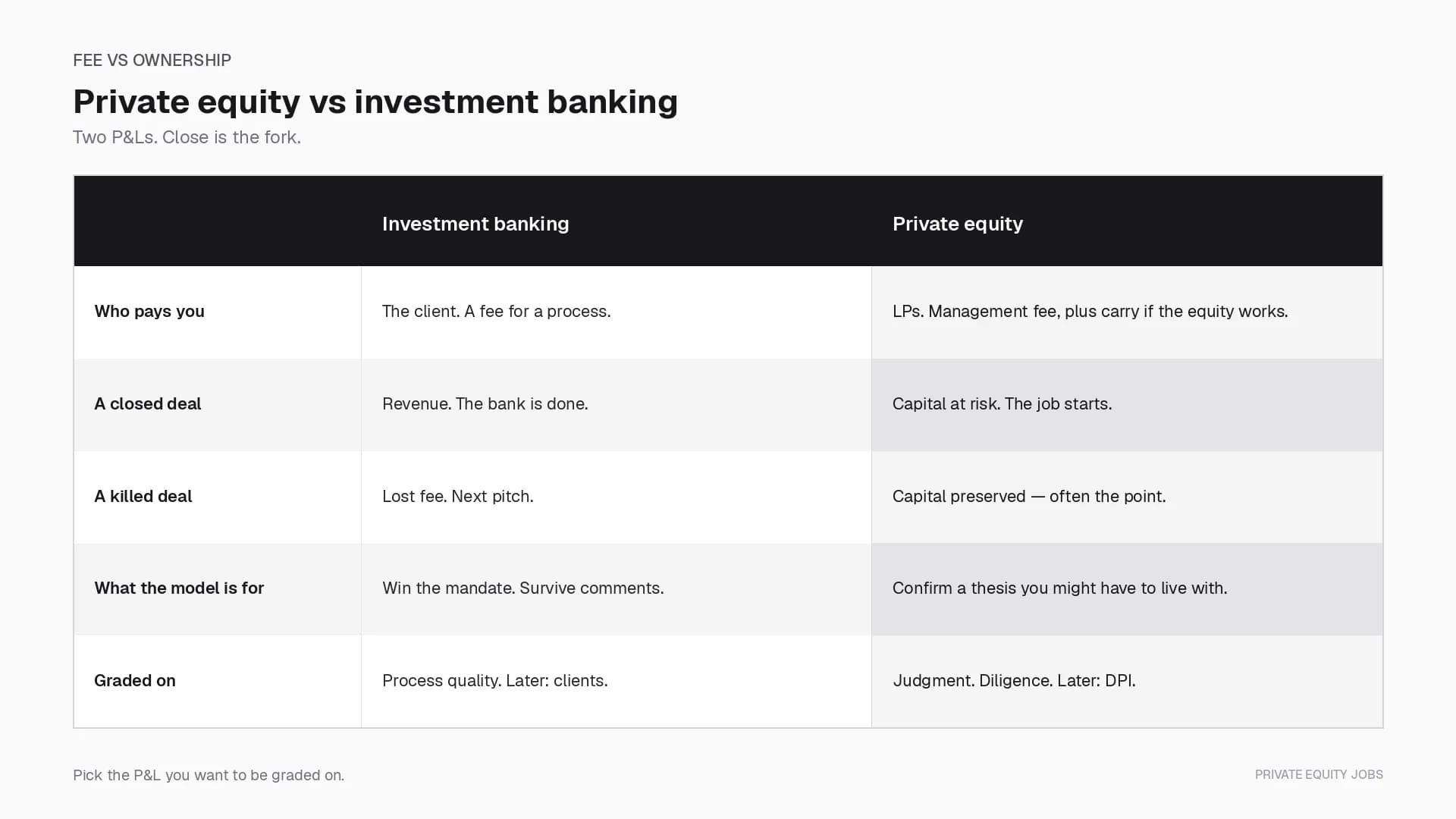
The management fee (the "2" in two and twenty) is billed whether the vintage works or not. Carry is the reason people want to be general partners (GPs). It is also delayed, vested, and easy to forfeit. A mark of 1.4x is not a carry check. Cash has to come back, the hurdle has to be cleared, and the person who was promised the points usually has to still be there.
What is carried interest?
Carry is a profits interest in the partnership. The GP typically puts up only a small slice of the fund's capital, often about 1 to 3 percent as a GP commitment. On that slice the firm earns the same return any LP earns. Carry is the extra claim: a right to 20 percent (classically) of the profits, even though the firm did not put up 20 percent of the capital. The word "carried" is the old one: the interest is carried through the life of the fund because the profit is not known until companies are sold.
That is a different instrument from the salary. It is also a different instrument from the management fee. The fee is an expense of running the firm. Carry is a share of what is left after LPs have been repaid, and only if the fund actually made a profit large enough to trip the waterfall.
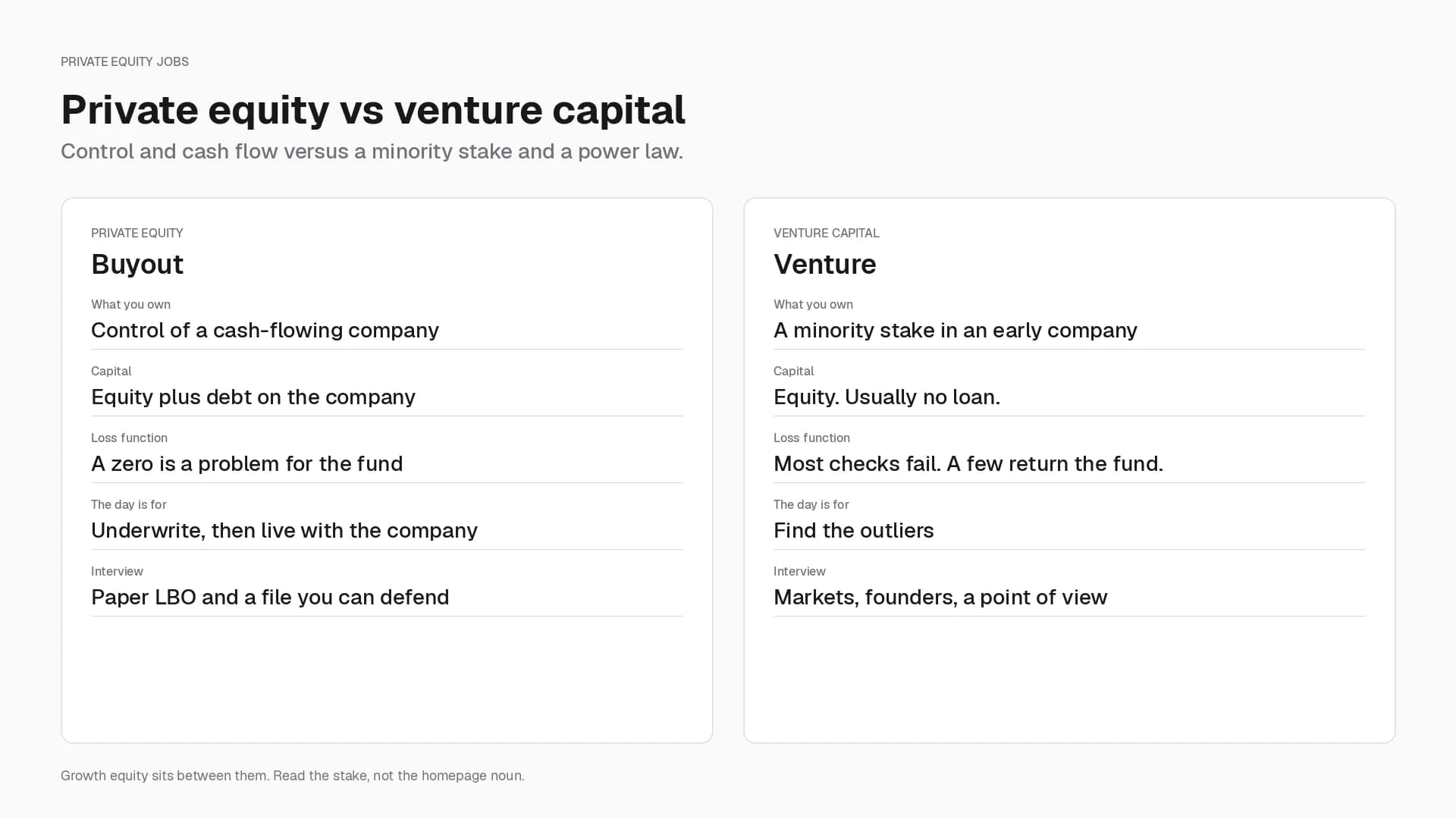
Private equity funds pay carry when investments exit, which can take years. Hedge funds often call the same idea a performance fee and can crystallize it annually because they hold liquid securities. Venture funds use carry too, usually on a whole-fund basis, and often without an 8 percent preferred return. Real estate partnerships use a cousin called a promote. The documents differ, but the economic idea is the same: the manager keeps a slice of the upside after the capital providers have had their turn.
Carry is not 20 percent of earnings before interest, tax, depreciation, and amortization (EBITDA). It is not 20 percent of enterprise value. If a fund contributes $40 million of equity to a company, sells that equity for $80 million, and the rest of the fund is a wash, the profit that might someday become carry is a share of that $40 million gain (after fees, after returning capital, after the hurdle), not a share of the company's revenue.
Two and twenty
Two and twenty is the shorthand for the two streams. The "2" is a management fee, classically about 2 percent a year. The "20" is carried interest, classically 20 percent of profits. Neither number is a law. Both are negotiated in the limited partnership agreement (LPA).
The fee is how the firm pays salaries, rent, and diligence before any company is sold. During the investment period it is usually charged on committed capital, not on the money that has actually been called. A $1 billion fund at 2 percent bills $20 million a year while LPs still hold most of the cash. After the investment period the base often steps down toward invested capital or net asset value (NAV), so the fee shrinks as capital comes back. Bain & Company's 17th Global Private Equity Report (released 23 February 2026), citing Preqin, puts the average buyout management fee at 1.6 percent in 2025. The advertised 2 percent is still the folklore number.
The fee pays salaries and rent. It is ordinary income to the people who receive it. A large firm can stay profitable in a weak vintage because 1.6 percent of a multi-billion-dollar pool covers payroll. Partners get rich if carry vests and the fund clears the hurdle.
Some managers with more demand than they need to fill a fund charge more than 20 percent (sometimes called super carry). Emerging managers sometimes charge less to get the vehicle closed. Venture hurdles are less common than buyout hurdles. Those numbers live in the limited partnership agreement, not in the two-and-twenty nickname.
Portfolio companies may also pay the firm for monitoring, and affiliates may sell services to the fund or the company. Those invoices are not carry. They are a different conflict, disclosed as such.
Preferred return, catch-up, and the waterfall
A distribution waterfall is the order in which cash from exits is paid. A common buyout order:
- Return of capital. LPs get contributed capital back.
- Preferred return. Often 8 percent a year on contributed capital, the hurdle the GP has to clear before carry starts.
- Catch-up. The GP receives the next dollars until it has caught up to the agreed split (classically 20 percent of profits so far).
- 80/20. Remaining profits split, classically 80 percent to LPs and 20 percent to the GP.
The Institutional Limited Partners Association's Model Limited Partnership Agreement (July 2020) writes the preferred return as an 8 percent annual rate, compounded annually and calculated daily, running from the date the fund received the contribution (or, if a subscription line was used, from the date that line was drawn) until the date of distribution. It is not "8 percent of the original commitment, once." Capital called in year 1 and still outstanding in year 6 has been compounding. A one-year sketch is a teaching tool. A six-year hold is the job.
Catch-up is the step most explainers skip, or bury as "the next 2 percent." It exists so that "20 percent of profits" means 20 percent of all profits, not 20 percent of the slice above the hurdle. Without a catch-up, LPs would keep the entire preferred return and then keep 80 percent of everything above it, and the GP would end with well under 20 percent of total profit. With a full (100 percent) catch-up, the GP takes the next dollars until its cumulative share is 20 percent of profits paid so far. Then the split reverts to 80/20, and the GP's final share of total profit is 20 percent.
A worked close, using a one-year simplification. LPs have contributed $100 million. After one year the fund distributes $130 million. Profit is $30 million. The 8 percent preferred return on $100 million is $8 million.
| Step | Paid to | Amount |
|---|---|---|
| Return of capital | LPs | $100,000,000 |
| Preferred return (8 percent of $100 million) | LPs | $8,000,000 |
| Catch-up (GP reaches 20 percent of profits so far) | GP | $2,000,000 |
| Remaining 80/20 | LPs $16,000,000, GP $4,000,000 | $20,000,000 |
| Close | LPs $124,000,000, GP $6,000,000 | $130,000,000 |
After return of capital, $30 million of profit is left. The first $8 million of that profit is the preferred return, and it goes to LPs. At that moment LPs have received $8 million of profit and the GP has received nothing. A 100 percent catch-up then sends the next $2 million to the GP, because $2 million is 20 percent of the $10 million of profits paid so far. The last $20 million splits 80/20. LPs end at $124 million ($100 million of capital back plus $24 million of gain). The GP ends at $6 million, which is 20 percent of the $30 million profit. That $6 million is carry. It is not 20 percent of the portfolio company's EBITDA.
Without a catch-up, the same $30 million would look different. LPs would still take the first $8 million. The remaining $22 million would split 80/20, so the GP would take $4.4 million. That is about 15 percent of total profit, not 20 percent. The catch-up is the difference.
Not every fund uses a 100 percent catch-up. The ILPA model documents allow an 80/20 catch-up (80 percent to the GP and 20 percent to LPs) until the GP has reached 20 percent of profits. That version is slower for the GP and slightly better for LPs in the middle of the waterfall. Some funds have no hurdle. Some have no catch-up. Those numbers live in the limited partnership agreement, not in the two-and-twenty nickname.
A 40 percent total gain does not automatically clear an 8 percent hurdle. Eight percent compounded for five years is about 47 percent. A fund that turns $100 million into $140 million in year 5 has not cleared an 8 percent preferred return. A fund that does it in year 1 has.
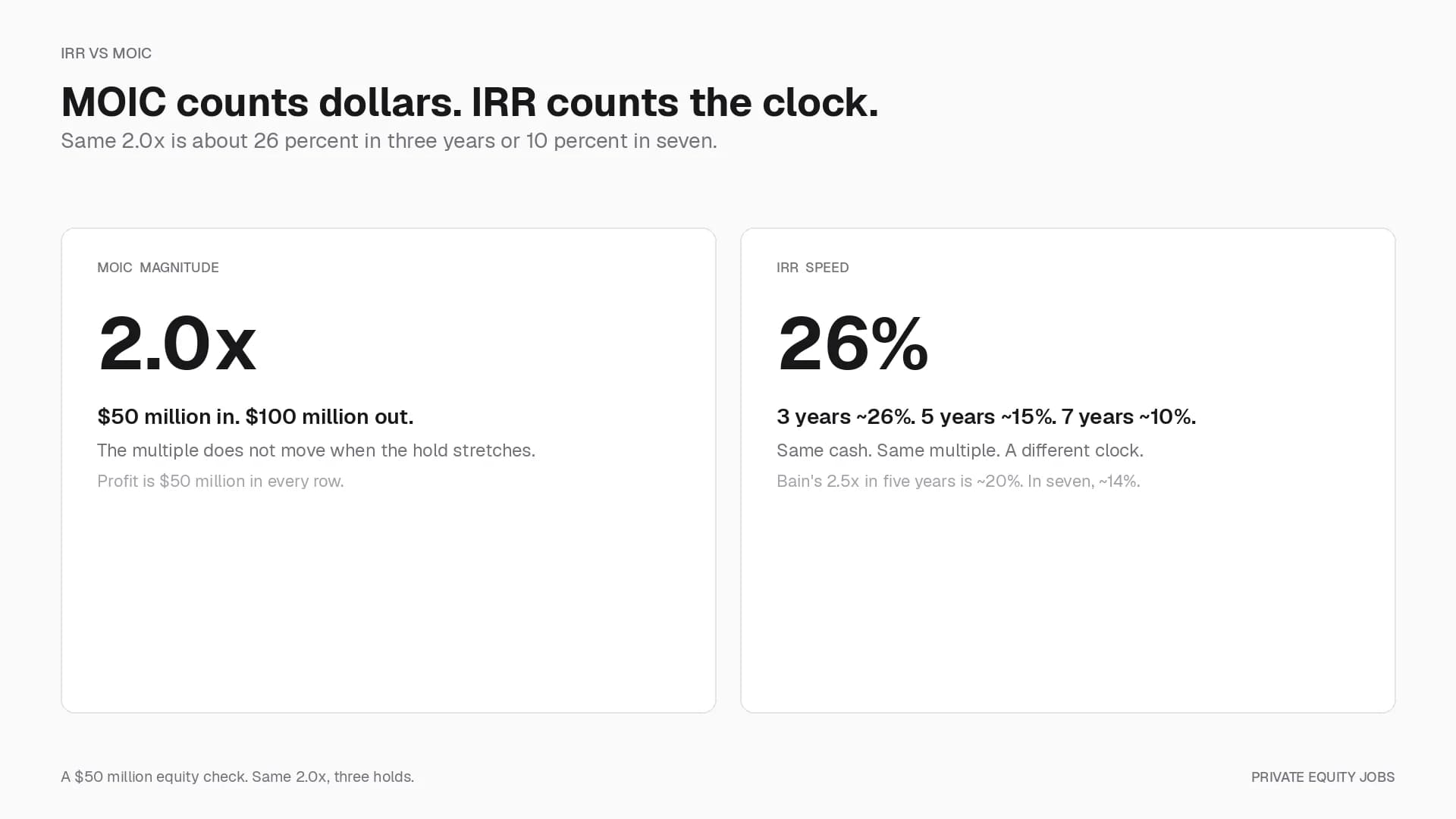
Internal rate of return (IRR) and multiple on invested capital (MOIC) are usually quoted net of carry. Gross is before it. The gap is the 20 percent, plus the fee drag, plus timing.
Deal-by-deal, whole-fund, and clawback
The same 80/20 can be applied to the whole fund or to each deal.
A European (whole-of-fund) waterfall waits until LPs have received back their capital, and usually the preferred return, across the entire portfolio before the GP takes carry. Early winners do not pay the firm while losers are still sitting there. It is simpler to administer. It is slower for the GP. ILPA's whole-of-fund model is this shape.
An American (deal-by-deal) waterfall can pay carry on a successful exit even if other companies in the fund are underwater. The GP gets cash earlier. LPs take more timing risk. If later deals lose money, the firm may have been paid carry it would not have earned on a whole-fund basis. That is why deal-by-deal documents almost always include a clawback, and often an escrow: a slice of carry is held back until the fund is closer to finished.
| Whole-fund (European) | Deal-by-deal (American) | |
|---|---|---|
| When carry is calculated | On the fund as a whole | On each realized deal |
| When the GP is paid | Later, after capital and usually the hurdle are back across the book | Earlier, as individual companies exit |
| LP timing risk | Lower. Capital comes back first | Higher. Early carry can precede later losses |
| What makes the math whole | Simpler administration | Clawback, and often an escrow of part of the carry |
A clawback is not a punishment for a 35 percent allocation when 30 percent was agreed. That is a drafting error. A clawback is a true-up. Early carry that exceeds the GP's final share of fund profits has to come back, usually net of taxes the individuals already paid. Collecting it years later, from people who may have left, is why sponsors escrow part of deal-by-deal carry and why LPs care which waterfall they signed.
Whole-fund carry still has a clawback in some agreements, because tax distributions and interim payments can get ahead of the final math. The need is more acute on deal-by-deal.
Who receives carry, and how it vests
The LPA pays carry to the GP, or to a carry vehicle sitting next to it. It does not name the associate. DLA Piper's Carried Interest Global Guide (data as of 30 September 2025) describes the usual structure: a separate limited partnership in many European funds, or an allocation through the general partner in many US funds. The carry vehicle is how the firm admits new joiners, reassigns points, and keeps individual names off the main LPA.
Inside that vehicle the firm divides the GP's 20 percent into points. One hundred points is a common unit: one point is 1 percent of the GP's carry, which is 0.2 percent of fund profits if the carry rate is 20 percent. Founders and partners hold most of them. Vice presidents start to see a meaningful grant. Associates often see none, or a token. Heidrick & Struggles' 2021 North American Private Equity Investment Professional Compensation Survey, a survey of 1,011 investment professionals, found that carry remains uncommon at the associate and senior-associate level and is typical at more senior seats. When carry vested on a fund basis, full vesting took an average of six years. When it vested deal by deal, the average was four years. Straight-line vesting was the usual schedule, not a cliff.
Vesting, in this context, is the date after which the grant is no longer forfeitable just because the person left, except for specified bad-actor events. Torys' September 2025 note Getting vesting right: aligning incentives around carried interest in private equity puts the leaver split in ordinary English. A good leaver (retirement, disability, an amicable departure the documents actually call good) typically keeps vested carry and may keep some unvested. A bad leaver (cause, or leaving for a competitor, depending on the agreement) typically forfeits unvested carry and sometimes vested carry as well. Unvested or forfeited points go back into a pool the remaining partners can reallocate. The firm's discretion in labeling the departure is part of the retention product.
Some sponsors back-load a tranche so that a slice vests only late in the fund, when value is actually created. Some tie a slice to a distributions to paid-in (DPI) or IRR hurdle inside the firm, on top of the LP hurdle in the LPA. Late joiners are often granted phantom carry instead of a profits interest: a contractual bonus linked to, and often paid from, carry receipts. DLA Piper treats phantom carry as employment income on receipt in many jurisdictions, which is how a bonus is taxed, not how a profits interest is taxed.
Unvested carry is not an asset that travels to the next employer. Vested carry can still be worthless if the vintage never clears the preferred return, or if a clawback eats an early check. Until a distribution actually arrives, a grant is a retention term.
Carry, bonus, and co-invest
Bonus is cash this cycle, paid from the management company's fee income (and, at some firms, from a share of deal fees). It is ordinary income. It arrives whether or not the fund has returned capital.
Carried interest is a profits interest in the fund, paid from exit proceeds after the waterfall. It arrives years later, if it arrives. Vesting and leaver terms sit on it. A below-hurdle vintage still pays a salary. It does not pay carry.
Co-invest (and the GP commitment) is a capital interest. The professional writes a check, or is lent the money to write one, and owns a slice of the same deal or fund on LP-like terms, usually with reduced or no extra fee. Gains on that capital are a return on money invested, not a 20 percent overlay on other people's money. DLA Piper's guide is explicit: its tax comparison is limited to carry, not to GP commitment or co-invest, because they are different claims.
Profits interest is the US partnership-tax name for the GP's carried interest at the fund. Equity compensation inside the management company can also be a profits interest in that LLC. Fund-level carry is the 20 percent in the LPA. A profits interest in the management company is how an individual is paid by the firm. Those are different grants.
Open investing seats sit on Private Equity Jobs. The companies directory is where those GPs are listed. The offer letter that matters for carry is the one that names the points, the vest, and the leaver definition, not the one that quotes last year's bonus.
Common questions
What does 20 percent carried interest mean?
It is the GP's contractual share of fund profits, typically after LPs have their capital back and, on buyout funds, after a preferred return. In the worked close above, LPs put in $100 million, the fund distributed $130 million, and the GP's $6 million was 20 percent of the $30 million profit, paid only after capital back, the 8 percent preferred return, and catch-up.
What is a clawback?
A provision that makes the GP return carry if earlier payments exceed the share the LPA finally allows. It shows up most often in deal-by-deal waterfalls, when early winners pay carry and later losers pull the fund back. Escrow is how many funds make that promise collectible.
How is carried interest taxed?
In the United States, carry that traces to long-term capital gain is generally taxed at the long-term capital-gains rate rather than as wages, if the underlying asset was held long enough. The Tax Policy Center's briefing on carried interest puts the top federal rate on that gain at 23.8 percent (20 percent plus the 3.8 percent net investment income tax), against a 37 percent top rate on ordinary income. The 2017 tax act (Code section 1061) made the holding period three years rather than one. Most buyout holds are longer than three years, so the extra year often does not change the result. Management fees are still ordinary income.
When does an associate see carry?
Often never, on the first fund. Sometimes a token grant. Material points usually start at vice president and dominate partner economics, and only if the person stays through vesting and the fund clears its hurdle. Until then the paycheck is salary and bonus.