

The investment banking career path runs through five titles: analyst, associate, vice president, director, and managing director. Some banks call the fourth rung senior vice president or executive director. Analysts and associates build the models and documents, vice presidents run deals day to day, and directors and managing directors win clients and bring in the fees. Each junior seat usually lasts two to four years, and the top takes much longer. The 638 people Goldman Sachs named managing director in November 2025 had been at the firm for 12 years on average. Mizuho | Greenhill's 2026 New York postings offer a base salary of $110,000 to $130,000 to an analyst and $400,000 to a managing director, and most of the pay growth comes from bonuses. The ladder narrows at every step, and by 2024 private equity firms had started recruiting analysts less than a month into the job. Private Equity Jobs lists open investment banking and private equity roles.
What investment bankers do
Investment banks advise companies, governments, and investment firms on mergers and acquisitions (M&A), and they help clients raise money by selling stock or debt. Most advisory income arrives as a fee when a deal closes. Junior bankers spend most of their time on execution: models, documents, and due diligence. Senior bankers spend more of theirs finding and winning new clients.
On a typical sale of a company, the work splits by level. The analyst builds the financial model and the valuation, drafts the marketing documents, and keeps the data room where buyers run due diligence. The associate checks the analyst's numbers, writes larger parts of the documents, and handles the client's finance team and lawyers on the details. The vice president runs the process itself: the timetable, the buyer list, and the questions buyers send back. The managing director owns the client relationship, sets price expectations with the client's board, and leads the negotiation. The same division of labor applies to an initial public offering (IPO), a bond sale, or advice to a private equity firm buying a business through a leveraged buyout.
Before any of that, the bank has to win the mandate. Bankers pitch companies with books of valuation analysis and deal ideas, and junior bankers build most of those books. Mizuho | Greenhill's posting for a New York M&A analyst lists the tasks: drafting pitch books, building discounted cash flow, comparable companies, precedent transactions, leveraged buyout, and merger models, and assisting with due diligence and execution.
The investment banking career path, level by level
Banks use the same core ladder, with different names for the rung below managing director. Mizuho | Greenhill, formed when Mizuho acquired Greenhill in 2023, posted New York openings at every level in 2026, each with a base salary and, below director, the experience it asks for.
| Title | Other names | Main job | Posted New York base, Mizuho / Greenhill (2026) | Experience the posting asks for |
|---|---|---|---|---|
| Analyst | First-year or second-year analyst | Models, pitch books, data room | $110,000 to $130,000 | Bachelor's degree; 1+ years for a lateral hire |
| Associate | Promoted analyst, post-business-school associate | Checks models, drafts documents, manages analysts | $175,000 to $225,000 | 3 years of banking, or a business school degree plus banking experience after it |
| Vice president | VP | Runs deal execution day to day | $250,000 to $275,000 | 6 years of banking, or a business school degree and a current VP title |
| Director | Senior vice president, executive director | Leads execution teams and starts to originate deals | $325,000 | Not stated |
| Managing director | MD; senior managing director above it at some firms | Owns client relationships and revenue | $400,000 | Not stated |
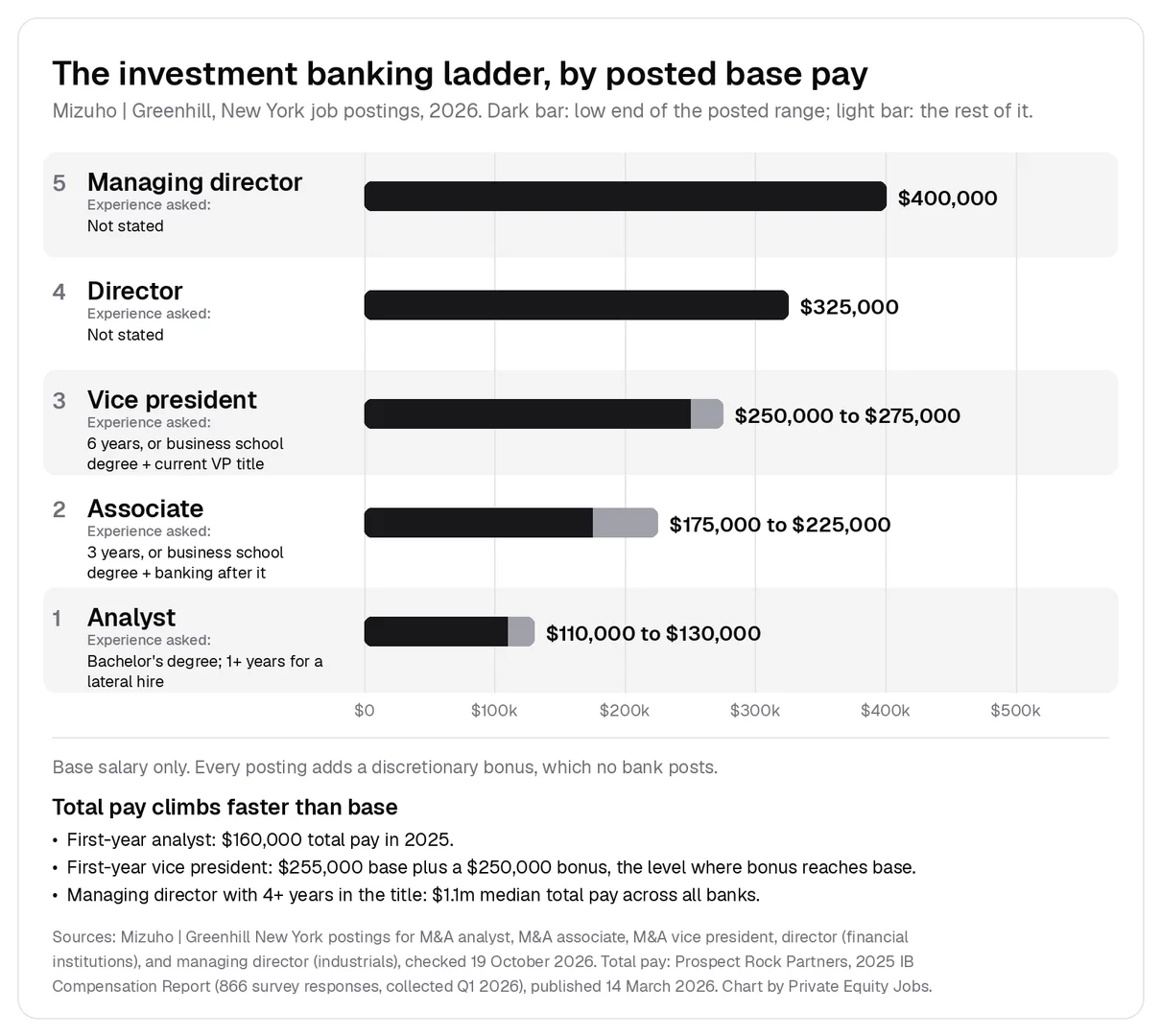
The analyst, associate, and vice president postings at Mizuho | Greenhill list the same duties nearly word for word: research, pitch books, models, client materials, and due diligence. What changes from one title to the next is the experience required, the pay, and how much of the final product each person answers for.
Title names cause confusion outside banking. In an investment banking division, vice president is a mid-level deal title held by someone with roughly six or seven years of experience. At commercial banks and in many support functions, vice president is a broad corporate grade that covers many more people. A Goldman Sachs posting for a New York vice president in industrials banking lists base pay of $250,000 to $300,000, in line with the $250,000 to $275,000 that Mizuho | Greenhill posts for the same title.
Investment banking analyst
Most analysts join straight from college, usually after a summer internship that turns into a full-time offer. Lincoln International, a middle-market bank that listed its shares in 2026, says in its IPO prospectus that it has hired about 335 analysts and associates through campus recruiting since 2019. Banks also hire analysts laterally from other banks. Goldman Sachs posted a New York analyst role in its Capital Solutions Group in 2026 asking for zero to one year of experience, with a base salary of $110,000 to $125,000. The posting says the hire may be eligible for a discretionary bonus if still employed at fiscal year-end.
The analyst does the production work on every deal: the model, the comparable-company and precedent-transaction tables, the pitch book pages, the management presentation, the data room, and the scheduling and contact lists that keep a deal team organized. Analysts also absorb most of the turnaround requests from everyone above them, which is why the hours at this level are the longest. Most of the training happens on the job. Goldman Sachs describes an apprenticeship model in which junior bankers learn by working closely with senior ones, backed by an in-house training school, Goldman Sachs University. Some of the work is changing. Fortune's report on Citi's 2026 change noted that banks, Citi among them, are using AI tools for entry-level tasks such as document review.
The analyst stint is a fixed program at most large banks. For years the standard was three years before promotion to associate, and Raymond James still describes its analyst seat as a three-year program. JPMorgan moved to two and a half years in 2025, Fortune reported that June. Citi told staff in an internal memo, whose contents it confirmed to Fortune in October 2026, that it would cut its analyst program from three years to two, and its current third-year analysts are due to become associates on 1 January 2027 if they meet performance standards. Promotion from analyst to associate without going to business school is often called a direct promote or "A to A."
By the second year, each analyst faces a decision. One option is to stay for the associate promotion. Another is to move to a buy-side seat, most often a private equity associate role. A third is to apply to business school, after which some analysts return to banking as associates.
Investment banking associate
Associates come from three places: analysts promoted at their own bank, graduates of master of business administration (MBA) programs hired after a summer associate internship, and lateral hires from other banks, accounting firms, and consulting. Lincoln's prospectus says it recruits laterally "from other investment banking advisory firms, professional services firms and accounting firms." Mizuho | Greenhill's New York M&A associate posting accepts either path. It asks for a bachelor's degree and at least three years of banking or corporate finance experience, or an MBA with post-MBA banking experience. A Goldman Sachs associate posting in industrials asks for a minimum of three years of investment banking or equivalent experience and lists a base of $150,000 to $225,000.
The associate is the first level that manages other people's work. Associates check every number the analyst produces, rewrite the narrative of the pitch or the confidential information memorandum, and keep the vice president informed. On a small team, the associate also becomes the daily contact for the client's finance staff. Associates answer for any analyst error that reaches the client. Like analysts, they are tracked by class year, from first-year to third-year associate.
The age at which people start this seat depends on the route. An analyst who starts at 22 and is promoted after two or three years becomes an associate at 24 or 25. An MBA associate is older. The Harvard Business School Class of 2027 profile reports an average of 4.9 years of work experience before the two-year program, with the middle 80 percent of the class between three and seven years, which puts most post-MBA associates in their late 20s.
Investment banking vice president
The vice president (VP) runs deal execution. A VP manages the timetable and the workstreams, reviews every page that goes to the client, handles calls with buyers and lenders, and decides when a question needs the managing director. VPs also start to carry their own client relationships, usually smaller companies or the day-to-day contacts at larger ones.
Postings show how long it takes to reach this seat. Goldman Sachs's New York industrials VP posting asks for a master's degree with at least four years of banking experience, or a bachelor's degree with at least seven, plus at least two years leading deal teams of analysts and associates. Mizuho | Greenhill's M&A VP posting asks for six years of banking and corporate finance experience, or an MBA and a current vice president title at another bank.
A VP answers to managing directors and clients for the result and to analysts and associates for the workload, so a stalled deal usually lands on the VP first. Pay at this level also changes shape. In Prospect Rock Partners' 2025 pay survey, the first-year VP was the level where the bonus caught up with base salary.
Director, senior vice president, and executive director
The rung between vice president and managing director carries different names at different banks: director, senior vice president, or executive director. Some banks have no separate rung and promote vice presidents straight to managing director. The job is the same wherever it exists. A director leads execution on several deals at once and is expected to start bringing in business.
At this level, promotion depends mostly on the business a banker brings in. A director who wants the next promotion usually needs clients who call them directly, a share of fees credited to their coverage, and support from the managing directors who sit on promotion committees. Mizuho posted a New York director role in financial institutions in 2026 with a base salary of $325,000 plus a discretionary bonus.
Managing director and beyond
A managing director owns client relationships and is judged on revenue. Managing directors decide which pitches to make, which mandates to accept, and what to charge, and they lead the negotiation when a deal reaches its final terms. Much of the work happens in meetings with clients, boards, and private equity firms.
There are few of these seats. Moelis & Company reported 1,416 employees at 4 February 2026, including 1,014 advisory professionals and 178 managing directors, in its annual report for 2025. The firm added 95 managing directors over the previous five years through hiring and promotion. Moelis reported 2025 revenues of $1.52bn, which works out to about $8.5m for each of its 178 managing directors. Moelis says its pay model is "not a commission-based structure where employees are compensated on a defined percentage of the revenues they generate."
Large banks promote managing directors in classes. Goldman Sachs's class announced in November 2025 had 638 people across all of the firm's divisions, up from 608 in its 2023 class. According to Goldman's figures, as reported by Business Insider, 31 percent of the new managing directors had joined as campus hires, and the class averaged 12 years at the firm. Lincoln's prospectus says its managing directors average more than eight years with the firm.
Above managing director, titles signal seniority and management roles. Evercore uses a senior managing director title above managing director and had 171 investment banking senior managing directors at the start of 2026, according to its annual report for 2025. Evercore promoted 11 managing directors to senior managing director in 2025 and eight more in January 2026, and it hired four investment banking senior managing directors from outside who were committed to join in 2026. Beyond that come group head, vice chair, and division head roles, which mix client work with running teams.
How long each promotion takes
Employers publish their timing in two places: the length of their analyst programs and the experience their postings ask for. Together they give a rough clock.
| Step | Typical time in the lower seat | Evidence |
|---|---|---|
| Analyst to associate | 2 to 3 years | Citi cut its program from three years to two in October 2026; JPMorgan moved to two and a half years in 2025; Goldman's associate posting asks for three years |
| Associate to vice president | About 3 to 4 years | VP postings ask for six years (Mizuho / Greenhill) or seven years after a bachelor's degree (Goldman Sachs) in total, so about three to four years after the analyst stint; Raymond James describes its associate seat as a three-year program |
| Vice president to director | Varies; employers publish no figure | Postings at this level list no years |
| Director to managing director | Varies; employers publish no figure | Goldman's 2025 managing director class averaged 12 years at the firm |
Counting from the first analyst year, the postings and Goldman's tenure figure put managing director more than a decade away for those who reach it. The senior steps depend on revenue and on whether a seat opens, so timing spreads widely. In Goldman's 2025 class, 69 percent of the new managing directors had joined the firm as experienced hires, so for most of the class the 12-year average at Goldman is shorter than the time since their first job.
For an analyst who starts at 22 and meets the posting minimums, the vice president requirement arrives at about 28 or 29. A Goldman campus hire who joined at 22 and matched the 2025 class's 12-year average tenure would be about 34 when named managing director.
The early steps are getting shorter. Citi's co-head of North America investment banking, David Friedland, tied its two-year analyst program to private equity firms interviewing analysts early, and the change brings the associate promotion forward by a year. Meridith Dennes, managing partner at the search firm Prospect Rock Partners, told Fortune that AI tools doing entry-level work could make a shorter program more appealing to banks, because it lowers the commitment they make to young hires.
Investment banking salary by level
Banker pay has two parts: a base salary and a discretionary bonus paid once a year. Banks list base pay ranges in US postings for New York and other locations, so the base side is public. The bonus side is not. Goldman Sachs's postings say only that the employee "may be eligible for a discretionary bonus" if still employed at fiscal year-end.
Base salary rises about three and a half times from analyst to managing director in the Mizuho | Greenhill postings, from $110,000 at the low end of the analyst range to $400,000. Total pay rises much more, because the bonus grows faster than the base at each level. Prospect Rock Partners, an executive search firm, published its 2025 investment banking compensation report in March 2026, based on 866 survey responses collected in the first quarter of 2026 and split by bank type, including bulge bracket banks, elite boutique investment banks, and middle-market investment banks. Its published findings include these figures:
| Level (Prospect Rock Partners, 2025 pay) | Figure |
|---|---|
| First-year analyst, total pay | $160,000 (up from $148,000 in 2023) |
| First-year associate, total pay | $280,000 at bulge brackets; $400,000 at elite boutiques |
| First-year vice president | $255,000 base and $250,000 bonus |
| Vice president, second year onward | Bonus exceeds base |
| Executive director, total pay | $878,000 at bulge brackets; $788,000 at elite boutiques |
| Senior levels | Bonus can be 70% to 77% of total pay |
| Managing director, 1 to 3 years in the title | $1.2m at bulge brackets; $1.325m at elite boutiques |
| Managing director, 4+ years in the title | $1.1m median across all banks; $1.6m at both elite boutiques and bulge brackets; near $738,000 at boutiques and large US banks |
| Group head | $1.75m |
Senior pay is not all paid up front. The same survey found that third-year vice presidents defer about 26 to 30 percent of their bonus on average, and that 67 to 70 percent of managing directors defer more than 25 percent. Many directors and managing directors receive $100,000 to $200,000 less in the first year than their headline number.
Bonuses move with deal activity. The New York State Comptroller estimated in March 2026 that the average securities industry bonus in New York City rose 6 percent in 2025 to $246,900, a figure that covers traders and other staff as well as bankers. For 2026, the pay consultancy Johnson Associates projected in August that bonuses for M&A bankers would rise 15 to 20 percent, and 20 to 30 percent for equity capital markets bankers.
The type of bank changes the curve. In the survey, first-year associates at elite boutiques earned 43 percent more than those at bulge brackets. The gap narrowed to 3 percent by the third vice president year, bulge brackets paid more at the executive director level, and the two met at $1.6m for managing directors with four or more years in the title. Middle-market banks matched bulge brackets for second-year associates, at about $340,000, then fell behind at vice president, where a second-year VP earned $500,000 against $580,000 at a bulge bracket and $660,000 at an elite boutique.
Hours at each level
Junior hours follow live deals. JPMorgan began capping junior banker hours at 80 a week in most cases in September 2024, with live deals exempt, on top of a "pencils down" period from 6 p.m. Friday to noon Saturday and one guaranteed weekend off every three months, Fortune reported. Bank of America began requiring US bankers to log hours daily, naming the deal and the senior banker overseeing the work. Both moves came after the death earlier that year of Leo Lukenas III, a Bank of America banker who had been working more than 100 hours a week on a $2bn deal. Bankers told the Wall Street Journal that a sample 80-hour week for a young JPMorgan banker could be six days from about 8:30 a.m. to 10 p.m.
Analysts work the longest hours because they produce the pages and models that everyone else reviews. Associates work almost as long, with more of the time spent checking and less spent building. From vice president upward, the hours shift toward client calls, travel, and internal approvals. Senior bankers usually spend fewer hours on documents than juniors do, but their time depends on clients rather than on a cap, and a deal in its final week can take over any level.
Who leaves, when, and where they go
The pyramid means that most people leave. Moelis, for example, reported 178 managing directors alongside 1,014 advisory professionals in February 2026.
The first departures now come early. Odyssey Search Partners, an executive search firm, found that private equity firms began recruiting junior bankers after about 11 months of training in 2010, and less than a month into the job by 2024, according to Fortune's October 2026 report. Large funds run this hiring as on-cycle recruiting, a burst of interviews for associate jobs that can start up to two years later. Banks have pushed back. JPMorgan told incoming US analysts in 2025 that if they accepted a job elsewhere "before joining us or within your first 18 months," their employment would end. Goldman Sachs reportedly asked junior analysts to confirm in writing every three months that they had not accepted an outside offer, and Citi reportedly required a one-time attestation.
Departures follow the ladder, and the usual investment banking exit opportunities change with seniority:
- Analysts leave mostly for private equity, hedge funds, growth equity, corporate development, or business school. Those who join a fund usually start as a private equity associate.
- Associates leave for post-MBA private equity seats, corporate development, or another bank.
- Vice presidents and directors more often move to another bank for a better title or to a company as head of corporate development. Buy-side seats at this level are rarer.
- Managing directors who change jobs often join another bank. Moelis's 95 new managing directors in five years and Evercore's four outside hires for 2026 show that banks hire senior bankers as well as promote them.
How to start an investment banking career
Most bankers enter through a campus program. Banks recruit for summer internships more than a year before they start, and they fill much of each analyst class from their own summer interns. Piper Sandler, a middle-market bank, took applications for its 2027 summer analyst program from college sophomores in the class of 2028 until the end of January 2026, and it describes the 10-week internship as a direct pipeline to its full-time analyst jobs. In October 2026, Mizuho | Greenhill's careers site listed a 2027 M&A analyst class in Chicago for students graduating in May or June 2027, at a base salary of $110,000. MBA candidates follow the same pattern a level up. Mizuho | Greenhill's 2027 New York M&A summer associate posting pays $3,365.38 a week and asks for students due to graduate in spring 2028, so they work the internship after the first year of the program.
Banks ask for a bachelor's degree and, for some groups, a quantitative major. Goldman's 2026 analyst posting asks for a degree in finance, economics, business administration, or a related quantitative field, while Piper Sandler's summer program invites applicants from all majors. None of the Mizuho | Greenhill or Goldman Sachs postings cited here asks for a professional designation such as the Chartered Financial Analyst charter or a certified public accountant license. Interviews test accounting, valuation, and modeling, along with attention to detail and a clear reason for wanting deal work. Candidates from schools where banks do not recruit on campus rely more on networking with alumni and on applying to smaller banks first.
Licensing comes in steps set by the Financial Industry Regulatory Authority (FINRA), the self-regulator for US broker-dealers:
- Securities Industry Essentials (SIE) exam. The SIE is open to anyone 18 or older, needs no employer sponsor, costs $100, and stays valid for four years. Candidates can take it before they apply.
- Series 79. The Series 79 investment banking representative exam requires sponsorship by a FINRA member firm, so new hires take it after they join. Together with the SIE, it qualifies a banker to work on offerings and M&A. Mizuho | Greenhill's New York analyst posting for lateral hires lists the Series 79 and Series 63 among its qualifications.
- Series 63. Bankers whose firm registers them as securities agents in a state also need the Series 63, the Uniform Securities Agent State Law Exam, which the North American Securities Administrators Association writes and FINRA administers. It costs $147 and needs no sponsor.
- Investment Banking Principal. Under FINRA Rule 1220, bankers who supervise investment banking work must register as an Investment Banking Principal, which requires the representative registration plus the General Securities Principal exam (Series 24).
Career changers have narrower doors. Accountants in valuation or transaction services, corporate bankers, and consultants usually enter as associates through MBA programs or lateral hiring. Entry above associate is rare for outsiders, because vice president postings ask for six or seven years of banking or equivalent experience, or a current vice president title at another bank. People who start at a smaller bank often move to a larger one after a year or two as analysts. The companies directory lists banks and private equity firms with their open roles.
Bank types and groups
Where a banker starts shapes the ladder. Bulge bracket banks are large universal banks with lending and trading arms and big analyst classes. Elite boutiques are independent advisory firms that work on large mergers without lending. Middle-market banks advise on smaller deals, often for private equity owners. The ladder and the titles are similar at all three, while class size, deal size, and pay differ.
Inside a bank, bankers sit in either an industry coverage group (such as healthcare, industrials, or technology) or a product group (such as M&A, equity capital markets, debt capital markets, leveraged finance, or restructuring investment banking). Coverage bankers own relationships with companies in one industry. Product bankers bring the technical skill for one type of transaction. A managing director can be senior in either kind of group.
Sales and trading and equity research sit in a bank's markets division, with their own ladders and pay. They use some of the same titles, which is another source of confusion about what a vice president does.
Pros and cons of an investment banking career
The main attractions are pay, fast training, and the jobs the analyst seat leads to. First-year analysts earned about $160,000 in total in 2025 in the Prospect Rock survey, and pay rises steeply for those who stay. The work teaches valuation, modeling, and deal process quickly, puts junior bankers in front of many companies and management teams, and makes the analyst seat a standard entry route into private equity.
The drawbacks start with the hours. Junior hours are long enough that JPMorgan capped them at 80 a week, and the cap exempts live deals, which are the busiest periods. Most people who start as analysts do not become managing directors, and bankers who stall at vice president or director find fewer buy-side openings than analysts do. Bonuses follow deal activity, which can fall sharply in a weak year. Senior pay also depends on bringing in clients, a different skill from the modeling that earns early promotions.
Common questions
Is investment banking a good career path?
For people who want high early pay, fast technical training, and a route into private equity or corporate finance, yes. The trade-off is long hours in the first several years and a narrow ladder at the top. A two- or three-year analyst stint is a common plan in its own right, and bankers who stay past vice president are betting on their ability to win clients.
Is 25 too old for investment banking?
No. Many associates start in their late 20s after an MBA. The average Harvard Business School student has 4.9 years of work experience before starting the two-year program, and banks hire those graduates as associates. Analyst programs are aimed at recent graduates, so someone older without banking experience usually enters at the associate level through business school or a lateral move.
Is an investment banker a 9-to-5 job?
No. Junior bankers work long enough weeks that JPMorgan capped their hours at 80 a week in most cases in 2024, and live deals are exempt from the cap. Bankers told the Wall Street Journal that a sample week at that cap could be six days from about 8:30 a.m. to 10 p.m. Senior bankers work fewer hours on documents but remain on call for clients.
How do I start a career in investment banking?
Take finance and accounting coursework, learn valuation and modeling, and apply for a summer internship for the summer before the final year of college. Applications for that internship often open in the sophomore year; Piper Sandler's 2027 program stopped taking them at the end of January 2026. Taking the SIE exam before applying is optional and requires no sponsor. MBA students follow the same path through summer associate internships. Lateral hires from accounting firms and consulting enter mostly as associates.
How long does it take to become a managing director in investment banking?
More than a decade for most people. Goldman Sachs's 2025 class of new managing directors averaged 12 years at the firm, and 69 percent of them had joined Goldman as experienced hires from other employers.
Sources
- Mizuho | Greenhill, New York job postings for M&A analyst, M&A associate, M&A vice president, director (financial institutions), and managing director (industrials), and 2027 M&A analyst (Chicago) and M&A summer associate (New York) postings, checked 20 October 2026.
- Goldman Sachs, New York job postings for analyst (Capital Solutions Group), associate (industrials), and vice president (industrials), checked 20 October 2026.
- Goldman Sachs, Investment Banking Careers page, checked 20 October 2026.
- Goldman Sachs, 2025 Managing Director Class fact sheet, November 2025.
- Business Insider, "Goldman Sachs promotes 638 people to managing director," Reed Alexander, 6 November 2025.
- Moelis & Company, Form 10-K for 2025.
- Evercore, Form 10-K for 2025.
- Lincoln International, final prospectus (Form 424(b)(4)), 2026.
- Raymond James, Career Path Investment Banking page, checked 20 October 2026.
- Piper Sandler, 2027 Investment Banking Summer Analyst program announcement, January 2026.
- Prospect Rock Partners, 2025 IB Compensation Report, published 14 March 2026.
- New York State Comptroller, Wall Street bonus estimate, 26 March 2026.
- Johnson Associates, bonus projections, August 2026.
- Fortune, Orianna Rosa Royle, 12 September 2024; Sheryl Estrada, 9 June 2025; Sasha Rogelberg, 7 October 2026.
- FINRA, Securities Industry Essentials exam; Series 79 exam; Series 63 exam; Series 24 exam; Rule 1220.
- Harvard Business School, MBA Class of 2027 profile.
Related posts
Related posts

Middle-market investment banks sell and finance companies worth tens of millions to about $2bn, many of them owned by private equity firms. The firms, the 2026 league table, how they get paid, posted pay, and where the seat leads.

Equity research covers public companies, publishes ratings, and sits between management and investors. How the seat differs from IBD on hours, conflicts, pay shape, AI pressure, and exits to AM, hedge funds, IR, and corporate finance.

Sales and trading is the markets division that pitches ideas and makes markets for institutional clients. How desks and roles work, how it differs from investment banking, and where the seat leads.