Middle Market Private Equity
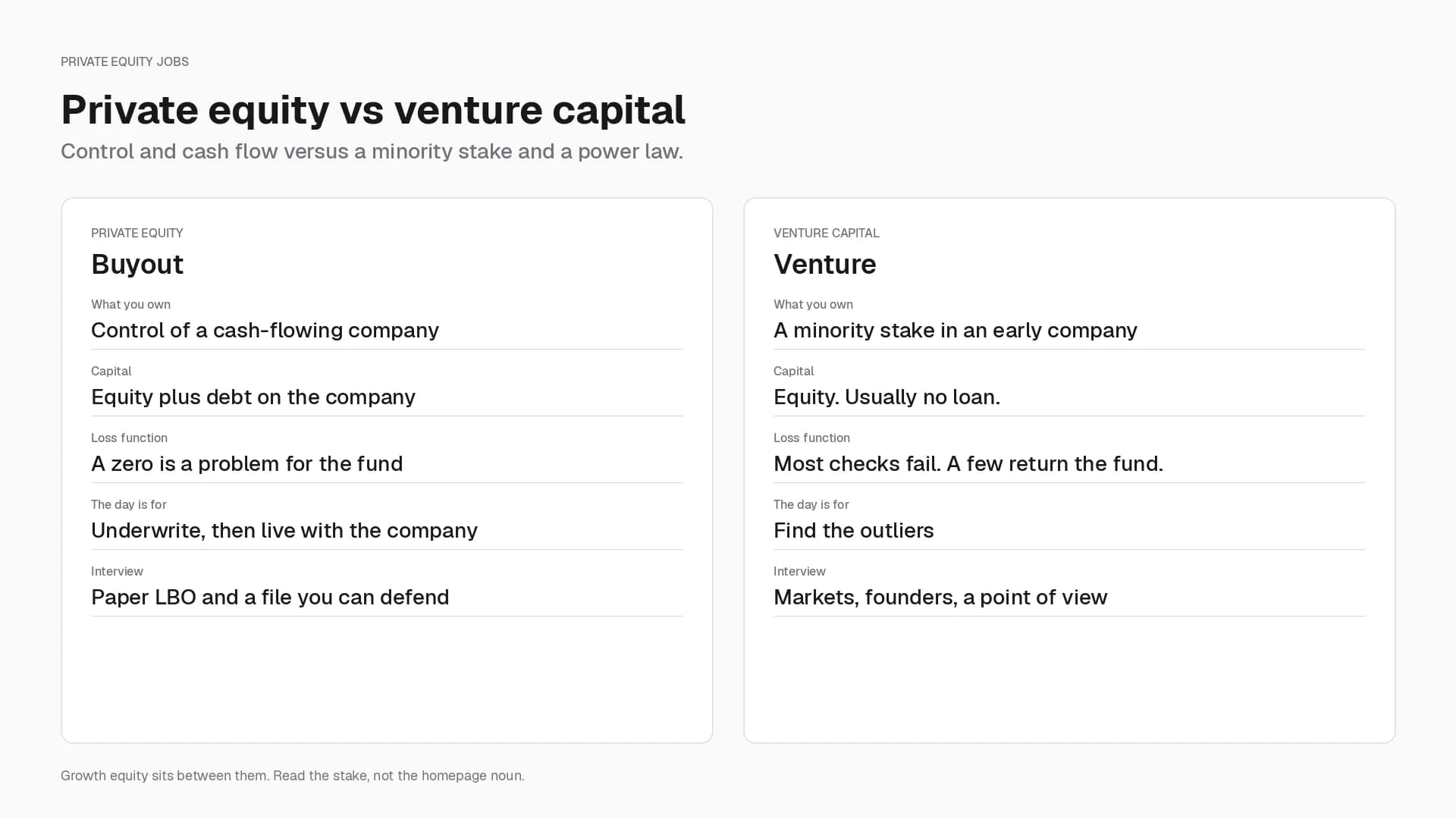
Middle-market private equity is a size label on a buyout. The fund still takes control of a company that already produces cash, often with a loan on that company's balance sheet, holds it for several years, and has to sell.

Middle-market private equity is a size label on a buyout. The fund still takes control of a company that already produces cash, often with a loan on that company's balance sheet, holds it for several years, and has to sell. Venture capital is a different product. So is a megafund take-private of a listed giant. The model in the middle is the same model. The company is smaller. The process around the deal is different, and so is the seat.
People use the same words for different dollars. A career page that says middle market usually means a purchase price between $50 million and $500 million. PitchBook's 2025 Annual US PE Middle Market Report counts US transactions valued between $25 million and $1 billion. Hamilton Lane, writing for limited partners on 23 September 2025, treats $1 billion to $3 billion of total enterprise value as its middle-market sweet spot. The National Center for the Middle Market counts companies by revenue, about $10 million to $1 billion. Those maps overlap. They are not the same.
That is why a $180 million industrial purchase and a $2 billion software deal can both be called middle market in the same week. Ask which ruler the speaker is using.
What middle market private equity is
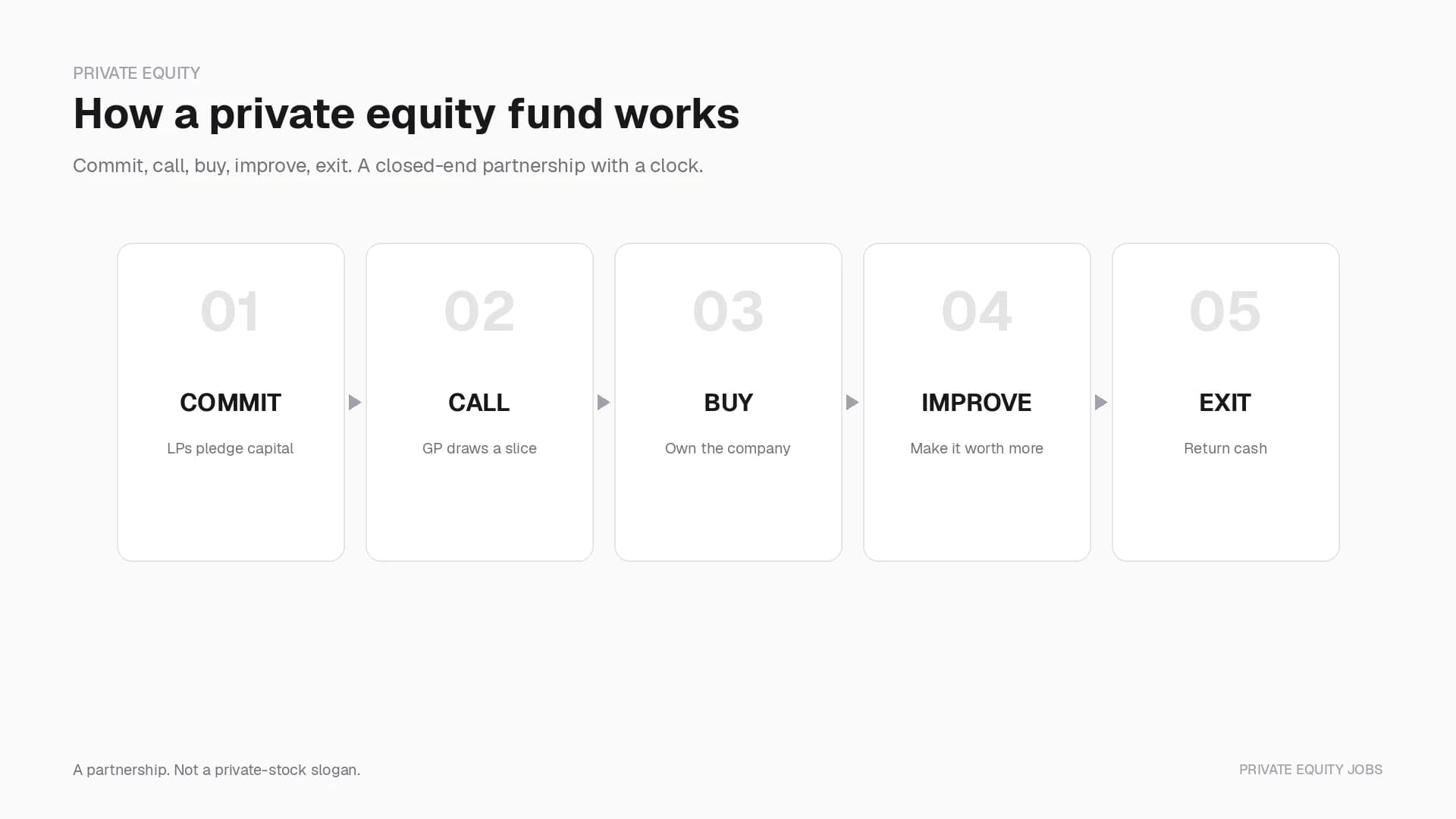
Private equity, in the sense a recruiter uses the phrase, is usually a leveraged buyout (LBO). The general partner (GP) calls committed capital from limited partners (LPs), buys control, and tries to grow earnings, pay down the loan, and exit. Middle market names the size of the company in that picture. It is not a sixth strategy next to buyout, growth, and venture. Size is a cut across a strategy, the way sector and geography are cuts.
The companies are established. They have customers and cash flow. They are often still founder-led or family-owned, with a finance function that is a controller and a spreadsheet rather than a public-company stack. They are too large for a venture check and too small to be a natural target for a $20 billion fund that needs to put $1 billion to work in one close.
The National Center for the Middle Market's usual US count is about 200,000 companies with $10 million to $1 billion of annual revenue. Rothschild & Co, citing that center in September 2022, put their combined revenue near $10trn and employment near 50 million, about one-third of private-sector output. Less than 5 percent of those companies had private equity backing at the time of that note. The universe is large. The funded slice of it is still a small minority of those companies.
PitchBook's 2025 report is the current US deal tape for the transaction-value definition ($25 million to $1 billion). Deal value rose 8.5 percent to $410.7 billion across an estimated 4,018 transactions, up 16 percent by count. Exits rose to an estimated 1,022 transactions and $140.4 billion. Fundraising fell more than 40 percent to $94.8 billion, the weakest year since before the pandemic, as limited-partner capital concentrated in fewer, larger platforms. Volume in the middle does not mean the middle was easy to raise.
Lower, core, and upper middle market
Once people split the middle, they usually split it three ways. The dollars still move with the speaker.
| Band | Deal or enterprise-value range you will hear | What the company often looks like | What the process often looks like |
|---|---|---|---|
| Lower middle market (LMM) | $25 million to $100 million (PitchBook and most career pages) | Founder or family. Thin staff functions. First institutional owner. | Off-cycle. More proprietary or lightly intermediated. Take-home cases. |
| Core middle market | $100 million to $500 million | A real management team. Some add-on history. Still room to professionalize. | Mix of banker processes and relationship origination. |
| Upper middle market (UMM) | $500 million to $1 billion (PitchBook). Some allocators run this to $2 billion or $3 billion. | Closer to a large-cap company. Formal auctions. Syndicated or large unitranche debt. | Recruiting and hours start to look like a megafund. |
Hamilton Lane's table is the reminder that "middle" is a house definition. In that September 2025 note, "small" is under $1 billion of total enterprise value, "middle market" is $1 billion to $3 billion, and "mega/large" is $3 billion to $10 billion. A recruiter who says middle market is rarely pointing at a $2 billion software auction. An allocator who says middle market might be.
Apollo, writing for wealth clients on 6 May 2026, used yet another band: enterprise values roughly $250 million to $2 billion. Corporate Finance Institute's lower-middle-market note uses revenue, $5 million to $50 million, which sits under the National Center's $10 million floor. None of those cuts is wrong as a house rule. Treating any one of them as the market is how people talk past each other.
A practical test if you are targeting a seat: look at the last ten deals, not the fund's marketing adjective. A $4 billion fund that buys $150 million companies is a middle-market buyer. A $1 billion fund that stretched into a $900 million auction is not "lower middle market" because the pitch deck says so.
How middle-market deals differ from large-cap buyouts
The types of private equity do not change when the check shrinks. Control, debt on the portfolio company, a hold of several years, and an exit that has to return cash are still the job. What changes is the raw material and the buyer set.
J.P. Morgan Asset Management's 20 August 2026 note on small and middle-market buyouts (companies with about $10 million to $300 million of revenue in that piece) is the current allocator arithmetic.
Roughly 147,000 US companies, 96 percent of privately held companies in that framing, sit in the small and middle-market set. That is about 25 times the opportunity set J.P. Morgan assigns to large-cap private equity. Since 2010, the median acquisition multiple for companies valued under $1 billion has been 25 percent lower than for companies valued between $1 billion and $3 billion, which in turn has been 18 percent lower than for companies valued above $3 billion. Companies valued under $1 billion have, on average, 34 percent less acquisition leverage than larger companies.
Those gaps are why the return story is usually operations and add-ons, not a bigger loan. A large-cap target already has a finance chief, a sales-ops stack, and a compensation plan a compensation consultant designed. A $40 million-EBITDA manufacturer in Ohio may still close the books in Excel. Value creation in that seat is hiring the first dedicated finance and human-resources leaders, installing a real reporting pack, and buying two competitors that were never going to sell to a megafund.
The process is different too. Large-cap deals run through bulge-bracket auctions with a full confidential information memorandum, a quality-of-earnings report, and a financing tree that assumes a syndicate. Lower-middle-market deals still arrive from a regional banker, an accountant, or a founder the partner has known for years. Upper-middle-market deals look more like the large-cap process, which is why people who treat "middle market" as one culture are describing a band that does not exist.
Exits differ in the same way. Over 90 percent of exits in J.P. Morgan's small and middle-market set have historically been sales to a strategic buyer or another financial sponsor. Large buyout funds lean more on initial public offerings because the company can be too big for many strategics and too big for many sponsors to digest. In 2025, sponsor acquisitions were more than 35 percent of exits in that J.P. Morgan set. Funds larger than $5 billion accounted for over 49 percent of capital raised that year. The larger funds are a buyer of the middle, not only a competitor.
| Middle-market buyout | Large-cap / megafund buyout | |
|---|---|---|
| Company | Established, often founder-led. Cash flow already exists. Infrastructure is incomplete. | Already professionalized. Public or about-to-be-public complexity. |
| How the deal is found | More proprietary and regional at the lower end. Formal auctions as you go up. | Almost always intermediated. Few unique ideas. |
| Leverage | Lower on average. Direct lenders rather than a bond syndicate. | Higher. Syndicated loans and, when the window is open, high-yield. |
| What is supposed to create the return | Earnings growth, professionalization, add-on acquisitions. | Scale, cost, a financing plan, and a smaller set of operating levers. |
| Who buys it next | A larger sponsor, a trade buyer, sometimes a continuation vehicle. | A strategic, a still-larger sponsor, or the public market. |
| The junior week | Screening plus origination plus a live model. Fewer parallel live processes. | More model and process. Less founder contact. |
Why limited partners put money here
Limited partners do not allocate to "the middle market" as a personality. They allocate because the opportunity set is larger, entry multiples have been lower, leverage has been lower, and the exit set is wider than a megadeal that needs an initial public offering.
J.P. Morgan's 2026 note puts the performance claim in one line: the internal rate of return (IRR) of top-quartile buyout funds smaller than $5 billion has been about 5 percentage points higher than that of larger peers. The same page says dispersion is wider at the small end. Manager selection is the job. A portfolio of twenty undifferentiated middle-market funds is a way to own the median.
Apollo's May 2026 wealth note is the counterweight, not a rebuttal of the tape. US middle-market deal value in 2025 was $410.7 billion across about 4,018 transactions, the highest since 2021, citing that same PitchBook report. The argument is that cheaper entry and easier operations are less of a structural free lunch than they were when financing was cheap and exits were fast. More sponsors, more lenders, and more banker processes now sit on the same pool of companies. A label on the size of the company does not replace underwriting the manager.
Both things can be true in the same year. The middle printed a lot of deals. Raising a dedicated middle-market fund got harder. Limited partners who still want the size cut have to underwrite the GP, not the adjective.
Value creation, and who buys the company next
The work after close is the same list you see on larger deals, applied to a company that still needs the list. Hire the missing operators. Clean the numbers so a later buyer can underwrite them. Add a product or a geography the founder never staffed. Buy a smaller company in the same niche and put it on the platform's multiple.
Buy-and-build is the tactic ranking pages name most often because it is the one that shows up in the deal count. A platform in the core middle market can absorb several sub-$25 million add-ons that a $15 billion fund will not staff a partner to chase. The multiple on the small purchase is usually lower than the multiple on the platform. The spread is part of the underwrite. Integration is the part that fails.
The natural buyer of a finished middle-market company is often a larger private equity fund. That is the sponsor-to-sponsor ladder. J.P. Morgan's 2025 print (sponsor acquisitions more than 35 percent of exits) is that ladder in a number. A trade buyer that wants the product line without buying a $10 billion company is the other door. An initial public offering is available in theory once the company is large enough. It is not the usual door.
A historical walk-through, because the ladder is easier to see on one name than on a table. In 1999 Apax Partners carved Vardon Attractions out of a listed parent for less than £60 million. Hermes Private Equity later owned the business as Merlin Entertainments. Blackstone bought it in 2005 for about £102.5 million. Eight years later Merlin listed in London with more than £1 billion of revenue and a valuation above £3 billion. That is one path from a mid-market carve-out to a public company, with two sponsor sales in the middle. It is not a template. It is what "sell it up the chain" looks like when it works.
A continuation fund or a secondaries sale of the fund interest is a different door. Those are ways to change who owns the stake when a sale of the company itself is not the best print. They do not make the company large-cap.
The job, and how the hiring works
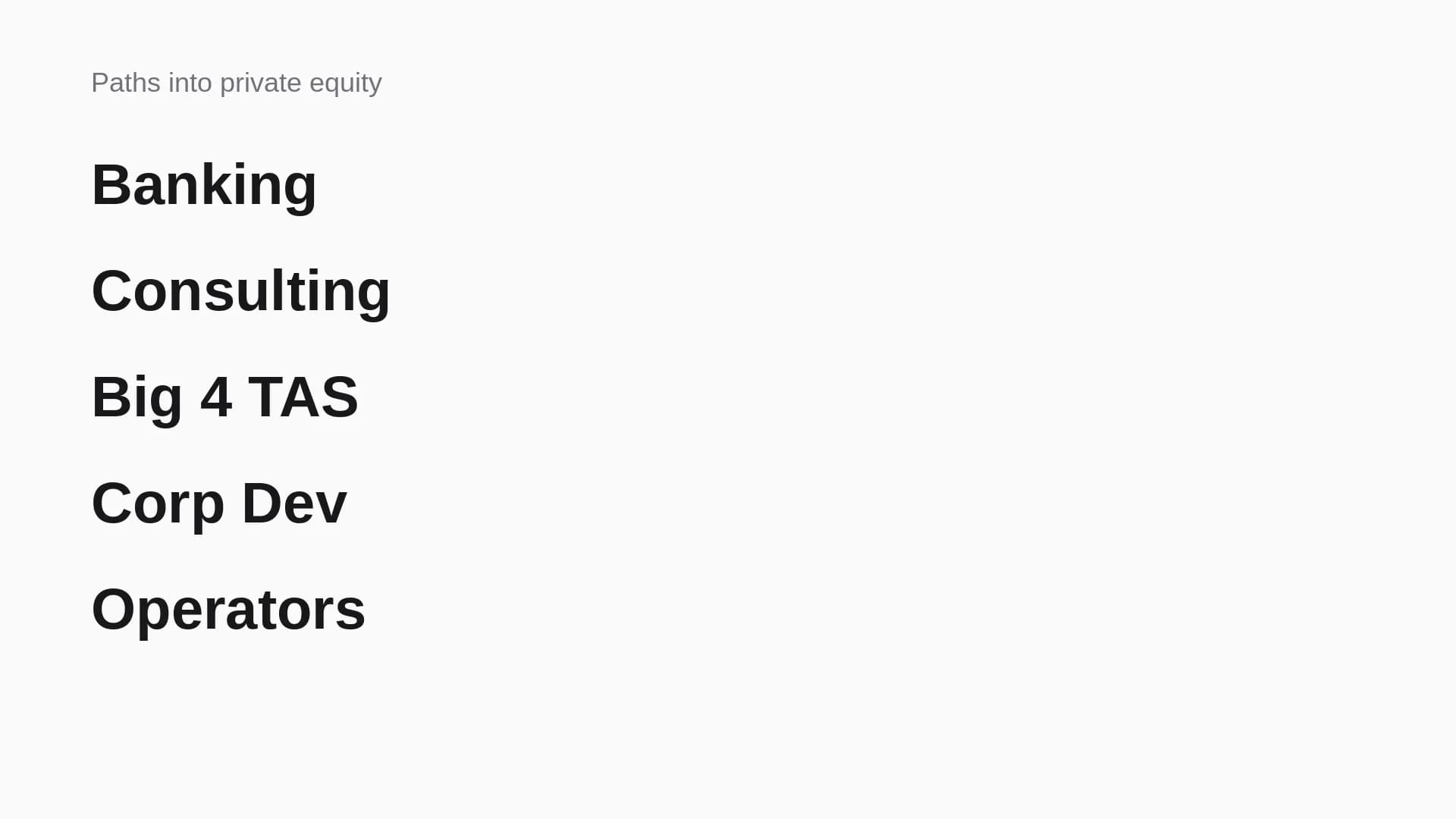
Most people who get a private equity seat do not get a megafund seat. The arithmetic is the same one the career blogs use: each large fund hires a thin associate class, and each large bank produces hundreds of analysts. The leftover seats are in the middle market, in growth, in credit, or back in banking.
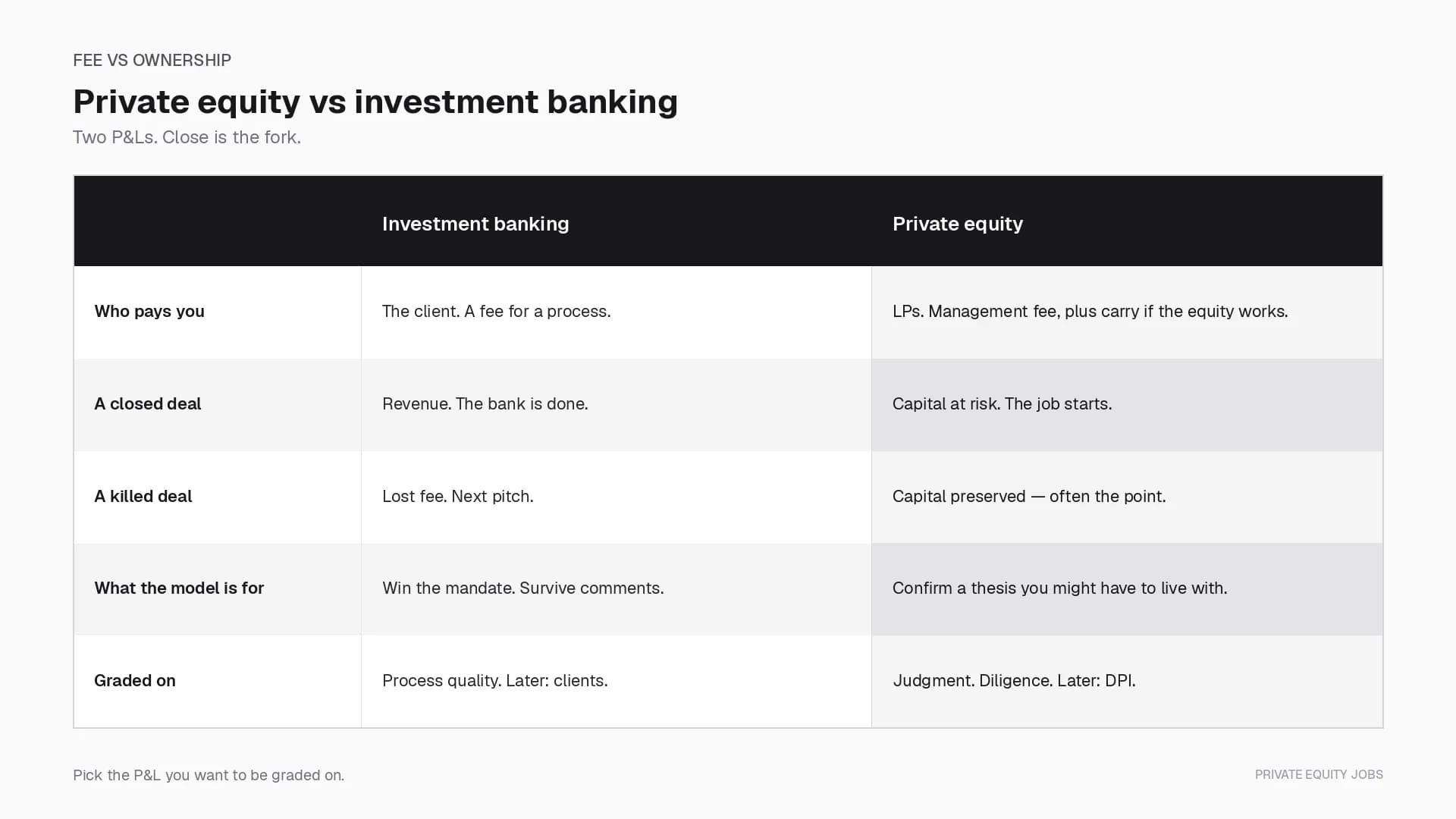
The work is still an investing associate's work. You screen teasers. You build and defend the model. You sit through quality-of-earnings. You write the memo the committee will rewrite. After close you live with monthly numbers that can invent or destroy free cash flow. What changes is how much of the week is origination, how close you sit to the founder, and how many other associates are in the room.
Lower-middle-market firms are small. A typical shop is a handful of investors, a chief financial officer, and an assistant. Hiring is episodic. An associate leaves for school, or the firm closed a new fund and needs another person. Headhunters still matter. The process is usually off-cycle: a call, a paper or short Excel leveraged buyout, then a take-home on a real company where the thesis matters more than the tab count. Boutique and regional bankers place here in a way they do not place into a January megafund weekend. How to break into private equity is still the process map. The targeting change is the point. You are recruiting into the market that actually hires.
Upper-middle-market firms run closer to the megafund machine: more headhunters, more timed tests, more exploding offers, a start date that can sit a year out. Hours move with that. A quiet week at a lower-middle-market shop can be sixty hours and a lot of founder contact. A live upper-middle-market auction looks like banking again.
Carried interest sometimes appears earlier at a smaller firm than it does in a megafund associate package. It is still delayed, vested, and easy to forfeit. A token grant is not a reason to take the seat. The career path after you are in is the same ladder (associate, vice president, principal, partner) with a better chance, at many middle-market shops, of promoting in place rather than being sent to a two-year program and an MBA.
Cash is lower than megafund cash. Brand is weaker if you later want a hedge fund or a different megafund. Deal structures are usually simpler. Those are the real discounts. Autonomy, earlier responsibility, and a promotion path that does not assume school are the usual offsets. None of that is a lifestyle product. Live deals still eat weekends.
Open investing roles sit on Private Equity Jobs. The companies directory is where those general partners are listed. Read the last fund size and the last ten deals before you treat a firm's "middle market" line as a targeting fact.
Common questions
What enterprise value is middle market?
There is no statute. Career pages and PitchBook's 2025 US report cluster around purchase or transaction values from about $25 million to $1 billion, with a common core of $50 million to $500 million. Some limited-partner notes, including Hamilton Lane's 2025 table, use $1 billion to $3 billion of total enterprise value as middle market. Ask for the last deals.
Is middle market a type of private equity?
No. It is a size cut on a strategy, usually buyout, sometimes growth. A $200 million manufacturer and a $20 billion software company can both be control deals with debt on the company. The model is the same. The lender set and the hours are not.
What is the difference between lower-middle-market and middle-market private equity?
Lower-middle-market usually means the $25 million to $100 million deal band: founder-owned companies, thinner processes, more off-cycle hiring. Core middle market is the $100 million to $500 million band. Upper-middle-market sits under $1 billion on PitchBook's cut and starts to recruit like a large fund. People collapse all three into "middle market" when they are not hiring.
Is it easier to get into than a megafund?
It is more accessible if you are not in a top group at a bulge-bracket or elite-boutique bank. It is not easy. The class is still small. Upper-middle-market on-cycle is a thinner version of the megafund weekend. Lower-middle-market off-cycle is a different test: a real take-home and a story that names this firm.
Does middle-market private equity pay less?
Junior cash is usually lower than megafund cash. Carry can appear earlier. Brand is weaker for some laterals. If you need a number for an offer, use a current recruiter and a dated survey, not an undated career-blog grid.
Why do megafunds raise middle-market funds?
Because that is where most of the companies are, and because a finished middle-market company is a natural add-on or platform for a larger fund. J.P. Morgan's 2025 fundraising split (funds larger than $5 billion taking over 49 percent of capital raised) is the other half of that sentence. Large funds have dry powder that has to be invested. The middle is inventory.
Sources
J.P. Morgan Asset Management, A big role for small and middle-market private equity investments (20 August 2026). PitchBook, 2025 Annual US PE Middle Market Report (deal value $410.7 billion, about 4,018 transactions, exits, fundraising $94.8 billion, $25 million to $1 billion transaction definition). Hamilton Lane, The Case for Middle Market Private Equity (23 September 2025; $1 billion to $3 billion total-enterprise-value band). Apollo, Beyond the Middle Market (6 May 2026), citing the same PitchBook report. National Center for the Middle Market revenue definition as cited by Rothschild & Co, Why the US middle market is attractive for Private Equity Investors (20 September 2022).