What Does a Private Equity Analyst Do
A private equity analyst is hired out of undergrad and owns pieces of a live deal: comps, data-room hygiene, first-pass research, model updates. They do not coordinate the process or vote. Many large buyout shops skip the title.

A private equity analyst is the most junior investing seat at a fund that hires one. They come straight from college, or from a non-MBA master's, with little or no full-time deal experience. On a live process they own pieces of the file: comparable companies, data-room hygiene, process tracking, first-pass research, and model updates the associate does not have time to touch. They do not coordinate the deal from teaser to investment-committee memo. They do not decide whether the fund writes the check.
Many large US buyout shops skip the title and hire at associate after two or three years in investment banking. Listings that want two to four years of banking and call the job analyst are describing an associate. Ask who owns the model, who sits on the quality of earnings call, and who writes the first memo. Those answers describe the seat better than the word on the card.
Open investing seats sit on Private Equity Jobs. Firm names sit in the companies directory.
What a private equity analyst does
A private equity firm raises a closed-end fund from limited partners, calls that capital, buys companies, tries to increase equity value, and returns cash before the fund ends. An analyst, where the seat exists, is involved in the junior work of those stages. Most of the hours sit in two places: companies the fund might buy, and portfolio companies it already owns.
On a live process they pull financials out of a teaser or a confidential information memorandum, build a first-pass leveraged buyout (LBO), clean a data dump the seller uploaded overnight, keep a tracker of open diligence items, and sit on calls they do not run. After a purchase closes they update the internal model when the monthly flash arrives and help assemble pages in a board pack. The associate is supposed to have a view: if you were the buyer, would you underwrite this price, this leverage, and this return. The analyst is graded on whether the tab is right, on time.
Job-description pages sometimes say the analyst sources the company, manages the portfolio business, negotiates the purchase, and plans the exit. That is vice-president and principal work, pasted onto the junior title. Analysts and associates often touch the same spreadsheets. Associates coordinate outside advisors, check the analyst's work when an analyst exists, and draft the memo someone more senior will rewrite. Analysts own pieces of that file. They are rarely in fundraising. Partners own the raise. An associate may still build a returns page or a case-study slide. An analyst more often formats the appendix.
GP Intel's 1 June 2026 careers guide puts the analyst as the most junior seat, where it exists: some growth-equity and middle-market firms hire from university for research and model support, and most large buyout firms skip the level and hire at associate. That is the US default. A European graduate programme can look different. Some of those houses second a junior into a portfolio company for months, or rotate them through senior calendars. Treat that as that house, not as the New York buyout law.
Deal work: screening, the model, diligence, the memo
A teaser or a confidential information memorandum arrives. The associate's first job is to kill it when it is obviously wrong: check size, sector, customer concentration, a growth story the company has never earned. The analyst's first job is usually a subset of that file. Review the rest of the book. Pull the financials into a simple model. Map a few comparables. Write the facts that let someone more senior kill the name in a meeting. The ones that survive get a fuller leveraged buyout. The analyst may build the first pass. The associate owns whether it ties.
The model has to tie: sources and uses, a debt schedule, a returns bridge to internal rate of return (IRR) and multiple on invested capital (MOIC). Management's case in the CIM is usually optimistic. Someone on the team has to add a case they would actually underwrite. When quality of earnings accountants send add-backs that are not run-rate, the associate changes the model. The analyst is often the person who re-exports the tables, fixes the bridge, and checks that the appendix still matches. Back-solving the file to a partner's preferred rate is how recommendations get dishonest. The analyst is not the person who decides to do that. They are the person who will be asked why the tab no longer foots.
Due diligence is where the hours go. A vice president usually owns the workstream list: financial, legal, commercial, insurance, tax. The associate is the person in the files, on the expert calls, and in the data room. The analyst keeps the room usable: folders named, open items tracked, a badly formatted customer file cleaned in Excel before anyone can use it, notes from a call they did not lead. They may own four or five lines on a tracker, not the tracker. They may sit on a commercial call and write "churn is unclear, follow up" rather than run the meeting.
The investment-committee memo is the product. It is not a pitch book. It says what you are buying, why cash flows are durable, which add-backs you do not believe, the work in the first hundred days that could produce real earnings growth, and who buys this in year five. The associate drafts it. The vice president rewrites it. The analyst more often owns a slice: comps, a market appendix, model outputs, footnotes. At some shops they present that slice. They still do not vote. They are not the person negotiating the purchase agreement.
Many processes die. The analyst still cleaned the file, sat the calls, and built the slides. From the firm's side that is how the partnership learns what it will not buy. From the analyst's side it is a week that did not produce a deal.
After the purchase closes
Banking ends at announcement. The fund's junior work does not. Analysts typically help cover a small set of portfolio companies, more at a small shop, fewer at a megafund where reporting is heavier. When the monthly flash arrives they update the internal model, compare actuals to the underwriting case, and flag when revenue misses or working capital eats cash. They help assemble board materials. They often do the first formatting pass on a bolt-on: a smaller company the platform wants to buy, modeled on a standalone and a combined basis, with the associate owning whether the combination case is honest.
How deep they go depends on the company and on whether the firm actually lets juniors into the work. A carve-out that is still standing up finance, tax, and systems will swallow the deal team, including the analyst. A large business with its own chief financial officer needs a clean flash. Copy that says the analyst implements new markets, restructures divisions, or prepares the company for a sale is describing a later seat. Value creation after close is the work of the hold. The analyst is rarely the person who changes pricing or sales. They are the person who keeps a tab true so the people who can change those things are looking at the same numbers.
Some European graduate programmes second a junior into a portfolio company for a stretch of months. Terra Firma has done that on a graduate intake (one 2014 hire spent months at Four Seasons Health Care). That is operating exposure inside someone else's P&L, not a New York megafund default. Ask whether the posting includes it before you underwrite the week.
How the job changes by fund size and strategy
A software growth-equity analyst in California and a New York megafund analyst on a public-to-private are both called analysts. The days are not interchangeable. At many shops the title does not exist at all.
At a megafund or large-cap buyout shop, some platforms run a formal analyst program and others skip straight to associate. Public career pages still list Blackstone, KKR, Bain Capital, Vista, Audax, Silver Lake, Leonard Green, and Warburg Pincus among US shops that have hired the title; the list is representative, not a census, and it changes by class. Where the seat exists, the work is high production: a full leveraged buyout, a large auction, specialist advisors, an investment-committee deck. Hours on a live process match banking. Sourcing is limited. Promotion to associate is not automatic. Some of those platforms expect you to recruit out, the same way banking analysts do.
At a middle-market shop the analyst is closer to management, more likely to sit in a diligence call, and more likely to see a whole process because the team is smaller. Sourcing is broader. The model is still an LBO, often with fewer debt layers. Hours in a quiet week are often 60 to 70. A live process still owns the calendar. Promote-in-place is more plausible than at a two-year megafund program. Smaller shops often collapse the two jobs and hire an associate from day one.
Growth equity puts more of the week on company evaluation and founder coverage, less on classic LBO machinery. Analyst seats are relatively more common. The interview, and the job, weight market and product more than a debt schedule. Cold-call and database work show up here more than on a large-cap buyout team.
| Megafund buyout | Middle market | Growth equity | |
|---|---|---|---|
| Seat exists | Some formal programs. Many shops skip and hire associates. | More common at some platforms. Smaller shops often collapse to associate. | Relatively more common. |
| Sourcing | Limited. Partners and bankers. | Broader. Teasers plus some outreach. | Often founder coverage and outbound support. |
| Diligence | Large auctions, specialist streams. Analyst owns lines on the tracker. | Leaner. Analyst closer to the file. | Higher-volume screening, less leverage work. |
| Model | Full LBO, multiple debt tranches. First pass, then associate QC. | LBO, often simpler capital structure. | Operating case. Debt is not the point. |
| Next seat | Promotion not automatic. Many recruit out. | Promote in place is possible. | Mixed. Partnerships are small. |
Analyst versus associate, and versus an investment banking analyst
Associate is the default US investing entry after two or three years in a deal seat. Analyst programs exist, are more common than a decade ago at some platforms, and remain a minority of large-cap buyout hiring. Analysts are hired out of undergrad. They own pieces. Associates are hired after a deal seat. They are expected to coordinate a process from teaser to memo draft without being walked through it. Ignore copy that calls private equity analysts people with two to four years of experience. That is an associate, mislabeled. Ignore copy that says most PE analyst roles recruit from investment banking analyst pools. That is the associate funnel with the wrong noun.
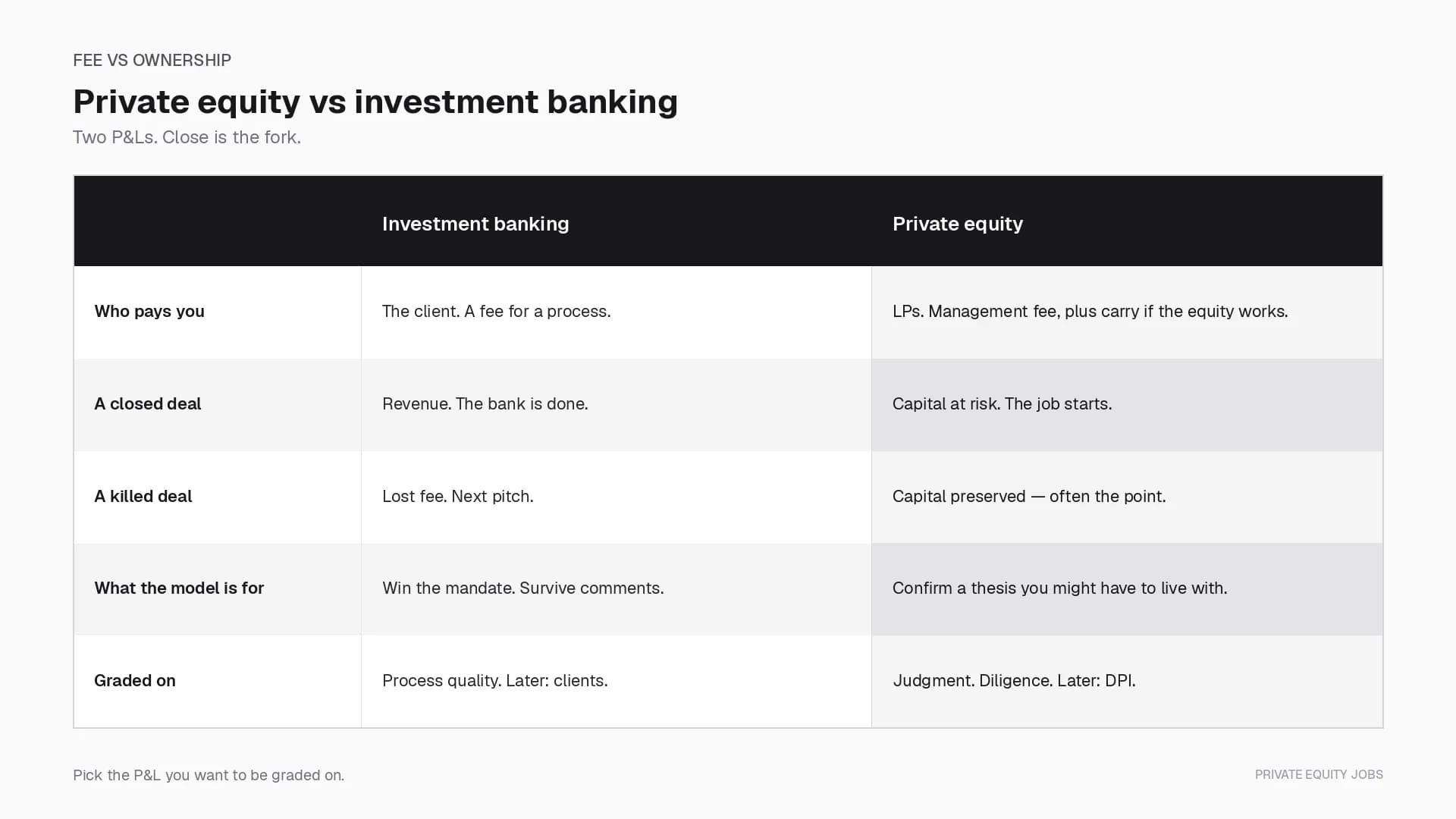
The investment banking analyst and the private equity analyst can look similar on a Tuesday: Excel, a book, a late night. The jobs are not the same. Banking sells a process for a fee. The PE analyst is building tabs a fund might have to live with. Teams are smaller. Training is thinner. You sit closer to the people who will say yes or no. The trade is less formal class-wide teaching and more exposure, if the firm actually lets you into the work. Hours on a live megafund process match the bank. Quiet weeks exist when the portfolio is humming and the funnel is thin. They almost never exist in a live banking coverage group.
The vice president is a different job again. Heidrick & Struggles' 2025 North America Private Equity Investment Professional Compensation Survey (19 November 2025), a survey of 656 North American investment professionals, defines the VP as the deal quarterback. They run the management meeting. The associate takes notes and updates the model. The analyst, when there is one, owns a workstream slice and the appendix. Technical excellence is assumed at every rung. The scoreboard changes. The analyst is graded on whether the piece was right. The associate is graded on whether the file was right. The vice president is graded on whether the recommendation was good and whether the process survived.
That private equity career path is a tournament inside a fund cycle, not a syllabus. Analyst is often not partner-track. Two or three years, then associate at the same firm, or out. Do not underwrite partner from this title.
Hours
Hours follow the process, not the title. Public guides still cluster the week at 60 to 80 hours, with smaller and middle-market funds toward the low end in a quiet week and megafund live processes at the high end or above it. Weekend work is usually light until a deal is in its last stretch. Quiet weeks exist. They are not the reason to take the seat.
The day is a first-pass model, a teaser screen, a data file that will not open, a quarterly flash, and a slide the associate will rewrite. A gym-to-midnight calendar describes one week. It does not tell you who owns the model.
Pay
Undated bands go stale. GP Intel's 1 June 2026 careers guide puts US analyst all-in cash at about $100,000 to $200,000, and UK cash at about £60,000 to £120,000, for zero to two years in the seat. Those figures are drawn from public 2026 salary surveys and skew toward megafunds and the upper middle market. They are not a Private Equity Jobs survey. Heidrick's 2025 survey of 656 North American investment professionals does not publish a standalone analyst 25th-75th. Junior seats are grouped with associates in some cuts. Cash there is still mostly base. Half of 2025 base increases were 10 percent or less. About three-quarters of bonuses stayed discretionary.
Older New York guides still print $100,000 to $150,000 total, with a rumor that some megafunds pay closer to $200,000. GP Intel's wider US band is the dated public shape to use. French school pages print euro juniors in the low five figures. That is a different market. Carried interest is almost never an analyst fact. Cash dominates. Carry, when it appears at all, is a later vest, and only if you stay and the fund clears its hurdle.
How people get the seat
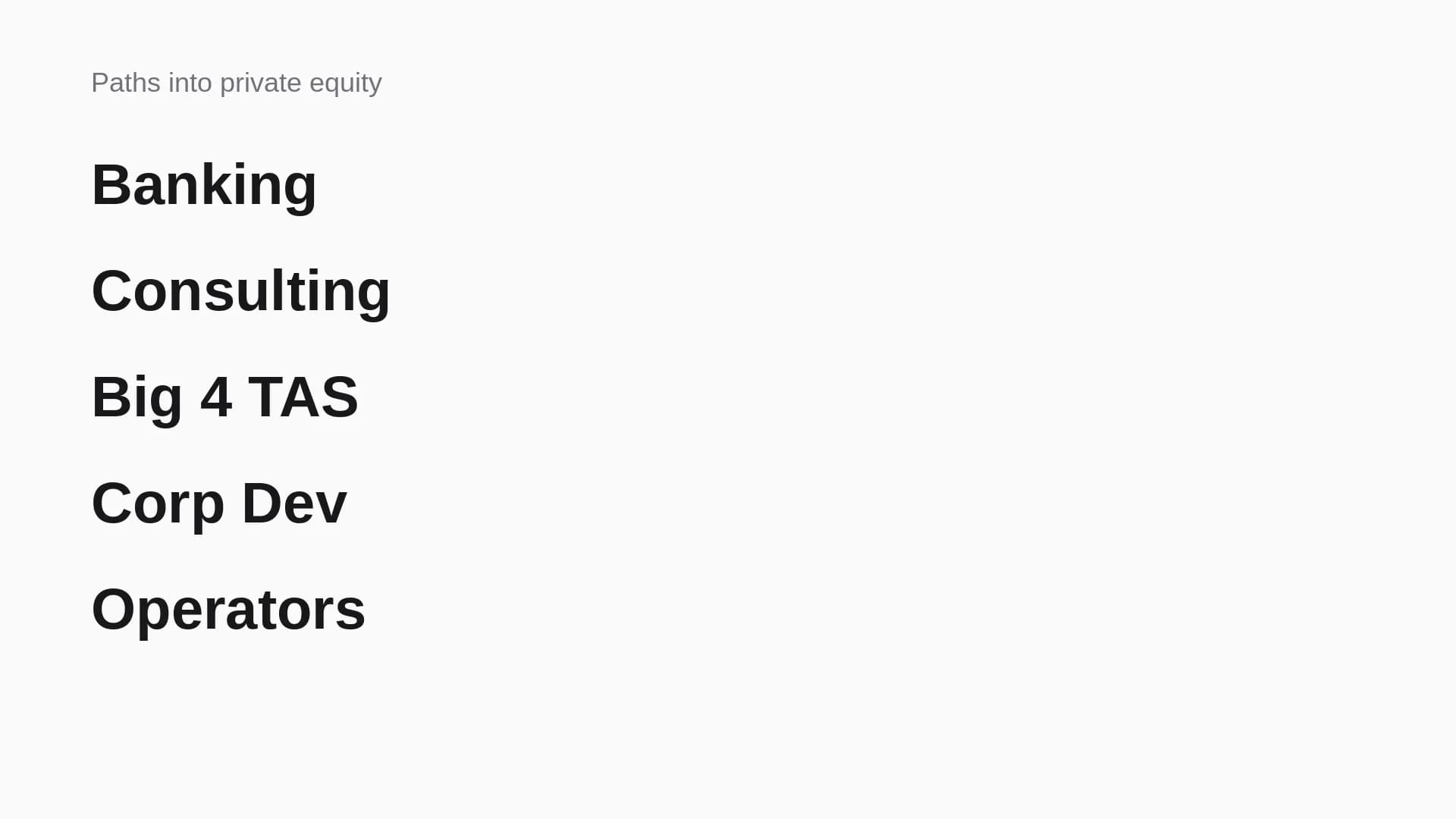
The default US buyout *associate* still comes from two or three years in investment banking. The analyst seat, where it exists, comes from undergrad or a non-MBA master's, usually with internships in corporate finance or a bank, and usually from a small set of undergraduate programs. Firms do not always post the jobs. Some convert a junior-summer internship. Some pick off bank interns. The process is less standardized than banking's. Interviews still test why you want to own companies rather than sell a process, and whether a simple paper LBO holds. Later rounds can add a longer model and the interview questions that keep coming back.
A master's is not the US floor. A French grande école page that treats it as required is describing that school's market. CFA and similar charters are optional credentials, not a recruiting gate. Do not pick this seat only to skip banking. The network, the training class, and the brand of a large bank are the things you give up. The reason to take it is that you already know you want the investing seat, the fund is real, the work is deal work rather than only outbound calling, and there is a plausible path to associate.
Common questions
Is a private equity analyst the same as an associate?
No. Analysts are hired out of undergrad and own pieces of the file. Associates are hired after a deal seat and are expected to coordinate the process.
Do all private equity firms hire analysts?
No. Many large US buyout shops skip the title and hire at associate. Growth-equity and some middle-market platforms are where the seat is more common.
Do analysts source deals?
At large buyout shops, usually not as a primary job. Partners and senior principals keep the pipeline. At growth shops, database work and outbound support can be a real share of the week.
Are the hours better than banking?
Often, at mid-sized and smaller funds, in a week with no live process. On a live megafund deal, no.
Do analysts get carried interest?
Almost never. Cash dominates. Carry becomes a negotiation from vice president up, and only if you stay through vest and the fund clears its hurdle.
What does success in the seat look like?
A tab seniors trust, a tracker that does not surprise the associate, and a first-pass model that does not have to be rebuilt from scratch. A view helps. Owning the recommendation is the next job.
Sources
Heidrick & Struggles, 2025 North America Private Equity Investment Professional Compensation Survey (19 November 2025). GP Intel, Private Equity Jobs and Salaries: The 2026 Careers Guide (1 June 2026).