How Private Equity Funds Exit
A private equity fund has to sell. A trade sale, a secondary buyout, an IPO, a dividend recap, or a continuation vehicle converts the company into cash so limited partners can be paid.

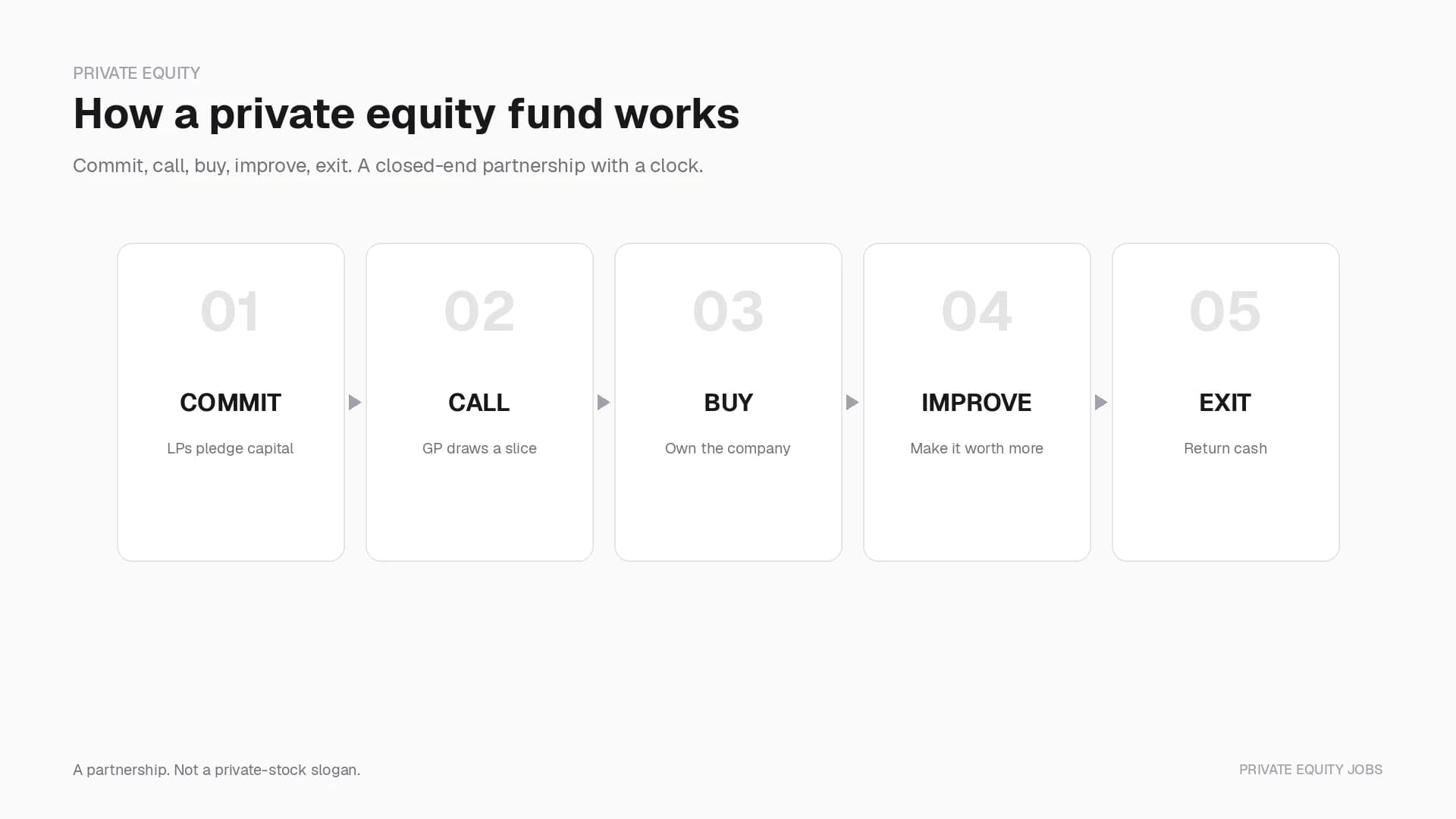
A private equity fund is a closed-end partnership with a clock. Limited partners commit capital. The general partner (GP) calls it, buys companies, tries to improve them, and has to sell. An exit is that sale: the conversion of a privately held company into cash (or into a security the fund can later sell) so the fund can distribute money back to the people who committed.
The common paths are a trade sale to a corporation, a secondary buyout to another fund, an initial public offering (IPO), a dividend recapitalization that pulls cash out without giving up the company, and, increasingly, a continuation vehicle that moves the asset into a new partnership. The menu is not a ranking. The fund's remaining life, the buyer set, and the state of credit and equity markets decide which door is open.
Why private equity funds exit
Most buyout funds are written as roughly ten-year limited partnerships, with room for extensions. The early years are the investment period: capital calls and purchases. The later years are harvest: hold, improve, exit, distribute. Allocators also call those later years the harvesting period. The point is the same. The partnership is not a perpetual company. It has to return capital.
That is why exits sit at the center of the model, not at the edge. A leveraged buyout underwrite assumes a buyer (or a public market) years out. Value creation during the hold is work toward that buyer. Distributions to paid-in capital (DPI) rises only when cash actually leaves the fund. Marks on unsold companies raise residual value. They do not write checks.
Bain & Company's 17th Global Private Equity Report (23 February 2026) puts the recent harvest under strain. Buyout holding periods at exit have hovered around seven years, against an average closer to five to six years from 2010 to 2021. Distributions to limited partners as a share of net asset value stayed below 15 percent for a fourth consecutive year. Arnold Madanha, writing for CFA Institute's Enterprising Investor (29 October 2025), cites McKinsey research that average buyout holding periods rose to 6.7 years from a two-decade average of 5.7 years, with the exit backlog larger than at any point since 2005. Longer holds and weak distributions are the same problem seen from two seats: the company's clock and the LP's cash account.
Trade sale to a strategic buyer
A trade sale, or strategic sale, transfers the company to an operating business, usually in a related industry. The buyer is hunting customers, technology, geography, or capacity it does not want to build. Synergies can support a higher price than a financial buyer will pay for the same cash flows.
The process is often an auction run by a sell-side adviser, or a negotiated deal with one named buyer. Diligence covers contracts, customers, employees, and liabilities. The purchase agreement sets price, closing conditions, and indemnities. Escrow or earn-outs are common when the parties disagree about what the next year will look like.
KKR's July 2025 essay Please Locate the Nearest Exit, by Bradlee Few, Alisa Amarosa Wood, and Emily Pollock, reports that across KKR's private equity business nearly 60 percent of exits have been a sale to a strategic corporation or to another sponsor. An IPO is the visible path. Most exits are still a sale to a corporation or another sponsor.
Secondary buyout
A secondary buyout is a sale from one private equity fund to another. The company stays private. The selling fund gets a realization. The buying fund gets a business that has already lived with a sponsor, often with a new capital structure and a new hold thesis.
This path shows up when the selling fund's remaining life is short, when the IPO window is closed, or when another firm sees a next chapter the current owner will not underwrite: a new geography, a buy-and-build program, or a different capital structure. It is a large share of sponsor exits in many years, not a consolation prize.
A management buyout sits next to this bucket. The company's executives buy the business, usually with debt and often with a new financial sponsor. Continuity of leadership is the pitch. Financing capacity and a fair price between friends are the constraints.
Initial public offering
An IPO lists the company on a public exchange. The fund does not usually walk away with all of its cash on the first trading day. Underwriters price and distribute the shares. Lock-up agreements typically restrict insider sales for a period after pricing, often about 180 days. The GP then sells down over time in secondary offerings or open-market sales. An IPO is a path to liquidity, not a single wire.
Public markets have to be open. The company has to be large enough and clean enough to live with quarterly reporting. Fees and management time are real. When the window is shut, funds lean on trade sales, secondary buyouts, and the paths below.
Dividend recapitalization
A dividend recapitalization puts new debt on the portfolio company and pays a large dividend to equity holders. The fund keeps ownership. Limited partners get cash earlier than a full sale would deliver. Internal rate of return (IRR) can look better because money came back sooner. The company's interest bill rises and the equity cushion at a later exit shrinks.
A dividend recap is not a true exit. It is a partial liquidity event that de-risks the position while the sponsor waits for a better sale window. It works when credit markets will fund the dividend and when cash flow can service the extra debt. It fails when the new leverage leaves the company fragile into a downturn. The cash from a recap is real, and the company is still on the fund's books.
Continuation vehicles
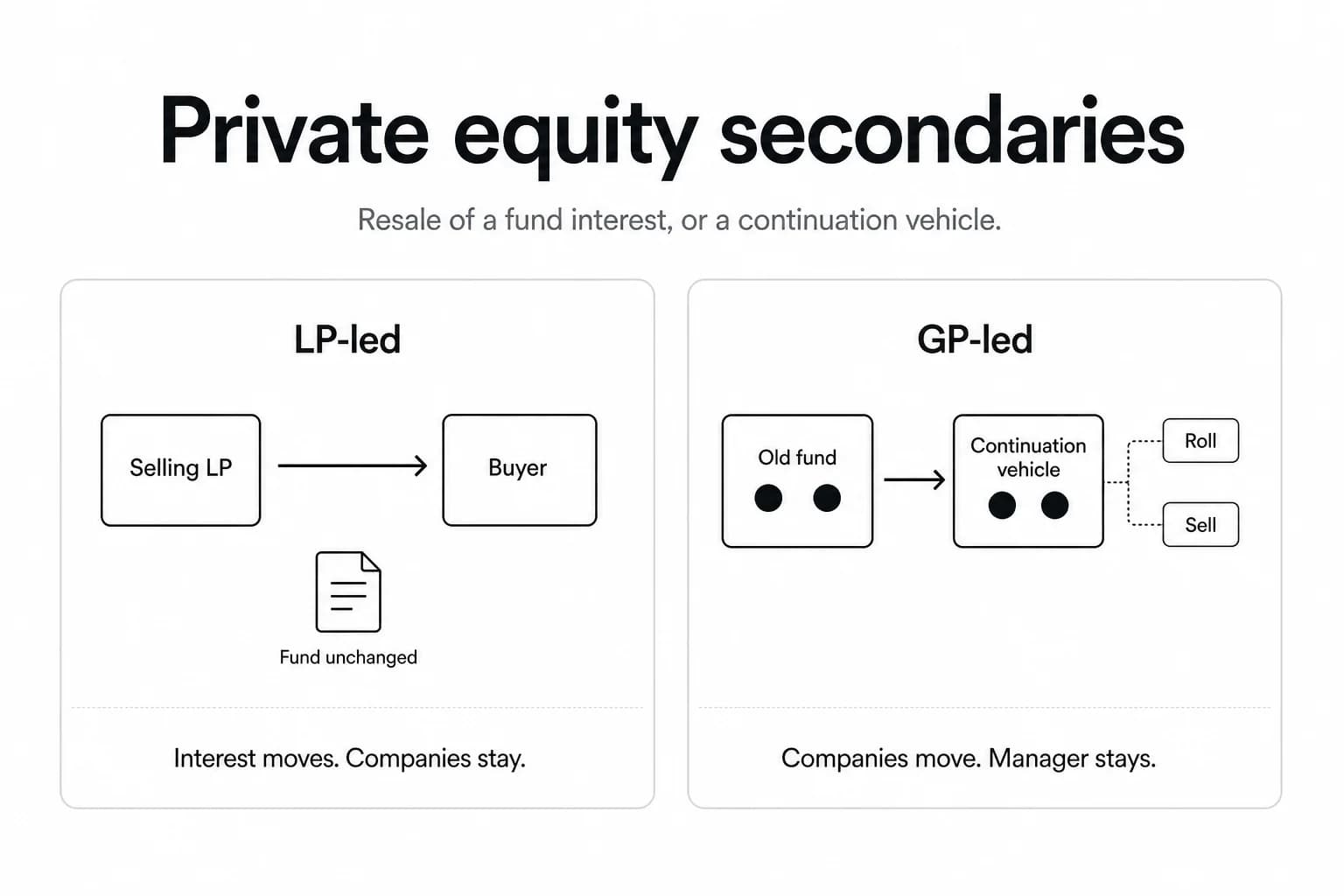
When the fund's contractual life is ending and the GP still wants the asset, a continuation vehicle can move one or more companies into a new partnership. Some limited partners cash out. Others roll. New capital often comes from secondaries buyers. Control can stay with the same GP.
CFA Institute treats continuation funds as the new exit playbook after five years of tighter financing and longer holds. The 2024 count is 96 continuation vehicles, 14 percent of private equity exits that year. Bain's 2025 print is volume, not count: GP-led continuation-vehicle volume rose 62 percent year on year, still less than 10 percent of total private equity exit value. Secondary transaction volume for GP- and LP-led vehicles rose 41 percent year on year in the same scoreboard.
A continuation is an exit for the selling fund's cash account and a hold extension for the asset. When the ten-year clock is real and the IPO or trade-sale door is shut, continuation is how some GPs return capital without abandoning the company.
How general partners choose and prepare
No path is always best. The choice sits at the intersection of the company's readiness, the fund's remaining life, credit and equity market conditions, and the buyer universe that will actually show up.
Trade sales tend to be fastest when a natural corporate acquirer exists. Secondary buyouts absorb companies that still have a private equity thesis left. IPOs need scale, a clean story, and an open window. Dividend recaps buy time with leverage. Continuations rewrite the partnership around an asset the GP will not sell at today's price.
Preparation starts early. Deal teams monitor the company against the business plan, control the board, and, when a sale is live, prepare an information memorandum, vendor diligence, and often a sell-side adviser. KKR's framing is to plan multiple exit doors from the first underwrite and to look toward monetization once most of the operating plan is done, with a target hold on the order of five to seven years. Leaving some growth for the next owner is part of what makes the company sellable.
When the sale closes, proceeds (net of transaction costs) flow through the partnership waterfall: return of capital, preferred return if the documents provide one, then carried interest to the GP. Liquidation of assets piece by piece remains the last resort when there is no going-concern buyer. Returns in that case are usually poor.
The associate work on an exit looks like the reverse of entry: update the model to the buyer's view, support the CIM and diligence Q&A, keep the board pack honest, and track what a strategic versus a sponsor will underwrite. Open roles that touch that work sit on Private Equity Jobs.
Sources
Bain & Company's 17th Global Private Equity Report (23 February 2026), for holding periods at exit near seven years, distributions as a share of net asset value stayed below 15 percent for a fourth consecutive year, GP-led continuation-vehicle volume up 62 percent year on year, continuation vehicles still under 10 percent of total private equity exit value, and GP- and LP-led secondary volume up 41 percent year on year. CFA Institute Enterprising Investor, Private Equity's New Exit Playbook (Arnold Madanha, CFA, 29 October 2025), including the McKinsey holding-period citation and the 2024 continuation-vehicle count. KKR, Please Locate the Nearest Exit (July 2025), for the share of exits that are strategic or sponsor sales and the five-to-seven-year hold framing.