Private Equity vs Asset Management
Private equity buys companies with limited-partner capital on a fund clock. Traditional asset management runs liquid portfolios for a fee on assets under management. Hours, pay, and the bridge between them follow from that.
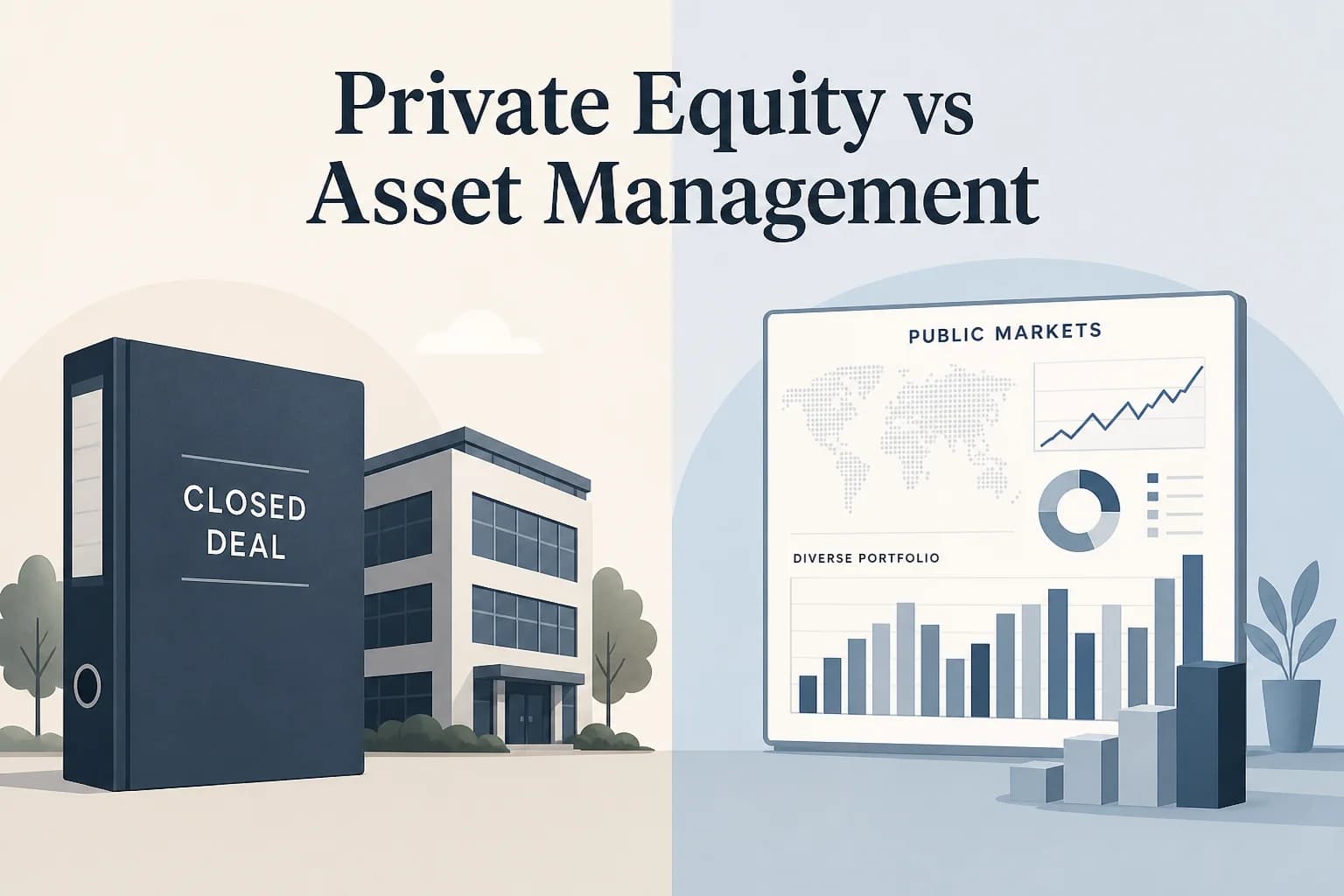
Private equity buys companies with limited-partner capital on a fund clock. Traditional asset management runs liquid portfolios and is paid a fee on assets under management. Hours, pay shape, and whether you can move between the seats follow from that difference.
Both sit on the buy side. Both raise money from institutions and, in many shops, wealthy individuals. Both ask juniors to read financial statements and defend an investment view. They are not the same product. A buyout fund is graded on equity returns it must return to pensions and endowments before the partnership ends. A long-only manager is graded on performance versus a benchmark and on whether clients keep or add assets. If you treat them as twins, you will prepare for the wrong interview and the wrong week.
Large sponsors such as Blackstone, KKR, and Apollo are often called alternative asset managers. Their private equity sleeve is still a closed-end buyout product. When people say "asset management" in a career conversation, they usually mean traditional long-only work at firms such as Fidelity, T. Rowe Price, Capital Group, Wellington, or a bank's asset-management division: mutual funds, separately managed accounts, and other portfolios of public securities. This page uses that career meaning.
What private equity and asset management are
Private equity is a closed-end investing partnership. Limited partners (pensions, endowments, sovereigns, insurers, family offices) commit capital. The general partner (GP) calls it, buys control of a company that already produces cash (often with a loan on that company's balance sheet), tries to increase equity value, and has to sell before the fund clock runs out. The unit of work is a file: a company the fund might buy, or already owns. When the purchase closes, the job starts. The firm is paid a management fee on the pool and, if the vintage clears its hurdle, carried interest.
Traditional asset management is the professional management of client portfolios, usually in public markets. The manager allocates across equities, fixed income, multi-asset, or other liquid sleeves, rebalances, and reports. Clients can be retail investors in a mutual fund or exchange-traded fund, high-net-worth households in a separately managed account, or institutions that hire the firm as an external manager. The capital is typically open-ended: subscriptions and, subject to fund rules, redemptions against a net asset value. There is no ten-year partnership forcing a sale of each holding. Pay for the firm is mainly a fee on assets under management, sometimes with a performance component tied to a benchmark.
People at funds usually mean a buyout when they say private equity. Asset management, in the narrow career sense, is coverage and portfolio construction rather than control of a private company. Hedge funds are also asset managers in the broad legal sense; the liquid, mark-to-market seat is covered on Private Equity vs Hedge Fund. This comparison is about traditional long-only work versus the buyout seat.
Key differences
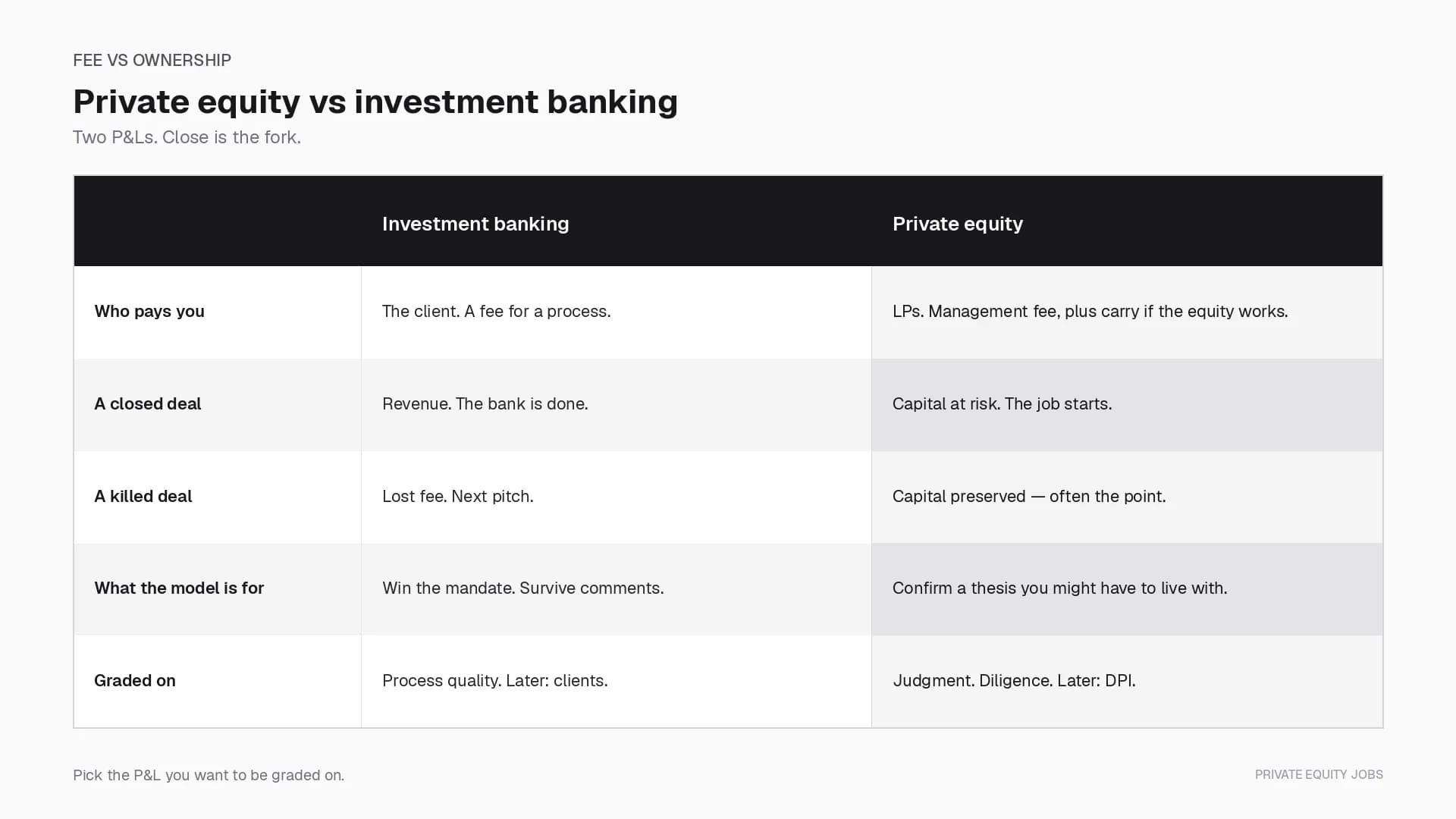
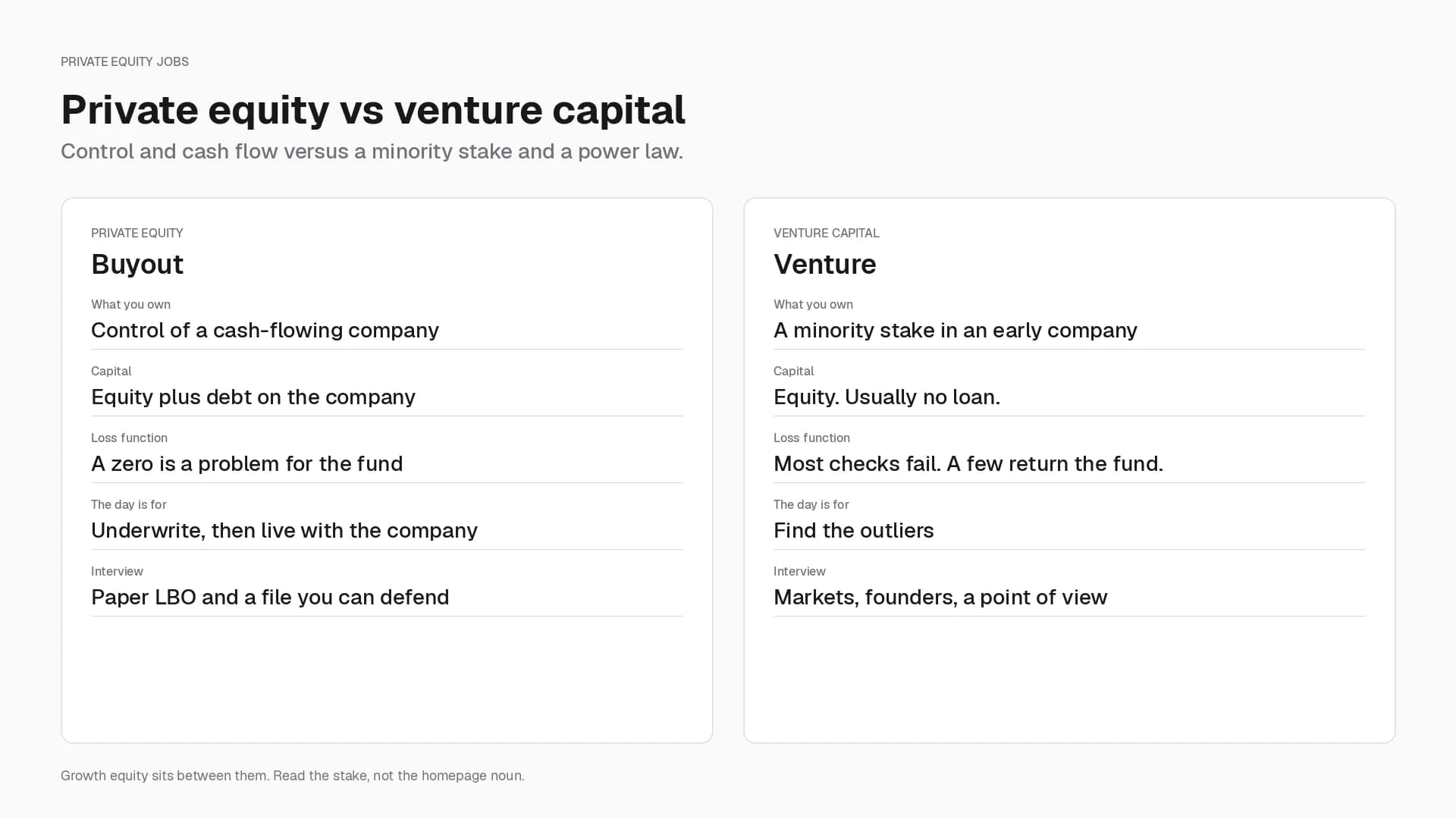
Private equity staffs a company it will eventually sell. Traditional asset management staffs a portfolio clients can leave.
| Scoreboard | Private equity (buyout) | Traditional asset management |
|---|---|---|
| Who puts up the equity | Limited partners via commitments and capital calls | Clients in open-end funds, SMAs, or mandates |
| What you own | Control of a private company, often with debt on that company | Positions in liquid securities sized inside a portfolio |
| How cash gets out | Distributions after exits, or a sale of the fund interest | Redemptions on dealing days (fund rules apply) |
| Clock | Years per company inside a fund of about ten years | Continuous marking; holdings can turn without a fund exit |
| How the firm is paid | Fee on committed (then often invested) capital; carry after capital back and, on most buyout funds, a preferred return | Fee on assets under management; sometimes a performance fee versus a benchmark |
| What a finished piece of junior work is | A closed purchase the team must live with, then exit | A thesis, a model update, and a portfolio decision the PM owns |
| Quiet-week hours (typical published bands) | Often 50-60, with live weeks much higher | Often 50-60, rarely above 60 outside earnings or mandates |
| Junior interview artifact | Paper leveraged buyout (LBO) and a deal you can defend | Investment process, sector coverage, and often CFA progress |
| Upside shape | Cash now; carry later if you still have points | Cash and bonus tied to AUM, performance, and level; PM seat is the ceiling |
Prestige does not travel as a single number. A megafund associate class is tiny. A research seat at a household-name mutual-fund complex can put you in front of more ordinary business rooms than a middle-market associate at a fund nobody has heard of. Pick the scoreboard you want to be graded on.
How each side is paid and graded
A private equity firm is paid to own companies for other people's capital. The management fee funds the office. Carry, typically around 20 percent of profits after capital back and, on most buyout funds, a preferred return, is delayed. It vests. You have to still be there. Leverage on the portfolio company amplifies equity returns when earnings grow and works in reverse when they do not. The committee underwrites an LBO: sources and uses that balance, a returns bridge, and a hold plan. After close, value creation is the job. Limited partners watch internal rate of return (IRR), multiple on invested capital, and later distributions versus value.
A traditional asset manager is paid mainly to keep and grow assets under management. The fee is a percentage of the portfolio. Active managers still have to beat, or at least justify themselves against, a benchmark after fees. Passive compression and passive products have made that justification harder at many long-only shops. The portfolio manager, not a ten-year partnership clock, decides when a position is done. There is no carry waterfall on a vintage of private companies. Bonus pools track performance, flows, and seniority. At the top of large complexes, portfolio-manager pay can rival senior private equity cash in a good year. The path there is usually longer coverage, not a two-year associate program with early carry hopes.
That is why the jobs feel adjacent in Excel and different on the calendar. Both require valuation skill and an investment view. Only one is scored on whether limited partners got their capital back plus a return inside a fund life.
The day: portfolio coverage versus the deal file
An associate at a fund may be in a live process, updating a company the fund already owns, and screening teasers in the same week. The first job on a new opportunity is to drop the ones that cannot work. What remains gets a model the investment committee might use and a commercial question that has to survive contact with the company. After close, the monthly flash can say revenue missed and working capital ate cash, and the board pack still has to be right. The associate owns the file. The committee owns the decision.
A buy-side analyst at a traditional asset manager covers a sector or a book of names. The day is filings, models, channel checks, portfolio meetings, and writing that helps the portfolio manager size or cut a position. Earnings seasons are busy. Quiet weeks are still market weeks. There is no CIM auction to staff unless the firm also runs a private-markets sleeve, and that sleeve is a different desk. Client-facing roles (institutional sales, consultant relations, wealth distribution) exist inside AM firms and look even less like a deal file. Research and portfolio seats are the fair comparison to investing PE.
Close rates are low on both sides for different reasons. Funds pass on most teasers because the underwriting does not clear. Asset managers may follow dozens of names and change only a few weights in a quarter because the portfolio already expresses a long-term view.
Hours and lifestyle
Published bands are averages that hide the distribution. Financial Edge Training and Mergers & Inquisitions both describe traditional asset-management weeks that rarely exceed about 60 hours, with weekends usually free outside urgent markets. Private equity often lands around 50-60 in a quiet portfolio week and 70-80-plus in exclusivity, with megafund deal teams able to match banking. Treat "asset management has better hours" as a claim about the average long-only research week, not as a law that covers every alternative sleeve or every distribution job.
Stress differs by clock. Private equity stress is a signing date, a lender, and a company that misses after you own it. Asset management stress is the mark, the benchmark, and clients who can leave. Neither is a soft seat. One compresses pain into deal spikes. The other spreads it across the calendar.
Pay shape
Junior cash at large US buyout funds is high because the associate class is small and competing with banking bonuses. Published 2023-style bands for first-year associates at large funds often land in the mid-high $200,000s all-in, with megafund outliers higher; middle-market shops pay less. Carry is uncommon at the associate level and becomes material later if you stay. The career path is short on titles and long on whether you still have points when distributions arrive.
Junior cash in traditional asset management is usually lower at the same age. Large-complex analyst seats often start closer to low-mid six figures all-in, with a wide range by firm size and strategy. The ceiling at portfolio-manager level at a huge complex can still be very high because fees sit on a large asset base. The trade is time and scarcity: more years of coverage before the seat that owns the book, and less early carry.
Do not pick a path from a single Glassdoor tile. Fund size, city, and whether you are on investing versus distribution change the check more than the logo on a recruiting slide.
Career path, exits, and the bridge
Private equity hiring into associate seats still runs heavily through investment banking (and some consulting and corporate development). On-cycle and off-cycle processes select for deal skills and a paper LBO. Promotion inside the fund is a narrow pyramid: associate, vice president, principal, partner. Exits include other funds, corporate development, operating roles, and, for some, traditional asset management or a hedge fund after the person is tired of process work.
Traditional asset management hires from undergrad and MBA programs, from equity research, and from bankers who want investing without a deal calendar. Advancement is analyst to senior analyst to portfolio manager at many shops, with slower movement and fewer seats at the top. Exits are mostly to other long-only managers, sometimes to hedge funds, and rarely into a PE investing seat without prior deal experience or an MBA reset. Mergers & Inquisitions states the constraint plainly: without deal experience, PE, banking, venture, and corporate development are hard to reach from mutual-fund work.
Bridge directions are asymmetric. Private equity to traditional asset management happens when someone wants steadier hours and public-markets work and can show investment judgment. Asset management to private equity investing is uncommon for pure long-only analysts. Funds can hire bankers who already model deals. An AM analyst who wants that seat usually needs a deal path, a growth or private-markets adjacent role, or a story that survives a modeling test. Do not plan on "AM first for lifestyle, PE later" unless you are honest about that gap.
The interview: paper LBO versus investment process
Private equity interviews for associate seats lean on a paper LBO, a timed model, and a deal you can defend. The firm is testing whether you can underwrite a company the partnership might own for years. Prep lives on interview questions and the LBO modeling test.
Traditional asset management interviews lean on how you think about a stock or a sector, how you size risk, and whether you will finish a Chartered Financial Analyst (CFA) program. Case work is an investment memo or a pitch, not a sources-and-uses balance that has to fund a purchase. Showing up with only banking war stories and no investment process is a miss. Showing up to a buyout process with only a CFA Level I plan and no LBO is also a miss.
Which to choose
Choose private equity if you want to own companies, live with a small portfolio of files, accept deal spikes, and take compensation that is cash now and carry later. Choose traditional asset management if you want public-markets coverage, a fee-on-AUM business, and weeks that more often stay near a normal professional calendar.
Choose neither logo in the abstract. A private-markets seat inside a large asset manager can look like PE economics with a different HR system. A "PE" title at a tiny shop with no institutional LPs can look like underpaid corp-fin. Read the product: closed-end control investing versus open-end portfolio management.
If you are still in banking and undecided, the practical question is which interview you can pass this year. Deal skills decay less when you use them. Public-markets judgment builds when you cover names. Pick the apprenticeship that matches the seat you want in three years, not the one your group chat votes prestige.
Common questions
Is private equity a type of asset management?
In the broad industry sense, yes: private equity firms manage capital for clients. In career talk, "asset management" usually means traditional long-only (and related) public-markets work, while "private equity" means closed-end private-company investing. Large alternative managers house both. Say which desk you mean.
Does asset management pay less than private equity?
Junior cash usually does, especially versus megafund associates. Senior portfolio managers at huge complexes can still earn very large sums. The shapes differ: PE loads upside into carry that arrives later; AM loads more of the economics into fees and bonuses tied to AUM and performance.
Can you move from asset management to private equity?
Into an investing seat, rarely without deal experience, a private-markets adjacent role, or an MBA that resets recruiting. Into investor relations, capital formation, or research support roles at a PE firm, the path is wider. Plan the seat, not the brand.
Is the lifestyle always better in asset management?
Average long-only research weeks are shorter than average live PE deal weeks. Earnings seasons, underperforming funds, and client pulls still create stress. Alternative sleeves and distribution jobs inside "AM" firms can look nothing like the mutual-fund research stereotype.
How is this different from private equity vs hedge fund?
A hedge fund is usually an open-ended vehicle that marks a liquid book and charges a performance fee above a high-water mark. Traditional asset management is also usually open-ended and liquid, but it is typically long-only (or long-biased) and graded against a benchmark rather than a hedged book. The PE versus hedge fund comparison is a separate page.
Sources
Definitions and career mechanics on this page draw on the opened comparison and career guides in the live research set for 7 September 2026, including SmartAsset's asset management versus private equity explainer (8 October 2025), WealthArc's differences article (14 August 2025), Mergers & Inquisitions' asset management industry overview and hedge fund versus private equity career comparison, Financial Edge Training's asset management career path note, and Wall Street Prep's private equity salary guide (2023 compensation framing). Specific PEJ definitions for fund mechanics, carry, LBOs, and return measures live on the linked Private Equity Jobs pages rather than on external dictionaries.