General Partner vs Limited Partner
A private equity fund is a limited partnership. The general partner controls it. Limited partners put up the capital, take limited liability, and do not run the companies.

A private equity fund is a limited partnership. The general partner (GP) controls it. Limited partners (LPs) put up almost all of the capital. They have no management authority, and they cannot lose more than they committed. Control versus capital is the cut. Unlimited liability sits on the general partner. Limited liability sits on the limited partners. That is why a pension or an endowment can write a large check without running the companies.
People who form a shop or a real-estate deal use the same words for a different thing. A general partnership has partners who all manage and all take personal liability. A limited partnership in that setting has one managing partner and silent investors. Those pages are entity-formation advice. This page is the closed-end private equity fund.
What a general partner and a limited partner are
Like shareholders in a corporation, limited partners have limited liability to the extent of their investment and have no management authority. They do not pick the companies. They do not sit in the portfolio-company boardroom as the owner. The general partner does.
The general partner is the managing partner of the limited partnership, with the right to participate in its management and with unlimited personal liability for the partnership's debts and obligations. The limited partners are the investors. They are not involved in day-to-day management, and they generally cannot lose more than their capital contribution.
"GP" is used three ways, and they are not the same legal person. The fund's general partner is an entity, usually an LLC, that signs the limited partnership agreement and has authority to bind the fund. The firm is the organization that raises successive funds; people call the firm "the GP" because it is the manager they underwrite. The people with partner titles (partners, managing directors) work at that firm. They are often members of the GP LLC. They are not, each of them, the general partner of the fund.
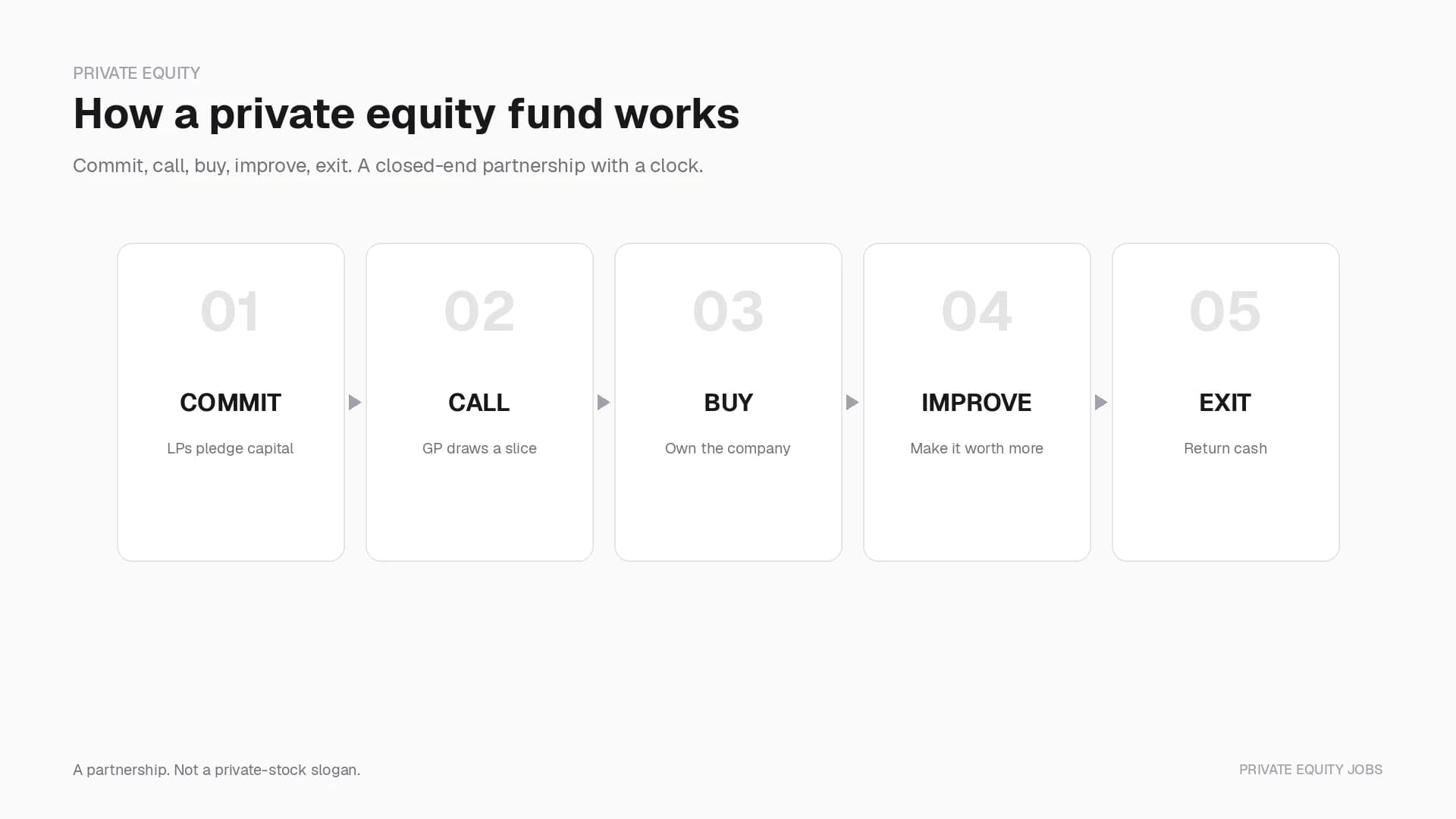
A capital call is how cash actually moves. The limited partner signs a commitment. That is a promise, not a wire. When the general partner has a use (a signed purchase, a fee, an expense), it issues a notice. The limited partner wires that slice. Unused commitment stays at the limited partner until the next notice.
GP vs LP: control, capital, and liability
| General partner | Limited partner | |
|---|---|---|
| Role | Controls the fund. Raises it, calls capital, buys and sells companies, reports. | Supplies capital. Does not run the fund or the companies. |
| Liability | Unlimited at the partnership. In practice the GP is an LLC, so the individuals' personal estates are not the fund's balance sheet. | Limited to the commitment (and any unpaid call). |
| Capital | A GP commitment alongside the LPs, in cash. A small slice of the fund. | Almost all of the fund. Carta's anatomy of a modern fund structure (3 December 2025) puts limited partners at more than 98 percent of capital in the usual case. |
| Pay | Management fee to run the firm. Carried interest if the vintage makes a profit after capital is back and, on most buyout funds, a preferred return. | Return of capital, then the agreed share of profits. No fee for being an LP. |
| Decisions | Full authority inside the limited partnership agreement. | No management. Consent rights on a short list (conflicts, key-person, term extensions, removal). |
| Who | The GP entity, the firm, and the people with partner titles. | Pensions, endowments, sovereign wealth funds, insurers, family offices, funds of funds, and some individuals who meet the securities tests. |
Who is an LP, and who is a GP
A private equity fund is typically open only to accredited investors and qualified clients, the U.S. Securities and Exchange Commission's Investor.gov page on private equity funds says. Those classes include institutions (pensions, endowments, insurers) and high-income or high-net-worth individuals. The first check is often very large. Even if you never see a subscription booklet, you may already be an indirect limited partner through a pension or an insurance policy.
ILPA's 101 page is the same list: to be a limited partner you must be a legally defined qualified investor, a class which includes public pensions, endowments, and insurance companies. The limited partner's job after the close is to fund calls on time, read the reports, sit on an advisory committee if asked, and vote when the documents require a vote. Defaulting on a call is a legal and reputational event. It is not a quiet skip.
The general partner is the firm that raised the fund, plus the entity that signed as GP, plus the people who will actually underwrite deals. The first work is a close: a strategy, a track record, and enough commitments to hold a first closing. After that the work is sourcing, diligence, owning companies, and exiting them. Limited partners underwrite those people. A key-person clause exists because the commitment was to named individuals, not to a logo.
The limited partnership agreement and the entities
The limited partnership agreement (LPA) is the contract between the general partner and the limited partners. It sets the fund's term, the investment period, how capital is called, how profits are split, what the fund may buy, and what happens if a named partner leaves or if limited partners want the manager out. Side letters can vary those terms for a given limited partner. They do not turn that limited partner into a manager.
A U.S. buyout fund is usually several entities, not one company. Carta's private equity fund-structure note (25 September 2024, written with Weil, Gotshal & Manges) is the map. The fund is the limited partnership that holds the commitments and the investments. The general partner sits on top of that partnership, directs strategy, and takes the profit share. The management company employs the people, pays rent and salaries, and is paid the management fee under a separate investment management agreement. The portfolio companies are what the fund owns.
The general partner, despite the name, is often itself an LLC. That is how the owners limit their personal liability to what they put into that entity, while still controlling the fund. Unlimited liability is still the partnership-law default for a general partner. The LLC is the wrap. Ranking pages that say "the partners' houses are on the line" are describing the default, not the structure actually used.
Delaware is a common formation state because its partnership and LLC statute has a long case record. That is a formation fact. It is not a reason to read a small-business "GP vs LP" filing guide as if it were a buyout fund.
The GP commitment
The general partner puts its own capital into the fund alongside the limited partners. ILPA's Principles 3.0 (2019) ask for a substantial equity interest, contributed in cash, not through a waiver of management fees and not through a specialized financing facility. The same page says the general partner should not cherry-pick co-invests as a substitute for that interest. The whole stake should sit in a pooled vehicle.
There is no statutory percentage. ILPA's glossary notes that the U.S. Treasury removed a legal requirement that the general partner contribute at least 1 percent, and that a 1 percent contribution remains standard practice, particularly among venture funds. Carta's administered-fund medians (3 December 2025) are 1.2 percent of fund size for vehicles under $1 million and 0.39 percent for vehicles over $50 million. A 10 percent cartoon on a $500 million teaching example is not a buyout median. A $5 billion fund at 1 percent is still a $50 million check. Limited partners care about the dollars relative to the partners' wealth, and about whether the cash is really cash.
The GP commitment usually does not pay the management fee. It earns the same deal-level return any limited partner earns on that slice. Carried interest is the extra claim: a right to a share of profits far larger than the capital share.
LPAC, key person, and who can be replaced
Limited partners are passive on purpose. If they start managing the fund, they can lose the limited-liability protection that is the point of the seat. That does not mean they have no rights. The documents give them a short list.
The Limited Partner Advisory Committee is a group of limited partners, usually the larger institutions in the fund. ILPA's Principles 3.0 say the mandate should be written down and should generally include conflicts of interest (cross-fund deals, related-party transactions), review of valuation methodologies, key-person time and attention, fund-term extensions, concentration and leverage questions, affiliated deals, and LP defaults. The general partner should not sit on the committee. Members act in their own interests in good faith. They are generally understood not to have a fiduciary duty to the fund beyond that. The committee is a sounding board with consent rights on named items. It does not pick the next deal.
A key-person clause names the individuals whose continued work was the reason limited partners committed. If enough of them leave, die, or stop spending the agreed time on the fund, the investment period is supposed to pause. New deals stop. Follow-ons in companies already owned usually continue. ILPA wants that pause to be automatic, and to become permanent within 180 days unless a defined supermajority of limited partners votes to reinstate. Preqin's Term Intelligence note (17 April 2026, data as of March 2026) finds that investment periods are suspended after a key-person event in 97 percent of private equity funds, for about 170 days on average. Reinstatement, where it is allowed, is most often a majority of limited-partner interests or the advisory committee (about 62 percent of private equity funds in that sample).
Limited partners can also replace the manager. ILPA's preferred thresholds: a majority in interest can remove the general partner or dissolve the fund for cause (fraud, material breach, bad faith, gross negligence). A vote of two-thirds in interest should be enough for a no-fault removal or dissolution. In either case the outgoing general partner should take a meaningful cut to carried interest, so there is economics left to hire a replacement. Removing a person who caused the breach is not, by itself, a cure. The clauses are in the documents because the limited partners underwrote people, and people leave.
How the GP and the LP get paid
Two streams pay the general partner. The management fee is an expense of running the firm. It is billed whether the vintage works or not. Classically it is about 2 percent a year of commitments during the investment period, often stepping down later as the base shifts toward invested capital. It covers salaries, rent, and diligence. It is not the reason people want to be general partners.
Carried interest is. Classically it is 20 percent of fund profits after limited partners have their capital back and, on most buyout funds, a preferred return (often 8 percent a year on contributed capital). Catch-up, American versus European waterfalls, and clawback live in that essay. They are not this comparison.
Limited partners do not earn a fee for being limited partners. They get their capital back, then the agreed share of what is left. An 8 percent preferred return, where it exists, is a hurdle the general partner has to clear before carry starts. It is not a coupon the limited partner is guaranteed.
The U.S. Securities and Exchange Commission names the conflict that sits next to those two streams. Portfolio companies may also pay the firm for monitoring, and affiliates may sell services to the fund or the company. Advisers have to disclose those conflicts. The fee on the fund and the fee on the company are not the same invoice.
The seat is on the GP
The job you apply for sits at the firm that is the general partner. Associates, vice presidents, principals, and partners work for the management company, on deals the fund will own. They are not limited partners. They are not the pensions that committed. When the deal closes, the job is to live with the company.
Open investing roles sit on Private Equity Jobs. The companies directory is where those general partners are listed.
Common mistakes
Reading a small-business "general partnership vs limited partnership" page as a buyout fund. Those pages are about who files a state form and whose house is on the line in a shop. A private equity fund uses a limited partnership as a pooling vehicle, with an LLC as the GP.
Thinking limited partners pick the deals. They do not. Consent on a conflict or a key-person event is not investment authority. Crossing into management can put the limited-liability shield at risk.
Treating "unlimited liability" as the partners' personal houses. The statute puts unlimited liability on the general partner. The general partner is usually an LLC. Reputation, the GP commitment, and occasional guarantees are still real. Saying the partners' houses are on the line describes the statutory default, not the LLC that actually signs as GP.
Treating the GP commitment as 20 percent because carry is 20 percent. Carry is a profits interest. The capital share is a small number. They are different claims.
Treating the advisory committee as a board of directors. It reviews named conflicts and process. It does not run the portfolio.
Using a 5-to-7-year clock as the life of the fund. A classic drawdown vehicle is raised for about ten years, often with written extensions. The hold on a company is not the same as the life of the fund.
Common questions
What is the difference between a general partner and a limited partner?
The general partner controls the fund. Limited partners put up the capital, take limited liability, and stay out of management. Pay, liability, and who can be replaced all follow from that cut.
Can a limited partner also be a general partner?
Not in the same capacity in the same partnership. The GP entity can itself be a partner that commits capital. People at the firm often invest as limited partners in the fund, or through a separate vehicle, on top of the GP commitment. That does not give a pension the right to bind the fund.
Do limited partners have any say?
Yes, on a short list written into the LPA: conflicts, valuation method, key-person, term extensions, and, if it comes to it, removal. They do not vote on the next acquisition.
What happens if a named partner leaves?
A key-person clause is supposed to suspend new investing until limited partners reinstate the period or accept a replacement. Preqin finds that pause in 97 percent of private equity funds, for about six months on average.
Is the GP personally liable?
The general partner of the limited partnership is. In a modern fund that general partner is an LLC, so the individuals' personal assets are not the partnership's. The cash they committed still is.
Sources
Institutional Limited Partners Association, Principles 3.0 (2019). Carta, The anatomy of a modern fund structure (Rita Astoor and Josephine Koh, 3 December 2025) and Private equity fund structures (25 September 2024, with Weil, Gotshal & Manges). U.S. Securities and Exchange Commission, Investor.gov, Private Equity Funds. Preqin, Remedial actions following key person events in investment funds (Heather Heys and Jordan Scott, 17 April 2026; Term Intelligence data as of March 2026).