Types of Private Equity
Limited partners sometimes use private equity for the whole private-market bucket. People at funds usually mean a buyout. The equity strategies are venture capital, growth equity, and buyout.

Limited partners sometimes use private equity for the whole private-market bucket. People at funds usually mean a buyout.
The equity strategies inside that bucket are venture capital, growth equity, and buyout. Distressed, mezzanine, real estate, and infrastructure sit next to them. Fund of funds and secondaries sit one layer up: they buy funds or fund interests rather than writing the first check into a company. Private debt sits next to that bucket, not inside it. Megafund versus middle market is a size cut, not a sixth strategy.
What "types of private equity" means
William Craig and Mark Watson, investment directors at Wellington Management, wrote for limited partners in their Private equity deep dive: private markets split into private equity, private debt, real estate, infrastructure, and natural resources. Inside private equity they list five strategies. Venture capital, growth equity, and buyout are direct. Fund-of-funds is indirect. Secondaries can be either.
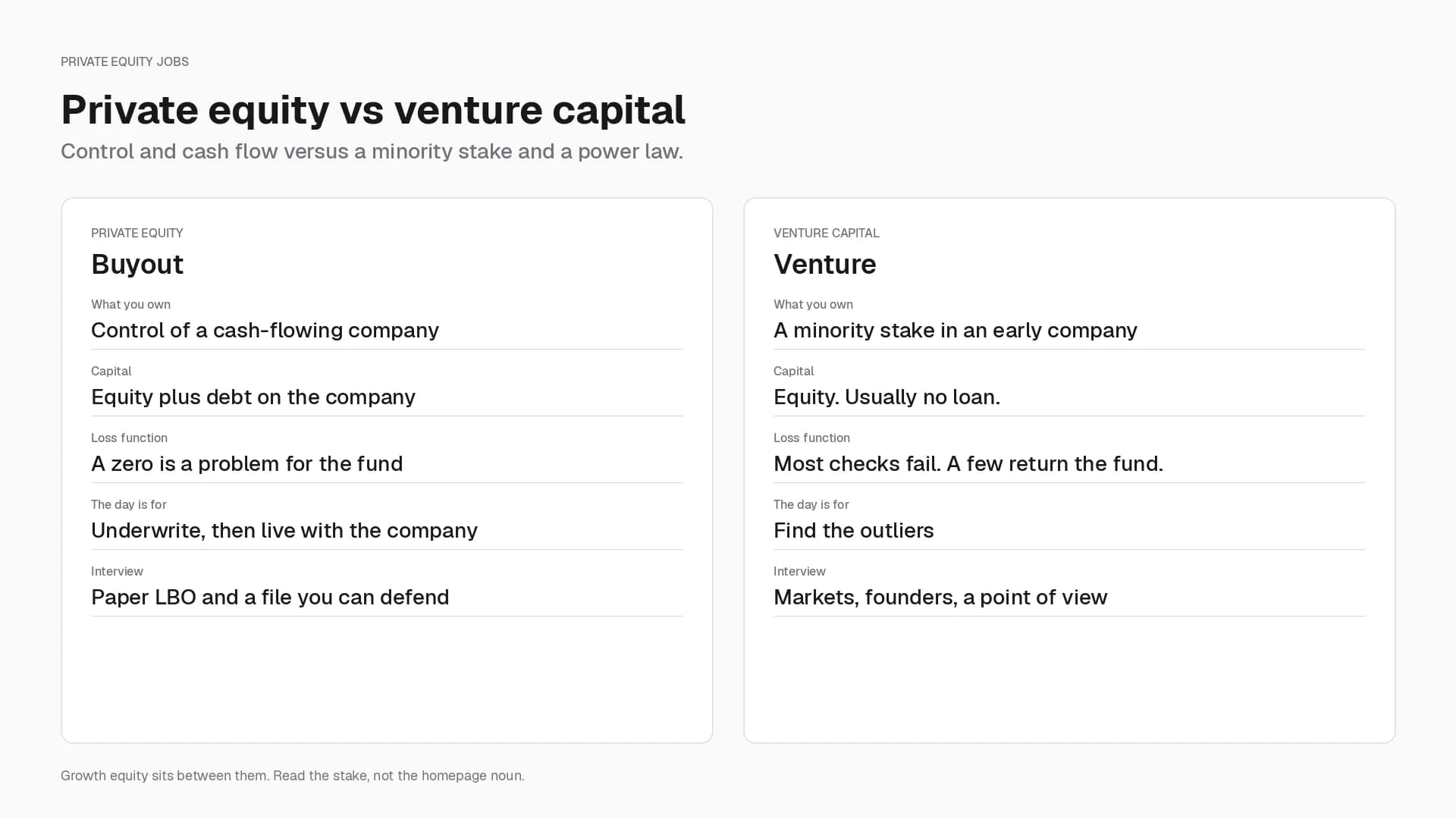
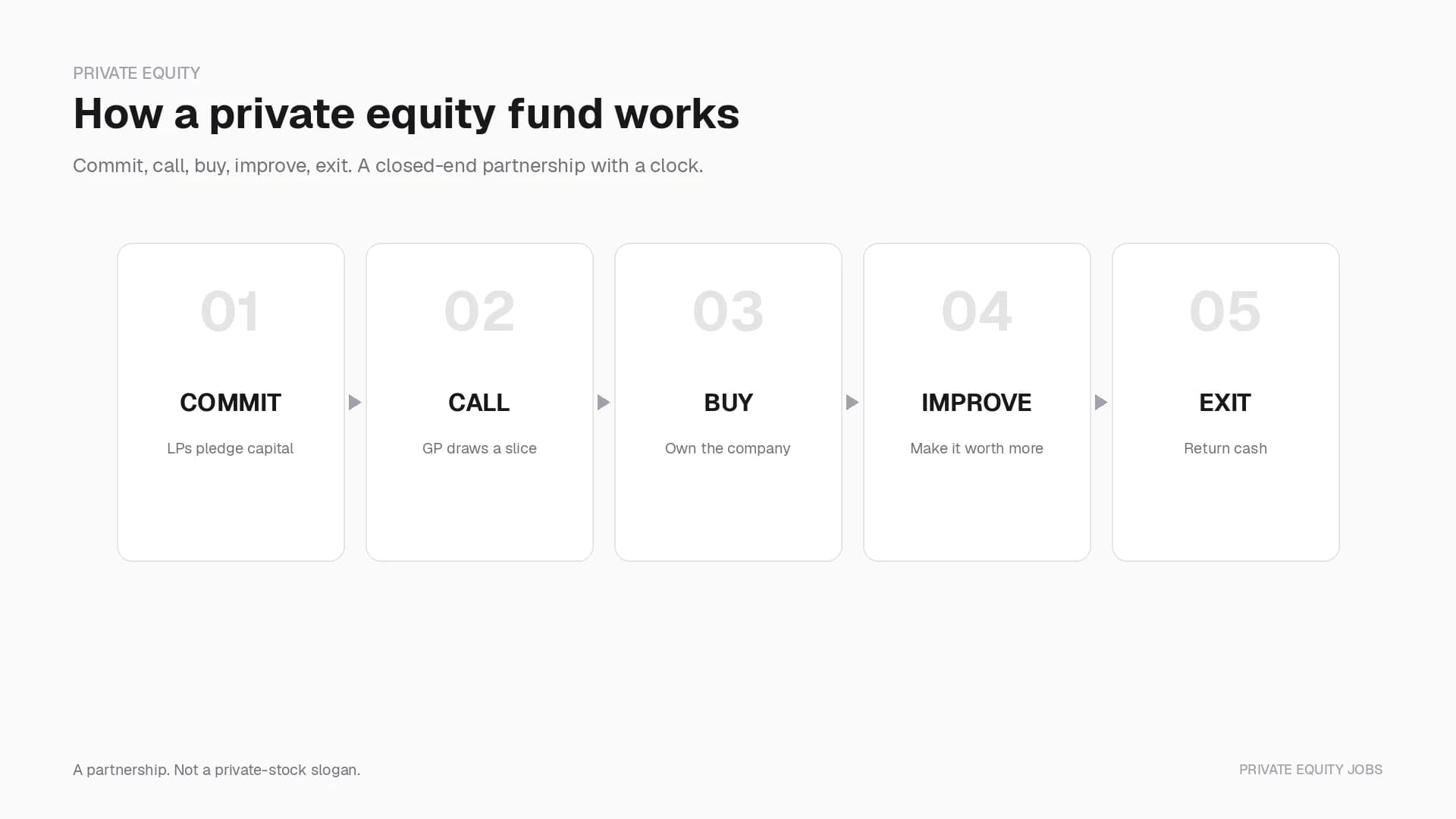
That is not how a recruiter uses the word. When a bank analyst says they want private equity, they usually mean a buyout seat: control of a cash-flowing company, debt on that company's balance sheet, a hold of several years, and an exit that has to return cash to limited partners (LPs). The general partner (GP) runs that vehicle. The LP committed the capital.
The asset class is large enough that both languages persist. Morgan Stanley Investment Management's An Introduction to Private Equity Basics (11 November 2025), citing Preqin (October 2025), puts private equity assets under management at $744 billion in 2004 and $9.7 trillion as of December 2024. Bain & Company's 17th Global Private Equity Report, released 23 February 2026, is the 2025 scoreboard for the buyout core: global buyout deal value excluding add-ons rose 44 percent to $904 billion, while buyout fundraising fell 16 percent to $395 billion. Private capital as a whole still raised $1.3 trillion, "thanks largely to strong growth in infrastructure funds." Buyout is the largest equity strategy. It is not the whole private-market bucket, and 2025 fundraising already showed that.
A list of nine fund types is a catalog. The cut that matters is who writes the check, who owns the company, and whether the work is equity, credit, or an asset.
Three core strategies: venture capital, growth equity, and buyout
Catherine Cote, writing for Harvard Business School Online in July 2021, lines the three up along a company's life: early, scaling, mature. The jobs are not interchangeable.
Morgan Stanley adds a financing cut that catalogs of nine fund types skip. A buyout is usually a secondary investment in the company sense: cash goes to an existing shareholder who is selling. Venture capital is usually primary: cash goes onto the company's balance sheet in exchange for new shares. Growth equity can be either, and the ownership stake can be minority or majority.
Wellington splits growth itself. Late-stage growth typically means companies already growing more than about 40 percent a year, often still venture-backed, minority stakes, little or no leverage, capital meant to fund expansion ahead of an IPO or sale. Growth buyout typically means profitable companies growing more like 20 to 30 percent, often with little prior institutional ownership, and a sponsor that may take minority or majority and may put some debt on the company. Lists that treat "growth equity" as one box hide that fork. It is the fork that changes the model and the hire.
| Venture capital | Growth equity | Buyout | |
|---|---|---|---|
| What they buy | Early companies, often pre-profit | Established companies that are still scaling | Mature companies with cash flow that can bear debt |
| Stake | Minority | Minority; growth buyout may be majority | Control, often 100 percent |
| Where the cash goes | Onto the company's balance sheet (primary) | Primary, secondary, or both | Usually to selling shareholders (secondary) |
| Debt on the company | Rare | Low; a growth buyout may use some | Common |
| Main risk Wellington names | Operational: the plan fails | Valuation: overpaying | Financial: the company cannot service the debt |
| Who they hire | Operators, product people, some bankers | Mix of bankers and commercial people | Former bankers, plus operating partners later |
None of those rows is a ranking of which strategy to pick. Wellington, citing Cambridge Associates Private Benchmarks (Q2 2025 reports, data as of 30 September 2025), puts ten-year pooled net internal rates of return at 13.55 percent for venture (3,429 funds), 13.63 percent for growth equity (886 funds), and 14.23 percent for buyout (2,079 funds), against 8.27 percent for the Russell 2000 and 10.23 percent for the MSCI World IMI over the same horizon. Those are pooled horizon IRRs, net of fees, expenses, and carried interest. They are not a forecast, and they are not a reason to pick a seat. A junior hire is paid a salary. Carry, if it arrives, arrives years later on a vintage that has to clear a waterfall.
Internal rate of return (IRR) and multiple on invested capital (MOIC) are how LPs keep score. They are usually quoted net of carry.
Venture expects a high failure rate and needs a few companies to return the fund. Buyout cannot underwrite that loss function. Growth sits between them: the business is proven enough that outright failure is less common, and the question is whether growth arrives at the price paid.
Inside a buyout: control, leverage, and deal shapes
Buyout is control. The fund buys a majority, often all, of a company. The debt used to help pay for it sits on the portfolio company, not on the fund. If cash flow cannot service that debt, the company is the one in trouble. The rest of the fund's companies are not on the hook. That structure is the leveraged buyout (LBO).
Two ownership shapes get collapsed into one word.
A management buyout (MBO) is the sitting management team taking control, sometimes with a PE fund as a minority backer so the managers can finance the purchase. A leveraged buyout in the fund sense is the GP taking control, using borrowed money against the company's cash flow, and replacing or backing management as the underwrite requires. Those are different jobs. One is a founder or CEO buying the company they already run. The other is a fund buying it.
Inside the fund version, the first company in a thesis is often a platform: large enough to stand alone. Later purchases in the same thesis are add-ons (also called bolt-ons or tuck-ins): smaller companies folded into the platform. The work after close is value creation: management, add-on M&A, operations, and a financial plan that grows free cash flow and pays down debt.
A public-to-private takes a listed company off the exchange. A carve-out buys a division a parent no longer wants and stands it up on its own. Both are still buyouts. The difference is the seller and the day-one cleanup, not a fourth strategy.
Specialty strategies: distressed, mezzanine, real estate, and infrastructure
Distressed (and special situations) buys companies, or their debt, when something has already gone wrong. Two common paths: loan-to-own, where the investor buys debt cheaply in the hope of converting it into control in a restructuring, and turnaround, where rescue financing is meant to restore a going concern. The first looks like a credit document until it becomes equity. The second looks like an operating plan with a bankruptcy lawyer on the call.
Mezzanine is junior capital: subordinated debt or preferred equity that sits above common equity and below senior loans. The coupon is higher than bank debt. There is often an equity kicker (warrants or similar). In a default, the mezzanine holder may convert into ownership. It is used to fill the gap when a buyout or an expansion needs more capital than senior lenders will provide. It is hybrid. It is not a buyout.
Real estate private equity (REPE) buys properties, not operating companies. The usual risk ladder is core (stabilized assets, income), value-add (buy and improve), and opportunistic (development or heavy repositioning). Rents follow incomes and occupancy, not a sales-rep productivity slide.
Infrastructure buys or builds assets that provide a service: roads, airports, power, pipelines, data centers, social infrastructure. Brownfield is an existing asset. Greenfield is a new one. Holds are long. Cash yield during the hold matters more than a single exit multiple. Bain's 2025 fundraising print is the reminder that this sleeve can move the whole private-capital total even when buyout fundraising is down.
Search funds and royalty streams show up on encyclopedia lists. A search fund is a vehicle for an operator to raise money, buy one small company, and run it. A royalty fund buys a cash-flow stream (for example a drug patent royalty) rather than the company. Both exist. Neither is how most PE recruiting uses the word.
Private debt
Limited partners and consultants usually say private debt. General partners and recruiters usually say private credit. It is the same sleeve. Wellington lists it as one of five common private-market asset classes, next to private equity, not inside it.
The fund is still a closed-end partnership. The claim is a loan. Direct lending is the core: the fund originates a senior or unitranche loan to a company, often a company a buyout fund already owns. The return is mostly the coupon and fees. The work is whether the borrower can still pay if a geography, a customer, or a cycle goes wrong. Covenants, intercreditor terms, and a refinancing path replace the LBO model.
The same firm often runs both products. On one deal the buyout team owns the equity and the credit team holds the loan. Distressed and mezzanine sit on the border: they can start as debt and become equity. Senior private credit usually stays a loan.
Hybrid strategies: fund of funds and secondaries
A fund of funds (FoF) does not buy companies. It buys other funds. The LP gets diversification across managers and vintages without building a direct PE program. The cost is a second fee layer on top of the underlying GPs.
Secondaries buy existing private-equity positions. In an LP-led deal, an LP sells a fund interest (and the remaining unfunded commitment) because the ten-year clock is real and they need out, or they want to rebalance. In a GP-led deal, often a continuation vehicle, the GP moves one or more assets into a new structure so some LPs can cash out while the firm keeps the company. Bain's 2026 report puts 2025 GP-led continuation-vehicle volume up 62 percent year on year, still less than 10 percent of total PE exit value. That is a liquidity path, not a fourth core strategy.
Size is not a strategy
Buyout funds are often grouped by the size of company they buy: lower-middle market, middle market, mega. Wellington's point is that the strategy is fairly consistent across those buckets. The difference is the size of the company. A $200 million manufacturer and a $20 billion software company can both be control deals with debt on the company. The model is the same. The process, the lender set, and the hours are not.
Size still changes the firm. A shop with a few hundred million under management tends to specialize. A firm with tens of billions tends to run several sleeves: buyout, growth, credit, real estate, infrastructure. Mega-fund is a scale label. It is not a sixth type of private equity. The associate at a mega-fund buyout group is still doing buyout work. The associate at that same firm's credit or real-estate sleeve is not.
Sector focus (software, healthcare, industrials) and geography are further cuts. They sit on top of a strategy. They do not replace it.
What the job looks like on each strategy
The title associate does not say which product you work on.
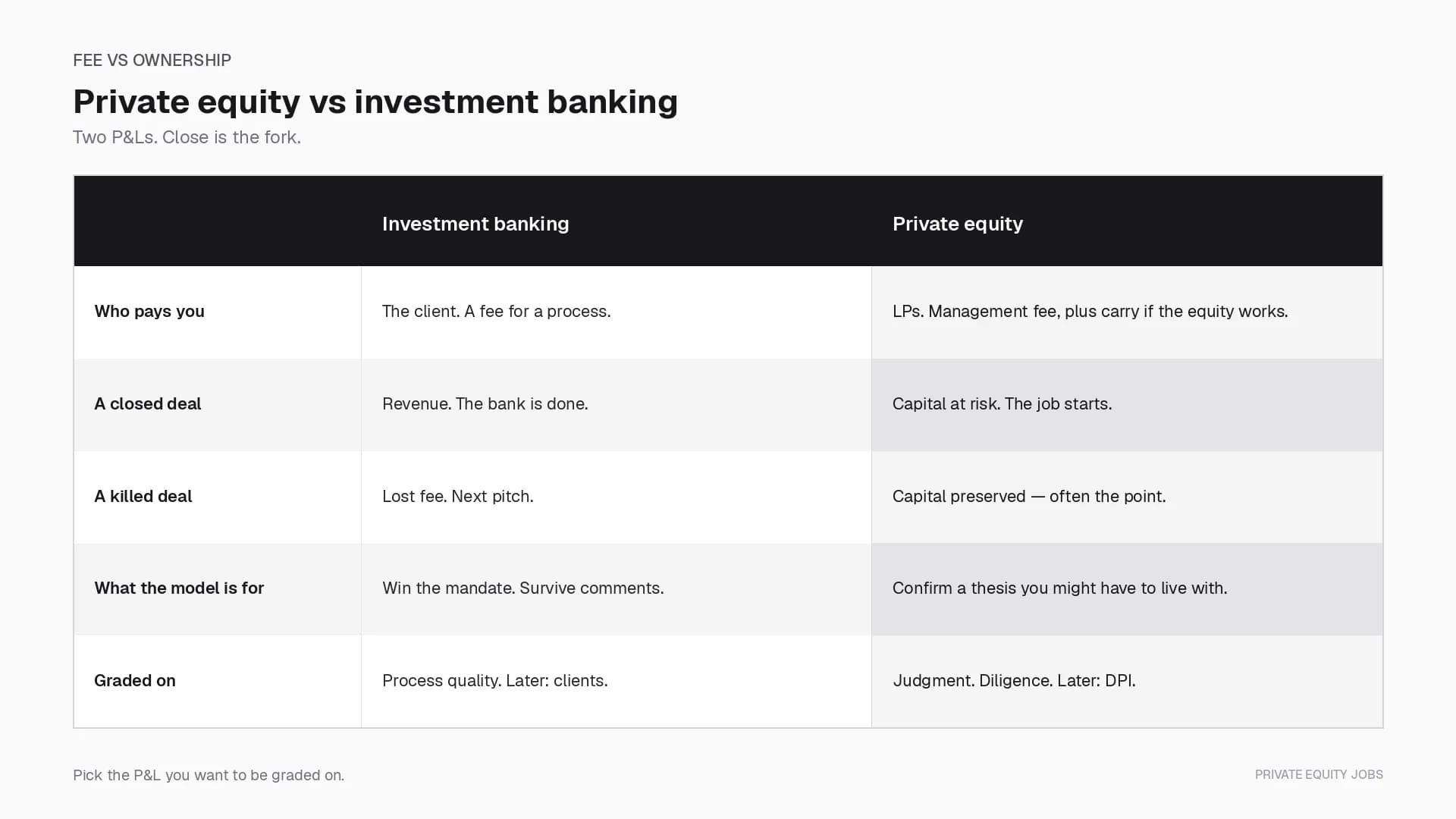
On a buyout deal the junior work is screening teasers and confidential information memoranda, building the LBO, running quality-of-earnings and commercial diligence, drafting the investment-committee memo, and then monitoring the portfolio company after close. That ladder is the career path. The hire is usually a former investment-banking analyst.
Growth equity still underwrites a company, but the model has less debt and more commercial work: can this company keep growing at the price, and is the check primary capital the business needs or a secondary sale by existing holders? Sourcing and founder contact take more of the week than they do in a large-cap buyout process.
Venture capital is markets and people: which category, which founder, which round. Cap tables and ownership math replace leverage math. The loss function is different, so the diligence is different. Former operators show up in a way they rarely do in mega-buyout recruiting.
Distressed and mezzanine live in documents: credit agreements, intercreditor terms, restructuring paths. Private-credit work is those documents without the equity kicker: a sources-and-uses that is mostly debt, a downside case, and a refinancing path. LevFin and restructuring analysts show up more often than they do in mega-buyout recruiting. Real estate and infrastructure live in assets: rent rolls, concessions, construction, contracted cash flows. Fund of funds diligence is on other GPs (team, track record, process), not on a single CIM. Secondaries diligence is on an existing book: net asset value, remaining value, and, in a continuation vehicle, whether the asset is worth another hold.
Breaking into private equity is still mostly a buyout on-cycle from banking. Off-cycle and specialist seats exist. When the strategy on the website is credit, real estate, or venture, the interview is not a paper LBO in the same way. Open investing seats sit on Private Equity Jobs. Firm names sit in the companies directory.
Common questions
How many types of private equity are there?
There is no official count. Limited-partner notes often name five (venture, growth, buyout, fund of funds, secondaries). Catalog pages name nine by adding distressed, mezzanine, real estate, and infrastructure. Product pages add private credit and impact. A working map is three core equity strategies, a specialty sleeve (distressed, mezzanine, real assets), a hybrid sleeve (fund of funds, secondaries), and a private-debt sleeve that sits next to equity.
Is venture capital a type of private equity?
Limited partners and consultants usually count it as a private-equity strategy. Recruiters and bank analysts usually mean a buyout seat, not a seed fund.
Is private debt a type of private equity?
No. Limited partners and consultants treat it as its own private-market sleeve. Product pages sometimes list private credit under PE strategies because the same firms sell both. Recruiters who say credit mean a lending seat, not a buyout seat. The return is mostly yield, not residual equity.
Does a megafund mean a different strategy?
No. It means a larger check, a larger firm, and often several products under one brand. The buyout sleeve is still buyout.
Which strategy pays more?
Junior cash compensation is generally highest at large traditional leveraged-buyout firms. That is starting pay, not lifetime carry, and it is not a published salary grid. Carry depends on the vintage, the waterfall, and whether the person is still there when it vests.
Sources
Wellington Management, Private equity deep dive, William Craig and Mark Watson, citing Cambridge Associates Private Benchmarks Q2 2025 reports (data as of 30 September 2025). Morgan Stanley Investment Management, An Introduction to Private Equity Basics, 11 November 2025, citing Preqin, October 2025. Bain & Company, 17th Global Private Equity Report, 23 February 2026.