
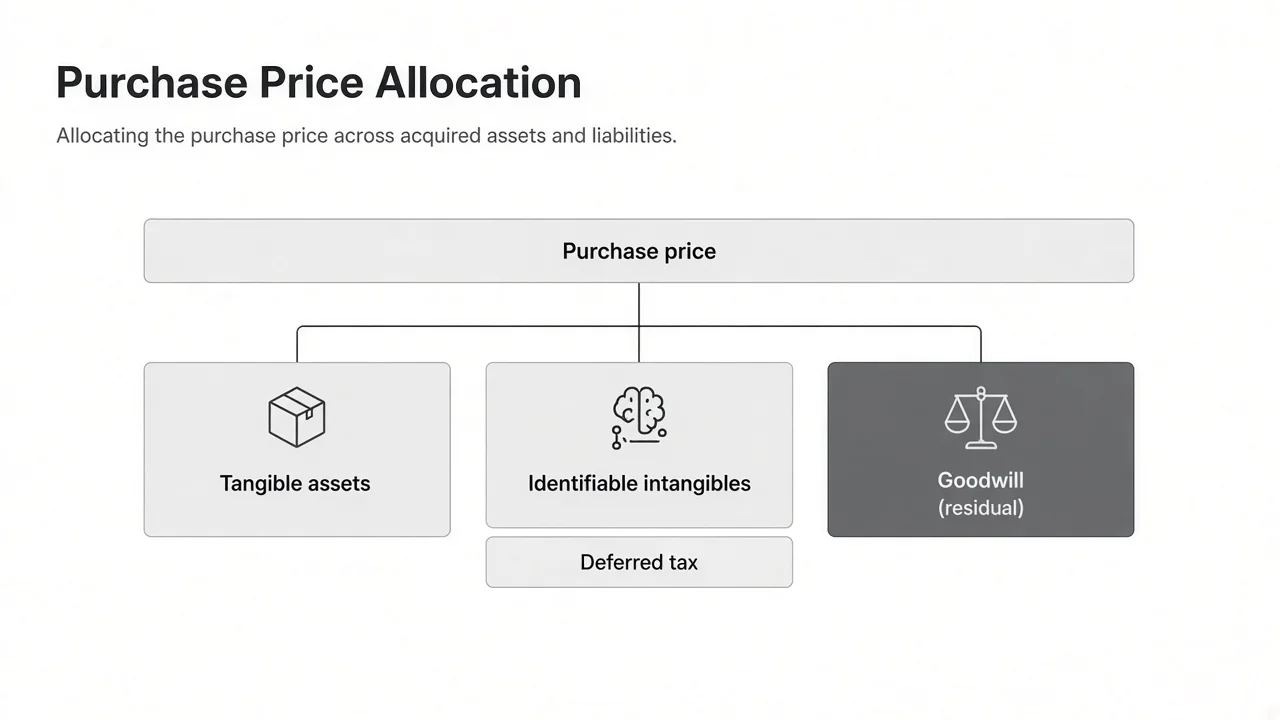
When one company buys another, the price does not arrive on the buyer's balance sheet as a single number. Accounting rules require the buyer to restate everything it acquired at fair value on the closing date, including brands, customer lists and technology that never appeared on the seller's books, and to record whatever is left of the price as goodwill. That exercise is purchase price allocation. It sets how much depreciation and amortization the buyer reports for years, how much goodwill sits on the balance sheet exposed to a write-down, and, when a deal is structured as a purchase of assets, how much of the price the buyer can deduct for tax. Kimberly-Clark's preliminary allocation for its $36.8bn purchase of Kenvue put $34.6bn on identifiable intangible assets and still left $13.2bn of goodwill, and more than two-fifths of that goodwill came from deferred taxes that the allocation itself created.
What purchase price allocation is
Purchase price allocation is the step in acquisition accounting where the buyer measures each identifiable asset acquired and each liability assumed at fair value on the acquisition date, then compares the total with the price paid. If the price is higher, the difference is goodwill. If it is lower, the buyer records a gain. In the United States the rules sit in Accounting Standards Codification Topic 805, Business Combinations (ASC 805), issued by the Financial Accounting Standards Board (FASB). Companies reporting under International Financial Reporting Standards follow IFRS 3, which works the same way on almost every point a deal team cares about.
Fair value has a specific meaning here: the price a market participant would receive to sell the asset, or pay to transfer the liability, in an orderly transaction on that date. It is not what the particular buyer thinks the asset is worth to it. Synergies that only this buyer can capture end up in goodwill rather than in any identified asset.
The allocation wipes the target's old accounting. The seller's historical goodwill goes to zero, because goodwill from the seller's own past deals is not an identifiable asset of the business being bought. Its old intangible assets are replaced by newly measured ones, and its equity disappears into the buyer's consolidated equity.
Most allocations are finished after closing, but buyers in larger deals often commission a pre-deal estimate during diligence to see how much of the price will land in amortizing intangibles, what that does to earnings and debt covenants, and how much goodwill will be exposed to impairment. The work starts by naming the acquirer, usually the company paying cash or issuing shares, and the acquisition date, the day control passes, which fixes the date for every fair value. The buyer usually hires an independent valuation specialist after closing, first conforms the target's accounts to its own accounting policies, and has its auditor review the result. Management remains responsible for the numbers. The auditor cannot prepare the allocation, because it would be auditing its own work. BD Emerson, a valuation adviser, puts fees for a middle-market allocation at $15,000 to $60,000, more for technology-heavy or multi-entity deals.
When ASC 805 applies: business combination or asset acquisition
Acquisition accounting under ASC 805 applies when a buyer obtains control of a business, whatever the legal form. A purchase of stock, a purchase of assets and a statutory merger are all business combinations if the buyer ends up controlling a business.
Whether the thing bought is a business is a real test, tightened by Accounting Standards Update 2017-01. The first screen asks whether substantially all of the fair value of the gross assets is concentrated in a single identifiable asset or a group of similar assets, such as one building or one drug license. If it is, the set is not a business. Otherwise the set must include inputs and a substantive process that together contribute to creating outputs. A going concern with employees, customers and systems almost always passes.
A transaction that fails is an asset acquisition. The buyer capitalizes transaction costs and spreads its total cost across the assets on a relative fair value basis, with no goodwill and no bargain purchase gain. In a business combination, each asset and liability is measured at its own fair value, transaction costs are expensed, and goodwill or a gain absorbs the difference. Tax law uses its own definitions, so a deal can be a business combination for the books and an asset purchase for tax at the same time.
Step 1: Measure the consideration transferred
The allocation starts with the price, measured the way the standard measures it. Consideration transferred is the sum of the acquisition-date fair values of what the buyer gives up: cash, shares issued, debt issued to the sellers, and contingent payments promised.
Shares are valued at the buyer's share price on the closing date, not the announcement date, so in a fixed exchange ratio deal the accounting price floats with the buyer's stock until closing. Kimberly-Clark's Form S-4/A, filed December 12, 2025, valued the roughly 280.2 million shares it expected to issue at $103.76 each, the November 20, 2025 share price, and showed that a 10 percent move in that price would change the consideration, and goodwill, by $2,992m.
Replacement equity awards are split in two. When a buyer swaps the target's employee options and restricted units for its own, the portion earned by service already performed counts as consideration and the rest is compensation expense after the deal. Kimberly-Clark counts $1,051m of replacement awards in its $36,828m estimated consideration. In private equity deals, sellers often roll part of their stake into the buyer's holding company; that rollover equity is consideration too, measured at fair value and adjusted for any differences in rights, such as nonvoting shares or transfer limits.
Contingent consideration, usually an earnout, goes in at acquisition-date fair value, reflecting the probability of each payout and the time value of money. An earnout capped at $10m might be recorded at $6m. If it is classified as a liability, as most cash earnouts are, the buyer remeasures it each reporting date through earnings, not goodwill. An earnout that founders forfeit if they leave the company is not consideration at all; it is pay for future service and is expensed after closing.
If the buyer already owned part of the target, it remeasures that stake at fair value, records any gain or loss in earnings, and adds the stake to the calculation. If it buys less than 100 percent, US rules measure the noncontrolling interest at fair value, and that amount also enters goodwill.
Payments that settle a pre-existing relationship between buyer and target, such as a supply contract or a lawsuit, are carved out of the price and accounted for separately. Deal costs are excluded too. Advisory, legal, accounting and valuation fees are expensed as incurred: Kimberly-Clark's 10-Q for the quarter ended September 30, 2026 reports $263m of acquisition-related costs for the first nine months of 2026 in marketing, research and general expenses. The same filing moved $6m of share issuance costs into additional paid-in capital at closing, and debt issuance costs reduce the carrying amount of the debt. A sources and uses table lists these fees together; the accounting sends them to three places.
Step 2: Identify and value the assets and liabilities
The buyer must recognize, separately from goodwill, every identifiable asset acquired and liability assumed, including assets the target never recorded. An intangible asset is identifiable if it arises from contractual or legal rights (trademarks, patents, customer contracts, licenses, non-compete agreements) or if it could be sold, licensed or exchanged on its own (customer lists, unpatented technology, databases). The standard's examples sort intangibles into five groups: marketing-related, customer-related, artistic-related, contract-based and technology-based. Internally built brands and customer relationships are the classic additions, because the target expensed the cost of building them.
Contracts the target signed at off-market terms, such as a below-market lease or supply agreement, become an asset or liability for the favorable or unfavorable part, and capitalized costs such as sales commissions are written off. An assembled workforce is valuable but not identifiable, so it stays in goodwill, along with buyer-specific synergies and customers the business does not yet have. A short list of items is measured under its own accounting topic instead of at fair value: income taxes, employee benefit plans, leases, share-based awards, and, since Accounting Standards Update 2021-08, revenue contracts. That update ended the practice of writing deferred revenue down to fair value, which used to erase revenue the target would otherwise have recognized after closing.
Valuation specialists choose among the income, market and cost approaches line by line.
| Asset or liability | Usual method | Inputs that move the number |
|---|---|---|
| Inventory | Finished goods at selling price less costs to sell and a profit allowance for the selling effort; raw materials at replacement cost | Gross margin, inventory turns |
| Property, plant and equipment | Cost approach: replacement cost new less physical, functional and economic obsolescence; market approach for land | Remaining useful life, which is reset |
| Customer relationships | Multi-period excess earnings method | Attrition, margins, charges for other assets used |
| Trade names, brands, technology | Relief from royalty; excess earnings when the brand is the main source of income | Royalty rate, revenue forecast, life |
| Non-compete agreements | With-and-without method | Likelihood and damage of competition by the seller |
| In-process research and development | Excess earnings; indefinite-lived until finished or abandoned | Probability of success, cost to complete |
| Debt assumed | Quoted prices or cash flows discounted at market rates | Market yields on the closing date |
| Deferred revenue | Carried over under the revenue standard | Performance obligations outstanding |
The multi-period excess earnings method values one asset, usually customer relationships, by taking the cash flows of the business and subtracting a fair return on every other asset that helps produce them; those deductions are contributory asset charges. The relief from royalty method values a brand or technology as the present value of royalties the owner avoids by owning rather than licensing it. Income-approach values usually include a tax amortization benefit, the present value of the 15-year tax deductions a market participant buying the asset would get.
Valuers check the result with a weighted average return on assets. Each asset gets a required return that fits its risk, lowest for working capital and highest for goodwill, and the weighted total should reconcile to the deal's internal rate of return and the target's cost of capital. A gap means an asset is overvalued, an intangible is missing, or the forecast behind the price disagrees with the forecast behind the assets.
The useful life matters as much as the value. A finite-lived intangible is amortized over the period it is expected to produce cash flows. An intangible with no foreseeable limit, such as a trade name the owner intends to keep using, is classified as indefinite-lived: it is not amortized and is tested for impairment at least annually. For a branded consumer business, that classification can matter more to reported earnings than the size of the allocation.
Step 3: Deferred taxes and the goodwill residual
Once assets and liabilities are at fair value, the buyer records the tax effect. In a purchase of stock, the target keeps its historical tax basis, because for tax it is the same taxpayer before and after the sale. Book values have been written up and tax values have not, so future book depreciation and amortization will exceed the deductions on the tax return, and the company will pay more cash tax than its book tax expense shows. Accounting records that future cost now as a deferred tax liability equal to the write-up times the tax rate. Indefinite-lived intangibles carry the liability too, because the gap between book and tax value would be taxed if the asset were sold.
The liability is assumed in the deal like any other, so it reduces net assets acquired and raises goodwill by the same amount:
Goodwill = consideration transferred + fair value of any noncontrolling interest + fair value of any previously held stake − fair value of identifiable net assets, after deferred taxes
A labeled hypothetical shows the arithmetic. A buyer pays $500m for all the stock of a company with $150m of book equity, of which $30m is goodwill from the target's own past deals. The valuation writes inventory up $10m, property $40m and intangibles $150m (customer relationships of $90m and a trade name of $60m that had no book value). The tax rate is 25 percent.
| Step | $m |
|---|---|
| Target book equity | 150 |
| Less target's existing goodwill | (30) |
| Plus write-ups: inventory 10, property 40, intangibles 150 | 200 |
| Less deferred tax liability (200 × 25%) | (50) |
| Fair value of identifiable net assets | 270 |
| Consideration transferred | 500 |
| Goodwill | 230 |
Without the deferred tax line, goodwill would be $180m. The extra $50m is the accounting cost of buying assets whose tax basis did not step up. If the same deal were an asset purchase for tax, tax basis would equal the new fair values, little deferred tax would arise at closing, and goodwill would be close to $180m. The target's existing deferred tax balances are also remeasured against the new book and tax bases, so they rarely survive the allocation unchanged.
If the calculation produces a negative number, the deal is a bargain purchase. Before recording a gain, ASC 805 requires the buyer to recheck that it has identified every asset and liability and to review each measurement, including the consideration. Only what survives that review goes to earnings on the acquisition date.
Worked example: Kimberly-Clark and Kenvue, from book equity to goodwill
Kimberly-Clark agreed on November 2, 2025 to buy Kenvue, the consumer health company behind Tylenol, Listerine and Neutrogena, for 0.14625 Kimberly-Clark shares plus $3.50 in cash per Kenvue share. Note 4 to the pro forma financial information in the Form S-4/A sets out a preliminary allocation as if the deal had closed on September 30, 2025. A merger model of the deal carries these lines into the combined balance sheet. Read in order, they run from Kenvue's book equity to the goodwill Kimberly-Clark expected to record.
| Bridge step (Form S-4/A, Note 4 and pro forma balance sheet) | $m |
|---|---|
| Kenvue stockholders' equity, as reported | 10,634 |
| Eliminate Kenvue's historical goodwill | (9,441) |
| Inventory to fair value (1,794 to 2,851) | 1,057 |
| Property, plant and equipment to fair value (2,092 to 3,062) | 970 |
| Identifiable intangibles to fair value (8,716 to 34,619) | 25,903 |
| Long-term debt to fair value, net of issuance costs written off (7,060 to 7,011) | 49 |
| Deferred taxes: liabilities up 5,378, deferred tax assets in other assets down 215 | (5,593) |
| Fair value of net assets acquired | 23,579 |
| Estimated consideration: cash 6,705, shares 29,072, replacement awards 1,051 | 36,828 |
| Estimated goodwill | 13,249 |
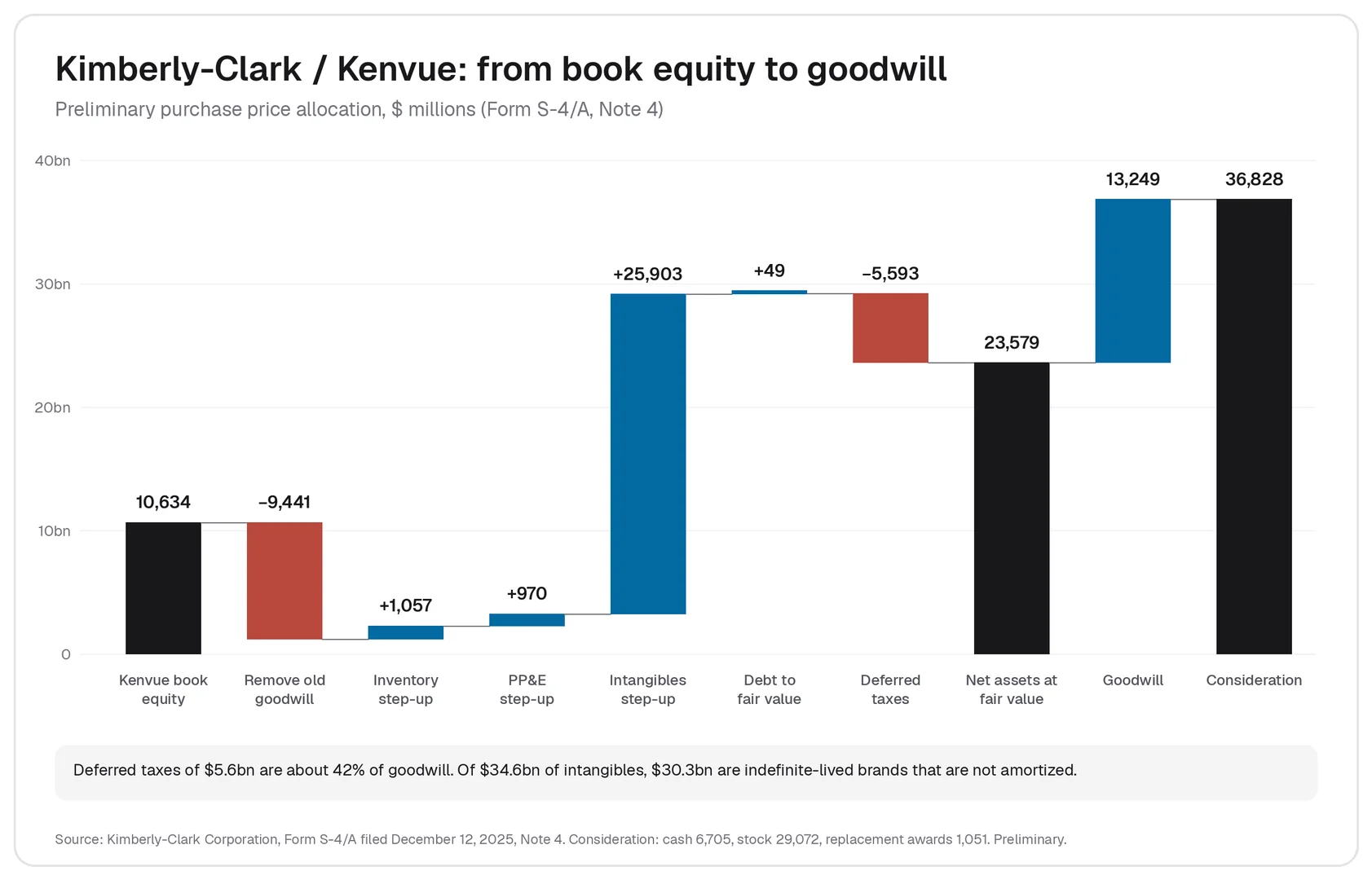
Most of the intangible write-up will never be amortized. Of the $34,619m of identifiable intangibles, $30,275m is brands classified as indefinite-lived. Only $1,352m of brands (10-year life) and $2,992m of customer relationships (15-year life) will be amortized. The pro forma income statement for 2024 shows $335m of amortization on the new values against $269m on Kenvue's old ones, an increase of $66m despite a $25.9bn write-up. Had the indefinite-lived brands been given a 20-year life, annual amortization would have been about $1.5bn higher. The filing values both brands and customer relationships with the multi-period excess earnings method.
Deferred taxes account for about 42 percent of the goodwill. The $5,593m of deferred tax adjustments inside the acquired net assets is the cost of buying stock without a tax step-up on more than $27bn of write-ups, set at statutory rates in each jurisdiction and net of eliminating a $790m deferred tax liability Kenvue had carried on tax-deductible goodwill. Without the deferred tax effect, goodwill would have been about $7.7bn. The filing attributes the goodwill to Kenvue's assembled workforce, planned growth in certain markets and expected synergies, and says a majority of it is not expected to be deductible for tax.
The smaller lines show how the allocation reaches the income statement. The $1,057m inventory step-up is expected to be sold within a year, so the pro forma statements add it to cost of products sold, a one-time hit to gross margin. Property rose $970m, with machinery and equipment given nine-year lives and buildings 26 years, yet pro forma depreciation fell by $12m for 2024 because the new useful lives are longer than the remaining lives Kenvue had used. The $50m write-down of assumed senior notes to quoted market value returns as extra interest expense as the discount accretes.
The deal closed on November 2, 2026. Kimberly-Clark's third-quarter 10-Q reports about $6.7bn of cash consideration and about 281.1 million shares delivered, against 280.2 million estimated a year earlier. The final stock line uses the closing-date share price, and every dollar of difference from the $29,072m estimate moves goodwill by a dollar. In an accretion dilution analysis, the extra amortization and depreciation, after tax, are among the lines that move pro forma earnings per share.
The measurement period and provisional amounts
Valuations of a business the size of Kenvue cannot be finished by the first reporting date after closing, so ASC 805 lets the buyer report provisional amounts and refine them for up to one year from the acquisition date. A measurement period adjustment must reflect new information about facts that existed on the acquisition date: a completed appraisal of a plant the target already owned, a tax return that reveals the target's actual tax basis, or a lawsuit filed before closing whose size becomes clear later. Those adjustments go against goodwill. Until the allocation is final, the buyer discloses which amounts are provisional and why, and its acquisition footnote sets out the allocation by line, which is where tables like Kimberly-Clark's come from.
Events after closing are not measurement period adjustments. If a large customer leaves in month four, the customer relationship is not retroactively reduced; the loss comes through amortization or impairment in the current period. A missed earnout target changes the earnout liability through earnings. A mistake in the original allocation is corrected as an error.
Since Accounting Standards Update 2015-16, US companies recognize measurement period adjustments in the reporting period in which the amounts are determined, including the catch-up of depreciation and amortization as if the final values had been used from the start, and they disclose that catch-up by line item. Prior periods are not restated. IFRS 3 still requires retrospective adjustment of comparative figures.
For Kimberly-Clark, which closed the Kenvue deal on November 2, 2026, the window to finalize the allocation closes no later than November 2, 2027.
Tax allocation: asset deals, stock deals, Section 338(h)(10), and Form 8594
The book allocation under ASC 805 and the tax allocation under the Internal Revenue Code are separate calculations that can produce different numbers for the same deal. Tax uses fair market value rather than fair value, counts an earnout only as it is paid, and carries assumed debt at face value. Which tax regime applies depends on how the deal is structured for tax.
In a stock purchase, nothing is allocated for tax. The target keeps its tax basis, its tax goodwill and its tax attributes, subject to limits on net operating losses after an ownership change. That is the Kenvue case and the source of the book deferred tax liability. Public C corporations are almost always bought this way, because an asset sale would tax the gain twice.
In an asset purchase, Section 1060 requires both sides to allocate the price by the residual method, and both generally report it on Form 8594. The Internal Revenue Service (IRS) instructions sort assets into seven classes and fill them in order. The price is first reduced by Class I (cash and deposit accounts), then allocated up to fair market value to Class II (actively traded securities, certificates of deposit, foreign currency), Class III (accounts receivable), Class IV (inventory), Class V (equipment, buildings, land, vehicles and other tangible assets) and Class VI (Section 197 intangibles other than goodwill, such as customer lists, trade names, licenses, non-compete covenants and, unlike the book rules, workforce in place). The remainder goes to Class VII, goodwill and going concern value. If the price later changes, for example when an earnout is paid, the affected party files a supplemental Form 8594.
The buyer gets a new tax basis in every asset. Section 197 intangibles, goodwill included, are amortized straight line over 15 years. Equipment is depreciated over five or seven years, and the One Big Beautiful Bill Act made 100 percent bonus depreciation permanent for qualifying property acquired after January 19, 2025, as described in IRS Notice 2026-11. A buyer can often deduct the full amount allocated to used equipment in the first year, so it wants price in Class V rather than Class VII. The seller pushes the other way: gain on goodwill is generally capital gain, gain on previously depreciated equipment is recaptured as ordinary income, and a payment for a personal non-compete is ordinary income to the individual who signs it. A seller with unused net operating losses minds ordinary income less, which gives the buyer room to ask for more in equipment. Because the allocation is negotiated, it belongs in the purchase agreement, and under Section 1060 a written agreement on it binds both parties unless the IRS finds it inappropriate. Forms 8594 that do not match invite an IRS challenge.
Two elections give asset-deal tax treatment to a purchase of stock. A Section 338(h)(10) election, made jointly on Form 8023, treats a qualified stock purchase by a corporation (at least 80 percent of the stock within 12 months) of an S corporation, or of a subsidiary of a consolidated group, as a sale of assets; the allocation follows the same residual method and is reported on Form 8883. A Section 336(e) election reaches a similar result without requiring a corporate buyer. Buyers of S corporations also use an F reorganization, converting the target into a limited liability company before the sale so the buyer gets a basis step-up.
On the book side of an asset deal, tax basis and book values start out close together, so the deferred tax liability that inflated goodwill in a stock deal largely does not arise. A new liability builds over time, because tax goodwill is deducted over 15 years while book goodwill is not amortized; Kenvue carried one of $790m before Kimberly-Clark's allocation eliminated it.
After closing: amortization, impairment, and the private company alternatives
Each line of the allocation then follows its own path. Inventory step-up flows through cost of goods sold as the stock is sold. Property is depreciated over the reset lives. Finite-lived intangibles are amortized, which is why acquisitive public companies often report adjusted earnings that add the amortization back. In a stock deal, the deferred tax liability unwinds as the write-ups are depreciated and amortized, so the after-tax hit is smaller than the pre-tax charge. Indefinite-lived intangibles and goodwill stay on the balance sheet until something goes wrong.
Public companies do not amortize goodwill under US rules. They assign it to reporting units, which are operating segments or one level below, and test it at least annually and whenever events suggest a fall in value. Since Accounting Standards Update 2017-04 the test is one comparison: if a reporting unit's carrying amount exceeds its fair value, the excess is an impairment loss, capped at that unit's goodwill.
Fiserv's 10-Q for the third quarter of 2026, filed November 4, 2026, shows how this plays out years after the deals that created the goodwill. Fiserv treated a sustained fall in its share price and market capitalization as a triggering event and tested every reporting unit. Using discounted cash flows at risk-adjusted discount rates of 14 to 18 percent, it found nine units worth less than their carrying amounts and recorded a $6,452m goodwill impairment. The related tax benefit was only $50m, on the part of the goodwill that was deductible for tax. Writing down goodwill that was never deductible cuts reported earnings and equity but saves no tax.
The FASB spent about four years on a project that would have brought back goodwill amortization for public companies, then removed it from its agenda on June 15, 2022. On July 29, 2026 the board added a narrower project, Targeted Improvements to Goodwill Impairment Testing, on the level at which goodwill is tested and how often. Amortization for public companies is not on the agenda.
Private companies have two shortcuts. Accounting Standards Update 2014-02 lets them amortize goodwill straight line over ten years or less and test it only when a triggering event occurs. Accounting Standards Update 2014-18 lets them fold non-compete agreements, and customer-related intangibles that cannot be sold or licensed separately, into goodwill instead of valuing them. Public business entities cannot use either, and the definition covers companies with securities registered with the Securities and Exchange Commission, so a company that later goes public or issues registered debt may have to rebuild its acquisition accounting. Under IFRS, goodwill is not amortized, it is tested annually by cash-generating unit under International Accounting Standard 36, and a goodwill impairment can never be reversed.
Purchase price allocation in private equity deals
In a leveraged buyout, the fund itself does not book the allocation. A buyout fund reports as an investment company: it carries each portfolio company at fair value and does not consolidate it. The allocation is booked by the acquisition holding company that owns the operating business and borrows the acquisition debt, because lenders require audited annual financial statements and those statements start from the opening balance sheet the allocation creates. The target can also elect pushdown accounting under Accounting Standards Update 2014-17, putting the new basis on its own standalone statements. Auditors test that opening balance sheet like a year-end close, so the finance team counts inventory near the closing date, checks invoices paid after closing for unrecorded liabilities, and sets contract assets and liabilities on open projects.
The sponsor's returns depend on cash, and only the tax allocation moves cash. The book allocation changes reported earnings, the balance sheet and the impairment base, but not the cash flows behind an internal rate of return. That is why tax structure shows up in a sponsor's bid. A $100m step-up in goodwill and intangibles deductible over 15 years gives about $6.7m of deductions a year, worth roughly $1.4m a year at the 21 percent federal corporate rate before discounting. Sponsors buying S corporations or carve-outs often pay sellers a gross-up for the extra tax a 338(h)(10) election or an asset sale imposes on them, which makes sense when the present value of the step-up exceeds the gross-up.
The allocation affects earnings before interest, tax, depreciation and amortization (EBITDA) less than many people assume. Amortization of acquired intangibles sits below that line by definition, so it needs no add-back. The allocation items that reach EBITDA are the inventory step-up, which inflates cost of goods sold for the first months after closing, and, for deals before the 2021 revenue update, the deferred revenue write-down. Credit agreements usually define covenant EBITDA to exclude purchase accounting adjustments and non-cash impairments, but the definition is negotiated, and the finance team needs the allocation in time to model the first covenant test.
Buy-and-build strategies multiply the work, because every add-on acquisition needs its own allocation and adds its own amortization. A platform that buys four companies a year, each with $15m of customer relationships amortized over ten years, adds $6m of annual amortization each year; after three years it reports $18m less pre-tax income under generally accepted accounting principles than its operations alone would show.
Each exit starts the cycle again. The next buyer performs its own allocation and eliminates the goodwill and intangibles the sponsor's holding company recorded. In a stock sale, the company's tax basis carries over, so remaining tax amortization from a step-up the sponsor obtained at entry is an asset the seller can market.
Allocation work sits mainly in valuation advisory and transaction services teams at accounting and valuation firms; bankers and private equity associates approximate it in models. Common interview questions ask why a stock-deal write-up creates a deferred tax liability and what happens to the target's existing goodwill. Open roles in those seats are on Private Equity Jobs, and firms can be researched in the companies directory.
Common mistakes
Quick allocations in models most often go wrong in the arithmetic: the target's existing goodwill is not eliminated, a deferred tax liability is applied to write-ups in an asset deal or a 338(h)(10) election where the tax basis steps up, an earnout goes in at its maximum, or deal fees are capitalized.
Full valuations go wrong in judgment. Valuers count buyer-specific synergies in an asset's value, leave too much of the price in goodwill without a real search for intangibles, or set useful lives by habit rather than from attrition and contract data. Teams that wait until audit season lose the forecasts and closing data the work depends on, and book and tax allocations prepared separately and never reconciled produce wrong deferred tax balances.
Common questions
Is purchase price allocation required?
Yes, for any company reporting under US generally accepted accounting principles or IFRS that obtains control of a business, private companies included, though private companies can simplify parts of it. For tax, an allocation is required in asset purchases of a trade or business and in stock purchases treated as asset purchases through an election.
Is purchase price allocation the same as a purchase price adjustment?
No. A purchase price adjustment changes how much the buyer pays, usually by comparing working capital and net debt at closing with an agreed target. The allocation assigns the final price to assets, liabilities and goodwill.
Do buyer and seller have to agree on the allocation?
For the books, no: the buyer prepares it and its auditor reviews it. For tax in an asset deal, both sides report the allocation on Form 8594, and a written agreement between them binds both unless the IRS determines it is not appropriate.
How long does a purchase price allocation take?
The rules allow up to one year from the acquisition date. In practice the buyer needs provisional numbers for its first financial statements after closing. Sofer Advisors, a valuation firm, estimates four to eight weeks of valuation work for a deal made up mostly of tangible assets and 16 to 24 weeks for a technology or life sciences target.
What is an ASC 805 valuation?
It is the fair value measurement of each identifiable asset and liability in a business combination as of the acquisition date, prepared by a valuation specialist and tested by the buyer's auditor.
How does IFRS 3 differ from ASC 805?
IFRS 3 lets the buyer measure a noncontrolling interest at fair value or at its share of identifiable net assets, which changes goodwill in partial acquisitions; US rules require fair value. IFRS also restates comparative figures for measurement period adjustments and never reverses a goodwill impairment.
Sources
Kimberly-Clark Corporation, Form S-4/A (Amendment No. 1, File No. 333-291928), filed December 12, 2025: unaudited pro forma condensed combined financial information, Notes 2 and 4. Kimberly-Clark Corporation, Form 10-Q for the quarter ended September 30, 2026, filed November 5, 2026: acquisitions note. Fiserv, Inc., Form 10-Q for the quarter ended September 30, 2026, filed November 4, 2026: goodwill note. Internal Revenue Service, Instructions for Form 8594, revised November 2021. Internal Revenue Service, Notice 2026-11. Financial Accounting Standards Board, Targeted Improvements to Goodwill Impairment Testing, project page.
Related posts
Related posts
A merger model combines two companies under a stated offer: consideration mix, funding, purchase price accounting, combined statements, and synergies. Build order, walk-through, and Kimberly-Clark's filed Kenvue consideration and preliminary PPA.

Sum-of-the-parts valuation values each business segment on its own, then bridges to equity. When to use it, how to build it, conglomerate discount, and Walgreens' filed Centerview and Morgan Stanley ranges.

Accretion dilution analysis tests whether an acquisition raises or lowers the buyer's earnings per share. The inputs, the calculation, the P/E shortcut, breakeven synergies, and Kimberly-Clark's filed pro forma EPS for Kenvue.