
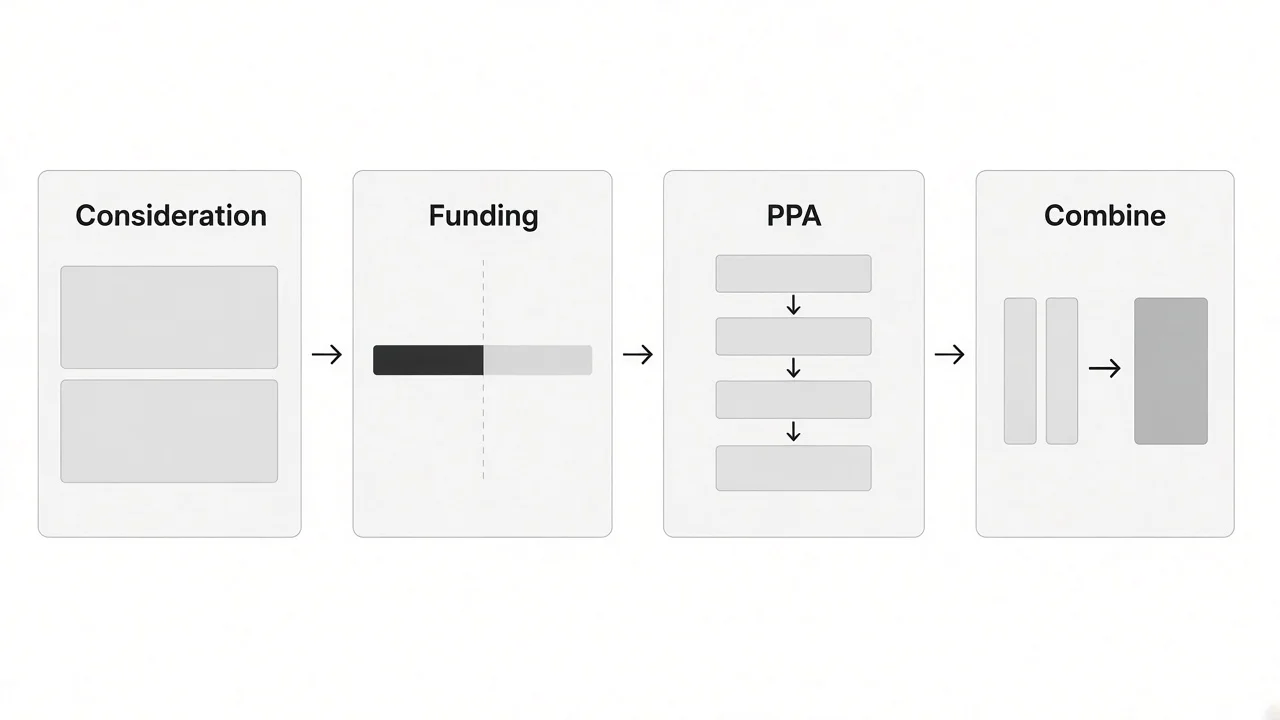
A merger model is the workbook that combines a buyer's and a target's financial statements under a stated offer and shows what the combined company would look like. The model takes the offer price and the mix of cash and stock, adds transaction and financing fees, reallocates the purchase price to fair-value assets and goodwill, combines the income statement and the balance sheet, and layers in synergies and one-time costs. Accretion dilution analysis is the earnings-per-share output of that workbook: whether the buyer's pro forma earnings per share rises or falls relative to what it would have earned alone.
Investment bankers and corporate development teams build merger models on public-company acquisitions. The same workbook appears in investment banking interviews as "walk me through a merger model." Private equity interviews ask the question too, even though a sponsor's live deal tool is a leveraged buyout (LBO) model, not a public earnings-per-share test.
The cash-and-stock agreement by Kimberly-Clark Corporation to buy Kenvue, announced on November 3, 2025, is the worked example on this page. The joint proxy statement and Form S-4/A filed with the Securities and Exchange Commission on December 12, 2025 publish the consideration, the exchange ratio, and a preliminary purchase price allocation. The steps below follow those filed tables. The earnings-per-share arithmetic from the same deal is on the accretion dilution page and is not reprinted here.
What a merger model is
A merger model is a multi-sheet workbook. One sheet holds the offer and the consideration mix. Another holds sources of funds and uses of funds, including fees and any debt being refinanced. A third holds purchase price accounting: the fair-value write-ups, the deferred tax liability those write-ups create, the incremental depreciation and amortization, and the goodwill residual. Later sheets combine the income statement and the balance sheet and show the earnings-per-share comparison.
Training sites often call the same workbook an "M&A model" or an "accretion/dilution model." The names point at different layers of the same file. The merger model is the full build. Accretion and dilution are the earnings-per-share comparison that sits at the end of that build. Treating the labels as synonyms is how purchase accounting and the balance sheet get skipped in walk-throughs. Keep the sheets in order.
The model can be thin or full. A screening model uses last-twelve-months earnings, a single year's forecast, and a simple cash-versus-stock toggle. A live deal model uses multi-year forecasts for both companies, a full sources-and-uses table, a detailed purchase price allocation, phased synergies, credit metrics, ownership after the stock issue, and sensitivity tables on price, mix, and synergies. The steps below are the same in both cases. Only the depth changes.
Training institutes sometimes split "single-company" merger models (one acquirer, one target) from "multi-company" or merger-of-equals models where ownership, governance, and the accounting acquirer need extra care. For interview purposes the single-company build is enough. For a live merger of equals, the same sheets apply, but purchase accounting still requires designating an accounting acquirer under the relevant rules, and contribution analysis (who brings what share of earnings, earnings before interest, tax, depreciation and amortization (EBITDA), and equity value versus who owns what share after closing) becomes more important next to earnings per share.
Who builds it and why
Buy-side corporate development teams and their investment banking advisers build merger models when a public company is buying another company. The board wants to see the combined income statement, the combined balance sheet, the credit ratios after the financing, and the effect on earnings per share. The model also feeds the transaction analysis pages of an investment banking pitch book, next to valuation and contribution analysis.
Sell-side advisers build a version when they advise a target, usually to test what a proposed exchange ratio and cash mix would do to the buyer's credit metrics and earnings per share, and to support the fairness opinion. Equity research analysts build simplified versions after a deal is announced so they can update their estimates.
A private equity sponsor buying a public or private company does not run the model as the decision tool. The sponsor cares about cash returns on the equity it puts in, measured as internal rate of return and multiple on invested capital. The workbook it builds is an LBO model. The merger-model question still shows up in private equity interviews because many candidates come from investment banking and because add-on acquisitions by a portfolio company that is already public can revive an earnings-per-share test.
Step 1: Standalone forecasts and the offer
Start with two clean standalone models. Each needs a forecast income statement for the years you will test, a diluted share count, and a balance sheet at the assumed closing date. For public companies, the forecasts usually come from management projections in a proxy or registration statement, from the consensus of research analysts, or from the banker's own operating model. For a private target, the forecasts come from the confidential information memorandum and diligence.
Then lock the offer:
- Equity purchase price. Offer price per target share times the target's diluted shares. Diluted shares include options, restricted stock units, and other instruments that will convert or be cashed out at closing.
- Enterprise value. Equity purchase price plus the target's net debt (debt minus cash), plus other debt-like items the buyer is effectively paying for. Kimberly-Clark's November 3, 2025 press release put Kenvue's enterprise value at about $48.7 billion on the announced terms.
- Premium. Offer price versus the target's undisturbed share price and versus recent volume-weighted averages. The premium drives how expensive the target's earnings are, which shows up later in the earnings-per-share math. On the Kimberly-Clark / Kenvue terms, $21.01 implied value was about a 46% premium to Kenvue's $14.37 close on October 31, 2025, and about a 15% premium to Kenvue's 90-day volume-weighted average price of $18.24. After closing, Kimberly-Clark stockholders are expected to own about 54% of the combined company and Kenvue stockholders about 46%, on a fully diluted basis.
Offer price and premium also sit inside precedent transactions and trading-comparable work when the banker is defending the price. The merger model takes the agreed or proposed price as an input; it does not invent it.
Cash, stock, or mix: consideration and the exchange ratio
The consideration mix is the share of the equity purchase price paid in cash, in buyer stock, or both. The mix changes three things at once: how much new debt or cash the buyer needs, how many new shares it issues, and how the purchase price is measured when the stock portion is marked to the buyer's share price. From a funding-cost view, balance-sheet cash is usually cheapest (the buyer gives up interest income), new debt is next (cash interest expense), and stock is usually the most expensive (new shares dilute earnings per share). Boards still mix the three for rating, ownership, and tax reasons, not only for the cheapest line.
All cash. The buyer pays cash from its balance sheet, from new debt, or both. No new shares are issued for the purchase (replacement equity awards for target employees are a separate line). Interest expense rises if the buyer borrows. Interest income falls if the buyer spends existing cash.
All stock. Each target share converts into a fixed number of buyer shares, the exchange ratio. New shares equal the exchange ratio times the target's diluted shares that take stock. There is no cash outflow for the equity purchase price itself, though the buyer may still refinance target debt and pay fees in cash.
Mix. Part cash, part stock. This is the common form for large public deals. Kimberly-Clark agreed to pay, for each Kenvue share, 0.14625 shares of Kimberly-Clark common stock plus $3.50 in cash. On October 31, 2025, the last trading day before the announcement, Kimberly-Clark closed at $119.71. The stock portion was worth $17.51 ($119.71 × 0.14625) and the total implied value was $21.01 per Kenvue share. The exchange ratio is fixed. It does not float with either company's share price between signing and closing, so the dollar value of the stock portion moves until closing.
Fixed versus floating matters for modeling:
- A fixed exchange ratio (Kimberly-Clark / Kenvue) keeps ownership percentages stable and lets the dollar value of the stock consideration move with the buyer's share price. The S-4/A states that a 10% move in Kimberly-Clark's share price moves estimated purchase consideration by about $3.0 billion in the same direction, with the same move in goodwill.
- A floating exchange ratio with a collar keeps the dollar value of the stock portion nearer to a target and lets the share count move inside the collar.
New shares issued equal the stock portion of the deal divided by the buyer's share price used for accounting, or, with a fixed ratio, the ratio times the target shares taking stock. Replacement awards for target employees can add more shares or a separate fair-value amount in purchase consideration.
Sources of funds and transaction fees
A sources and uses table is the funding sheet of the merger model. Uses are everything that must be paid at closing: equity purchase price (cash portion), refinanced target debt, advisory and legal fees, financing fees, change-in-control and retention payments, and cash to the balance sheet if the structure requires it. Sources are the cash and debt that fund those uses: buyer balance-sheet cash, new term loans or bonds, new revolving drawings, stock issued (shown at value), and sometimes proceeds from asset sales.
Fees belong on this sheet even when they are small relative to the purchase price, because they affect cash, debt, and (for financing fees) the effective interest cost. The Kimberly-Clark S-4/A unaudited pro forma notes include, among other items, about $259 million of nonrecurring transaction-related expenses for Kimberly-Clark at closing and $100 million of retention bonuses in total, of which $50 million is expected to be paid at closing and $50 million no earlier than six months later, subject to continued service. Those are model inputs, not afterthoughts.
Credit metrics sit next to sources and uses. Rating agencies and the buyer's board watch pro forma leverage, interest coverage, and liquidity. A buyer that wants to protect a rating often caps the cash-and-debt portion of the consideration and pays the rest in stock, which is why mix and funding are set together.
Financing fees are amortized over the life of the debt in the income statement even when the cash is paid at closing. Original-issue discount and call premiums on refinanced notes belong in the uses column if they are paid in cash, or in the debt fair-value adjustment if they are embedded in assumed debt. The Kimberly-Clark pro forma package separates "Transaction Accounting Adjustments" from "Financing Adjustments" so readers can see the deal accounting apart from the new debt raised to fund the cash consideration. A clean merger model keeps the same split.
Purchase price accounting: write-ups, deferred tax, and goodwill
Under acquisition accounting (Accounting Standards Codification Topic 805 in U.S. rules), the buyer records the target's identifiable assets and liabilities at fair value on the closing date. The excess of purchase consideration over the fair value of net identifiable assets is goodwill.
The model steps are:
- Compute purchase consideration. Cash paid, plus the fair value of buyer stock issued, plus the fair value of replacement equity awards attributable to pre-combination service, plus other contingent consideration if any.
- Write assets and liabilities to fair value. Inventory, property, plant and equipment, and identifiable intangible assets (brands, customer relationships, technology, in-process research and development) often step up. Debt may step to fair value. Deferred revenue may step down.
- Record a deferred tax liability on taxable temporary differences. When the buyer purchases stock and the write-ups are not deductible for tax, book basis exceeds tax basis. The model records a deferred tax liability equal to the write-up times the tax rate. That deferred tax liability increases goodwill.
- Compute goodwill. Purchase consideration minus fair value of net identifiable assets (which already reflect the deferred tax liability) equals goodwill. Public acquirers do not amortize goodwill under U.S. rules. They test it for impairment. Identifiable intangibles with finite lives are amortized; that amortization is a recurring drag on GAAP earnings.
A labeled hypothetical shows the arithmetic before the filed table. Suppose purchase consideration is $2,000 million, the target's book net assets are $800 million, and the buyer writes up property, plant and equipment by $500 million and identifiable intangibles by $200 million. At a 25% tax rate, the deferred tax liability on those $700 million of write-ups is $175 million. Fair value of net identifiable assets becomes $800 + $500 + $200 − $175 = $1,325 million. Goodwill is $2,000 − $1,325 = $675 million. Incremental annual depreciation and amortization equal the write-ups divided by their useful lives. Inventory step-up flows through cost of goods sold once.
That hypothetical is for teaching the signs. Live models use appraisal support or management's preliminary allocation, then update after closing.
Worked example: Kimberly-Clark and Kenvue consideration and preliminary PPA
The Kimberly-Clark Form S-4/A filed December 12, 2025 publishes both the consideration math and a preliminary purchase price allocation as of a September 30, 2025 assumed closing for the pro forma balance sheet.
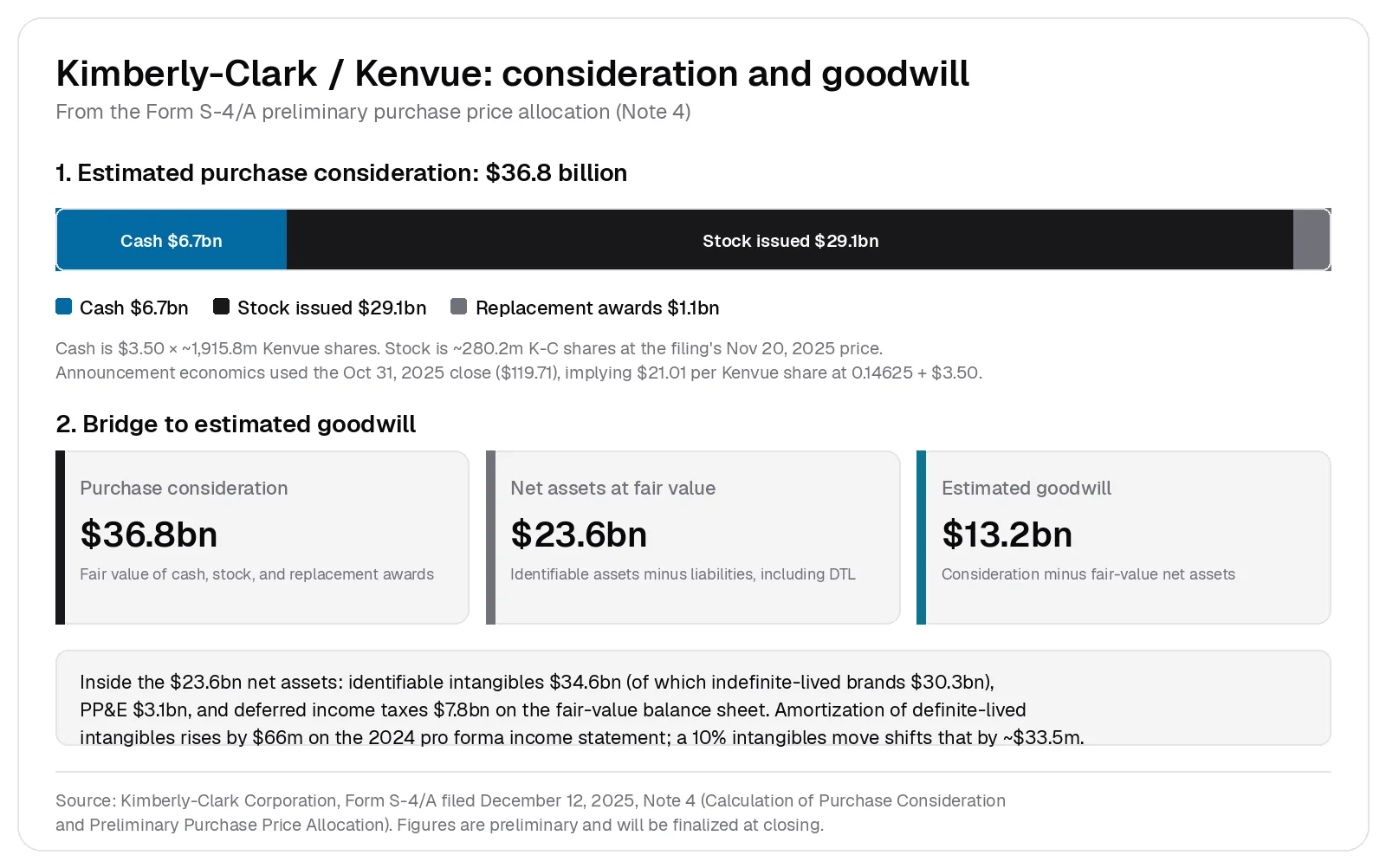
Consideration transferred (S-4/A, unaudited pro forma notes):
| Component | Amount ($ millions) |
|---|---|
| Estimated cash consideration ($3.50 × about 1,915.8 million Kenvue shares) | 6,705 |
| Estimated fair value of Kimberly-Clark common stock to be issued (about 280.2 million shares) | 29,072 |
| Estimated fair value of replaced equity awards attributable to pre-combination service | 1,051 |
| Total estimated purchase consideration | 36,828 |
The stock fair value in that table uses Kimberly-Clark's share price as of November 20, 2025 ($103.76 in the filing's note), which is why the stock line differs from the $17.51-per-share figure based on the October 31, 2025 close used in the announcement economics. Purchase consideration in the model should use the accounting fair value at the assumed closing date, and sensitivity to the buyer's share price should be shown when the ratio is fixed.
Preliminary allocation of that $36,828 million (same notes, $ millions):
| Fair value | |
|---|---|
| Cash and cash equivalents | 388 |
| Accounts receivable, net | 2,788 |
| Inventories | 2,851 |
| Other current assets | 311 |
| Property, plant, and equipment, net | 3,062 |
| Other intangible assets, net | 34,619 |
| Other assets | 752 |
| Total assets | 44,771 |
| Debt payable within one year | 1,163 |
| Trade accounts payable | 2,445 |
| Accrued expenses and other current liabilities | 1,797 |
| Long-term debt | 7,011 |
| Deferred income taxes | 7,803 |
| Non-current employee benefits | 373 |
| Other liabilities | 600 |
| Total liabilities | 21,192 |
| Net assets acquired | 23,579 |
| Estimated purchase consideration | 36,828 |
| Estimated goodwill | 13,249 |
Identifiable intangibles in the same notes include definite-lived brands ($1,352 million, 10-year life), customer relationships ($2,992 million, 15-year life), and indefinite-lived brands ($30,275 million). The pro forma income statement reflects higher amortization from the definite-lived step-up (the filing shows a $66 million increase for the year ended December 31, 2024) and notes that a 10% change in the intangibles valuation would move annual amortization by about $33.5 million. The deferred tax line includes an estimated increase of about $5.3 billion to net deferred tax liabilities driven primarily by the fair valuation of intangibles.
Those figures are preliminary. The filing states that Kimberly-Clark had not completed the valuation in sufficient detail for every asset and liability class, and that final amounts will be based on fair values at the actual closing date. A merger model built off a live registration statement should label the allocation as preliminary and keep the sensitivity.
Combining the income statement and the balance sheet
With consideration, funding, and purchase accounting set, combine the statements.
Income statement. Add buyer and target revenue and expenses line by line for each forecast year. Then apply adjustments: remove target interest if debt is refinanced; add interest on new acquisition debt; subtract foregone interest on cash spent; add incremental depreciation and amortization from write-ups; add synergies as they phase in; subtract one-time transaction and integration costs in the periods they hit; tax every adjustment. Divide adjusted net income by pro forma diluted shares (buyer shares plus new issue, including dilutive securities under the treasury stock method) to get pro forma earnings per share.
Balance sheet. At the assumed closing date, replace the target's equity with the purchase accounting: add fair-value assets, add goodwill, add the deferred tax liability, add new debt, remove cash spent, and issue new share capital and additional paid-in capital for the stock consideration. Eliminate the target's historical equity. The balance sheet must balance after every toggle on price, mix, and allocation.
Common mistakes at this step are double-counting target cash that was already subtracted in net debt, forgetting the deferred tax liability on write-ups, amortizing goodwill in a U.S. public-company GAAP case, and using basic shares when the rest of the model uses diluted shares.
Two more checks save time. First, the change in cash on the combined balance sheet should reconcile to sources and uses: cash spent on the equity consideration, fees, and debt repayment, minus cash raised from new debt and any asset-sale proceeds. Second, the increase in share capital and additional paid-in capital should reconcile to the fair value of stock issued, and the increase in goodwill should reconcile to purchase consideration minus fair-value net assets. If those two bridges fail, an input is wrong or an adjustment was applied twice.
When the target has multiple segments, some teams value pieces on a sum of the parts basis before they lock the offer. The merger model still consolidates one income statement and one balance sheet after closing. Segment detail belongs in the forecast supporting the model, not as a substitute for purchase accounting.
Synergies and one-time costs in the model
Synergies are model inputs, not a separate valuation theory. Cost synergies reduce operating expenses (or cost of goods sold) on the combined income statement. Revenue synergies increase revenue or gross profit, usually with less certainty and a slower ramp. One-time costs to achieve synergies (severance, systems, duplicate-lease exits) hit cash and usually earnings in the first one or two years and are often excluded from adjusted earnings per share.
Kimberly-Clark's announcement materials identify about $1.9 billion of cost synergies and about $500 million of incremental profit from revenue synergies, partially offset by about $300 million of reinvestment, for about $2.1 billion of run-rate synergies net of reinvestment. The companies expect the cost synergies in the first three years after closing and the revenue synergies within four years, with about $2.5 billion of cash costs to achieve them in the first two years. In the model, those figures become annual phase-in lines and a costs-to-achieve line, not a single headline pasted onto year one.
Do not use synergies to paper over an offer price. The earnings-per-share page walks breakeven synergies against the same deal. Here, keep synergies as explicit, timed inputs next to the purchase accounting charges they have to overcome on GAAP earnings.
Where accretion and dilution plug in
Once pro forma net income and pro forma diluted shares exist, the earnings-per-share comparison is a short step: pro forma earnings per share versus the buyer's standalone earnings per share. Relative price-to-earnings ratios (a higher-multiple buyer issuing stock for a lower-multiple target tends toward accretion), the after-tax cost of debt or cash versus the target's earnings yield, the premium paid, and synergies are the main drivers of that result. The price-to-earnings shortcut, breakeven synergies, contribution analysis, and the Kimberly-Clark / Kenvue filed earnings-per-share bridge are covered in accretion dilution analysis. This page stops at the inputs that feed that comparison: consideration, funding, purchase accounting, combined statements, and synergies.
A deal can look fine in the merger model on credit metrics and strategic fit and still be dilutive on earnings per share for years, or the reverse. Boards see both.
Walk me through a merger model
In an investment banking interview, answer in build order:
- Project standalone earnings and diluted shares for buyer and target.
- Set the offer price, premium, and consideration mix (cash, stock, or both), including the exchange ratio and new share count.
- Build sources and uses: cash and new debt on the sources side; equity cash outlay, refinanced debt, and fees on the uses side.
- Run purchase price accounting: fair-value write-ups, deferred tax liability, incremental depreciation and amortization, and goodwill.
- Combine the income statement and the balance sheet with those adjustments, then add synergies and one-time costs on their timelines.
- Compare pro forma earnings per share with standalone earnings per share and say whether the deal is accretive or dilutive on GAAP and on the adjusted basis the company uses.
If the interviewer asks only for accretion and dilution, give the shorter earnings-per-share walk from the accretion dilution page. If they ask for the merger model, include funding and purchase accounting. Skipping goodwill and the deferred tax liability is the usual miss.
How private equity work differs
A private equity fund that takes a company private, or that buys a private company, measures success with cash returned to the fund relative to cash invested. The model is an LBO model: sources and uses, debt schedule, operating forecast, exits, and returns. Earnings per share for a delisted company is not the scoreboard.
Merger-model mechanics still appear in private equity work in three places. First, interviews: candidates from banking are asked the walk-through above. Second, add-on acquisitions by a public portfolio company, or by a company preparing to go public, can put earnings per share back on the page. Third, when a sponsor sells to a strategic buyer, the strategic's merger model and earnings-per-share story affect what that buyer will pay. The sponsor still underwrites its own returns with an LBO model.
For the modeling test used in many private equity processes, see the LBO modeling test. For interview breadth beyond the model, see private equity interview questions.
Common questions
What is the difference between a merger model and accretion dilution analysis?
A merger model is the full workbook: offer, funding, purchase accounting, combined statements, synergies, and then earnings per share. Accretion dilution analysis is the earnings-per-share comparison. People use the names interchangeably in interviews; a precise answer keeps the sheets distinct.
How do you calculate the exchange ratio?
In a fixed-ratio stock or mixed deal, the exchange ratio is set in the merger agreement (0.14625 Kimberly-Clark shares per Kenvue share in the worked example). In a deal negotiated as a dollar price with a stock component, the exchange ratio is the stock portion of the price per target share divided by the buyer's share price. New shares equal the ratio times target shares taking stock.
What is purchase price allocation in a merger model?
Purchase price allocation assigns the purchase consideration to fair-value assets and liabilities and puts the residual in goodwill. It drives incremental depreciation and amortization and, when write-ups are not tax-deductible, a deferred tax liability. It is not the same as a purchase-price adjustment for working capital at closing.
How does a merger model differ from an LBO model?
A merger model combines two operating companies for a strategic or public buyer and usually ends in earnings per share and credit metrics. An LBO model finances a purchase with debt and equity in a special-purpose structure and ends in sponsor returns. Both use sources and uses; only the merger model centers purchase accounting into public-company earnings.
Can ChatGPT or another model build a merger model?
Tools can draft sheets quickly. They still need correct inputs, a coherent purchase price allocation, and a balance sheet that balances. Interviewers and deal teams grade the judgment in the assumptions, not the speed of the first draft.
What are the four types of mergers?
People often mean horizontal (same industry), vertical (along a supply chain), conglomerate (unrelated), and market-extension or product-extension deals. The merger model does not change its sheet order for those labels. What changes are the synergy story, the antitrust risk, and sometimes the accounting acquirer. The workbook still needs consideration, funding, purchase accounting, and combined statements.
Where does a merger model show up in recruiting?
Analyst and associate interviews at investment banks ask for the walk-through above, often after a paper LBO or accounting questions. Some assessment centers put candidates in front of a simplified workbook and ask them to toggle cash versus stock or to fix a broken goodwill calculation. Candidates aiming at banking can start from how to get into investment banking. Private equity processes lean on the LBO modeling test; the merger-model question is usually oral.
Sources
Kimberly-Clark Corporation, Form S-4/A (Amendment No. 1 to Form S-4, File No. 333-291928), filed December 12, 2025: merger consideration and exchange ratio; unaudited pro forma condensed combined financial information, Note 4 (calculation of purchase consideration and preliminary purchase price allocation). Kimberly-Clark Corporation, Form 8-K Exhibit 99.1, November 3, 2025: enterprise value, synergy, and costs-to-achieve headline figures.
Related posts
Related posts

Sum-of-the-parts valuation values each business segment on its own, then bridges to equity. When to use it, how to build it, conglomerate discount, and Walgreens' filed Centerview and Morgan Stanley ranges.

Accretion dilution analysis tests whether an acquisition raises or lowers the buyer's earnings per share. The inputs, the calculation, the P/E shortcut, breakeven synergies, and Kimberly-Clark's filed pro forma EPS for Kenvue.

Precedent transaction analysis values a company from the multiples buyers paid for similar companies. Screening, data sources, multiples, the control premium, and two banks' filed tables from the Walgreens take-private.