

Accretion dilution analysis measures how an acquisition changes the buyer's earnings per share (EPS). An analyst compares the buyer's standalone EPS, what it would earn per share without the deal, with its pro forma EPS, what the combined company would earn per share after the deal. If pro forma EPS is higher, the deal is accretive. If it is lower, the deal is dilutive. If the two are equal, the deal is breakeven. Investment bankers and corporate development teams run it on acquisitions by public companies, because boards, investors, and research analysts watch EPS closely.
The agreement by Kimberly-Clark Corporation (K-C) to buy Kenvue, the consumer health company behind Tylenol and Listerine, shows the test with filed numbers. K-C announced the cash-and-stock deal on November 3, 2025 under a headline that said it was "Expected to Be Accretive to Kimberly-Clark's Adjusted EPS By Year 2." The registration statement it filed with the Securities and Exchange Commission in December 2025 shows 2024 diluted EPS falling from $6.97 to $3.37 on a pro forma basis. The two figures do not conflict. The press release refers to the company's adjusted EPS once synergies arrive. The filing shows EPS under generally accepted accounting principles (GAAP) for a past year with every one-time charge from the deal included.
What accretion dilution analysis is
Earnings per share is net income attributable to common shareholders divided by the weighted average number of shares outstanding. Diluted EPS also counts shares that options, restricted stock units, and convertible securities would add. Accretion dilution analysis uses diluted EPS on both sides of the comparison. The same test can be run on other per-share figures, such as free cash flow per share or, for master limited partnerships, distributions per unit. It also applies to financings: issuing new shares, borrowing, or buying back stock raises or lowers EPS in the same way.
The calculation is a ratio of two numbers. Pro forma net income is the buyer's net income plus the target's net income, adjusted for everything the deal changes: interest on new debt, interest no longer earned on cash spent, cost savings from combining the businesses (synergies), and new accounting charges created by the purchase. Pro forma shares are the buyer's existing diluted shares plus any new shares issued to pay for the target. Accretion or dilution is pro forma EPS divided by standalone EPS, minus one, expressed as a percentage.
Analysts usually run the test on forecasts for the first two or three full years after closing, using management projections or the consensus of research analysts' estimates. Some also show the last twelve months of reported results, taken from the companies' annual and quarterly reports on Forms 10-K and 10-Q. Most also show two versions of EPS:
- GAAP EPS follows generally accepted accounting principles and includes every charge the deal creates, including one-time costs and amortization of intangible assets written up in the purchase.
- Adjusted EPS, also called cash EPS in some models, excludes one-time deal costs and often excludes amortization of acquired intangibles. Companies announcing deals usually quote accretion on their own adjusted EPS definition.
A deal can be dilutive on GAAP EPS and accretive on adjusted EPS at the same time, which is what happened with Kimberly-Clark and Kenvue.
Why acquirers and boards care about it
Public company investors value many companies as a multiple of earnings, so a deal that lowers EPS can lower the share price unless investors believe the lost earnings will come back. Kimberly-Clark's registration statement states the risk directly: "Any dilution of, or delay of any accretion to, K-C's earnings per share could cause the price of K-C common stock to decline or increase at a reduced rate."
That is why accretion shows up in three places. Companies put the expected accretion in the announcement press release and on the investor call, usually for a specific year and before or after synergies. Bankers put it on the transaction analysis pages of a pitch book, next to the synergies needed to pay for the deal. And corporate development teams use it to screen ideas early, because a deal that is heavily dilutive for years is hard to get past a board.
Accretion is used to screen deals, but it says nothing about whether the buyer paid more than the target is worth, which is why boards also see valuation and value-creation analyses before they approve a deal.
The inputs
Every accretion dilution model needs the same inputs. The exact list depends on how the deal is paid for and what the purchase accounting does to the combined income statement.
- Purchase price and premium. The offer price per target share times the target's diluted shares gives the equity purchase price. Adding the target's debt and subtracting its cash gives enterprise value. The premium over the target's share price drives how expensive the target's earnings are.
- Consideration mix. The share of the price paid in cash, in buyer stock, or both. Cash comes from the buyer's balance sheet, new debt, or both. A sources and uses table lays out exactly where the money comes from and where it goes, including fees and any target debt being repaid. The mix is often set by credit limits: a buyer that wants to keep its credit rating can borrow only so much and pays the rest in stock.
- Exchange ratio and new shares. In a stock deal, each target share converts into a fixed number of buyer shares. The exchange ratio times the target's diluted shares gives the new shares issued. In a deal priced in dollars, the exchange ratio is the stock portion of the offer price per target share divided by the buyer's share price, and new shares equal the stock portion of the total price divided by the buyer's share price.
- Foregone interest on cash. Cash spent on the deal stops earning interest. The lost interest, after tax, comes out of pro forma net income.
- Interest on new debt. Interest and amortization of financing fees on any acquisition debt, after tax, also come out of net income.
- Target debt. If the target's debt is repaid at closing, its interest expense disappears. If it is assumed, it stays, sometimes with a fair value adjustment.
- Synergies. Cost savings and, less often, extra profit from higher revenue. Models usually phase them in over two to four years and show EPS before and after synergies, along with the one-time costs to achieve them. Before management has a bottom-up estimate, bankers often size cost synergies as a percentage of the target's revenue or costs. Kimberly-Clark's $1.9 billion of expected cost synergies is about 12% of Kenvue's 2024 net sales of $15,455 million.
- Purchase accounting. Under acquisition accounting, the buyer records the target's assets at fair value. Higher values for brands, customer relationships, and technology create new amortization expense. Write-ups of property, plant, and equipment change depreciation. Inventory written up to fair value raises cost of goods sold once, as that inventory is sold. Any excess of price over net assets becomes goodwill, which public companies do not amortize under U.S. accounting rules but test for impairment.
- Deal structure and deferred taxes. When the buyer purchases the target's stock, the write-ups are usually not deductible for tax. The model records a deferred tax liability, and the new amortization lowers book earnings without a matching cash tax saving. In an asset purchase, or a stock purchase treated as an asset purchase under a Section 338(h)(10) election, the write-ups are tax-deductible, which raises after-tax cash earnings.
- Other target items. Deferred revenue may be written down to fair value, which lowers revenue in the first year after closing. Target convertible securities may convert into shares or be repaid. Target stock options and restricted stock units are usually replaced with buyer awards, which add to the share count. Acquired in-process research and development is recorded as an intangible asset and is not amortized until the project is completed or abandoned.
- Transaction costs and other one-time items. Advisory, legal, and financing fees, costs of repaying target debt early, retention bonuses, and integration costs. Most are expensed and excluded from adjusted EPS.
- Tax rate. Every adjustment is taken after tax, usually at the buyer's statutory or blended rate.
How to calculate accretion or dilution, step by step
The calculation follows six steps:
- Project the buyer's and the target's net income for the years being tested.
- Add the two net income figures.
- Adjust for the deal, all after tax: subtract foregone interest on cash used, interest on new debt, and new amortization and depreciation; add interest saved on target debt that is repaid; add synergies.
- Calculate pro forma diluted shares: the buyer's diluted shares plus new shares issued.
- Divide pro forma net income by pro forma shares to get pro forma EPS.
- Compare pro forma EPS with the buyer's standalone EPS for the same year.
Two timing adjustments come before step 2. If the deal closes partway through the buyer's fiscal year, the first year includes the target's earnings only for the months after closing. If the target's fiscal year ends in a different month, its quarterly results are re-added to match the buyer's year, which analysts call calendarization.
A hypothetical deal shows how the payment method changes the answer. A buyer has 100 million shares trading at $50 and expects net income of $250 million, so its EPS is $2.50 and its price-to-earnings (P/E) ratio is 20x. It agrees to buy a target expected to earn $60 million for a purchase price of $1.0 billion. New debt costs 6% before tax and the tax rate is 25%, so debt costs 4.5% after tax. Synergies are left out to keep the arithmetic simple.
| Hypothetical deal | All stock | All new debt | Half stock, half debt |
|---|---|---|---|
| Combined net income before financing ($ millions) | 310 | 310 | 310 |
| After-tax interest on new debt ($ millions) | 0 | (45) | (22.5) |
| Pro forma net income ($ millions) | 310 | 265 | 287.5 |
| New shares issued at $50 (millions) | 20 | 0 | 10 |
| Pro forma shares (millions) | 120 | 100 | 110 |
| Pro forma EPS | $2.58 | $2.65 | $2.61 |
| Accretion vs $2.50 | 3.3% | 6.0% | 4.5% |
All three versions are accretive, and debt is the most accretive because 4.5% after-tax interest is cheaper than issuing stock at 20x earnings. If the buyer paid from cash on hand that earns 4% before tax, it would lose $30 million of after-tax interest income, and pro forma EPS would be $2.80, a 12% increase.
Purchase accounting can turn the answer. Suppose $200 million of the price is allocated to customer relationships amortized over 10 years. That adds $20 million of pre-tax amortization, $15 million after tax. The all-stock deal's pro forma net income falls to $295 million and EPS to $2.46, which is 1.7% dilutive on GAAP EPS. On an adjusted EPS that excludes acquired-intangible amortization, it is still 3.3% accretive.
Worked example: Kimberly-Clark and Kenvue
K-C agreed to pay $3.50 in cash plus 0.14625 K-C shares for each Kenvue share. On October 31, 2025, the last trading day before the deal was announced, K-C closed at $119.71, which made the stock portion worth $17.51 and the total $21.01 per Kenvue share. The press release put Kenvue's enterprise value at about $48.7 billion. K-C planned to fund the cash with balance sheet cash, proceeds from selling 51% of its International Family Care and Professional business into a joint venture with Suzano, and new debt.
Because K-C registered the new shares on Form S-4, the filing includes unaudited pro forma financial statements prepared under Regulation S-X Article 11, which combine the two companies' historical results as if the deal had closed at the start of 2024. The filing's 2024 pro forma income statement, condensed:
| Year ended December 31, 2024 ($ millions, except per share) | K-C (pro forma historical) | Kenvue | Transaction adjustments | Financing adjustments | Pro forma combined |
|---|---|---|---|---|---|
| Net sales | 16,805 | 15,455 | 32,260 | ||
| Operating profit | 2,700 | 1,793 | (1,473) | 3,020 | |
| Interest expense | (270) | (431) | 37 | (245) | (909) |
| Income before taxes | 2,418 | 1,415 | (1,436) | (245) | 2,152 |
| Income taxes | (442) | (385) | 329 | 60 | (438) |
| Net income attributable to K-C | 2,348 | 1,030 | (1,107) | (185) | 2,086 |
| Diluted shares (millions) | 337.0 | 618.8 | |||
| Diluted EPS | $6.97 | $0.54 | $3.37 |
Source: Kimberly-Clark Corporation, Form S-4/A, filed December 12, 2025, page 171 and Note 6 (page 187). K-C's column already reflects the Suzano transaction, which adds K-C's share of the joint venture's income and lifts its historical 2024 diluted EPS from continuing operations of $6.41 to $6.97 (Note 3, page 180). Net income attributable to K-C also includes K-C's equity income and noncontrolling interests, which the condensed table does not show. The 37 in interest combines a 40 reversal on Kenvue notes due 2026 and a 3 fair value accretion charge on assumed notes.
On the filed numbers, the deal cuts 2024 diluted EPS by 51.6%. The filing books the one-time charges in 2024, the first pro forma year. For the nine months ended September 30, 2025, it shows diluted EPS of $4.14 for K-C and $3.84 pro forma, a decline of about 7.2% (Note 3, page 179, and Note 6, page 187). The pieces of that dilution come from the notes to the statement:
- New shares. K-C issues 280.2 million shares to Kenvue holders, plus 1.6 million for replacement equity awards, taking diluted shares from 337.0 million to 618.8 million. Adding Kenvue's $1,030 million of net income to K-C's $2,348 million and dividing by 618.8 million shares gives $5.46 before any deal adjustment, 21.7% below $6.97. Kenvue's 2024 earnings include a $578 million impairment of intangible assets, which depresses this step.
- Financing. Interest and amortization expense on $5.0 billion of assumed bank borrowing, a $3.2 billion bridge loan and a $1.8 billion delayed-draw term loan at an assumed 4.6%, total $245 million before tax and $185 million after tax.
- One-time charges. The inventory step-up adds $1,057 million to cost of products sold, transaction expenses are $259 million, retention bonuses $100 million, and a Kenvue executive's transaction bonus $4 million. The filing describes these as nonrecurring.
- Recurring purchase accounting. Amortization of the written-up intangibles rises by $66 million, and depreciation falls by $12 million, based on the fair values and useful lives assigned to property, plant, and equipment. The filing notes that a 10% change in the intangibles valuation would move annual amortization by about $33.5 million.
Removing the one-time items shows what the recurring dilution looks like. The following steps are a Private Equity Jobs calculation from the filed figures, using the filing's 23% blended tax rate for the transaction adjustments:
| Step (2024 basis) | Net income ($ millions) | Diluted shares (millions) | EPS | Change vs $6.97 |
|---|---|---|---|---|
| K-C standalone | 2,348 | 337.0 | $6.97 | |
| Filed pro forma combined (GAAP) | 2,086 | 618.8 | $3.37 | -51.6% |
| Excluding $1,420 million of one-time items ($1,093 million after tax) | 3,179 | 618.8 | $5.14 | -26.3% |
| Adding $1.9 billion of run-rate cost synergies ($1,463 million after tax) | 4,642 | 618.8 | $7.50 | +7.6% |
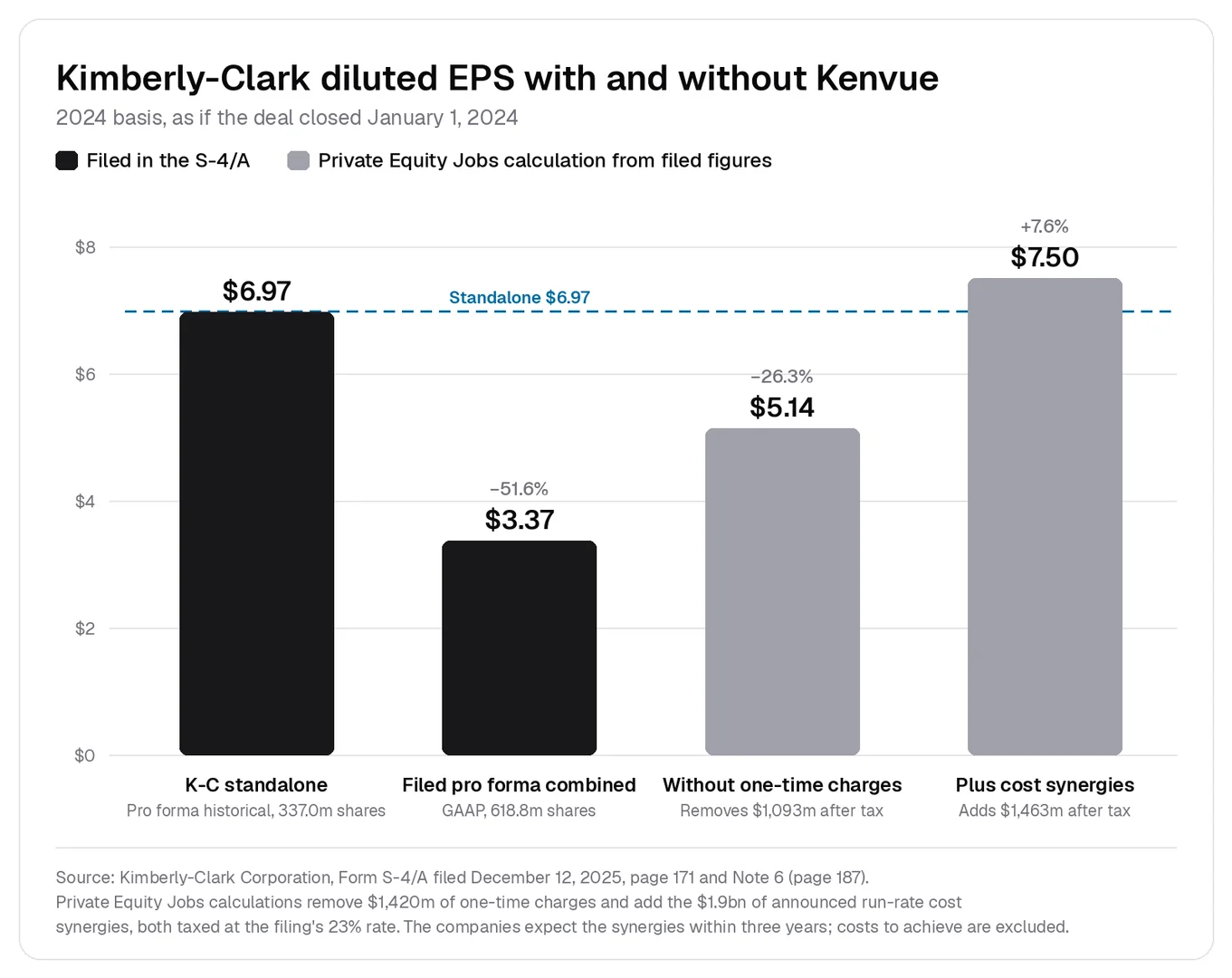
The last row is illustrative. It puts full run-rate cost synergies, which the companies expect to capture over the first three years after closing, into a 2024 base year, and it ignores the $2.5 billion of cash costs to achieve them, about $500 million of expected profit from revenue synergies, about $300 million of planned reinvestment, and growth in both businesses. It shows the mechanics behind the announcement: the deal is dilutive before synergies and becomes accretive on adjusted EPS once most of the cost savings arrive. That matches the company's "By Year 2" headline, which refers to its own adjusted EPS and its own forecasts.
The P/E shortcut: cost of acquisition vs the seller's yield
Bankers check a model's answer with a rule of thumb. Each way of paying has an after-tax cost:
- Stock costs the buyer its earnings yield, the inverse of its P/E ratio. A buyer at 20x earnings gives up 5% of earnings per dollar of stock issued.
- New debt costs the interest rate times one minus the tax rate.
- Cash on hand costs the interest income it would have earned, after tax.
The weighted average of those costs, by the share of the price paid each way, is the buyer's cost of acquisition. The seller's yield is the target's net income divided by the equity purchase price, the inverse of the P/E the buyer is paying. If the seller's yield is higher than the cost of acquisition, the deal is accretive before synergies and purchase accounting. If it is lower, the deal is dilutive.
In the hypothetical above, the seller's yield is $60 million divided by $1.0 billion, or 6.0%. Stock at 20x costs 5.0% and debt costs 4.5%, so every mix is accretive, as the full calculation showed.
Kimberly-Clark's numbers point the other way. At $119.71 and $6.97 of 2024 EPS, K-C traded at about 17.2x, an earnings yield of 5.8%. The new debt cost 4.6% before tax, about 3.5% after tax at the filing's 24.6% rate. Stock was about 83% of the $21.01 per-share price, so the weighted cost, treating all of the cash as new debt, was about 5.4%. At $21.01 against Kenvue's $0.54 of 2024 EPS, K-C paid about 38.9x earnings, a seller's yield of about 2.6%. Both the stock and the cash parts of the price cost more than Kenvue's earnings yield, so the deal had to be dilutive before synergies.
The shortcut has limits. It assumes the two companies have the same tax rate, ignores synergies, purchase accounting, and fees, and assumes a full year of combined earnings. It also uses one year's earnings, and a target with temporarily low profits, like Kenvue in a year with a large impairment, looks more expensive than it is on forward earnings.
Breakeven synergies and sensitivity tables
Breakeven synergies are the pre-tax synergies needed to bring pro forma EPS back to standalone EPS. The calculation runs backward: multiply standalone EPS by pro forma shares to get the net income needed, subtract pro forma net income before synergies, and divide the shortfall by one minus the tax rate.
For Kimberly-Clark, excluding one-time items (a Private Equity Jobs calculation):
- Net income needed: $6.97 times 618.8 million shares equals about $4,313 million.
- Pro forma net income excluding one-time items: about $3,179 million.
- Shortfall: about $1,134 million after tax.
- Pre-tax synergies needed at 23%: about $1,472 million, or about 77% of the $1.9 billion in announced cost synergies.
On the full GAAP figure, including the one-time charges, breakeven would take about $2.9 billion of pre-tax synergies in the first year, which is why companies quote accretion on adjusted EPS.
Models show these results in sensitivity tables, usually built with Excel data tables. A typical page varies two inputs at a time, such as the offer premium against the share of stock in the price, or synergies against the buyer's share price, and shows accretion or dilution in each cell for each forecast year. The tables tell a board how much room the deal has: how much synergy can fall short, or how much more the buyer could pay, before the deal stops being accretive.
Contribution analysis
Contribution analysis compares what each company brings to the combined business with the share of the combined company its shareholders will own. It is most useful in stock deals and mergers of companies of similar size, where the ownership split is the main economic term.
Kimberly-Clark's filing says K-C shareholders will own about 54% of the combined company and Kenvue shareholders about 46%. The 2024 columns of the pro forma statement show K-C contributing about 52% of combined net sales, 60% of operating profit, and 70% of net income (a Private Equity Jobs calculation from page 171). Kenvue's shareholders receive a larger share of the company than Kenvue's share of combined net income, which is the same dilution the EPS calculation shows, viewed through ownership instead. The ownership split also understates what Kenvue holders get, because they receive $3.50 per share in cash on top of the stock.
Fairness opinions turn the same idea into implied exchange ratios. J.P. Morgan, one of K-C's two financial advisers, valued both companies on trading multiples and on discounted cash flows without synergies, and divided Kenvue's value per share, less the $3.50 in cash, by K-C's. The resulting ranges were 0.0711x to 0.1595x on trading multiples and 0.0856x to 0.2156x on discounted cash flows, compared with the agreed exchange ratio of 0.14625.
Why an accretive deal can still destroy value
Accretion measures the change in one year's earnings per share. A deal can raise EPS and still make shareholders poorer, and a dilutive deal can be worth doing.
- Cheap financing makes almost any deal accretive. When after-tax borrowing costs are low, a buyer can borrow to buy a target at a high P/E and still add to EPS, while taking on risk that EPS does not price.
- A high-P/E buyer gets accretion for free. A buyer trading at 30x can buy a company at 20x with stock and report accretion, even if it pays far more than the target is worth to anyone else.
- The market multiple can change. EPS rises, but if investors see the combined company as slower-growing or riskier, the P/E can fall by more than EPS rises.
- Return on the price is left out. A second check divides the target's after-tax operating profit plus after-tax synergies by the enterprise value paid, which gives the return on invested capital, and compares it with the buyer's weighted average cost of capital. A deal can be accretive with a return below that cost.
- Timing and growth are left out. A dilutive deal for a faster-growing target can raise EPS within a few years and raise the value of the company more than an accretive deal for a slow-growing one.
The analysis that tests value directly is a discounted cash flow comparison, often called a has/gets analysis or value creation analysis: what a buyer's shareholder owns now, per share, against what the same shareholder would own after the deal. In Kimberly-Clark's filing, J.P. Morgan added K-C's standalone discounted cash flow value, Kenvue's, and the present value of synergies net of tax-affected transaction costs, subtracted the cash paid to Kenvue holders, and took 54% of the result. It found an increase of about 26.8% in value per K-C share with cost synergies only and about 30.4% with cost and growth synergies. PJT Partners, K-C's other adviser, ran a similar has/gets analysis and found an increase of about 30.4%. The same deal that cut 2024 GAAP EPS by more than half was, on the advisers' cash flow analysis, worth more than a quarter more per K-C share.
Accretion dilution in fairness opinions and board decisions
A fairness opinion is a letter from a bank to a board stating that the price in a deal is fair, from a financial point of view, to the shareholders it covers. It does not opine on accretion. J.P. Morgan's opinion to K-C's board said that "the merger consideration to be paid by K-C in the proposed transaction was fair, from a financial point of view, to K-C," and was limited to that question.
The analyses behind the opinion are summarized in the merger proxy or registration statement, usually in a section titled "Opinion of [the bank]." For a buyer's board they typically include trading comparables, precedent transactions, discounted cash flows, implied exchange ratios, and value creation. EPS accretion often sits in the bank's procedures rather than its printed analyses. PJT Partners, for example, lists among the steps behind its opinion that it "reviewed the potential pro forma financial impact" of the deal on K-C's financial performance, without printing an EPS figure.
For a reader looking for real accretion numbers, three places in public filings are useful:
- The announcement press release and investor presentation, filed as exhibits to a Form 8-K or as Rule 425 communications, which state the company's own adjusted accretion target and synergy figure.
- The unaudited pro forma financial statements in a Form S-4 or merger proxy, which show GAAP pro forma EPS on a historical basis with every adjustment footnoted.
- The fairness opinion summaries, which show how the advisers valued the deal and whether they ran value creation analyses.
Accretion dilution questions in investment banking interviews
Accretion dilution is a standard technical topic in investment banking interviews, especially for mergers and acquisitions (M&A) groups and corporate development roles. Common questions, with short answers:
- Walk me through an accretion dilution analysis. Project both companies' net income, combine them, adjust after tax for foregone interest on cash, interest on new debt, new depreciation and amortization, and synergies, divide by the buyer's shares plus new shares, and compare with the buyer's standalone EPS.
- How can you tell quickly whether an all-stock deal is accretive? Compare P/E ratios. If the buyer's P/E is higher than the P/E it pays for the target, an all-stock deal is accretive before synergies and purchase accounting.
- Is a cash deal or a stock deal more likely to be accretive? Usually cash funded with debt, because the after-tax cost of debt is lower than most companies' earnings yields. The answer reverses for a buyer with a very high P/E or expensive debt.
- Can you compare debt with a P/E? Yes. Debt at 6% before tax with a 25% tax rate costs 4.5% after tax, which is the same cost as issuing stock at about 22x earnings (1 divided by 4.5%). Buying a target at less than about 22x earnings with that debt is accretive before synergies and purchase accounting.
- What is the most a buyer can pay in an all-stock deal without dilution? Before synergies, the target's net income times the buyer's P/E. In the hypothetical above, $60 million times 20 is $1.2 billion, which issues 24 million shares and keeps EPS at $2.50.
- Why might a deal be accretive and still a bad idea? Because EPS ignores overpayment, risk, growth, and changes in the market multiple. Value creation analysis tests value directly.
- Why do companies quote adjusted EPS accretion? Because one-time costs and acquired-intangible amortization can make a deal dilutive on GAAP EPS for years, as the Kimberly-Clark pro forma shows.
Interviewers also use breakeven questions: how much in synergies, or how large a premium, keeps the deal at breakeven. The method is the backward calculation in the breakeven section above. Private equity interviews ask for a paper leveraged buyout instead, and the LBO modeling test replaces the merger model.
How private equity firms think about accretion
A private equity firm buying a company has no earnings per share to accrete. The buyer is a newly formed holding company owned by a fund, and its owners judge the deal by the cash they get back. The deal team models a leveraged buyout and tests the internal rate of return and multiple on invested capital at the price, debt, and exit assumptions in the model. A buyout can be "dilutive" in every year on an EPS view, because of heavy interest expense, and still meet the fund's return target.
Accretion still reaches private equity work in four places:
- Selling to a strategic buyer. When a firm sells a portfolio company to a public company, the buyer's bankers run an accretion dilution analysis. A buyer that can pay with highly valued stock or cheap debt, and that expects large synergies, can pay a price a financial buyer cannot, which is why sell-side bankers running a sale test strategic bidders' capacity to pay.
- Bidding against strategic buyers. In an auction, a sponsor's bid is limited by its return target, while a strategic bidder's is limited by dilution and synergies. Knowing the strategic buyer's breakeven price tells the sponsor how high the competition can go.
- Add-on acquisitions. When a portfolio company buys a smaller business in an add-on acquisition, sponsors talk about deals being accretive to earnings before interest, taxes, depreciation, and amortization (EBITDA) or to the platform's valuation multiple, not to EPS. Buying at a lower multiple than the platform's expected exit multiple raises equity value.
- Public portfolio companies and take-privates. After an initial public offering, a sponsor-backed company is judged on EPS like any other public company. In a take-private, the target's board weighs the cash offer against the standalone plan, not against EPS accretion to the buyer.
For candidates moving from banking to private equity, the shift is from asking whether a deal raises next year's EPS to asking whether the cash returned at exit justifies the equity invested today.
Common questions
How do you calculate accretion dilution?
Divide pro forma EPS by the buyer's standalone EPS and subtract one. Pro forma EPS is the combined net income after all deal adjustments, divided by the buyer's diluted shares plus any new shares issued. A positive result is accretion and a negative result is dilution.
What is the formula for calculating accretion?
Accretion (or dilution) equals pro forma EPS divided by standalone EPS, minus one. Pro forma EPS equals (buyer net income plus target net income, minus after-tax interest on new debt and foregone interest on cash, minus after-tax new amortization and depreciation, plus after-tax synergies) divided by (buyer diluted shares plus new shares issued).
How can you tell if a deal is accretive or dilutive?
Run the full calculation, or use the shortcut: compare the seller's yield, the target's net income divided by the equity purchase price, with the buyer's weighted after-tax cost of the cash, debt, and stock used. A seller's yield above the cost of acquisition points to accretion before synergies and purchase accounting.
What is the difference between accretion and dilution?
Accretion means the deal raises the buyer's EPS. Dilution means it lowers EPS. In a related sense, dilution also refers to new shares reducing each existing shareholder's ownership percentage, which can happen even in a deal that is accretive to EPS. Outside M&A, accretion also describes the rise in a bond's carrying value toward face value when it was bought below par. Accrual is a different term: recording revenue or expenses when they are earned or incurred rather than when cash changes hands.
What is the difference between a merger and an acquisition?
In an acquisition, one company buys another, and the target becomes part of the buyer or one of its subsidiaries. In a merger, two companies combine, and the shareholders of both often own the combined company. Accounting rules still name one side the acquirer. Kimberly-Clark and Kenvue is structured as two mergers that make Kenvue part of K-C, with K-C as the accounting acquirer, so the accretion test is run on K-C's EPS.
What are the four types of M&A?
Deals are commonly grouped by the relationship between the companies: horizontal (two companies in the same business), vertical (a company and a supplier or customer), concentric or congeneric (related businesses that share customers or technology), and conglomerate (unrelated businesses). The type affects accretion mainly through synergies, which are usually largest in horizontal deals.
Can a private company run an accretion dilution analysis?
A private buyer can calculate EPS, but its owners rarely judge deals on it. Private companies and their owners usually look at the effect on EBITDA, cash flow, leverage, and equity value instead.
Sources
- Kimberly-Clark Corporation, Amendment No. 1 to Registration Statement on Form S-4 (Form S-4/A), Registration No. 333-291928, filed December 12, 2025: risk factors (page 28), Opinion of J.P. Morgan (beginning on page 80), Opinion of PJT Partners (beginning on page 88), business combination accounting (page 168), unaudited pro forma condensed combined statement of income for 2024 (page 171) and Notes 3 to 6 (pages 177 to 187).
- Kimberly-Clark Corporation, press release filed as Exhibit 99.1 to Form 8-K, November 3, 2025, announcing the agreement to acquire Kenvue.
Related posts
Related posts

Precedent transaction analysis values a company from the multiples buyers paid for similar companies. Screening, data sources, multiples, the control premium, and two banks' filed tables from the Walgreens take-private.
A pitch book is the presentation an investment bank uses to win a mandate. Types, the pages in order, the valuation pages, who builds each part, and real bank decks filed with the SEC.

Corporate finance runs a company's own money; investment banks advise companies on deals for a fee. The jobs inside each, 2026 posted pay, recruiting, hours, and how people move between them.