

Corporate finance is the finance department inside a company. Its staff build the budget, close the books each month, manage cash and borrowing, and, at larger companies, look for acquisitions. Investment banking is a business that sells advice to those companies. When a company wants to buy a rival, sell a division, or raise money by issuing stock or bonds, its chief financial officer hires an investment bank to run the transaction, and the bank earns most of its fee when the deal closes. The two careers meet on every large deal, but one works for a single employer all year and the other works for a changing list of clients. The name causes confusion, because some investment banks and the large accounting firms also call their deal advisory businesses "corporate finance."
Citi hires for both, which allows a same-employer comparison. In September 2026 it posted an annual salary of $130,000 for its 2027 Financial Management Associate program, a two-year rotation through controllers, treasury, and financial planning for master of business administration (MBA) and other master's graduates. In October it posted a base range of $175,000 to $225,000 for an investment banking associate in New York. Banking pays a higher base at most levels and adds a larger bonus. Corporate finance hires from more backgrounds and keeps a schedule closer to 40 hours, and its senior seats run through controllership and planning to chief financial officer. Movement between the two runs mostly one way: bankers move into company finance far more often than company finance staff move into banking.
What corporate finance and investment banking are
Inside a company, corporate finance covers several separate jobs. Financial planning and analysis (FP&A) builds the budget and forecast and explains results to business leaders. The controller's group runs accounting and financial reporting. Treasury manages cash, debt, foreign exchange exposure, and the company's relationships with its banks. Corporate development is the in-house team that finds and executes acquisitions, divestitures, and minority investments. The Bureau of Labor Statistics (BLS) groups the senior versions of these jobs under financial managers: controllers who "direct the preparation of financial reports," treasurers and finance officers who manage budgets and "plans to raise capital, such as issuing stocks or bonds," and cash managers who "monitor and control the flow of money."
An investment bank works for many companies at once. Its advisory groups handle mergers, acquisitions, and sales of businesses. Its capital markets groups underwrite new stock and bond issues and sell them to investors. Citi's October 2026 posting for full-time investment banking analysts in New York describes the junior job as preparing "valuation materials and statistical exhibits for pitches and live deals" and building "complex financial models for valuation purposes." The bank's clients are corporate finance executives: the chief financial officer, the treasurer, and the head of corporate development decide when to hire bankers and which bank gets the mandate.
When advisers call it corporate finance
In a company, investment banking is not corporate finance. Investment banking is a service the corporate finance team buys. In the deal industry, the words overlap. The investment bank Houlihan Lokey reports its mergers and acquisitions and capital-raising business as a segment named Corporate Finance. Its 10-K for the year ended March 2026 lists 251 managing directors and 644 closed transactions in that segment. Accounting firms do the same with their broker-dealer subsidiaries. When a job title says "corporate finance," the employer tells you which job it is: a company's finance team, or an adviser that runs deals for companies. Many of those advisers are middle-market investment banks.
Corporate banking is a third, separate job. A corporate banker works at a bank and manages a company's loans, credit lines, and cash management products. The treasurer inside the company is that banker's main counterpart.
Key differences at a glance
| Factor | Corporate finance (in a company) | Investment banking |
|---|---|---|
| Employer | The company whose money is being managed | A bank or advisory firm serving many companies |
| Who the work is for | Business leaders, the chief financial officer, the board | Outside clients: companies, private equity firms, governments |
| Unit of work | The monthly close, quarterly results, the annual budget | A transaction, from pitch to closing |
| Junior output | Budget and forecast models, variance reports, account reconciliations, cash forecasts | Valuation models, pitch books, offering and sale documents |
| What juniors are judged on | Accuracy, reliability, and how well they explain the numbers to managers | Accuracy, speed, and deal execution under deadlines |
| Entry routes | Many: graduate programs, analyst roles, transfers from audit and accounting | Narrow: summer internships about a year before the full-time start |
| Licenses | None for most seats; a certified public accountant license for PayPal's controller roles | Series 79 and 63 licenses for Citi's analysts |
| 2026 posted junior base | $43,888 to $93,574 (CVS FP&A analyst); $73,650 to $100,050 (Boeing associate financial analyst) | $80,000 to $115,000 (Citi 2027 analyst class, New York) |
| Hours | About 40 a week, more at month-end and budget season | JPMorgan caps juniors at 80 a week "in most cases", live deals exempt |
| Common next move | Senior FP&A, controller, treasurer, chief financial officer | Private equity, corporate development, senior corporate finance, or promotion in banking |
The jobs inside corporate finance
Financial planning and analysis
Financial planning and analysis is the largest entry point and the seat most bankers mean when they say "corporate finance." Analysts build the annual budget with business units, update the forecast each month or quarter, and explain why actual results differ from the plan. The work depends on the company's business. A CVS Health FP&A analyst posting in Northbrook, Illinois, from October 2026 centers on entering manufacturer contracts into a database and reviewing them; it asks for a year of work experience, lists "Anticipated Weekly Hours 40," and gives a pay range of $43,888 to $93,574. Boeing's October 2026 posting for financial analysts on its Next Generation Air Dominance programs in Hazelwood, Missouri, covers program budgets and material cost analysis, requires an active Secret security clearance and a year of experience in finance, accounting, or a related role, and lists three levels: $73,650 to $100,050 for associate, $90,950 to $123,050 for experienced, and $114,750 to $155,250 for senior. Further up, Target posted $73,000 to $132,000 for a senior financial analyst, Adobe $131,700 to $256,500 for an FP&A manager, and Mastercard $163,000 to $269,000 for a director of FP&A.
Controllership and accounting
The controller's group closes the books each month, prepares financial statements, applies accounting standards, and works with outside auditors. Salesforce's October 2026 posting for a revenue accounting manager in Seattle describes general ledger work, the "proper application of US GAAP," compliance with the Sarbanes-Oxley Act, and quarterly reviews with external auditors, at $117,400 to $177,600. PayPal posted $152,500 to $226,600 for a director in its bank controller group and $250,000 to $360,000 for a vice president, controller in New York. Both PayPal controller postings require an active certified public accountant license, and the vice president posting asks for 12 or more years of experience, including significant time in public accounting. The track usually draws people from audit and public accounting, and it is the seat bankers move into least often, because banking does not teach accounting operations.
Treasury
Treasury handles the company's cash, debt, and financial risk. PayPal's September 2026 posting for a senior treasury analyst in Omaha lists daily cash management and forecasting, monitoring foreign exchange exposure, and executing "daily FX trades including derivatives hedging with bank counterparties," and asks for at least three years of relevant experience, at $94,000 to $134,750. Mastercard posted $137,000 to $218,000 for a corporate treasury manager in New York focused on foreign exchange, and Workday $166,700 to $250,100 for a senior treasury manager. Treasury is the corporate seat that deals most with banks, including the corporate bankers who lend to the company and the capital markets bankers who sell its bonds.
Corporate development
Corporate development is the company's own mergers and acquisitions (M&A) team. It screens targets, builds deal models, runs due diligence, hires outside bankers on large transactions, and plans integration. Mastercard's October 2026 posting for a manager in Purchase, New York, describes "a small and highly visible team" and says "Prior M&A, Investment Banking, Corporate Development or Transaction Advisory experience required," at $137,000 to $218,000. PayPal's senior analyst posting in New York, at $109,000 to $156,200, says the role "is for someone who has built a strong foundation in investment banking and wants to move from advising on transactions to owning them." Salesforce posted $99,400 to $150,300 for a senior analyst, or $118,900 to $163,500 in parts of the San Francisco and New York areas, and prefers at least a year in corporate M&A, banking, private equity, consulting, or strategic finance. 3M posted $124,127 to $151,710, including variable incentive, for an analyst with two years of combined M&A, finance, or consulting experience. Corporate development is the corporate seat closest to banking, and its teams are small. Adam Porter-Price, who runs corporate development at the defense company Anduril, wrote on X in September 2026 that "There isn't really a good entry-level version of the job. Most Corp Dev teams are tiny," and that Anduril does not take corporate development interns.
Rotational programs and other seats
Large companies and banks run finance leadership programs that rotate new hires through several of these seats before placing them. Citi's Financial Management Associate program lasts 24 months in three eight-month rotations across controllers, treasury, FP&A, tax, and business-aligned finance offices. Target's Finance Leadership Development Program is a "3-year accelerated curriculum"; its 2027 posting for a senior FP&A manager in the program lists $95,000 to $171,000. Investor relations, tax, and internal audit also sit inside the finance function, and at smaller companies one person may cover FP&A, corporate development, and investor relations together.
Corporate finance at an accounting firm
"Big 4 corporate finance" refers to the deal advisory businesses of the large accounting firms. Deloitte Corporate Finance LLC is a broker-dealer registered with the Securities and Exchange Commission (SEC) and a member of the Financial Industry Regulatory Authority (FINRA). Its FINRA BrokerCheck report describes the business as advising "institutional clients on mergers, acquisitions, and capital raising activities, along with fairness opinions." Deloitte's careers page calls it a business with "the client service and middle-market focus of a boutique investment bank" and hires investment banking analysts and associates who must obtain their FINRA licenses within 60 days of starting. KPMG Corporate Finance LLC's 2025 filing with the SEC says its "primary business is providing investment banking and infrastructure advisory services."
These seats are investment banking jobs with an accounting firm's name on the door. They sell companies for owners and raise capital, mostly in the middle market. They are different from the same firms' transaction services or valuation groups, which perform financial due diligence and valuations for buyers and do not run sale processes.
The work and the skills
Both jobs live in spreadsheets and presentations, but the models answer different questions. An FP&A model asks how much the company will earn next quarter and where costs are running over plan. A treasury model forecasts cash and tests how much debt the company can carry. A controllership team asks whether the numbers are right under accounting rules. An investment banking model asks what a business is worth to a buyer and how a merger or financing changes the buyer's earnings and balance sheet.
The rhythm differs too. Corporate finance runs on a calendar the company sets: the month-end close, quarterly earnings, the annual budget, and board meetings. Investment banking runs on a calendar the client and the counterparty set, and a junior banker works on several deals and pitches at once. Corporate finance staff present to managers who know the business. Bankers present to clients and buyers who are judging the bank as well as the analysis.
The skills that transfer from banking into a company are valuation, deal modeling, process management, and presentation. The skills that do not transfer are accounting operations, budgeting with business units, and knowledge of one company's systems and data. That is why former bankers cluster in corporate development and strategic finance and rarely land in the controller's group.
Recruiting and interviews
Investment banking hires most of its analysts through summer internships. Citi's posting for the full-time analyst class starting in 2027 went up in October 2026, and its 2027 summer associate posting went up the same month. Students at schools where banks recruit apply early in college, and the recruiting timeline runs ahead of most other industries. Students at non-target schools rely more on networking and smaller banks. Interviews test accounting, valuation, and merger mechanics, plus an account of why the candidate wants banking.
Corporate finance hires through more doors. Large companies run analyst and leadership programs for graduates. Many FP&A and accounting jobs ask for one to three years of experience, which audit and accounting firms supply. Interviews lean toward accounting, including journal entries and reconciliations, Excel, and how the candidate would explain a variance to a manager, rather than valuation technicals. Hiring is spread across thousands of employers, so there is no single industry calendar.
Corporate development is the exception. The corporate development postings at PayPal, 3M, Mastercard, and Salesforce all ask for experience, and most name investment banking. PayPal's senior analyst posting requires three years and prefers two to four in banking or a similar role, 3M requires two years for an analyst and five for a manager, Mastercard requires prior M&A, banking, corporate development, or transaction advisory work, and Salesforce prefers at least a year. Graduates who want company-side M&A work usually start in banking, transaction advisory, or a company's FP&A team and move over later.
A grade point average (GPA) carries more weight in banking than in corporate finance because banks fill analyst classes from internship applications screened early in college. Banks do not publish cutoffs.
Pay
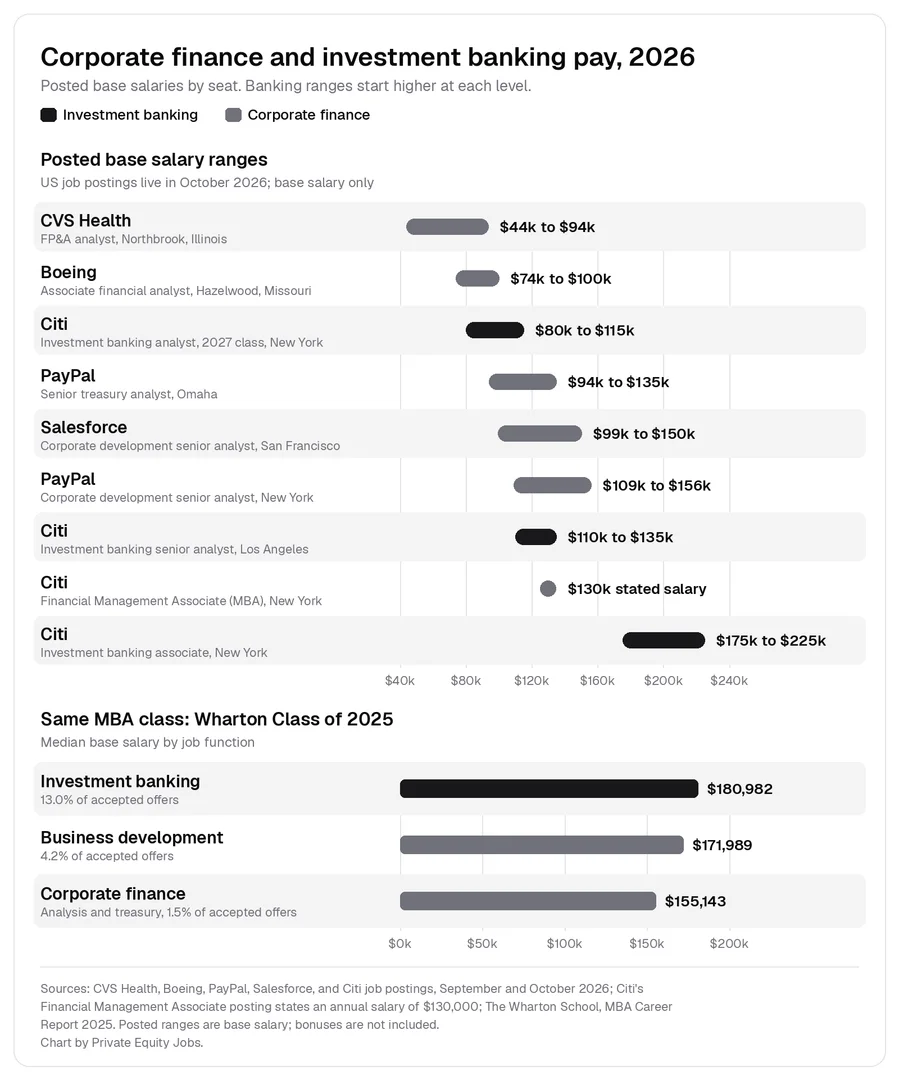
Posted base salaries show the gap at each level. CVS's FP&A analyst range starts at $43,888, and Boeing's associate financial analyst range tops out at $100,050. Citi's 2027 investment banking analyst range is $80,000 to $115,000 and its senior analyst range in Los Angeles is $110,000 to $135,000. Corporate development, the best-paid junior corporate seat, posts senior analyst ranges of $99,400 to $150,300 at Salesforce, up to $163,500 in its highest-cost areas, and $109,000 to $156,200 at PayPal, close to banking base pay for people with a few years of experience.
The bonus widens the gap. Prospect Rock Partners' 2025 investment banking compensation report, based on 866 responses collected in early 2026, puts first-year analyst total compensation at $160,000 and first-year associate total compensation at $280,000 at bulge bracket banks and $400,000 at elite boutiques. Corporate finance postings mostly describe bonuses only as "eligible," and 3M's corporate development ranges include the variable incentive in the posted figure. Banking salary by level rises faster because the bonus grows with title.
Government data put corporate finance pay in a wider frame. The BLS reported a May 2025 median of $102,740 for financial and investment analysts, a group that includes company FP&A analysts as well as analysts at banks and funds; in the management of companies and enterprises the median was $101,760, and in securities and financial investment firms it was $124,370. The median for financial managers, which covers controllers, treasurers, and finance directors, was $166,570, with the top 10 percent above $323,270. The BLS projects financial manager jobs to grow 10 percent from 2025 to 2035.
MBA graduates show the same order. In the Wharton School's Class of 2025, graduates who took corporate finance jobs (the school's category covers analysis and treasury) reported a median base of $155,143, against $180,982 for investment banking and $171,989 for business development. Only 1.5 percent of the class accepted corporate finance jobs, against 13.0 percent for investment banking. The school's Class of 2026 summer interns showed a wider gap: a median of $8,666 a month in corporate finance and $14,583 in investment banking.
At the top, the gap narrows for those who reach senior corporate seats. PayPal's vice president, controller range of $250,000 to $360,000 and Mastercard's vice president of M&A range of $230,000 to $368,000 ($240,000 to $384,000 in New York City) are base salary ranges, before any bonus or equity. A banking director at Citi in San Francisco posted a base of $200,000 to $300,000, with the bonus on top.
Hours and lifestyle
Corporate finance postings state hours more often than banking postings do. CVS lists 40 anticipated weekly hours for its FP&A analyst. The BLS says most financial analysts and financial managers work full time and "some work more than 40 hours per week." Peaks come at predictable times: the close at month-end, quarterly earnings, budget season, and, in corporate development, live acquisitions.
Banking hours depend on the deal flow and the client. In 2024 JPMorgan capped junior bankers' hours at 80 a week "in most cases," with live deals exempt, according to Fortune. Hours at each level change with seniority but stay tied to clients.
Corporate finance usually leaves evenings and weekends free and lets people plan their year around a known calendar, while banking puts more deal experience and more pay into the first years of a career at the cost of that predictability.
Career path and promotion
In corporate finance, titles usually run from analyst to senior analyst, manager, senior manager or director, and vice president of finance, with controller, treasurer, and chief financial officer at the top. The BLS says financial managers typically need a bachelor's degree and at least five years in another business or financial job, such as accountant or financial analyst, and that experienced financial managers "may advance to become chief financial officers." Promotion depends on openings above, so it is slower than in banking and varies by company.
In investment banking, the ladder is analyst, associate, vice president, director, and managing director, and promotion is tied to years and performance. Analysts are promoted to associate or leave after a few years, and the investment banking associate class also takes MBA hires. Senior bankers are judged on the fees they bring in, which is why senior pay swings with the deal market.
Moving between the two
From investment banking to corporate finance
This is the common direction and one of the main exit opportunities from banking. Bankers leave after the analyst years or the associate years and usually land in corporate development, strategic finance, or senior FP&A. The postings show the entry points. PayPal's senior analyst in corporate development prefers two to four years in investment banking or a similar role. Salesforce prefers at least one year. Mastercard's manager seat requires prior M&A, banking, corporate development, or transaction advisory experience, and 3M's manager seat requires five years of M&A experience in corporate development or banking. The posted pay ranges for those seats run from $99,400 at the low end of Salesforce's senior analyst range to $230,084 at the top of 3M's manager range, so a former analyst usually takes a lower total package than in banking and a shorter week.
Bankers who move into FP&A often enter a level above where they would start out of college, at senior analyst or manager, because their modeling and presentation work counts as experience. They still have to learn budgeting with business units and the company's accounting.
From corporate finance to investment banking
The reverse move is harder, mainly because banks hire analysts from internships and want associates with deal experience. Three routes work. The first is an MBA. Banks recruit associates from business schools, and 13.0 percent of Wharton's Class of 2025 went into investment banking, so an FP&A or treasury analyst can switch through a summer associate internship; Citi's 2027 summer associate posting in New York lists a full-time salary range of $150,000 to $180,000. The second is corporate development: a few years of company-side M&A experience can support a lateral move to a bank's coverage group, and Deloitte's careers page, for example, says its corporate finance associates need prior investment banking or M&A execution experience. The third is a lateral analyst move early in a career, usually to a smaller bank that recruits off-cycle.
A treasury analyst who works with capital markets bankers, or an FP&A analyst who has supported an acquisition, has a better story than one who has only run budgets. Accounting experience alone rarely gets an interview.
Which one to choose
Choose investment banking if you want the fastest exposure to mergers and financings, the highest early pay, and the widest set of later options, including private equity, and you can accept weeks of up to 80 hours for several years. Apply early, because the internship route dominates hiring.
Choose corporate finance if you want regular hours, a career inside one industry, and a path toward controller, treasurer, or chief financial officer, and you are comfortable with lower early pay. Pick the seat deliberately: FP&A for business partnering, controllership for accounting depth, treasury for capital markets and risk, and corporate development if you can get there from a deal background.
If you are unsure, banking keeps more doors open in the first few years, because moving from banking into corporate finance is common and the reverse usually requires an MBA.
Common questions
Which is better, corporate finance or investment banking?
Neither is better for everyone. Investment banking pays more, with Citi posting $175,000 to $225,000 base for an associate against $130,000 for its corporate finance MBA program, and builds deal skills faster. Corporate finance offers hours near 40 a week, more entry routes, and a path to chief financial officer.
Is investment banking considered corporate finance?
Not inside a company, where investment banking is an outside service the finance team buys. Some advisers use the name for their deal business: Houlihan Lokey reports its M&A and capital-raising segment as Corporate Finance, and Deloitte and KPMG run investment banking broker-dealers called Corporate Finance LLC.
What is big 4 corporate finance?
It is the investment banking arm of an accounting firm, such as Deloitte Corporate Finance LLC or KPMG Corporate Finance LLC. These firms are FINRA-registered broker-dealers that advise on mergers, acquisitions, and capital raising, mostly for middle-market companies.
Is M&A corporate finance?
Mergers and acquisitions work happens on both sides. In a company, the M&A team is corporate development, part of corporate finance. At a bank, M&A is an advisory group within investment banking.
Does investment banking pay more than corporate finance?
Yes, at most levels once the bonus is counted. Wharton's Class of 2025 reported a median base of $180,982 in investment banking and $155,143 in corporate finance, and banking adds a larger bonus; Prospect Rock's survey puts first-year analyst total pay at $160,000.
Can you move from corporate finance to investment banking?
Yes, most often through an MBA and a summer associate internship, through corporate development experience, or through an early lateral move to a smaller bank. The move from banking into corporate finance is far more common.
Is a 3.5 GPA bad for investment banking?
Banks do not publish GPA cutoffs. Grades are one screen among several, alongside school, internships, and networking, and they matter more for undergraduate internship applications than for lateral or MBA hiring.
Sources
- Citi, Functions, Finance, Full Time Associate, New York 2027, Financial Management Associate program (job 26996818, posted 29 September 2026); Investment Banking LATAM Full-Time Analyst, New York 2027 (job 261001253, posted 13 October 2026); Investment Banking Senior Analyst, Metals & Mining (job 26999512); Investment Banking Associate, Power (job 26996739); Investment Banking Summer Associate 2027 (job 26998318); Investment Banking Director, Technology (job 26995246).
- Company postings, September and October 2026: CVS Health, Analyst, FP&A; Boeing, Financial Analyst; Target, Sr Financial Analyst; Target, Senior FP&A Manager, FLDP; Adobe, Mgr, FP&A; Mastercard, Director, FP&A; PayPal, Sr Analyst, Treasury; Mastercard, Manager, Corporate Treasury; Workday, Senior Treasury Manager; Salesforce, Manager, Accounting; PayPal, Director, Bank Controller; PayPal, VP, Controller; Salesforce, Corporate Development M&A Senior Analyst; PayPal, Sr Analyst, Corporate Development; 3M, Corporate Development Analyst; 3M, Corporate Development Manager; Mastercard, Manager, Corporate Development; Mastercard, Vice President, Mergers and Acquisitions.
- US Bureau of Labor Statistics, Occupational Outlook Handbook: Financial Managers and Financial Analysts, May 2025 wage data, pages modified 27 August 2026.
- Wharton MBA Career Report 2025, published February 2026.
- Prospect Rock Partners, 2025 IB Compensation Report, 14 March 2026.
- Houlihan Lokey, Inc., Form 10-K for the fiscal year ended 31 March 2026.
- FINRA BrokerCheck, Deloitte Corporate Finance LLC; Deloitte, Corporate Finance Investment Banking Analyst careers page.
- KPMG Corporate Finance LLC, Statement of Financial Condition, 30 September 2025.
- Fortune, JPMorgan just capped junior bankers' hours at 80 per week, 12 September 2024.
- Adam Porter-Price on X, 4 September 2026.
Related posts
Related posts

Investment banks are paid per deal; asset managers are paid a percentage of the money they run. How the jobs, recruiting, pay, hours, and career paths compare, with 2026 postings, MBA reports, and 10-K filings.

What an investment banking associate does, how the job differs from analyst and vice president, posted 2026 pay at five banks, the MBA and lateral routes in, licenses, and interviews.

How students and career changers get into investment banking: the five routes in, the dated 2028 recruiting calendar, what banks screen for, networking, interviews, and the SIE exam.