

An investment banking associate is the second rung of the banking ladder, above the analyst and below the vice president. Associates still build and check financial models and client presentations, but most of the job is running that work. They take a vice president's instructions, split the work among analysts, check every page and number before it reaches a client, and handle more of the day-to-day contact with clients, lawyers, and accountants on a live deal. Citi's June 2026 New York Industrials posting describes the job as "an intermediate level position," and its list of duties includes managing and mentoring analysts "by providing detailed guidance and feedback."
People reach the role three ways. Analysts get promoted after two to three years, business school graduates join after a summer associate internship, and experienced hires move over from other banks, accounting firms, or corporate finance jobs. In New York, the 2026 associate postings from Mizuho, Citi, RBC Capital Markets, and TD Securities all list a base salary of $175,000 to $225,000, and Goldman Sachs posts $150,000 to $225,000. A year-end bonus comes on top of that.
What an investment banking associate does
Associates work on the same deals as analysts, mainly mergers and acquisitions (M&A) advisory, stock and bond offerings, and restructurings. The difference is responsibility. An analyst produces a model or a set of slides. The associate decides what the analysis needs to show, checks that it is right, and answers for it when a vice president or client asks a question.
Bank postings describe the job in similar terms. Mizuho's Greenhill M&A team in New York, in a June 2026 associate posting, lists the "design, origination, structuring and execution" of M&A deals, with duties that include company research, pitch books, discounted cash flow (DCF) analysis, comparable company and precedent transaction analysis, leveraged buyout (LBO) and merger models, due diligence, and client relationships. TD Securities' October 2026 Software associate posting sums the job up as "financial analysis and modeling, managing a team, preparing client presentations and interacting with senior bankers and clients." Both of TD's October associate postings add internal underwriting memos, help with client negotiations and documentation, and working with junior colleagues "to ensure accuracy."
In practice the work falls into five areas:
- Checking and editing. Associates review analyst models, valuation outputs, and presentation pages for errors and logic before anything goes to a vice president or a client. This is the part of the job most people mean when they say associates spend less time building and more time reviewing.
- Running workstreams on live deals. On a sell-side M&A process, an associate typically owns pieces such as the confidential information memorandum, the management presentation, the buyer list, the data room, and diligence requests. Citi's September 2026 senior associate posting describes "independently owning assigned analytical workstreams and coordinating directly with clients and external advisors, including legal, accounting, and financing counterparts."
- Pitching. Associates draft the story for pitch books and decide which analyses go in. RBC's August 2026 Industrials associate posting asks associates to work with other groups to "evaluate and originate new business ideas/opportunities."
- Managing analysts. Associates assign tasks, set deadlines, and explain what the senior bankers want. When an analyst's output is wrong, the associate usually catches it and fixes the process that produced it.
- Client and advisor contact. Associates join more calls than analysts do, field routine questions from clients, and coordinate with lawyers, accountants, and financing banks. Goldman Sachs' Industrials associate posting says associates "coordinate teams of tax advisors, attorneys, and bankers," "lead due diligence processes," and take part in negotiating legal documents.
The mix depends on the size of the bank and the deal team. At bulge bracket banks and large elite boutique and middle-market banks, associates sit between analysts and a vice president. At small firms the layers are thinner. Objective Investment Banking & Valuation, a San Diego advisory firm, says in its M&A associate posting that it staffs deals "with smaller teams," that the associate reports directly to the managing director, and that the job includes writing "significant portions" of confidential information memorandums and pitches as well as reviewing analysts' models. It lists a base of $100,000 to $140,000 with a quarterly bonus, well below the New York ranges at large banks.
Associate versus analyst and vice president
The three junior and middle titles work on the same deals, but each one is judged on something different.
| Analyst | Associate | Vice president | |
|---|---|---|---|
| Main job | Build models, comparables, and presentation pages | Check and direct the analysts' work; own deliverables | Run deals day to day; manage the client relationship below the managing director |
| Who they manage | No one | Analysts | Associates and analysts |
| Judged on | Accuracy, speed, and reliability | Quality of everything the team sends out; managing people | Deal execution, client trust, and early origination |
| Client contact | Little | Regular on routine matters | Constant |
Pay steps up at each title. Associate postings in New York in 2026 list a base of $175,000 to $225,000 at Mizuho, Citi, RBC, and TD, and $150,000 to $225,000 at Goldman Sachs. Mizuho's July 2026 M&A vice president posting lists $250,000 to $275,000, and a Goldman Sachs Industrials vice president posting read on 26 October 2026 lists $250,000 to $300,000 and asks for experience "leading deal teams of analysts and associates." Above the vice president, the investment banking career path runs through director and managing director. The buy-side job with the same title, the private equity associate, is an investing role at a fund rather than an advisory one.
First-, second-, and third-year associates
Banks usually split the title into three years, and pay surveys report first-, second-, and third-year associates separately. The job changes over that time. A first-year associate who came from business school is still learning to model at banking speed and often leans on second- and third-year analysts for the mechanics. A promoted analyst starts the title already knowing the mechanics, so the adjustment is to stop doing every task personally and start reviewing.
By the second year, associates usually run workstreams without close supervision and may manage analysts across more than one deal. Third-year associates often do parts of a vice president's job, such as running a smaller deal day to day or leading drafting sessions, while they wait for the promotion. Some banks give that stage its own title. Citi's September 2026 New York opening for an "Investment Banking Sr Associate" lists a base of $200,000 to $225,000, above the $175,000 floor on its associate postings.
Pay rises with each year. Prospect Rock Partners, a financial recruiting firm, published survey data on 14 March 2026 from 866 responses collected in the first quarter of 2026 across 17 title levels and eight bank types. Its total compensation figures for 2025 put a third-year associate at a middle-market bank at $410,000, against $340,000 in the second year, and a third-year associate at a bulge bracket bank at $450,000.
How people become associates
There are three main routes into the associate title, and each brings a different starting point.
Promotion from analyst. This is the most common route at many banks, and it has been getting faster. Citi cut its analyst program from three years to two, according to a Fortune report on 7 October 2026, and said its current third-year analysts would be promoted to associate on January 1 if they meet performance standards. JPMorgan made analysts eligible for promotion to associate after two and a half years instead of three, Fortune reported on 9 June 2025. Both moves came as banks competed with private equity firms for their junior bankers.
A master of business administration (MBA) degree. Banks hire MBA students for a summer associate internship between the first and second years of the program and make full-time associate offers to the interns who do well. This route is the main one for career changers, including people from consulting, the military, law, and corporate jobs.
Lateral hiring. Banks fill associate seats with people who have already done similar work elsewhere. Lincoln International, which describes itself as an independent investment banking advisory firm focused on private capital markets, said in its May 2026 initial public offering prospectus that it has hired about 335 analysts and associates through campus recruiting since 2019 and that it also recruits laterally "from other investment banking advisory firms, professional services firms and accounting firms." Bank postings name the backgrounds they accept. RBC asks for experience in investment banking, private equity, or corporate finance, and TD's Software posting accepts investment banking, investing, or corporate development.
What associate job postings ask for
Bank postings for experienced associates state minimum experience, degrees, and licenses. The table below shows the requirements in New York associate postings read on 26 October 2026.
| Bank and posting | Experience asked for | Education | Licenses |
|---|---|---|---|
| Mizuho (Greenhill), M&A associate, posted June 2026 | At least 3 years of investment banking, corporate finance, and M&A experience at a top-tier bank, or post-MBA investment banking experience at a top-tier bank | Bachelor's degree, or MBA concentrating in finance | Series 79 and 63 |
| RBC Capital Markets, Industrials associate, posted August 2026 | At least 3 years, including investment banking, private equity, or corporate finance | Bachelor's degree and an MBA, master of arts, or master of science | Series 79 and 63 |
| Citi, Industrials associate, posted June 2026 | 5 to 8 years of relevant experience recommended | Bachelor's degree or equivalent experience; MBA recommended | Series 79 and 63 |
| Citi, Communications associate, posted September 2026 | 5 to 8 years of relevant experience required | Bachelor's degree in finance, business administration, or a related field; MBA a plus | Series 79 and 63, current or able to obtain |
| Citi, senior associate, posted September 2026 | 3 years in the job or a related financial role, including M&A analysis, LBO and merger models, and valuation | Bachelor's degree in finance, economics, business, or a related field | Not listed |
| TD Securities, Software associate, posted October 2026 | 2 or more years in investment banking, investing, corporate development, or related roles | Bachelor's degree from a leading university | Series 79 and 63 within four months of hire |
| TD Securities, Power and Utilities associate, posted October 2026 | 3 or more years, including prior investment banking | Undergraduate degree in business (accounting or finance), math, or economics | Series 7, 79, and 63 |
| Goldman Sachs, Industrials associate | At least 3 years of investment banking or equivalent experience | Not listed | Not listed |
Three patterns stand out. First, the usual minimum for a lateral associate is about three years of deal experience, which matches the length of a traditional analyst program, and TD accepts two. Second, an MBA is an alternative to experience at some banks and a requirement at others; RBC's posting asks for a graduate degree in addition to three years. Third, most of these postings expect the Series 79 and Series 63 licenses, and RBC lists "registration status" among the factors that set an offer's salary. Postings also ask for sector knowledge. TD's software posting prefers prior software coverage, and Goldman's Industrials posting prefers Industrials experience.
Private Equity Jobs lists open roles at private equity firms and investment banks.
The MBA route and the summer associate internship
The summer associate internship is the MBA version of the undergraduate summer analyst program, and the summer works as an extended interview for a full-time associate offer. Banks posted their 2027 summer associate roles between August and October 2026, during students' first year of the MBA.
Postings for the summer of 2027 show the terms:
- Wells Fargo runs a 10-week Investment Banking Summer Associate Program for MBA students between their first and second year, with expected graduation between December 2027 and June 2028. Its August 2026 posting asks for at least two years of investment banking program experience "or equivalent, demonstrated through work, military service, training, or education," and lists pay of $175,000 a year in New York and Charlotte, with a few positions in Houston, Chicago, and Washington, D.C.
- RBC Capital Markets describes its 10-week New York program, posted August 2026, as a chance to "experience the role of a full-time Associate," with placements across industry and product groups. It lists $175,000 annualized.
- JPMorgan runs a nine-week Investment Banking Associate Program in its coverage, advisory, and capital markets groups. It begins with a full week of classroom training, and interns who perform well "may receive an offer of continued employment with the firm at the end of the program."
- Houlihan Lokey lists the same $175,000 for its 2027 Real Estate, Lodging and Leisure summer associate in New York, for MBA students graduating between December 2027 and June 2028.
Summer associates work on live deals alongside full-time associates. RBC's posting lists financial models, client presentations, and client meetings among the tasks and pairs each intern with a mentor, typically a full-time associate or vice president. Houlihan Lokey's lists confidential information memorandums, management presentations, and direct client contact.
Business school employment reports show how many graduates take this path and what they are paid when they start.
| School and class | Share of graduates in investment banking | Median base salary | Signing bonus |
|---|---|---|---|
| Harvard Business School, Class of 2025 | 6% | $175,000 (also the 25th and 75th percentile) | Median $50,000; 90% received one |
| The Wharton School, Class of 2025 | 14.2% of accepted offers (investment banking and brokerage) | $175,000 (75th percentile $185,000) | Median $50,000; 74% received one |
| Columbia Business School, Class of 2025 | 17.1% of offers | $175,000 (high $225,000) | Median other guaranteed pay $50,000; 91% received it |
The flat $175,000 at Harvard, where the 25th, median, and 75th percentiles match, shows how standardized first-year associate base pay has become at large banks. Harvard also reports a median variable bonus of $82,500 for the class, received by 76 percent of graduates who went into banking. Harvard's class profile for the Class of 2027 shows an average of 4.9 years of work experience before enrolling, which means a typical post-MBA associate starts the job in their late 20s or early 30s. Most of them reach the job through the summer associate internship between the two years of the program, the standard route for getting into investment banking through an MBA.
Investment banking associate salary and bonus
Associate pay has two parts. The base salary is set by the bank's pay scale for each year in the title. The year-end bonus is discretionary and depends on the bank's results, the group's results, and the associate's rating. Goldman Sachs' associate posting states that the hire "may be eligible for a discretionary bonus if you are an active employee as of fiscal year-end."
New York postings list base salary ranges, which makes the 2026 figures easy to compare.
| Bank and posting | Posted | New York base salary range |
|---|---|---|
| Mizuho (Greenhill), M&A associate | 24 June 2026 | $175,000 to $225,000 |
| Citi, Industrials associate | 26 June 2026 | $175,000 to $225,000 |
| RBC Capital Markets, Industrials associate | 14 August 2026 | $175,000 to $225,000 |
| Citi, senior associate | 15 September 2026 | $200,000 to $225,000 |
| Citi, Communications associate | 30 September 2026 | $175,000 to $225,000 |
| TD Securities, Software and Power and Utilities associates | 22 October 2026 | $175,000 to $225,000 |
| Goldman Sachs, Industrials associate | Read 26 October 2026 | $150,000 to $225,000 |
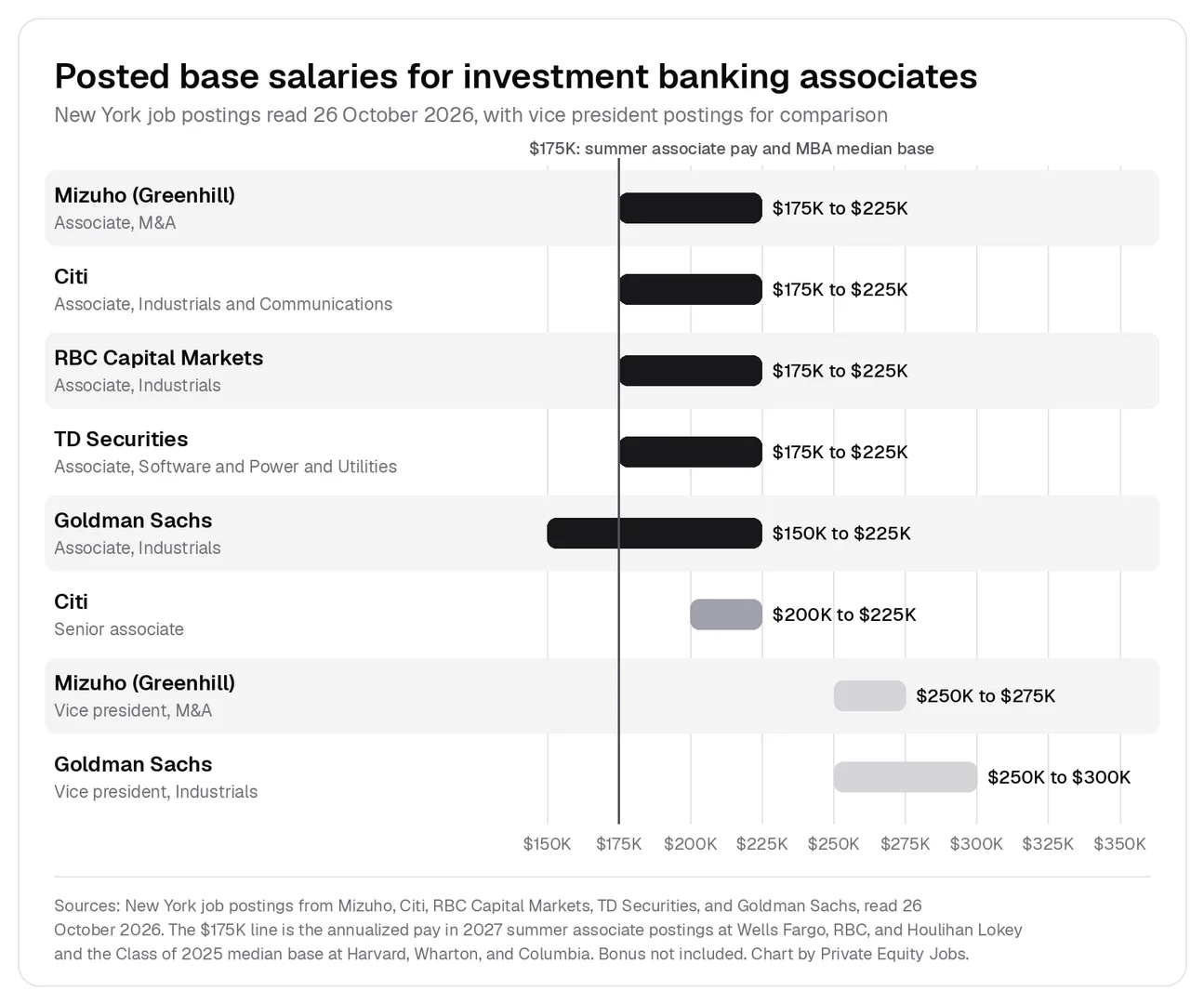
The ranges line up closely with the steps of the associate title. The $175,000 floor matches the median first-year base in the Harvard, Wharton, and Columbia reports and the annualized pay in the 2027 summer associate postings. The $225,000 top of the range is where the vice president postings begin to take over, at $250,000 and up.
Bonuses make up a large share of total pay. Prospect Rock's survey found that base salary is the larger part of pay at the analyst and associate levels. At the first vice president year base and bonus are about equal, at $255,000 and $250,000, and from the second vice president year the bonus is larger. Total associate pay also varies by type of bank. The same survey put a first-year associate at an elite boutique at $400,000 in total compensation for 2025, 43 percent above the $280,000 it reported at bulge bracket banks. Middle-market associates were close to bulge bracket pay in the second year ($340,000 versus $339,000) and below it in the third ($410,000 versus $450,000). Survey figures come from self-reported responses and should be read as ranges, not offers. Above the associate title, investment banking salary by level shifts further toward bonus, which Prospect Rock found can be 70 to 77 percent of total pay at senior levels.
MBA hires also receive a signing bonus. The median at Harvard, Wharton, and Columbia for the Class of 2025 was $50,000.
Hours
Associates work hours close to analysts' during busy periods, because the associate's review comes after the analyst's draft and before the vice president's. The difference is in what fills the time. Associates spend fewer late nights building a model from scratch and more hours checking pages, turning comments, and waiting on other people's input.
Banks have started to put limits on junior hours. JPMorgan capped junior bankers at 80 hours a week in most cases, Fortune reported on 12 September 2024, with live deals exempt, and Bank of America launched a platform to monitor individual workloads because its own 80-hour cap was reportedly ignored. JPMorgan also keeps a "pencils down" period from 6 p.m. Friday to noon Saturday and guarantees one full weekend off every three months. The reports describe the rules as covering junior bankers without separating analysts from associates, and hours at each level start to fall at vice president.
Licenses
Associates in the United States who advise on M&A deals or securities offerings need to be registered with the Financial Industry Regulatory Authority (FINRA). The usual combination for an investment banker is the Securities Industry Essentials (SIE) exam plus the Series 79 Investment Banking Representative exam, and many banks also require the Series 63 state law exam.
- Series 79. FINRA requires candidates to be associated with and sponsored by a member firm, so an associate takes it after being hired. The SIE is a corequisite. The exam has 75 questions, lasts two hours and 30 minutes, requires a score of 73 to pass, and costs $395.
- Series 63. A North American Securities Administrators Association (NASAA) exam administered by FINRA. It has 60 scored questions and five unscored ones, a 75-minute limit, a passing score of 43 correct, and a $147 fee.
Banks set their own deadlines. TD Securities' October 2026 Software associate posting requires the Series 79 and 63 "within four months of hire date," and its Power and Utilities posting asks for the Series 7 as well. Wells Fargo's 2027 summer associate posting asks hires who do not hold the SIE, Series 63 (or 66), and Series 79 to obtain them within 90 days. An MBA hire who has never worked at a broker-dealer usually studies for them during the first months on the job. Lateral hires from another bank often hold them already. FINRA opens the SIE to anyone 18 or older without a sponsoring firm, so students can take it before they are hired, one of the licenses and certifications open to them.
Associate interviews
Associate interviews cover the same ground as analyst interviews, with more weight on judgment and on the candidate's past work. What the interviewer looks for depends on the route.
- Lateral candidates and promoted analysts spend much of the interview walking through deals they worked on, including what the client wanted, how the process ran, what the valuation showed, which buyers or investors were involved, and what the candidate personally did. Interviewers test whether the candidate understood the deal or only built pages for it.
- MBA candidates face technical questions on accounting, valuation, and the mechanics of an LBO model, along with "why banking" and "why now" questions about the career change. A former consultant or military officer needs a short, specific answer for why banking follows the work they did before.
- All candidates get questions on managing people and on handling pressure, because the job includes both. Interviewers ask how the candidate handled an error in someone else's work, a tight deadline with conflicting requests, or a difficult client.
Associates are expected to know the bank's main sector or product group well enough to discuss recent deals, so candidates should read the group's recent announcements before the interview. The technical questions overlap heavily with the analyst-level interviews.
Moving up or moving on
Inside a bank, the promotion after associate is vice president. Bank postings show how much experience the vice president title assumes. Mizuho's July 2026 vice president posting asks for a bachelor's degree and six years of experience, or an MBA and current vice president experience, against three years for its associate posting. Goldman Sachs' Industrials vice president posting asks for a master's degree and at least four years of investment banking experience, or a bachelor's degree and at least seven. Read together, those requirements mean a post-MBA associate becomes a vice president candidate after about four years of banking, and an analyst who was promoted without an MBA needs six to seven years in total. Director and managing director come later, and how long each promotion takes varies by bank.
The usual investment banking exit opportunities for associates are corporate development and other in-house finance jobs, private equity and growth investing, and a bigger role at another bank. An associate who leaves brings experience the analyst postings do not ask for, such as running workstreams and managing analysts.
Pros and cons of the associate job
Reasons people take the job
- Pay. Posted base salaries start at $175,000 in New York at most of the banks above. Prospect Rock's survey put total compensation at $280,000 for a first-year associate at a bulge bracket bank and $450,000 for a third-year.
- A path to vice president. The title is the standard step toward running deals and, later, winning clients.
- Management experience early. Associates manage analysts and deal workstreams within a few years of starting.
- A reset for career changers. The MBA route lets people from consulting, the military, and other fields move into deal work at the same $175,000 base that the associate postings list.
Reasons people leave or avoid it
- Hours. The job still involves long weeks, and JPMorgan's 80-hour cap exempts live deals.
- Being caught in the middle. Associates take pressure from vice presidents above and are responsible for analysts' errors below.
- Less technical work. Some promoted analysts miss modeling once the job turns to checking and coordinating.
- Pay depends on bonuses. The bonus is discretionary, and Prospect Rock found the elite boutique premium over bulge bracket pay is strongest at the associate and early vice president levels.
Common questions
How long do you stay an investment banking associate?
Usually three to four years, with first-, second-, and third-year pay steps. Bank vice president postings ask for about four years of banking after an MBA, or six to seven years with only a bachelor's degree.
How much does a first-year investment banking associate make?
In New York, the base is usually $175,000. That figure is the floor of the 2026 associate postings at Mizuho, Citi, RBC, and TD, the median at Harvard, Wharton, and Columbia for the MBA Class of 2025, and the annualized pay in the 2027 summer associate postings. Total pay including bonus was $280,000 at bulge bracket banks and $400,000 at elite boutiques in Prospect Rock's survey of 2025 pay.
Do you need an MBA to be an investment banking associate?
No. Many associates are promoted analysts who never went to business school. The degree matters mainly for career changers, and some postings, such as RBC's, ask for a graduate degree for lateral hires.
What is the difference between an investment banking associate and an analyst?
Analysts build models and presentations. Associates check that work, manage the analysts doing it, and own the deliverables that go to vice presidents and clients. Associates also have more direct contact with clients and outside advisors.
Can you become an associate without being an analyst first?
Yes, through an MBA and summer associate internship, or as a lateral hire with comparable experience. Wells Fargo's 2027 summer associate posting accepts experience gained "through work, military service, training, or education" instead of a banking analyst program.
Is an associate or an analyst higher in investment banking?
The associate is higher. Analyst is the entry-level title, associate comes next, and vice president comes after that. Citi's Industrials posting calls the associate job "an intermediate level position" and asks associates to manage and mentor analysts.
How hard is it to get an investment banking associate job?
It is competitive at every entry point. Goldman Sachs told Fortune in June 2026 that it accepted fewer than one in 100 applicants to its 2026 summer internship program, the third year in a row below 1 percent, a figure that covers all of the firm's divisions. At the MBA level, investment banking took 6 percent of Harvard's Class of 2025, 14.2 percent of Wharton's accepted offers, and 17.1 percent of Columbia's offers. Lateral postings at large banks ask for two to eight years of deal experience.
Is a 3.5 GPA bad for investment banking?
No. Most bank postings do not publish a cutoff, and Bank of America's 2027 investment banking summer analyst posting lists a "3.5 minimum GPA preferred," so a 3.5 meets that bank's stated preference. Associate postings for experienced hires ask about deal experience, degrees, and licenses rather than grades.
Is 25 too old to become an investment banking associate?
No. Associates are usually older than analysts. Harvard Business School's Class of 2027 entered with an average of 4.9 years of work experience, and Wells Fargo's 2027 summer associate posting asks MBA students for at least two years of prior experience.
Is an investment banking associate a good job?
It pays well, it leads to vice president, and it gives management experience early. The costs are long hours, pressure from both directions, and pay that depends on a discretionary bonus.
What licenses does an investment banking associate need?
Typically the SIE, the Series 79, and the Series 63, and some postings add the Series 7. The bank sponsors the Series 79 after hiring and sets a deadline, such as four months at TD Securities or 90 days at Wells Fargo.
Sources
- Mizuho, Mizuho Greenhill Investment Banking M&A Associate posting (New York), posted 24 June 2026, read 26 October 2026.
- Mizuho, Mizuho Greenhill Investment Banking M&A Vice President posting (New York), posted 7 July 2026, read 26 October 2026.
- Citi, Investment Banking Associate, Industrials, Investment Banking Associate, Communications, and Investment Banking Sr Associate postings (New York), posted June and September 2026, read 26 October 2026.
- RBC Capital Markets, Associate, Global Investment Banking, Industrials and 2027 Global Investment Banking Summer Associate postings (New York), listed 14 and 28 August 2026, read 26 October 2026.
- TD Securities, Associate, Investment Banking, Software and Associate, Investment Banking, Power and Utilities postings (New York), posted 22 October 2026, read 26 October 2026.
- Goldman Sachs, Investment Banking Associate, Industrials and Investment Banking Vice President, Industrials postings (New York), read 26 October 2026.
- JPMorganChase, Investment Banking Associate Program page, read 26 October 2026.
- Objective Investment Banking & Valuation, M&A Investment Banking Associate posting (San Diego), read 26 October 2026.
- Bank of America, Global Investment Banking Summer Analyst Program, 2027 posting, read 26 October 2026.
- Wells Fargo, 2027 Investment Banking Summer Associate Program posting, posted 17 August 2026, read 26 October 2026.
- Houlihan Lokey, 2027 Summer Associate, Real Estate, Lodging and Leisure posting (New York), posted 28 September 2026, read 26 October 2026.
- Harvard Business School, Investment banking employment data, Class of 2025 and MBA class profile, read 26 October 2026.
- The Wharton School MBA Career Management, Full-time industry choices, Class of 2025, read 26 October 2026.
- Columbia Business School, Employment report, Class of 2025, read 26 October 2026.
- Prospect Rock Partners, 2025 IB compensation report, 14 March 2026.
- Fortune, Citi slashes promotion timeline for analyst program, 7 October 2026.
- Fortune, JPMorgan policy on analyst job hopping, 9 June 2025.
- Fortune, JPMorgan caps junior bankers' hours, 12 September 2024.
- Fortune, Goldman Sachs intern acceptance rate falls below 1% for third straight year, 8 June 2026.
- Lincoln International, Form 424(b)(4) prospectus, 19 May 2026.
- FINRA, Securities Industry Essentials (SIE) exam, Series 79, and Series 63 exam pages, read 26 October 2026.
Related posts
Related posts

How students and career changers get into investment banking: the five routes in, the dated 2028 recruiting calendar, what banks screen for, networking, interviews, and the SIE exam.

Corporate bankers manage a company's loans and cash; investment bankers advise on deals. How the work, revenue, recruiting, pay, hours, and exits compare, with 2026 bank postings and JPMorgan's 10-K.

Investment banking and consulting now start at almost the same base pay. How the work, fees, recruiting, interviews, bonuses, hours, and exits to private equity compare, with 2026 data.