

Investment banking and asset management are two different businesses that often sit inside the same firm. An investment bank advises companies on mergers and acquisitions and helps them raise money by selling stock and bonds, and it earns a fee when each deal closes. An asset manager invests other people's money in stocks, bonds, and other securities, and it earns a fee every year on the assets under management. Bankers sit on the sell side, working for issuers and companies that sell. Asset managers sit on the buy side, deciding what to own for mutual fund investors, pension plans, and other clients.
The jobs follow from that difference. A junior banker builds valuation models and client presentations for transactions on a deal calendar set by clients. A junior analyst at an asset manager studies a set of companies or bonds, builds models to support buy and sell decisions, and is judged over years on whether those decisions made money for the funds. Posted base pay overlaps. In October 2026 Citi posted $80,000 to $115,000 for full-time investment banking analysts starting in New York in 2027 and $110,000 to $135,000 for a senior analyst in Los Angeles. T. Rowe Price posted $110,000 to $140,000 for an associate analyst in its equity research program, a seat that asks for at least a year of experience. Banking pays larger bonuses earlier and hires many more people. Asset management hires far fewer, usually offers steadier hours, and rewards investment results over a career.
What investment banking and asset management are
Investment banks work for companies, governments, and private equity firms on one-off transactions. The advisory side handles mergers, acquisitions, and sales of businesses. The capital markets side underwrites new issues of stock and bonds, buying the securities from the issuer and selling them to investors. Citi's October 2026 posting for full-time investment banking analysts in its New York Latin America team describes the junior job: preparing "valuation materials and statistical exhibits for pitches and live deals," building financial models, and comparing a company's results with its industry. The largest advisers are the bulge bracket banks such as Goldman Sachs, JPMorgan, and Morgan Stanley, along with elite boutique banks such as Evercore, Lazard, and Centerview.
Asset managers run pools of money for investors and charge a percentage of the assets each year. The products are mutual funds, exchange-traded funds (ETFs), separately managed accounts for institutions, and target-date and other multi-asset portfolios. In a career conversation, "asset management" usually means the investment teams at traditional firms such as BlackRock, Vanguard, Fidelity, Capital Group, T. Rowe Price, and Wellington, and at the asset management arms of banks such as J.P. Morgan Asset Management and Goldman Sachs Asset Management. These firms mostly buy publicly traded securities. Alternative managers that buy private companies, such as private equity firms, are a separate career.
The Investment Company Institute's 2026 Fact Book puts the net assets of US-registered funds at $45.1trn at the end of 2025, and estimates that fund companies and related businesses employed 1.1 million people in the US in 2024. BlackRock alone reported $14.0trn of assets under management at the end of 2025 in its annual report filed with the Securities and Exchange Commission (SEC).
The two businesses answer to different laws. BlackRock's 10-K says the Investment Advisers Act of 1940 imposes record-keeping, operational, and marketing requirements on registered investment advisers, and the Investment Company Act of 1940 imposes governance, compliance, and disclosure obligations on registered funds and their advisers. Goldman Sachs's 10-K describes its main US broker-dealer, Goldman Sachs & Co., as registered with the SEC and subject to rules set by self-regulatory organizations such as the Financial Industry Regulatory Authority (FINRA) and the New York Stock Exchange. Bankers who deal with clients and securities work inside a broker-dealer, which is why banking postings ask for FINRA licenses and research postings at asset managers usually do not.
Key differences at a glance
| Factor | Investment banking | Asset management |
|---|---|---|
| Side of the market | Sell side, advising issuers and sellers | Buy side, investing for fund holders and institutions |
| Client | Companies, private equity firms, governments | Mutual fund and ETF investors, pension plans, insurers, endowments |
| How the firm earns | Advisory and underwriting fees, mostly paid when a deal closes | Fees charged as a percentage of assets each year, plus performance fees on some products |
| Unit of work | A transaction, from pitch to close | A portfolio of holdings, reviewed continuously |
| Junior output | Pitch books, valuation models, offering documents | Company models, earnings notes, buy and sell recommendations |
| How juniors are judged | Accuracy, speed, and deal execution | Quality of research and, over time, the returns on ideas adopted |
| Entry-level hiring | Large analyst classes at each major bank | Small analyst programs; many seats ask for prior experience |
| Main US rules | Broker-dealer registration with the SEC; FINRA rules | Investment Advisers Act and Investment Company Act of 1940 |
| Licenses | Series 79 and 63 (Citi analyst postings) | None required for T. Rowe Price research roles; Chartered Financial Analyst progress often preferred |
| 2026 posted base, junior | $80,000 to $115,000 (Citi 2027 analyst class, New York); $110,000 to $135,000 (Citi senior analyst, Los Angeles) | $110,000 to $160,000 (T. Rowe Price associate analysts) |
| Hours | Set by live deals and client deadlines; long and unpredictable | Set by the market calendar and earnings seasons; usually shorter |
| Common next move | Private equity, hedge funds, corporate development, the buy side | Senior analyst, portfolio manager, hedge funds |
How each business earns its money
The fee model explains most of the career differences. An investment bank is paid for transactions. Goldman Sachs reported investment banking fees of $9.34bn for 2025 in its annual report on Form 10-K, 21 percent higher than in 2024, and attributed the rise mainly to "a significant increase in completed mergers and acquisitions volumes." Revenue moves with deal activity, so bank bonuses and hiring rise and fall with the deal cycle. A banker's value to the firm is measured in mandates won and deals closed.
An asset manager is paid on assets. BlackRock's 2025 Form 10-K says its investment management revenue comes mainly from fees set as a percentage of the assets it manages and, for some products, from performance fees. Of BlackRock's $24.2bn of 2025 revenue, $19.2bn came from those base fees and securities lending, and $1.4bn came from performance fees. Revenue grows when markets rise and when clients add money, and it shrinks when they withdraw. An analyst's value is measured by whether the funds beat their benchmarks, because performance is what keeps and attracts client money.
The two businesses often share a roof. JPMorgan's 2025 Form 10-K shows its Asset & Wealth Management segment earned $15.5bn of asset management fees, more than the $9.6bn of investment banking fees the whole firm earned that year. Goldman Sachs's Asset & Wealth Management segment had net revenues of $16.68bn. A bank's asset management division is a separate business with its own hiring, its own analysts, and its own career ladder.
Fee pressure is the main change in asset management. The Investment Company Institute reports that index mutual funds and index ETFs held 52 percent of US long-term fund assets at the end of 2025, up from 19 percent in 2010. Over 2016 to 2025, actively managed domestic equity mutual funds had net outflows of $3.4trn while index domestic equity funds and ETFs took in $2.9trn. The asset-weighted expense ratio of equity mutual funds fell from 0.99 percent in 2000 to 0.40 percent in 2025. Index funds need far fewer stock pickers per dollar than active funds, so the number of research seats grows more slowly than assets do.
Asset management vs wealth management
Wealth management is a different job, although the two titles are often used as if they meant the same thing. A wealth manager or financial adviser works for individual clients and families. The job is financial planning, choosing among funds and managers, tax and estate coordination, and keeping the relationship. An asset manager builds and runs the funds and portfolios that wealth managers and institutions buy. A Fidelity research analyst covering asset-backed bonds and a Fidelity financial consultant meeting clients in an investor center work for the same company in different businesses.
The postings show the gap. Fidelity's October 2026 posting for a financial consultant in Chicago describes face-to-face work with clients, "providing mentorship and personalized planning," asks for FINRA Series 7 and 66 licenses or the ability to obtain the Series 66 on hire, and lists a base of $60,000 to $75,000, with bonus or other variable pay depending on the role. Fidelity's fixed income research analyst posting describes recommendations "that have significant impact on the funds." The first job is judged on clients kept and assets gathered, the second on investment results. Johnson Associates, a compensation consulting firm, projected in August 2026 that wealth management incentive pools would rise 5 to 10 percent for the year, against 7 to 11 percent for traditional asset management.
The confusion comes partly from how firms report. JPMorgan and Goldman Sachs both put asset management and wealth management in one segment called Asset & Wealth Management. JPMorgan's 10-K splits that segment's $24.1bn of 2025 revenue into $11.7bn for Asset Management and $12.4bn for the Global Private Bank, which serves wealthy individuals. A posting in that segment can be either kind of job. The description makes the difference clear. Wealth roles mention clients, relationships, and planning. Investment roles mention coverage, models, and recommendations to portfolio managers.
The jobs inside an asset manager
Asset managers hire for several distinct careers, and titles are not reliable guides. The roles below come from postings at large US managers between July and October 2026.
- Research analyst. The core investing job for most graduates who join from banking. T. Rowe Price runs an associate analyst program, described as a "three-to-five-year structured program" that pairs juniors with senior analysts to build models, write earnings summaries, and meet company management. Exceptional performers "have the potential to be promoted to Investment Analyst," and the posting says accomplished associate analysts may "rate and recommend stocks after several years." Capital Group's Fundamental Research Group associates do the same work under its investment professionals. Fidelity's fixed income research analyst posting covers bonds backed by loans and receivables and states that "Research Analysts make recommendations that have significant impact on the funds."
- Portfolio manager. The person who decides what a fund owns and how much. Most portfolio managers were analysts first. T. Rowe Price's August 2026 posting for a multi-asset portfolio manager listed a base of $175,000 to $275,000.
- Portfolio and model strategists. Multi-asset teams build model portfolios that advisers use with their clients. BlackRock's Multi-Asset Strategies & Solutions group posted an associate model portfolio strategist at $110,000 to $150,000 and a vice president model portfolio manager at $155,000 to $210,000 in New York.
- Investment stewardship. Stewardship teams vote the funds' shares at company meetings and meet boards on governance. Vanguard's investment stewardship analyst develops proxy voting recommendations and prepares and documents engagements with the companies its funds own. Wellington's stewardship associate does similar work from its chief operating officer's group. The function is changing. In January 2026 J.P. Morgan Asset Management said it would stop using outside proxy advisers for US votes and use an in-house artificial intelligence tool covering more than 3,000 annual meetings, ESG Dive reported.
- Product, distribution, and client roles. Product managers, client portfolio managers, and sales teams explain the funds to investors and raise assets. These roles need investment knowledge but do not make the buy and sell decisions. Wellington's September 2026 postings titled "Investment Analyst" sit in equity product management, not in stock research.
The research analyst seat is the one that compares most directly with investment banking, and it is the one most bankers mean when they talk about moving to asset management.
The work and the skills
Both jobs use the same tools: financial statements, a three-statement model, valuation, and industry research. The difference is the question the work answers. A banker's model supports a transaction, such as what a buyer can pay or how to price a stock offering. An asset management analyst's model supports a decision to buy, hold, or sell, and the analyst has to say why the market price is wrong. A banker presents the work to a client, while an analyst presents it to a portfolio manager, who can ignore the recommendation.
The junior banking week is organized around deals. The analyst updates a model when a client asks, turns comments on a presentation overnight, and joins due diligence sessions on live transactions. Citi's posting for an investment banking associate adds the next layer: managing deal timelines and client deliverables "from mandate to close" and supervising analysts. The work is varied and the feedback is fast, and most of it ends when the deal does.
The junior asset management week is organized around a coverage list and the market calendar. T. Rowe Price's associate analyst posting lists building and updating financial models, quarterly earnings analysis, conferences and meetings with management teams, and industry and thematic research. Capital Group asks its research associates to help generate investment ideas, monitor holdings, and set up meetings with management teams, sell-side analysts, and industry experts. The same companies come back every quarter, and an analyst builds knowledge of an industry over years. Feedback is slow because an investment idea takes months or years to prove right or wrong.
The skills that transfer from banking are modeling speed, accounting, and the ability to read a company's filings. Banking does not teach an analyst to form a view against the market and defend it. Equity research on the sell side is the closest training for that, which is why many asset managers recruit from it. Licenses differ too. Citi's analyst postings list the Series 79 and 63 FINRA licenses as requirements. T. Rowe Price's research postings say FINRA licenses "are not required and will not be supported," and its associate analyst posting prefers candidates who have passed at least Level I of the Chartered Financial Analyst program.
Recruiting and how many seats there are
Investment banking hires in bulk and asset management hires a few people at a time. Both banks and large asset managers run summer internships for undergraduates and master of business administration (MBA) students that lead to full-time offers, and getting into investment banking runs mostly through those internships. The class sizes differ. The clearest comparison comes from business school reports, which count graduates from the same class going to each industry.
Wharton's 2025 MBA Career Report shows 14.2 percent of graduates who accepted full-time jobs went into investment banking and brokerage, about 75 people, and 5.3 percent went into investment management, about 28 people. Both groups had the same median base salary of $175,000. Harvard Business School's Class of 2025 data show 6 percent of graduates in investment banking and 7 percent in investment management and hedge funds, a category that combines the two. Employers listed in Wharton's report on both sides include Goldman Sachs, J.P. Morgan, Evercore, Lazard, and Centerview for banking, and BlackRock, T. Rowe Price, Vanguard, and Wellington for investment management.
Many asset management seats are not entry-level at all. Capital Group's research associate posting asks for "2+ years of experience in a related field (equity research, investment banking, consulting, accounting or other)." T. Rowe Price's technology associate analyst posting asks for at least one year of experience and says "equity research or investment banking experience preferred." Both employers treat two years as a banking analyst as an accepted qualification for a research seat. Interviews for these roles test for an investment view. Candidates are usually asked to pitch a stock or bond and defend it, in addition to the technical accounting and valuation questions both industries share.
Pay
At the start, base salaries in the two industries overlap. The difference is in the bonus, the speed of increases, and what the top of each ladder pays. The chart shows base salary ranges posted by employers in New York, Baltimore, and California in 2026. Base pay is only part of compensation in both industries, and none of these postings states a bonus.
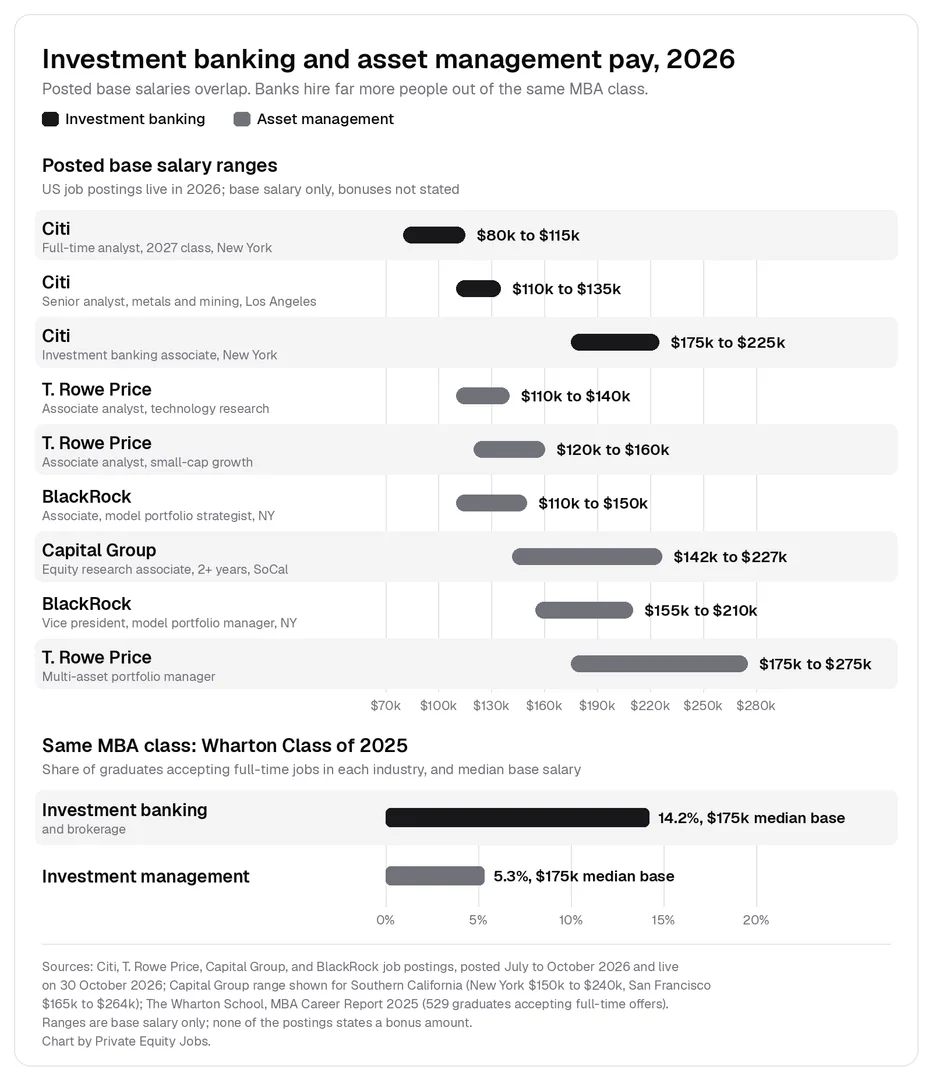
Banking bonuses are large from the first year and grow quickly. Prospect Rock Partners' 2025 investment banking compensation report, based on 866 survey responses collected in early 2026, put first-year analyst total compensation at $160,000 and first-year associate total compensation at bulge bracket banks at $280,000. Its first-year vice president figures were a $255,000 base and a $250,000 bonus. Banks follow a salary ladder by level, and the bonus pool depends on the year's deal fees.
Asset management bonuses at the junior level are smaller and less certain, but research pay can rise as an analyst's ideas make money. Capital Group's research associate range of $141,648 to $226,637 in Southern California, and $165,185 to $264,296 in San Francisco, sits above Citi's posted analyst ranges, for people with two or more years of experience. The postings say only that bonuses depend on performance. MBA data give the best like-for-like view. Harvard Business School's Class of 2025 had a median base of $182,500 in investment management and hedge funds against $175,000 in investment banking, and median variable bonuses of $85,000 and $82,500. Only 50 percent of the investment management group reported receiving a variable bonus, against 76 percent in banking. At Wharton, graduates working in investment management or portfolio management functions reported a median base of $190,917, against $180,982 in investment banking functions. Wharton's medians are base salary only.
In both industries the bonus pool follows the firm's results. BlackRock's 10-K attributes its higher 2025 incentive compensation to "higher operating income and performance fees," and the firm had accrued $2.7bn of annual incentive compensation at the end of 2025. Johnson Associates projected in August 2026 that year-end incentive pools would rise 10 to 15 percent or more at investment and commercial banks and 7 to 11 percent at traditional asset managers. Within banking, it projected 20 to 30 percent or more for equity underwriting, 15 to 20 percent for advisory, and 5 to 10 percent for debt underwriting. Within asset management, it projected 8 to 13 percent for equity teams and about 5 percent for fixed income. Those are changes in the size of the pool from 2025, not pay levels, and they describe one strong year for deal fees.
At senior levels the comparison depends on results. A managing director's pay in banking depends on the fees the banker brings in. A portfolio manager's bonus depends on the fund's performance and its assets, and is rarely published. T. Rowe Price's multi-asset portfolio manager posting gives a base of $175,000 to $275,000, before any bonus. There are few of those seats, and they usually take a decade or more to reach. Private equity firms add carried interest, a share of fund profits that traditional asset managers do not pay their analysts.
Hours and lifestyle
Hours are where the two jobs differ most. In investment banking, client deadlines, signing dates, and offering timetables set the schedule, and junior bankers are expected to respond in the evening and on weekends when a live deal needs it. In September 2024 JPMorgan began limiting junior banker hours to 80 a week in most cases, with live deals exempt, Fortune reported. Hours vary by group, by bank, and by level.
In asset management, the market sets the calendar. Analysts are in the office before the market opens, and the heavy weeks come during quarterly earnings season, when every company on the coverage list reports. Most nights and weekends are free outside those periods, because there is no client waiting for a deliverable. The pressure comes from accountability for performance, which builds slowly over a career instead of arriving deal by deal.
Asset managers do not offer more remote work than banks. BlackRock's 2026 postings require at least four days a week in the office, Wellington's say four days, and T. Rowe Price allows up to one day a week from home. Fidelity's October 2026 postings say the firm is moving to a full-time onsite model through a phased rollout across regions and roles. Citi's posting for an investment banking associate offers three days in the office and two remote. The lifestyle advantage in asset management is fewer late nights and weekends.
Career path and moving between them
The asset management ladder runs from associate analyst or research associate to analyst, then senior analyst, then portfolio manager. T. Rowe Price's associate analyst program lasts three to five years, and exceptional performers can be promoted to investment analyst. Becoming a portfolio manager usually takes a decade or more, and some analysts stay analysts for a career by choice. Promotion depends on the track record of an analyst's recommendations, which is measured and kept for years.
The banking ladder runs from analyst to associate, vice president, director, and managing director. Promotion follows a set timetable at most banks, and seniority means selling to clients rather than doing the analysis. The investment banking associate role is the first step that requires managing analysts and clients.
Moving from investment banking to asset management is common and usually happens after two or three years as an analyst. Capital Group and T. Rowe Price list banking experience as an accepted background for research roles. Bankers who move need to show they can pick investments, and a stock pitch in the interview is the test. The move is one of several investment banking exit opportunities, along with private equity and hedge funds. Moving from asset management to investment banking is less common. An analyst who wants deals usually needs an MBA and a banking associate role, because banks hire analysts from college and associates from business school. An asset manager with a public-markets track record moves more easily into hedge funds than into banking.
Job security depends on different things in each business. Banks cut staff when deal volume falls, because most fees are paid only when deals close. Asset managers cut when fees fall, and the shift to index funds has lowered fees per dollar for two decades. In its August 2026 outlook Johnson Associates noted "headcount trimming as firms benefit from AI efficiencies" at banks, and "AI-driven efficiencies and headcount management" at traditional asset managers, which it also expected to consolidate into very large firms and boutiques.
Private Equity Jobs lists open roles at investment banks and investment firms, and its companies directory shows the firms behind them.
Which one to choose
Choose investment banking if you want the fastest route to transaction skills, a large employer network, a pay ladder that is predictable for the first several years, and the widest set of next jobs, including private equity. Choose it knowing that the hours are set by clients and that much of the work is presentation and execution.
Choose asset management if you want to spend your career forming investment views on public companies or bonds and being judged on whether they work. The hours are more predictable, the research is deeper and narrower, and pay rises with performance more than with title. The seats are scarcer, so many people reach them through two years of banking or sell-side research first. If you already know you want to be a portfolio manager, an analyst program at an asset manager is the direct route. If you are unsure, banking keeps more options open.
Common questions
Which is better, asset management or investment banking?
Neither is better for everyone. Investment banking suits people who want transaction work, fast early pay growth, and broad exit options. Asset management suits people who want to research and pick investments with more predictable hours, and who accept fewer entry seats and pay that depends on performance.
What pays more, investment banking or asset management?
Investment banking pays more for most people in the early years because bonuses are larger and more certain. Posted base salaries overlap. Citi posted $80,000 to $115,000 for its 2027 New York analyst class and $110,000 to $135,000 for a senior analyst in Los Angeles, and T. Rowe Price posted $110,000 to $160,000 for associate analysts with some experience. Bonus pools at banks were projected to grow faster than at asset managers in 2026, 10 to 15 percent or more against 7 to 11 percent, according to Johnson Associates. Portfolio manager pay depends on fund performance and is rarely published, and few people reach that seat.
Is investment banking the same as asset management?
No. Investment banks advise on and arrange transactions and are paid fees per deal. Asset managers invest client money in portfolios and are paid a percentage of assets each year. Some firms, such as JPMorgan and Goldman Sachs, do both in separate divisions.
What is the difference between an investment bank and an asset manager?
An investment bank works for companies that are buying, selling, or raising money. An asset manager works for investors whose money it invests. When a company sells new shares, the investment bank sells them for the company and the asset manager decides whether to buy them for its funds.
Does JP Morgan do asset management?
Yes. J.P. Morgan Asset Management is part of JPMorgan's Asset & Wealth Management segment, which reported $4.8trn of assets under management and $7.1trn of client assets at the end of 2025. It is a separate business from the firm's investment bank, with its own hiring.
Who are the big three asset managers?
The term usually refers to BlackRock, Vanguard, and State Street, the three firms most associated with index funds. BlackRock reported $14.0trn of assets under management at the end of 2025. Vanguard reports $13.4trn as of 30 September 2026. State Street's 10-K puts State Street Investment Management at about $5.67trn at the end of 2025. The dates differ, so the figures show scale rather than an exact ranking.
Is asset management considered investment banking?
No. Some banks place asset management and investment banking in the same company, but they report them as separate segments with separate staff. JPMorgan reports Asset & Wealth Management apart from its Commercial & Investment Bank, and the asset management side is regulated as an investment adviser rather than as a broker-dealer.
Sources
- Citi, Investment Banking LATAM Full-Time Analyst, New York 2027 (job 261001253, posted 13 October 2026); Investment Banking Senior Analyst, Metals & Mining, Los Angeles (job 26999512, posted 6 October 2026); Investment Banking Associate, Power (job 26996739, posted 26 October 2026).
- T. Rowe Price, Associate Analyst, Technology (job 80209, posted 1 July 2026); Small-Cap Growth Equity Strategy Associate Analyst (job 82404, posted 6 October 2026); Multi-Asset Portfolio Manager (job 81992, posted 7 August 2026).
- Capital Group, Equity Research Associate (job JR6916, posted 2 September 2026).
- BlackRock, Associate Model Portfolio Strategist (job R266582, posted 25 September 2026); Vice President, Model Portfolio Manager (job R266288, posted 16 October 2026).
- Vanguard, Investment Stewardship Analyst (job 182878, posted 14 October 2026). Wellington Management, Stewardship Associate (job R94737) and Investment Analyst (job R94795), posted September 2026. Fidelity, Fixed Income Research Analyst, Structured Products (job 2132796, posted 12 October 2026); Financial Consultant, Gold Coast, Chicago (job 2132667, posted 21 October 2026).
- Wharton MBA Career Report 2025, published February 2026.
- Harvard Business School, Class of 2025 employment data, investment management and hedge fund, and investment banking.
- Prospect Rock Partners, 2025 IB Compensation Report, 14 March 2026.
- BlackRock, Inc., Form 10-K for 2025, filed 25 February 2026.
- JPMorgan Chase & Co., Form 10-K for 2025, filed 13 February 2026.
- Goldman Sachs Group, Form 10-K for 2025, filed 25 February 2026.
- Investment Company Institute, 2026 Investment Company Fact Book.
- Johnson Associates, Q2 2026 compensation estimates, 5 August 2026.
- State Street Corporation, Form 10-K for 2025, filed 19 February 2026.
- Vanguard, Our history, global assets under management as of 30 September 2026.
- Fortune, JPMorgan just capped junior bankers' hours at 80 per week, 12 September 2024.
- ESG Dive, JPMorgan eschews proxy advisers for internal AI tool, 7 January 2026.
Related posts
Related posts

What an investment banking associate does, how the job differs from analyst and vice president, posted 2026 pay at five banks, the MBA and lateral routes in, licenses, and interviews.

How students and career changers get into investment banking: the five routes in, the dated 2028 recruiting calendar, what banks screen for, networking, interviews, and the SIE exam.

Corporate bankers manage a company's loans and cash; investment bankers advise on deals. How the work, revenue, recruiting, pay, hours, and exits compare, with 2026 bank postings and JPMorgan's 10-K.