

Investment bankers advise companies on mergers and acquisitions and help them raise money by selling stock and bonds. Most of them got in through a summer internship. In the United States, banks hire undergraduates for a summer analyst program of nine or 10 weeks between junior and senior year, then offer full-time analyst jobs to the interns who perform well. The rest of the entry routes are narrower: full-time recruiting in senior year for students without an internship offer, a move from an adjacent job such as corporate banking or transaction advisory within a year or two of graduating, or an MBA followed by a summer associate internship. People who come in later than that usually move from a related field and enter as associates.
The calendar is earlier than most students expect. Evercore took applications for its 2028 summer analyst program from September 9 to November 15, 2026, from students graduating between December 2028 and June 2029. Those applicants were college sophomores, applying about a year and a half before the internship began. Getting an offer usually takes a solid academic record, some earlier work experience that looks relevant, many conversations with working bankers, and enough accounting and valuation knowledge to pass technical interviews.
The ways into investment banking
There are five common entry points. Which ones are open to you depends mostly on where you are in school or how long you have been working.
| Entry point | Who uses it | Role you start in | When it happens |
|---|---|---|---|
| Summer analyst internship | Undergraduates | Summer analyst, then full-time analyst | Apply in sophomore year (sometimes earlier), intern after junior year, start full time after graduating |
| Full-time analyst recruiting | Seniors without a return offer, students in one-year master's programs | Analyst | Late summer and fall of the final year, as banks fill seats left after return offers |
| Move from an adjacent job | Recent graduates in corporate banking, Big Four valuation or transaction services, corporate finance, or a smaller bank | Analyst (sometimes second-year analyst) | Usually within one to two years of graduating, when a bank has an opening |
| MBA summer associate internship | MBA students, often career changers | Summer associate, then associate | Recruiting in the first year of the MBA, internship after the first year |
| Experienced lateral | People with deal experience in law, accounting, consulting, or industry | Associate | When a team has an opening, usually through referrals |
The undergraduate route fills most seats. Banks treat their summer program as a long interview and fill much of each full-time analyst class from their own interns. Goldman Sachs told Fortune in June 2026 that it would hire about 2,500 permanent entry-level employees that July, roughly the size of its intern class, and that about 40% of its partners began as campus hires. Those figures cover the whole firm, not only investment banking.
The later routes still lead to the same job. An analyst who joins from a smaller bank after a year does the same modeling and deal work as one hired from a summer program. The difference is that there are fewer seats and less structure, so the candidate has to find the opening, usually through people already at the bank. Once hired, every analyst follows the same investment banking career path, whatever the route in.
The recruiting timeline
Undergraduate recruiting at large US banks now runs about 18 months ahead of the internship. A student who will graduate in spring 2029 interns in summer 2028, and for that student the 2026 to 2028 cycle runs as follows.
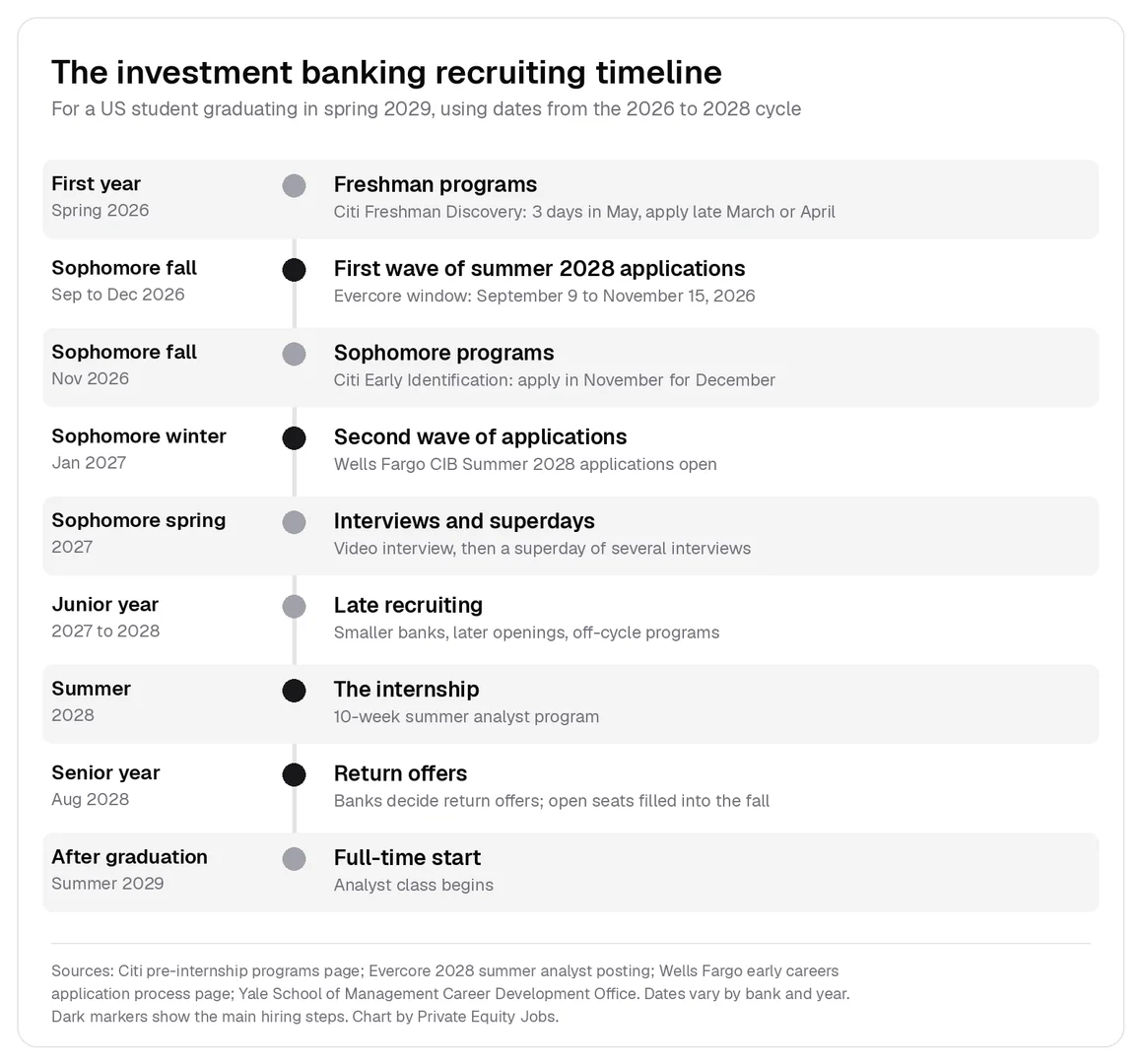
- First year (2025 to 2026). Freshman programs at some banks. Citi's Freshman Discovery program, for example, runs for three days in May and takes applications in late March or early April from first-year students of any major.
- Sophomore fall (September to December 2026). The first wave of summer 2028 applications. Evercore's window ran from September 9 to November 15, 2026. Some banks also run sophomore programs that end in interview preparation for the summer analyst role.
- Sophomore winter and spring (January to spring 2027). The second wave. Wells Fargo's early careers page says applications for its Corporate and Investment Banking Summer 2028 internships open in January 2027. Interviews and superdays follow over the next few months.
- Junior fall and spring (2027 to 2028). Students without an offer keep recruiting with banks that hire later, smaller banks, and off-cycle programs.
- Summer 2028. The internship, which runs 10 weeks at Evercore and nine weeks at JPMorgan.
- August 2028. Return offer decisions. Wells Fargo says its full-time roles typically open in August and September "based on intern conversion," and banks that end the summer with open seats recruit seniors from mid-August through the fall.
- Summer 2029. Full-time analyst start after graduation.
The dates are not uniform. Banks do not open on the same day, and the order changes from year to year. Evercore's window opened in September and Wells Fargo's opens in January, four months apart for the same summer. Some banks review applications in the order they arrive, so applying early helps. Evercore said it would not review applications on a rolling basis, so applying on November 1 carried no penalty there. Goldman Sachs says it evaluates applications "throughout the recruiting season." Check each bank's own careers page in the summer before sophomore year and record its opening date and its review policy.
The early calendar applies to US undergraduates. MBA programs and most markets outside the United States recruit later and on different schedules.
Programs for first- and second-year students
Many banks run short programs for first- and second-year students. They are smaller than summer internships and easier to get into, and they put a bank's name on a resume before the main application season. Several end in interview preparation or a fast track into the summer analyst process.
Citi's US programs show the format. Freshman Discovery is a three-day virtual program in May for first-year students of any major. Early Identification is a three-week virtual program for sophomores at four-year colleges, two to three hours a day, with one cohort starting in December (applications open in November) and one in March (applications open in February). Participants choose at most two lines of business, and Citi lists technical training and interview preparation for its summer analyst roles among the benefits.
Other banks run diversity programs, insight days, and one-day office visits for first- and second-year students. They change names and dates often, so the reliable way to find them is to read the early careers page of each bank on your list in the spring of first year. A sophomore program matters most to students at schools where banks do not recruit on campus, because it gives them a recruiter contact and an interview before the summer analyst applications open.
Freshman summer experience also counts, even if it is not at a bank. A job at a small advisory firm, a wealth manager, a company's finance team, or a startup gives a student something to discuss in interviews 12 months later. The work does not need to be prestigious. It needs to show interest in finance and some contact with financial statements.
What banks look for
Bank postings ask for less than many applicants assume. Evercore's 2028 summer analyst posting asks for an undergraduate degree, says "all majors encouraged to apply," and lists a strong academic record, critical thinking, "demonstrated knowledge in investment banking and global markets," quantitative and communication skills, and a strong work ethic. It does not name a major, a GPA cutoff, or a professional designation.
In practice, interviewers screen on five things.
- Grades. Bank postings rarely publish a hard GPA cutoff. Bank of America's 2027 Global Investment Banking summer analyst posting is one of the few that names a number, a "3.5 minimum GPA preferred." A lower GPA has to be offset by stronger experience and a referral.
- School. Large banks recruit on campus at a limited set of universities, usually called target schools. Students elsewhere can still get in, but the route runs through networking and smaller banks.
- Experience. A prior internship in finance, accounting, or a related field shows you know what the work involves. Banks look at what you did more than where you did it.
- Interest in the job. Interviewers want a specific reason for choosing investment banking over consulting, sales and trading, or corporate finance, and some knowledge of recent deals. More banks now hire straight into industry groups, so interest in a sector counts too. Yale School of Management's career office reported in August 2025 that many banks are moving from generalist pools to hiring candidates directly into coverage groups such as technology or healthcare.
- Something distinctive. Goldman Sachs told Fortune that its 2026 intern class included more than 30 elite athletes, nearly 50 musicians, and close to 20 nonprofit founders, and described this as a deliberate effort to hire beyond the traditional pipeline.
Your major matters less than your grades. Finance, economics, and accounting majors arrive knowing more of the technical material, but history and engineering majors get hired too, provided they learn accounting and valuation on their own. Certifications are not required. The Chartered Financial Analyst (CFA) program and a certified public accountant (CPA) license are designed for different careers and take years, and entry-level bank postings do not ask for either.
Target schools and non-target routes
A target school is one where a bank recruits on campus, with information sessions, resume drops, and interview slots reserved for its students. The list is short and differs by bank, usually a set of selective private universities and a few large public ones near the bank's offices. A semi-target sends some students to banks each year but gets less on-campus attention. Every other school is a non-target.
The application process is the same for everyone. What differs is how the bank finds you. At a target school, a recruiter collects resumes and alumni at the bank put names forward. At a non-target, nobody does that for you, so the work moves to networking, earlier preparation, and a wider list of banks.
Students at non-target schools who get in usually do several of these things:
- Start earlier. They contact alumni at banks in first year and apply to sophomore programs, so their name is known when summer analyst applications open.
- Apply widely. They include middle-market investment banks, regional banks, and boutiques, which recruit from more schools and depend more on referrals than on a campus schedule.
- Use the local office. Regional offices, such as those in Charlotte, Houston, or Chicago, often recruit from nearby universities.
- Take a stepping stone. An internship at a small bank or in Big Four transaction services in sophomore summer often leads to a summer analyst offer at a larger bank the next year.
- Over-prepare technically. Without a referral, a candidate's technical answers carry more weight.
A non-target student who misses the summer analyst cycle still has the full-time recruiting cycle in senior year, the adjacent-job route after graduating, and a master's in finance or an MBA.
Networking
Networking in banking means conversations with people who work at the banks you want to join. Its purpose is practical. A banker who has spoken with you can pass your resume to the recruiting team, tell you which group is hiring, and confirm that you know what the job involves. Yale's career office calls networking "required by hiring teams" and says coffee chats are "frequent and expected before applying to roles." Goldman Sachs's preparation page tells students that their school's career office can connect them with alumni at the firm.
The standard approach has four steps:
- Build a list. Start with alumni of your school at banks on your target list, found through the school's alumni database and LinkedIn. Analysts and associates answer more often than senior bankers and remember recruiting more clearly.
- Send a short email. Say who you are, your school connection, and that you would like 15 minutes to learn about the person's group. Do not ask for a job or attach a long cover letter. A note of four or five sentences is enough, for example: "I'm a sophomore at [school] studying economics, and I found you through our alumni directory. I'm interested in [group] at [bank] because of [a specific reason, such as a recent deal]. Would you have 15 minutes in the next two weeks for a short call about your work? I'm free [two or three times]."
- Have the call. Prepare questions about the person's group, recent deals, and how they got in. Keep to the time. Ask at the end whether there is someone else you should speak with.
- Follow up. Send a thank-you note the same day, and an update a few weeks later on something they suggested. If someone does not reply to the first email, follow up once about a week later, then move on.
Keep a simple spreadsheet of each contact's name, bank, group, the date you wrote, the date you spoke, and what they said. Over several months the list grows to dozens of names, and it tells you whom to update when applications open.
Start six to 12 months before the applications open, which for most students means first year or the start of sophomore year. A few conversations a week over that period is enough to know several people at each bank on your list. Send several notes to each firm, not one, because many bankers will not reply.
Attend the information sessions, conferences, and campus events banks run. Recruiters at these events often record names, and a short conversation with an analyst there gives you a reason to follow up.
The resume and the application
Banking resumes follow a standard one-page format, with education at the top, then work experience, then leadership and activities, and a final line for skills and interests. Each work experience line should name a task and a result, with numbers where they exist, for example the size of a transaction you worked on or the number of companies you analyzed. Bankers read resumes quickly, so each line should be short enough to read at a glance.
Students without banking experience can still show relevant work. A finance club stock pitch, a valuation project for a class, or a summer job analyzing a company's costs is worth more on a resume than a general description of responsibilities. Put a grade point average on the resume if it is 3.5 or higher, and include test scores only if they are strong and recent.
Applications go through each bank's online portal, usually with a resume, transcript, and short written questions, and sometimes an online test. Read the instructions on each portal. Evercore, for example, allowed each student at most two applications across all its programs, said a withdrawn application still counted toward that limit, and asked students to apply only to the two programs that interested them most. Its 2028 summer program pages were split by office and group, including a technology group program in Menlo Park and San Francisco. At banks with rules like these, the choice of office and group is part of the application strategy, and networking is how you learn which teams are short of people.
The interviews
Most large banks use the same sequence. The application is screened, then a candidate takes a recorded video interview, then a first-round interview with a banker, and finally a superday. Goldman Sachs describes its own version on its student preparation page. Selected applicants complete a video interview of about 30 minutes, and those who pass are invited to a superday, a series of final-round interviews that "typically" runs between two and five interviews for campus hires, depending on the division.
The video interview is usually run through HireVue, a recorded format in which the candidate sees a question, gets a short time to prepare, and records an answer. The questions are mostly behavioral, with some basic technical questions. Practice with a webcam until you can answer in under two minutes without notes.
The superday is a block of back-to-back interviews with bankers from analyst to managing director, held in person or by video on a single day. Each interviewer covers some mix of these types of questions:
- Behavioral and fit. Walk me through your resume. Why investment banking? Why this bank and this group? Tell me about a time you worked on a team under pressure. Have a two-minute version of your story that explains each step on your resume and ends with why you want this job. An answer that rests on the pay or the exit opportunities usually counts against a candidate. Tie the reason to the work itself, such as an interest in how companies are valued or a deal you followed closely.
- Technical. How the three financial statements link, how a change such as $10 of depreciation flows through them, the main valuation methods (comparable companies, precedent transactions, discounted cash flow), enterprise value and equity value, and the basics of a merger or a leveraged buyout. Summer analyst interviews test whether you understand the concepts. Associate interviews expect fluency.
- Estimation questions. Some interviewers ask a market-sizing or estimation question, such as how many dentists work in a city. They are testing how you structure the problem, so talk through each assumption.
- Markets and deals. A recent deal you followed, what you would buy or sell, where interest rates are and why that matters to the bank's clients. Pick one deal in the group's sector and know its price, the buyer's reasoning, and how it was financed.
Offers often follow within days of a superday. Candidates with an offer from one bank sometimes tell other banks where they are still interviewing, which can speed up those processes.
Turning an internship into a full-time offer
The summer internship decides most full-time offers. JPMorgan's investment banking summer analyst program, for example, starts with five days of orientation and classroom training in accounting, financial modeling, valuation, and Excel, and places interns in a coverage, advisory, or capital markets group for the nine weeks. Interns work on live deals alongside analysts, and at the end of the summer the bank decides who receives a return offer for a full-time analyst job after graduation. Yale's career office says return offer decisions are made in August. Interns are paid at analyst rates. Evercore's 2028 summer analyst posting lists an expected base salary of $120,000, an annualized figure that an intern earns only for the 10 weeks worked. After graduation the bonus adds to the base. First-year analysts earned about $160,000 in total pay for 2025, up from about $148,000 in 2023, according to the 2025 compensation report of Prospect Rock Partners, an executive search firm, which drew on 866 survey responses collected in early 2026.
Interns who receive return offers usually did the work accurately, took feedback without repeating mistakes, were available when the team needed them, and got along with the analysts and associates who did the reviews. Accuracy matters most. A formatting error or a wrong number in a presentation sent to a client counts against an intern more than slow work does.
An intern without a return offer still has options. Banks fill seats left open after return offers from mid-August through the fall, according to Yale's career office, and smaller banks recruit seniors for full-time analyst roles on their own schedules. A summer at a bank, even one without a return offer, is the experience those recruiters look for.
Getting in after graduation
Graduates who did not land a banking job in college can still move in, but the window is short. Banks hire recent graduates as analysts when a seat opens, usually because an analyst has left, and these openings are filled quickly through referrals and recruiters.
The jobs that lead most often to an analyst seat are close to banking work:
- Corporate banking at a large bank, where analysts work with the same clients as the investment bankers and sometimes transfer internally.
- Big Four valuation or transaction services, where analysts build valuation models and work on due diligence for deals.
- A smaller bank or boutique, from which analysts often move to a larger bank after a year.
- Corporate development or financial planning at a company, especially in a sector the bank covers.
- Equity research, where analysts already value companies in one sector.
Move within one to two years. Lateral analyst postings show why. Houlihan Lokey's posting for a senior analyst in its New York healthcare group, read in October 2026, asked for one to two years of investment banking experience and listed a salary range of $120,000 to $130,000. A candidate from another field competes for those seats with analysts who already have that experience. After three or more years in another job, banks usually expect a candidate to enter as an associate, which in practice means an MBA. A one-year master's in finance is another option for graduates under about two years out, because these programs run their own on-campus banking recruiting.
Getting in through an MBA
For career changers, an MBA is the most common way into banking. Most MBA students have several years of work experience. Harvard Business School's class of 2027 averaged 4.9 years before enrolling, and the middle 80% had between three and seven years. Associate classes include former consultants, engineers, military officers, lawyers, and accountants. Yale's career office says prior finance experience at the MBA level "is a plus, not a must," and that banks are open to candidates from other fields if they can show how their earlier work applies.
MBA recruiting runs on its own calendar. At Yale, recruiting for summer associate internships starts in the fall of the first year with company presentations and networking events, application deadlines fall in late fall or early winter, and interviews take place in December and January. The internship is the summer after the first year, and a return offer leads to a full-time associate job after graduation. Second-year students without a return offer, and students in one-year programs, can apply for the full-time seats that open from mid-August through the fall. Yale also tells graduating students who already have investment banking experience that they may qualify for "just-in-time" hiring and lateral roles that open in the spring. That leaves about three months between arriving on campus and the first interviews, so most MBA candidates start networking and learning the technical material before the program begins.
The school matters more at this level. Banks recruit on campus at a limited set of business schools, and associate classes come mostly from those programs. A candidate considering an MBA mainly to enter banking should check each school's employment report for the number of graduates who joined investment banks.
Candidates with more experience than a typical MBA student face a harder path. People more than a few years past their MBA rarely enter banking at associate level, and banks seldom hire outsiders above associate. The exceptions are specialists, such as lawyers, engineers, or industry executives, who join a sector group because the bank needs their knowledge.
Which banks to apply to
Apply across bank types, not only to the best-known names. The main types differ in size, hiring volume, and how they recruit:
- Bulge bracket banks, the large global banks such as Goldman Sachs, JPMorgan, and Morgan Stanley, hire the largest classes and recruit from the most schools, but also draw the most applicants.
- Elite boutique investment banks such as Evercore, Lazard, and Centerview focus on mergers and acquisitions advice and restructuring. Their classes are smaller, and they often recruit early.
- Middle-market banks such as William Blair, Houlihan Lokey, and Piper Sandler advise on smaller transactions and hire more evenly across schools and regions.
- Regional banks and small boutiques hire a few analysts at a time, often from nearby universities and through referrals.
Location matters too. Yale's career office reported that banks are expanding offices in Charlotte, Chicago, San Francisco, and Miami, partly for access to new pools of candidates, and that this makes a top-tier banking career "no longer exclusively tied to New York." An application to a bank's office in one of these cities usually faces fewer competitors than one to its New York headquarters.
Candidates who get offers usually apply to many programs across several types. Starting at a smaller bank is common and does not close doors, because analysts move to larger banks or to the buy side after a year or two. The companies directory on Private Equity Jobs lists banks and investment firms with their open roles.
Licenses and certifications
You do not need a securities license to apply. US investment bankers need to pass exams set by the Financial Industry Regulatory Authority (FINRA), but the bank sponsors most of them after you join.
The exception is the Securities Industry Essentials (SIE) exam, which FINRA opens to anyone 18 or older, including students, without a sponsoring firm. It costs $100, has 75 questions, and the result is valid for four years. Passing it before you start shows interest and saves time later, but passing it alone does not register you for anything. FINRA is shortening the waiting periods for retakes from January 19, 2027, to 15 days after a first or second failed attempt and 60 days after a third.
The investment banking exam itself, the Series 79, requires sponsorship by a FINRA member firm, so new hires take it in their first months on the job. Under FINRA Rule 1220, a new hire in a bank's training program can work for up to six months before registering. Bankers who later supervise investment banking work must also register as Investment Banking Principals, which requires the General Securities Principal exam.
The CFA charter and a CPA license are not required for banking jobs and are not a substitute for an internship. Someone already working in accounting may find a CPA useful for moving into transaction work, but a student is better off spending the time on networking and interview preparation.
How competitive it is
Investment banking is one of the most competitive entry-level jobs in finance. Goldman Sachs told Fortune that it accepted fewer than 1% of applicants to its summer internship program in 2026, the third year in a row below that mark. In 2024 it received 315,126 applications and accepted 0.9%. In 2025, Fortune reported, more than 360,000 students applied, for an acceptance rate of 0.7%. A decade earlier the acceptance rate was about 5%. Those figures cover every Goldman division, not only investment banking, and a typical candidate applies to many banks, so the odds for any one serious candidate are better than the headline rate. They still show how many people apply.
The competition is uneven. Large banks' New York programs tend to draw the most applicants. Regional offices, middle-market banks, and boutiques draw fewer, and many analysts who later move to larger banks or to private equity started there. Students who start early, apply widely, and prepare for technical questions improve their odds more than any single credential does.
Common questions
Can you get into investment banking from a non-target school?
Yes. Non-target students get in every year, usually by starting networking in first year, applying to sophomore programs, interning at a smaller bank first, and applying to middle-market banks, boutiques, and regional offices as well as bulge bracket banks.
What GPA do you need for investment banking?
Bank postings rarely state a hard cutoff. Evercore's 2028 summer analyst posting asks for "a strong academic record." Bank of America's 2027 investment banking summer analyst posting says a "3.5 minimum GPA" is preferred. A 3.5 therefore meets that bank's stated preference rather than falling short of it. A GPA below 3.5 needs stronger experience and referrals to offset it.
Can you get into investment banking without a finance degree?
Yes. Evercore's 2028 summer analyst posting encourages all majors to apply. Students from other majors need to learn accounting and valuation on their own before interviews.
Is 25 too old for investment banking?
No. Bank postings set eligibility by graduation date and work experience, not by age. Bank of America's 2027 summer analyst posting, for example, is open to students graduating between November 2027 and August 2028 and says nothing about age, so a 25-year-old who is still an undergraduate applies like anyone else. For graduates, the question is years of work experience. Lateral analyst postings, such as Houlihan Lokey's, ask for one to two years of banking experience, so a 25-year-old with three or more years in another field will usually find the associate route through an MBA more open than an analyst seat.
Which schools do banks such as JPMorgan hire from?
JPMorgan does not publish a list of the schools it recruits from, and neither do most large banks. JPMorgan's investment banking summer analyst page describes the skills it looks for, such as analytical, quantitative, and communication skills, and does not name schools. Its students page says summer internships are for undergraduates in their next-to-last year. Where a bank holds campus events varies by office and year, so ask your school's career office which banks recruited there in the last cycle and check each bank's careers site for campus events.
When should you start preparing?
In first year. Summer analyst applications at some banks open in the fall of sophomore year, about 18 months before the internship, and networking should start six to 12 months before that.
Is it too late to get into investment banking as a junior or senior?
No, but the routes narrow. Juniors can still apply to banks that recruit later, smaller banks, and off-cycle programs. Seniors can apply for full-time analyst roles that open from mid-August through the fall. Graduates can move from an adjacent job within one to two years, or go to business school.
How long does it take to get into investment banking?
For an undergraduate, about three years from the start of first year to a full-time offer, which usually comes at the end of the summer after junior year. For a career changer, about three to four years, including two years in an MBA program.
Can you get into investment banking in your 30s?
Yes, usually through an MBA and a summer associate internship, or as a lateral hire with directly relevant experience such as transaction law, Big Four transaction services, or deep expertise in an industry a bank covers. Banks rarely hire people without prior banking experience above associate level.
Sources
- Evercore, 2028 Strategic Advisory: M&A Summer Analyst Program posting, applications September 9 to November 15, 2026, as listed by the Harvard FAS Mignone Center for Career Success, read 25 October 2026.
- Wells Fargo, Early careers application process, read 25 October 2026.
- Goldman Sachs, Prepare (students) page, read 25 October 2026.
- Citi, Pre-internship programs, read 25 October 2026.
- Fortune, Goldman Sachs intern acceptance rate falls below 1% for third straight year, 8 June 2026.
- Fortune, A record 360,000 students applied for a Goldman Sachs internship this year, and fewer than 1% were accepted, 16 June 2025.
- Bank of America, Global Investment Banking Summer Analyst Program, 2027 posting, read 25 October 2026.
- JPMorganChase, Investment Banking Analyst Internship and Students and graduates pages, read 25 October 2026.
- Houlihan Lokey, Investment Banking Senior Analyst, Healthcare posting (New York), read 25 October 2026.
- Harvard Business School, MBA class profile, class of 2027, read 25 October 2026.
- Prospect Rock Partners, 2025 IB compensation report, read 25 October 2026.
- Yale School of Management Career Development Office, Your guide to investment banking recruiting, 29 August 2025.
- FINRA, Securities Industry Essentials (SIE) exam and Series 79 exam pages and Rule 1220, read 25 October 2026.
Related posts
Related posts

Corporate bankers manage a company's loans and cash; investment bankers advise on deals. How the work, revenue, recruiting, pay, hours, and exits compare, with 2026 bank postings and JPMorgan's 10-K.

Investment banking and consulting now start at almost the same base pay. How the work, fees, recruiting, interviews, bonuses, hours, and exits to private equity compare, with 2026 data.

Venture capital is equity money that funds put into young, fast-growing private companies. How a VC fund works, the stages, deal terms, fees and carry, returns, and who provides it.