

Corporate banking and investment banking usually sit inside the same bank and serve the same large companies, but they sell different things. A corporate banker manages a company's ongoing relationship with the bank: its revolving credit facility and term loans, its cash management and payments, and the other everyday products the bank provides. The bank earns interest and fees on that relationship year after year. An investment banker works on one-off transactions, such as advising on a merger or acquisition or underwriting a stock or bond sale, and the bank earns most of its fee when the deal closes. Corporate banking is built on credit judgment and client coverage. Investment banking is built on valuation, deal execution, and hours set by the deal calendar.
Pay starts closer together than the two jobs' reputations suggest. In October 2026 JPMorgan posted a base salary range of $90,000 to $105,000 for an analyst in its Global Corporate Banking group in New York, and Citi posted $110,000 to $135,000 for a corporate banking senior analyst. Wells Fargo listed $110,000 for its 2027 investment banking analyst class, and Bank of America listed $110,000 for an analyst in its Global Corporate and Investment Banking (GCIB) group. The gap opens with the year-end bonus, widens with seniority, and comes with a different set of exits. Two neighboring terms are often mixed up with these. Commercial banking serves smaller companies than corporate banking does, and corporate finance is a job inside a company rather than at a bank.
What corporate bankers and investment bankers do
Corporate bankers cover large companies and institutions, usually organized by industry, and own the bank's lending relationship with each one. The core products are revolving credit facilities, which a company draws on and repays as it needs cash, and term loans, which are repaid on a schedule. Around the loans sit treasury services: cash management, payments, foreign exchange, and trade finance. JPMorgan's October 2026 posting for a Global Corporate Banking analyst describes the daily work. The analyst prepares pitch books for new business, maps clients' cash management structures, prices responses to requests for proposals, builds profitability models, and drafts internal approval documents "such as credit memos and balance sheet committee models." The same posting asks the analyst to work with the bank's product groups in payments, debt capital markets, foreign exchange, and rates. A corporate banker lends, and also decides which of the bank's specialists to bring to a client and when. The difference from debt capital markets is where the debt ends up. A corporate loan stays with the bank or a small group of lending banks, while a bond arranged by the debt capital markets team is sold to investors and leaves the bank's balance sheet.
Investment bankers advise on and execute transactions. Advisory work covers mergers, acquisitions, and divestitures. Capital markets work covers underwriting new stock and bond issues, where the bank buys the securities from the issuer and sells them to investors. Wells Fargo's 2027 investment banking analyst program lists building financial models, researching companies and industries, preparing client materials and pitch presentations, and joining due diligence sessions and client meetings. Investment banking is also done by firms with no lending business at all. Elite boutique banks such as Evercore and Lazard advise on mergers without a loan book. The large universal banks compete with them by offering financing alongside advice.
The client is often the same company. A corporate banker might manage a manufacturer's credit facility for a decade. When that manufacturer buys a competitor, the bank's investment bankers pitch to advise on the deal, and the lending relationship helps the bank win a role in financing it.
Key differences at a glance
| Factor | Corporate banking | Investment banking |
|---|---|---|
| What it sells | Loans, credit lines, cash management, payments, foreign exchange | Advice on mergers and acquisitions; underwriting of stock and bond issues |
| How the bank earns | Interest, lending fees, and payments fees over the life of the relationship | Advisory and underwriting fees, mostly paid when a deal closes |
| Typical clients | Large companies and financial institutions (commercial banking covers smaller and midsize ones) | Large companies, private equity firms, governments |
| Core question | Can this borrower repay? | What is this company or security worth, and who will buy it? |
| Main documents | Credit memo, pitch book, pricing and profitability models | Pitch book, valuation and merger models, offering documents |
| Licenses | Securities Industry Essentials (SIE), Series 79, and Series 63 often required or preferred at large banks | SIE, Series 79, and Series 63 |
| Posted base pay, 2026 | $90,000 to $105,000 (JPMorgan analyst, two or more years' experience); $110,000 to $135,000 (Citi senior analyst) | $110,000 (Wells Fargo, Bank of America analysts); $110,000 to $125,000 (Goldman Sachs analyst) |
| Bonus | Smaller share of total pay | Larger; first-year analysts' total pay was $160,000 in 2025 in one survey |
| Hours | Driven by credit approvals and client calendars; usually shorter | Driven by deal deadlines; JPMorgan caps junior hours at 80 a week except on live deals |
| Common next moves | Senior relationship manager, credit or portfolio management, capital markets, private credit lenders, a lateral move into investment banking | Private equity, hedge funds, growth equity, corporate development |
How one bank runs both businesses
JPMorgan is both a commercial bank and an investment bank. Its 2025 Form 10-K reports a single Commercial & Investment Bank segment, and inside it a Banking & Payments business that earned $37.1 billion of revenue in 2025. That revenue came from three products:
- Investment banking: $10.2 billion, including $4.5 billion of debt underwriting fees, $3.5 billion of advisory fees, and $1.7 billion of equity underwriting fees. JPMorgan ranked first worldwide in investment banking fees, according to Dealogic.
- Payments: $19.3 billion, from moving clients' money and holding their deposits.
- Lending: $7.6 billion.
The same filing splits that revenue by client. Its Global Corporate Banking and Global Investment Banking coverage teams, which serve "large corporations, financial institutions and merchants," brought in $25.3 billion. Commercial Banking, which serves "start-ups, small and mid-sized companies, local governments, municipalities, and nonprofits, as well as commercial real estate clients," brought in $11.9 billion. JPMorgan reports corporate banking and investment banking coverage as one line because the two teams cover the same clients.
The numbers show why a bank wants both. Lending ties up the most capital. Commercial Banking alone held $222.1 billion of loans at the end of 2025, and the corporate and investment banking coverage teams held $146.1 billion, against lending revenue of $7.6 billion for the whole business. Fees from advice, underwriting, and payments need far less of the bank's capital. A bank extends credit to a large company partly to earn that fee business, so the corporate banker's loan often opens the door for the investment banker's mandate and the treasury team's payments contract. For that reason corporate banking teams judge a loan by the revenue of the whole client relationship.
The combination is legal because of a change in 1999. The Banking Act of 1933, known as Glass-Steagall, separated commercial banking (taking deposits and making loans) from investment banking (underwriting and dealing in securities). Banks had a year to choose a side, and a commercial bank could earn only 10 percent of its income from securities. The Federal Reserve began loosening the line in 1987, when it approved the first "Section 20" securities subsidiary of a bank holding company, and by 2000 there were 51. The Gramm-Leach-Bliley Act of 1999 repealed the provisions that barred banks from affiliating with securities firms and created financial holding companies. JPMorgan, Bank of America, Citi, and Wells Fargo now run lending, payments, and investment banking under one holding company, which is why their careers pages list corporate banking and investment banking jobs side by side.
Corporate banking vs commercial banking
Commercial banking and corporate banking do the same kind of work for clients of different sizes. Commercial bankers lend to and manage the cash of smaller and middle-market businesses, plus local governments, nonprofits, and real estate owners. Corporate bankers cover large companies and financial institutions. Wells Fargo's commercial banking program describes its clients as "businesses with sales generally greater than $25 million." Its Corporate & Investment Banking unit, which covers the largest companies, says it serves over 12,000 clients, including more than 90 percent of the S&P 500.
The names change from bank to bank. JPMorgan renamed its Middle Market Banking coverage segment Commercial & Specialized Industries in 2025. Bank of America calls its combined corporate banking and investment banking business Global Corporate and Investment Banking. Citi lists its corporate banking jobs under the job family group "Institutional Banking." A job title alone will not say which client size a seat covers, so the client description in the posting is the better guide.
Client size changes the job in three ways:
- Deal size and structure. A commercial bank loan is smaller and more often held on the bank's own balance sheet. A loan to a large company is more often syndicated, meaning several banks each take a share, and the corporate banker's bank may lead the group.
- Number of clients. Commercial bankers cover more companies with smaller relationships each, so more of the job is finding new clients. Corporate bankers cover fewer, larger clients and spend more time coordinating the bank's product teams for each one.
- Location. Commercial banking is spread across regional offices. Wells Fargo's 2027 commercial banking program says analysts begin in one of 13 regional locations, and its listing names seven offices from Atlanta to Minneapolis. The corporate banking and investment banking postings cited here are in New York, with Wells Fargo's investment banking class in San Francisco and Los Angeles.
Where corporate finance fits
Corporate finance is a function inside a company, not a job at a bank. A company's finance team handles budgeting and forecasting (often called financial planning and analysis), accounting and reporting, treasury and cash management, and corporate development, the in-house team that looks for acquisitions. The company's treasurer is the corporate banker's day-to-day counterpart, and the chief financial officer is the person who hires investment bankers when the company wants to sell a division or issue bonds.
Investment banking is therefore a service that a company's corporate finance team buys. The careers differ in pay and pace. The Bureau of Labor Statistics put the median annual wage for financial and investment analysts, a category that includes analysts in company finance teams, at $102,740 in May 2025. Hours in corporate finance follow the budget cycle and quarterly reporting rather than deal deadlines. The skills overlap with corporate banking more than with investment banking, because both depend on reading a company's cash flows over several years. A move from a company's finance team into investment banking is possible but less direct than a lateral move from a bank, and it most often runs through business school and an associate role.
The work and the skills
A corporate banking analyst spends most of the day on credit. Before the bank commits to a loan, someone has to write the credit memo: what the company does, how its industry is doing, its historical financial statements, a projection of cash flow under a base case and a downside case, the proposed loan terms, and the covenants that let the bank step in if results fall below agreed levels. The memo goes to a credit committee for approval. Wells Fargo's commercial banking program describes the same task in its rotations: conducting due diligence, analyzing financial statements, building financial models, and "determining risk ratings to prepare comprehensive memos that support credit recommendations." After the loan closes, the work continues with annual reviews, covenant compliance checks, and amendments when the client's plans change.
The rest of the job is relationship economics. A bank has limited capital to lend, so corporate banking teams track whether each client earns enough across all its products to justify the credit the bank extends. JPMorgan's posting asks its analyst to build profitability models and balance sheet committee models. Citi's October 2026 posting for a corporate banking senior analyst in its capital management team asks for regular reports to senior management on capital and returns metrics, and for driving client planning with "effective capital allocation."
An investment banking analyst spends most of the day on valuation and transaction documents. The models estimate what a company is worth using discounted cash flow, trading comparables, and precedent transactions, and test what a buyer could pay using a leveraged buyout model. Bank of America's posting for a GCIB analyst in New York lists financial models and "various financial analyses including valuations and merger consequences," the analysis of how an acquisition changes the buyer's earnings per share. Around the models sit pitch books, buyer lists, data rooms, management presentations, and the coordination of lawyers, accountants, and the client's team through a sale or financing.
The overlap is larger than either job title suggests. Both seats need fluent accounting, Excel, and PowerPoint, and both write for senior bankers who will put the work in front of a client or a committee. The difference is the question each analysis answers. A credit memo asks whether the company can repay and what protects the bank if it cannot. A valuation model asks what the company is worth and what someone will pay. A corporate banker who later moves into investment banking already has the first skill and has to add the second.
Recruiting and interviews
Both jobs hire most of their junior staff through campus analyst programs that recruit students a year or more before they start. The investment banking timeline is earlier and narrower. Wells Fargo's listing for its 2027 investment banking analyst class went up on 2 July 2026 with a posting end date of 7 August, for students graduating between December 2026 and June 2027. Its 2027 commercial banking program, for the same graduating classes, had a posting end date of 18 September 2026. Both listings carry Wells Fargo's standard requirement of six months of experience or the equivalent, but they screen differently beyond that. The investment banking listing asks for strong academic achievement, a demonstrated interest in financial markets, and relevant internship experience. The commercial banking listing asks for intermediate Microsoft Office skills and says all majors are welcome.
Banks do not publish acceptance rates for either program, so any claim that one is a fixed multiple harder than the other is a guess. What is clear is that investment banking interviews test more technical ground:
- Corporate banking interviews focus on accounting and credit. Expect questions on how the three financial statements connect, what makes a borrower creditworthy, how leverage and interest coverage ratios work, and what a covenant does. Some banks add a short credit case: read a company's financials and recommend whether to lend.
- Investment banking interviews cover accounting plus valuation, merger math, and often a leveraged buyout question, along with questions about recent deals.
- Both ask why the candidate wants the specific seat, and a candidate who cannot explain the difference between the two jobs usually fails that question.
Licensing is another sign of how close corporate banking sits to investment banking at the large banks. Citi requires its corporate banking senior analysts to pass the SIE exam, the Series 79 investment banking representative exam, and the Series 63 within 150 days of joining, and JPMorgan lists the same three as preferred for its corporate banking analysts. Those are the licenses investment bankers hold. The Wells Fargo commercial banking program posting lists none of them.
Experienced hires follow a separate path. JPMorgan's corporate banking analyst posting asks for at least two years of experience, and Citi's senior analyst posting asks for two to five. Banks fill those seats with analysts from other banks, from commercial banking programs, and from credit roles, which makes commercial banking a common way into corporate banking. Lateral hires into investment banking most often join at the associate level, the second rung of the investment banking career path.
Pay
Banks now publish base salary ranges in US job postings, which makes a like-for-like comparison possible. The JPMorgan, Citi, and Goldman Sachs postings below were open in October 2026. The Wells Fargo and Bank of America listings closed between July and September 2026.
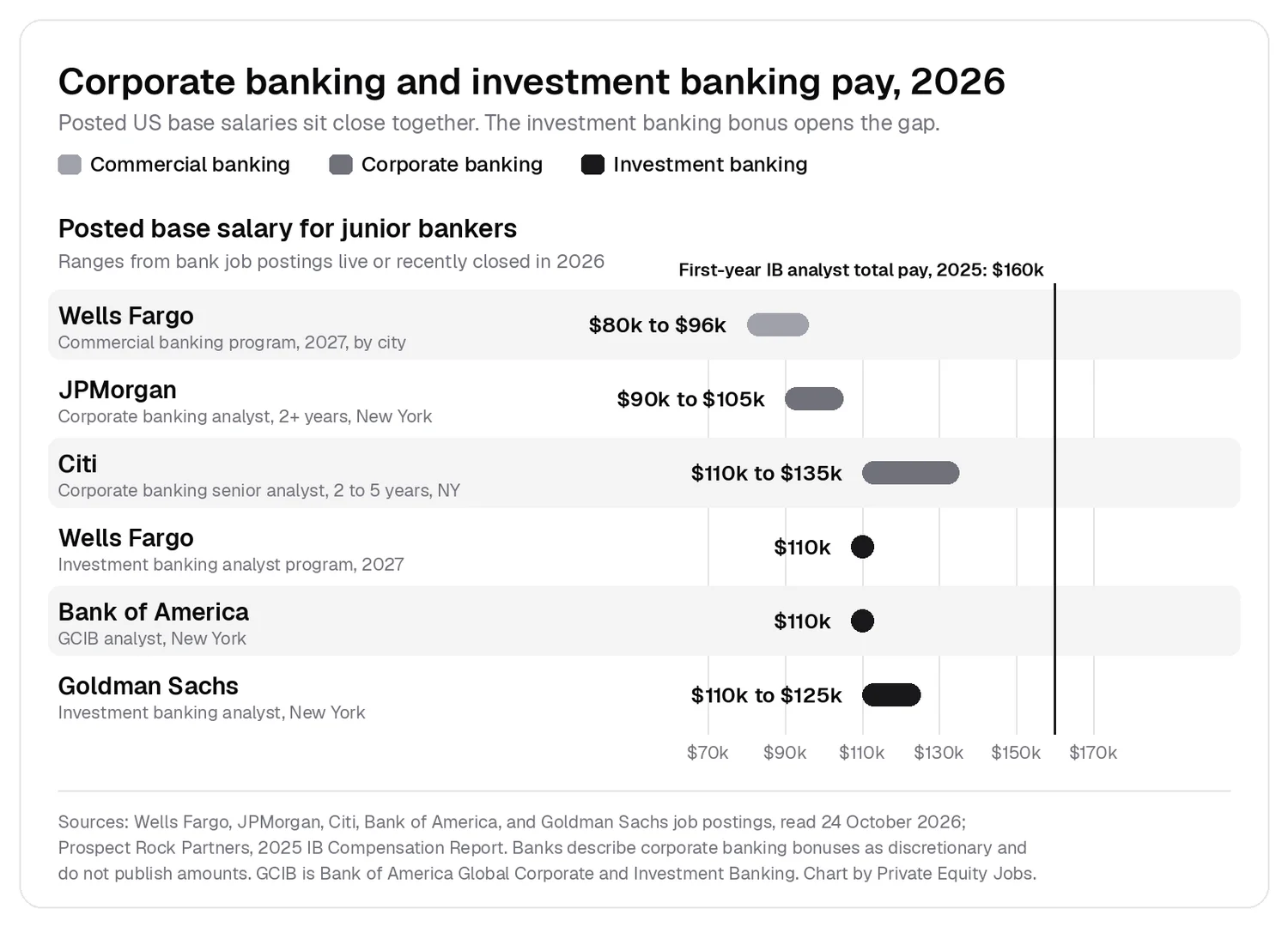
| Seat | Bank and location | Posted base salary |
|---|---|---|
| Commercial banking program, 2027 class | Wells Fargo, seven listed cities | $80,000 to $96,000 by city |
| Corporate banking analyst, two or more years' experience | JPMorgan, New York | $90,000 to $105,000 |
| Corporate banking senior analyst, two to five years' experience | Citi, New York | $110,000 to $135,000 |
| Investment banking analyst program, 2027 class | Wells Fargo, San Francisco and Los Angeles | $110,000 |
| Global Corporate and Investment Banking analyst | Bank of America, New York | $110,000 |
| Investment banking analyst, Capital Solutions | Goldman Sachs, New York | $110,000 to $125,000 |
Sources: Wells Fargo commercial banking program listing on Built In; JPMorgan and Citi postings linked above; Wells Fargo investment banking listing linked above; Bank of America listing on Built In NYC, removed 13 July 2026; Goldman Sachs careers site.
Three points follow from the postings. First, entry base pay for investment banking analysts clusters at $110,000 across banks. Second, corporate banking analysts with two or more years of experience are posted at or slightly below that figure, and Citi's senior analyst range sits above it. Third, commercial banking programs start lower, at $80,000 in Atlanta, Charlotte, Houston, and Dallas and $96,000 in Boston and Chicago at Wells Fargo, with Minneapolis at $88,000.
The bonus is where the two jobs separate. In Prospect Rock Partners' 2025 compensation report, first-year investment banking analysts reported total pay of $160,000, which implies a bonus of about $50,000 on a $110,000 base. The gap grows with seniority. Prospect Rock found that a first-year vice president earned a $255,000 base and a $250,000 bonus, that bonus could make up 70 to 77 percent of total pay at senior levels, and that managing directors with four or more years in the title had a median of $1.1 million. No comparable survey covers corporate banking, and the JPMorgan, Citi, and Wells Fargo postings describe bonuses only in general terms, as discretionary or incentive awards on top of salary. Corporate banking bonuses are generally a smaller share of pay because a lending relationship produces steadier, smaller annual revenue than a run of advisory and underwriting fees.
Posted base pay for corporate banking stays below investment banking higher up the ladder too. In October 2026 Citi posted $200,000 to $225,000 for a corporate banking vice president in the same capital management team in New York, asking for six to 10 years of experience. Prospect Rock's first-year investment banking vice presidents reported a $255,000 base.
Per hour, the gap narrows. An analyst paid $160,000 for 80-hour weeks earns about $38 an hour over a full year. A salary of $100,000 over 50-hour weeks works out to about the same.
Hours and lifestyle
Investment banking hours follow the deal. A signing date, a filing deadline, or a buyer's markup can turn a quiet week into a series of late nights, and junior bankers absorb most of it. JPMorgan told Fortune in 2024 that it would limit junior bankers to 80 hours a week in most cases, with live deals exempt, and Bank of America, which already capped junior hours at 80, began requiring US bankers to log hours daily. Bankers told the Wall Street Journal that an 80-hour week can mean six days of roughly 8:30 a.m. to 10 p.m.
Corporate banking hours follow the credit process and the client calendar. Work peaks when a new loan goes to committee, when annual reviews come due, at quarter-end covenant checks, and when a client does a deal that the bank is financing, at which point the corporate banker works alongside the investment bankers. Outside those peaks the job keeps closer to standard office hours, a common reason people choose it. Hours vary by bank and group, though. A corporate banker in a group that finances acquisitions for private equity firms works on the deal calendar more often than one covering investment-grade companies that borrow once every few years.
Titles and career path
The title ladder looks the same in both businesses: analyst, associate, vice president, director or executive director, and managing director. The jobs at each level differ.
In investment banking, analysts build the models and documents, associates check and manage the work, vice presidents run deals day to day, and directors and managing directors win mandates.
In corporate and commercial banking, the path splits after the first few years into two tracks:
- Relationship managers cover a portfolio of clients, bring in new business, and are judged on the revenue and returns of their relationships. The senior version owns the bank's most important accounts and directs the bank's product specialists for each.
- Credit and portfolio managers underwrite new loans, monitor existing ones, and sign off on risk. This track leads toward senior credit officer roles, which approve the loans that relationship managers bring in.
Wells Fargo's commercial banking program lists the roles its graduates move into: relationship manager, business development officer, portfolio manager, business execution consultant, credit product sales specialist, and credit product portfolio specialist. Pay in corporate banking tends to rise more gradually than in investment banking, because a relationship manager's book of clients grows over years rather than with each closed deal.
Exits and moving into investment banking
Investment banking is the more common route to the buy side. Analysts leave for private equity, hedge funds, growth equity, and corporate development, the most common investment banking exit opportunities. Private equity firms hire from investment banking because the analyst has already built the valuation and leveraged buyout models a fund uses to buy companies.
Corporate banking leads to a different set of jobs:
- Senior corporate banking and credit roles. Many corporate bankers stay and build a client book, which is the clearest path to senior pay inside the bank.
- Investment banking. Lateral moves happen. A corporate banking analyst with strong reviews can move into an industry or capital markets group at the same bank, often at the analyst level, or join investment banking as an associate after business school. The move requires learning valuation and merger modeling, which the corporate banking job rarely uses.
- Private credit. Private credit funds lend directly to companies, often those owned by private equity firms, and they value credit memo skills. The odds depend on the group. Corporate bankers who have lent to companies owned by private equity firms, or who sit in a lending group focused on one product such as asset-based loans, have the most relevant experience. Private credit interviews often add a leveraged buyout model, so candidates from investment-grade coverage groups need to learn one.
- Corporate finance. A treasury or finance role at a client company is a common move for corporate bankers who want regular hours, because the client already knows them.
A direct move from corporate banking into a private equity associate role is rare, because private equity firms recruit mostly from investment banking analyst classes. The usual way to break into private equity is through two or three years as an investment banking analyst.
Which one to choose
The choice comes down to the job you want after this one.
Choose investment banking if the goal is private equity, a hedge fund, or another buy-side seat, or if you want the higher ceiling on pay and accept the hours and less predictable schedule. Investment banking also suits people who want to work on mergers and capital raising, which corporate bankers see from the side.
Choose corporate banking if you want a long career at a bank built on client relationships, prefer credit analysis to valuation, or want more predictable hours at a base salary close to investment banking. It is also a sound route into private credit if you pick a lending group that works with companies owned by private equity firms.
Choose commercial banking if you want to work with smaller companies, stay in a particular region, or start with the broadest training in credit. The base pay is lower, and the move to investment banking is longer.
If you hold only a corporate banking offer and want to reach investment banking, take it and build the case for a lateral move: strong reviews, valuation skills learned on your own time, and relationships with the investment bankers who cover your clients.
Common questions
Is corporate banking better than investment banking?
Neither is better for everyone. Investment banking pays more and leads to more buy-side jobs. Corporate banking offers base pay close to investment banking, shorter and more predictable hours, and a long career inside a bank.
Is corporate banking a high-paying job?
Yes. Posted 2026 base salaries for corporate banking analysts in New York ran from $90,000 to $105,000 at JPMorgan and $110,000 to $135,000 for senior analysts at Citi, around or above the $102,740 national median for financial and investment analysts. Citi posted $200,000 to $225,000 for a corporate banking vice president. Bonuses are smaller than in investment banking.
Is J.P. Morgan a commercial or investment bank?
Both. In its 2025 Form 10-K JPMorgan Chase describes itself as "a leader in investment banking, financial services for consumers and small businesses, commercial banking, financial transaction processing and asset management," and its Commercial & Investment Bank segment contains corporate banking, commercial banking, and investment banking. In 2025 that business earned $10.2 billion from investment banking, $7.6 billion from lending, and $19.3 billion from payments.
Which is better, corporate finance or investment banking?
Investment banking pays more and builds transaction skills faster. Corporate finance offers regular hours and a path to senior finance roles inside one company, such as treasurer or chief financial officer. Many investment bankers later move into corporate finance roles at companies.
Can you move from corporate banking to investment banking?
Yes, usually through an internal transfer to an industry or capital markets group, or through business school and an associate role. Credit skills transfer; valuation and merger modeling have to be learned.
Sources
- JPMorgan Chase & Co., Form 10-K for 2025, filed with the US Securities and Exchange Commission, February 2026.
- JPMorgan Chase, Global Corporate Banking Subsidiary Banking Analyst posting, job 210787304, posted 12 October 2026.
- Citi, Corporate Banking Senior Analyst, Global Capital Management posting, job 26997697, and Corporate Banker, Global Capital Management, Vice President posting, job 26997737, both posted 19 October 2026.
- Wells Fargo, 2027 Commercial Banking Early Career Development Program listing (Built In, posting end date 18 September 2026) and 2027 CIB Investment Banking Analyst Program listing (Simplify, posting end date 7 August 2026), read 24 October 2026.
- Bank of America, GCIB Analyst listing (Built In NYC), removed 13 July 2026, read 24 October 2026.
- Goldman Sachs, Capital Solutions Group (Latin America) analyst posting, role 186685, read 24 October 2026.
- Prospect Rock Partners, 2025 IB Compensation Report, March 2026.
- US Bureau of Labor Statistics, Occupational Outlook Handbook: Financial Analysts (May 2025 wages).
- Federal Reserve History, Banking Act of 1933 (Glass-Steagall) and Financial Services Modernization Act of 1999 (Gramm-Leach-Bliley).
- Fortune, JPMorgan caps junior bankers' hours, 12 September 2024.
Related posts
Related posts

Investment banking and consulting now start at almost the same base pay. How the work, fees, recruiting, interviews, bonuses, hours, and exits to private equity compare, with 2026 data.

Venture capital is equity money that funds put into young, fast-growing private companies. How a VC fund works, the stages, deal terms, fees and carry, returns, and who provides it.

The investment banking ladder runs from analyst to associate, vice president, director, and managing director. What each level does, how long promotions take, posted pay at every rung, hours, and when people leave.