
A pitch book is the presentation an investment bank prepares to win work from a client. Bankers build it in PowerPoint, print it or send it as a PDF, and walk the client through it in a meeting. A typical book introduces the bank and the team, shows deals the bank has done, describes the client's company and market, puts a preliminary value on the business, and recommends what to do next, such as selling the company, buying a rival, or raising debt or equity. The audience is usually a chief executive, a chief financial officer, a board of directors, or a special committee of independent directors. Bankers also use "pitch book" loosely for almost any deck they bring to a client, including the board presentations they deliver after they are hired.
Most pitch books stay private, but some are filed with the Securities and Exchange Commission (SEC). When a public company is taken private by insiders, its going-private filing must include outside reports "materially related" to the deal, so bank decks appear as exhibits on EDGAR, the SEC's public filing database. One of them is Goldman Sachs's 35-page draft pitch to the special committee of the technology company Airvana, dated July 14, 2009, five days after the committee was formed. The committee hired Goldman on July 27. Reading that document next to the board materials Goldman filed for the same committee five months later shows the difference between a book that sells a bank and a book that advises a client.
What a pitch book is
A pitch book is a sales document. It is written before the bank has a mandate, the formal engagement that makes it the client's adviser on a transaction, and its purpose is to get that mandate. The bank's senior bankers present it, and the client's decision makers receive it. When several banks compete for the same mandate, each presents its own book in a separate meeting, a round that bankers call a bake-off. On a sale of a company, that is the founder or the chief executive and the board. On a going-private deal, it is the special committee that the board forms to negotiate with the insiders who want to buy the company.
The meeting matters as much as the pages, and banks print disclaimers that say so. J.P. Morgan's February 2013 presentation to Dell's board, filed as an exhibit, states that the materials are "incomplete without reference to, and should be viewed solely in conjunction with, the oral briefing provided by J.P. Morgan." Its pages are marked "DRAFT Preliminary Analysis" and "For Discussion Purposes Only."
Inside banks the name stretches. Bankers call the deck for a first meeting a pitch book, and they often call the process updates, valuation discussions, and board presentations that follow by the same name. Filings use more formal titles, such as "discussion materials" and "presentation to the board of directors." For the client, the difference is that a pitch argues for hiring the bank, while board materials are the advice the bank gives once it is hired.
Three other uses of the word cause confusion. PitchBook is a financial data company whose database of private companies, deals and funds shares the name; it is not a document. A startup pitch deck is the presentation a founder uses to raise money from investors; it describes the founder's own company and asks for capital, while a bank's pitch book describes the client's company and asks for the assignment. Asset managers and financial advisers also call the deck they show prospective clients a pitchbook; it presents a fund or strategy and its performance against a benchmark rather than a transaction.
Types of pitch books
Banks build different books for different mandates. The opening pages on the bank and its team change little from book to book, while the analysis changes with the mandate.
General credentials or bank book
A credentials book, sometimes called a bank book or a general pitch, introduces the bank to a company it does not yet cover. It shows the bank's platform, league table rankings, and a list of closed deals in the client's industry, often as tombstones, the small boxes that name the deal, the parties and the size. It may include a market update for the sector. There is little or no analysis of the client's company. Coverage bankers use these books to start relationships and to stay in front of companies between deals.
Sell-side pitch
A sell-side pitch asks to run the sale of the client's company or a division. It covers how buyers will see the company and how the bank would position it to them, a preliminary valuation, a list of likely strategic buyers and private equity firms, and the recommended process: a broad auction, a narrow process with a few bidders, or a direct negotiation with one party. On a sell-side mandate, the bank represents the seller and earns most of its fee when the deal closes.
Goldman's 2009 Airvana pitch is a sell-side pitch to a special committee. Its first page of substance poses the committee's questions: whether now is the right time to sell the company, what other alternatives exist, and whether to run a broad or a narrow process. Section I, "Why Goldman Sachs For This Assignment," runs from page 3 to page 9 and includes mergers and acquisitions (M&A) league tables for 2002 to 2008 with the claim "58% of Goldman Sachs' Deals are Sell-Sides."
Buy-side pitch
A buy-side pitch goes to a company or a private equity firm that might acquire a business. It profiles possible targets, shows what each might cost and how the buyer could pay for it, and often tests whether the deal adds to the buyer's earnings per share. Buy-side pitches are filed less often than sell-side materials, because most acquisition ideas never become deals, and an idea that does not become a deal leaves no filing.
Financing and capital markets pitch
A financing pitch asks to raise money for the client. An equity capital markets pitch for an initial public offering (IPO) covers how investors would value the company, a range of offering sizes and prices, and the bank's record of underwriting similar offerings. A debt pitch covers the loan or bond markets, the leverage the company can carry, and the likely pricing. Leveraged finance teams pitch private equity firms on the debt for a leveraged buyout. These books have no list of buyers; the market pages and the terms take their place. Restructuring bankers pitch a company in financial distress, or a group of its creditors, on the options for its debt, such as an out-of-court exchange, a Chapter 11 filing, or a distressed sale.
Special committee and fairness materials
When a board or a special committee is weighing a sale, its bank delivers a series of decks: process updates, valuation discussions, and, at the end, the analysis behind the fairness opinion, a letter stating that the price is fair from a financial point of view to the shareholders. These are not pitches, but they share the format, and they are the bank books most often found in public filings. Goldman's December 17, 2009 "Discussion Materials Prepared for the Atlas Special Committee" (Atlas was the code name for Airvana) follows this pattern: a transaction overview, a financial overview, market performance and a status quo valuation, an "Illustrative Proposed Transaction Analysis," and an appendix of valuation support. The price under review was $7.65 per share, an equity value of $536 million and a 23% premium to the share price at the time.
What goes in a pitch book, in order
Most pitch books follow the same order. The pages that sell the bank come first, the pages about the client come next, and the recommendation comes last.
- Cover and disclaimer. The client's name or a code name, the bank's name, and the date. The disclaimer limits who may rely on the book.
- Team page. The bankers who would work on the deal, with titles and experience. Senior names go first.
- Situation overview or executive summary. The client's situation as the bank sees it, the questions the client faces, and the bank's short answer.
- Bank credentials. League tables, relevant deals, and case studies. In a credentials book this section is most of the book.
- Company and market overview. The client's business, recent results, share price performance for a public company, the industry, and recent deals and financings in the sector.
- Valuation. Preliminary ranges from several methods, summarized on a football field chart.
- Buyers, targets, or investors. Who might buy, be bought, or invest, and how each would value the deal.
- Transaction analysis and issues. For a merger, whether the deal adds to or dilutes the buyer's earnings per share, the synergies needed to pay for it, and a contribution analysis comparing what each side brings with the share of the combined company it would own; for any deal, the risks and how the bank would handle them.
- Process and timeline. How the bank would run the deal and how long each stage would take.
- Recommendation and next steps. What the bank suggests the client do now.
- Appendix. Detailed comparable company tables, transaction lists, assumptions, and banker biographies.
The Airvana pitch follows this order with sections that fit a special committee. After the cover and team page come "Summary Observations on Potential Next Steps for the Special Committee," the credentials section, a section titled "Issues for the Special Committee" (pages 10 to 15) that includes a page titled "Challenges to 'Going Private' Transactions Have Arisen," and an overview of Airvana (pages 16 to 25) that includes share price performance, comparisons with similar companies, customer concentration, a "Preliminary Hypothetical Airvana Analysis at Various Prices," and a page of "Selected Private Capital Players in the Space," the buyout firms that might bid. Page 15, "Role of Goldman Sachs in Assisting the Special Committee," lists what the bank would do if hired: diligence, valuation, dealing with the management buyout group, and negotiating. Additional materials on the shareholder base, banker biographies, and a disclaimer close the book.
The following is an illustrative layout of a sell-side pitch book, not a copy of any bank's book.
| Section | What the pages show | Who usually drafts it |
|---|---|---|
| Situation overview | The client's options and the bank's view in one or two pages | Managing director and vice president, written by the associate |
| Bank credentials | League tables, sector deals, case studies | Analyst, from the bank's deal database and earlier books |
| Company overview | Business description, results, share price chart | Analyst, from filings and data services |
| Valuation | Comparable companies, precedent transactions, discounted cash flow, football field | Analyst builds; associate checks |
| Buyers | Strategic buyers and private equity firms, with reasons each would bid | Associate and vice president, with sector bankers |
| Process | Auction or negotiated sale, timeline, next steps | Vice president and managing director |
| Appendix | Supporting tables, biographies | Analyst |
The valuation pages
Valuation pages give the client a first sense of what the business is worth. Before a mandate, they rely on public information and the client's published results, so the ranges are wide and labeled preliminary. Most books use some combination of these methods.
- Trading comparables. The value of similar public companies as a multiple of earnings, most often enterprise value to EBITDA (earnings before interest, taxes, depreciation, and amortization), applied to the client's numbers.
- Precedent transactions. The multiples paid in past acquisitions of similar companies. They usually run higher than trading multiples because they include a premium for control.
- Discounted cash flow. The present value of the company's projected cash flows, which depends on the discount rate and on a terminal value at the end of the forecast.
- Leveraged buyout analysis. The price a private equity firm could pay and still reach a target return, given the debt it could raise. Banks include it when a private equity buyer is plausible, as Morgan Stanley did for Nordstrom.
- Premiums paid. The percentage above the unaffected share price that buyers paid in past acquisitions of public companies, applied to the client's own share price.
- Reference ranges. The 52-week trading range and analysts' price targets, shown for context rather than as valuations.
A football field chart puts all of these on one page. Each method is a horizontal bar showing the low and high value per share or enterprise value, and vertical lines mark the current price, the unaffected price, or an offer. The client can see in one view where an offer falls against each method.
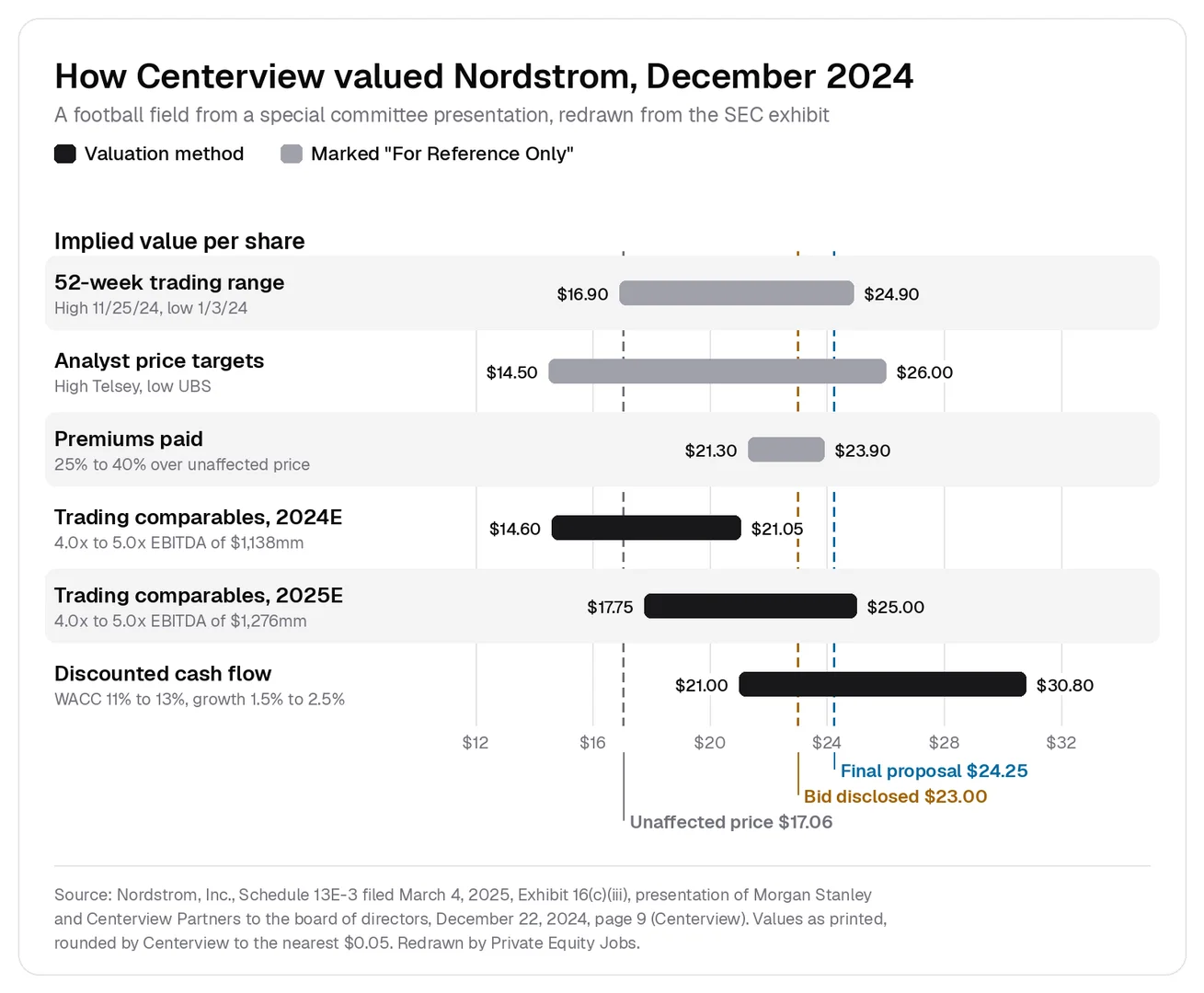
The chart above is redrawn from page 9 of the December 22, 2024 presentation that Morgan Stanley and Centerview Partners gave Nordstrom's board of directors, filed with the company's going-private statement. Centerview's page shows six bars. Three are marked "For Reference Only": the 52-week trading range ($16.90 to $24.90), analysts' price targets ($14.50 to $26.00), and premiums paid of 25% to 40% over the unaffected price ($21.30 to $23.90). The other three are the valuation methods: trading comparables at 4.0x to 5.0x estimated 2024 EBITDA of $1,138 million ($14.60 to $21.05), the same multiples on estimated 2025 EBITDA of $1,276 million ($17.75 to $25.00), and a discounted cash flow at an 11% to 13% weighted average cost of capital and a 1.5% to 2.5% perpetual growth rate ($21.00 to $30.80). Lines mark the $17.06 unaffected price, the $23.00 price the buyer group disclosed in September, and its final proposal of $24.25. The $24.25 line sits above the 2024 comparables range, near the top of the 2025 comparables range, and inside the discounted cash flow range. Morgan Stanley's version of the same analysis, on the preceding page, adds a leveraged buyout row, showing the price a buyer could pay and earn a 17.5% to 22.5% internal rate of return.
Banks also show how much the value depends on the forecast. J.P. Morgan's February 2013 deck for Dell's board ran each method against several sets of projections: an illustrative Wall Street consensus, the company's internal fiscal 2014 plan, the board's preliminary plan, and cases prepared by the Boston Consulting Group. The market pages applied 3.5x to 5.5x fiscal 2014 EBITDA and 5.0x to 10.0x fiscal 2014 earnings, and the discounted cash flow used a 9.5% to 13.5% discount rate and a 3.5x to 5.5x exit multiple. A line marked the $13.65 offer from the buyer group, code-named Salamander, against the $10.88 unaffected price. A separate page showed the sources and uses of funds at that price: $17,900 million of debt and $5,803 million of equity, a total of $23,703 million.
Who builds which part
Analysts, associates, vice presidents, and managing directors each have a part in a pitch book.
The managing director owns the client relationship, decides what the bank will recommend, and presents the book. The Airvana team page names only senior bankers: managing directors with titles such as global head of communications technology investment banking, head of technology M&A, co-head of technology financing, and global head of raid and activism defense, and two vice presidents, with years of experience listed from 8 to 35. No analyst or associate appears on it. Managing directors also decide when a book is ready to send.
The vice president runs the work. Citi's 2026 posting for a vice president in its Shanghai coverage team lists "drafting situation analyses, pitch materials, information memoranda, investor and management presentations" and the duty to "oversee work being performed by analysts & associates." The same posting says the vice president will "drive pitch preparation and business development efforts in collaboration with Directors and MDs." The vice president turns the managing director's view into an outline, decides which pages the book needs, and reviews every draft before it goes up the chain.
The associate writes the story and checks the numbers. An associate drafts the situation overview and the key messages, decides which analyses support them, and reviews the analyst's valuation work before the vice president sees it.
The analyst builds most of the pages. Citi's October 2026 posting for a senior analyst in its Metals and Mining group in Los Angeles, with a posted base salary of $110,000 to $135,000, asks the analyst to "prepare high-quality written recommendations, valuation materials, and statistical exhibits for both pitch presentations and active transactions." Its posting for a senior analyst in M&A in London uses nearly the same words: "valuation materials and statistical exhibits for pitches and live deals." The analyst pulls financial data, updates the comparable company and transaction tables, runs the valuation, formats the charts, and makes every comment change the senior bankers request.
How a pitch book gets made
A pitch starts with a meeting date. A managing director learns that a company is considering a sale, a financing, or an acquisition and gets a meeting, and the date of that meeting sets the deadline. Work then runs in roughly this order.
- Outline. The vice president and associate agree on the pages with the managing director. Many books start from an earlier book for the same industry.
- Data. The analyst pulls the client's filings, share price history, research estimates, and transaction data, and updates the comparable company set. Some banks keep this material in a public information book, a binder of the company's filings, research reports, and news.
- Analysis. The analyst runs the valuation methods and any deal-specific work, such as the leveraged buyout analysis or a buyer's ability to pay.
- Pages. The analyst builds the slides in the bank's template; the associate writes the text on the key pages.
- Comment rounds. The associate, then the vice president, then the managing director mark up the draft. Each round changes numbers, charts, and wording, and every change has to carry through to every page where the number appears.
- Checking. Before the book goes out, the team checks page numbers, footnotes and sources, chart titles, logos, and that each figure matches across pages. Compliance or legal review may apply, especially for capital markets pitches.
- Delivery. The book is printed and bound for an in-person meeting or sent as a PDF. The senior bankers named on the team page present it.
The pace depends on the meeting date. Goldman's Airvana draft is dated July 14, 2009, five days after the special committee was formed. Once a bank is hired, it produces a series of decks, each dated and each building on the last, and the filings show how many a single deal produces. Airvana's filing includes five Goldman presentations to the special committee, dated from July 14 to December 17, 2009. Dell's 2013 going-private statement includes 27 adviser presentations to the board or its special committee as exhibits: 14 from J.P. Morgan, delivered on 13 dates between September 14, 2012 and February 4, 2013, four from Evercore, two from Goldman Sachs, and seven from the Boston Consulting Group. Nordstrom's 2025 filing lists 16 decks from Morgan Stanley and Centerview delivered between February 4 and December 22, 2024.
Pitch book vs confidential information memorandum, teaser and other deal documents
A sale of a company produces several documents that look alike. They differ in who writes them, who reads them, and when.
| Document | Prepared by, for | When | Purpose | What is in it |
|---|---|---|---|---|
| Pitch book | Bank, for the client | Before the bank is hired | Win the mandate | Bank credentials, the client's situation, preliminary valuation, recommended process |
| Teaser | Bank, for possible buyers | Start of a sale process | Get buyers to sign a non-disclosure agreement | One or two pages describing the company without naming it |
| Confidential information memorandum | Bank and seller, for buyers under a non-disclosure agreement | After the teaser | Give buyers enough to make a first bid | Detailed description of the company, its market, management and financials |
| Management presentation | Seller's management with the bank, for shortlisted buyers | Second round | Let buyers meet management and test the plan | The company's strategy and forecasts, presented live |
| Investor deck | Company with its bank, for investors | Capital raise or IPO roadshow | Sell shares or debt to investors | Business, growth, financials, terms of the offering |
The pitch book is the only one of these written to sell the bank. Once the bank is hired, its work turns to the documents for buyers. A confidential information memorandum describes the company in detail and goes out only after a buyer signs a non-disclosure agreement; a pitch book describes the bank's view of the company and goes to the client.
The management presentation and the investor deck are the company's own story, delivered by its executives, with the bank drafting much of the material. The Nordstrom deck shows the outreach that a sell-side process creates: Morgan Stanley and Centerview contacted 19 strategic and financial parties, 10 signed non-disclosure agreements, and 8 received further due diligence information and met with management.
Real pitch books you can read
Bank presentations reach the public mainly through going-private transactions. Under Rule 13e-3, when insiders or an affiliate take a public company private, they file a Schedule 13E-3 with the SEC. Item 1015 of Regulation M-A asks whether the filer "has received any report, opinion (other than an opinion of counsel) or appraisal from an outside party that is materially related to the Rule 13e-3 transaction," and requires a summary that covers "the procedures followed; the findings and recommendations; the bases for and methods of arriving at such findings." It also requires disclosure of any material relationship between the adviser and the parties in the past two years "and any compensation received or to be received." Item 1016(c) requires the filer to attach "any report, opinion or appraisal referred to in response to Item 1014(d) or Item 1015" as an exhibit. Banks' board decks count as such reports, so they are filed in full, sometimes with redactions.
To find them, search EDGAR for a company's filings of type SC 13E3 (and amendments, SC 13E3/A) and open the exhibits numbered (c). In Dell's filing, exhibits (c)(1) and (c)(2) are the two fairness opinions and the later (c) exhibits are the presentations. Three worth reading:
- Airvana, 2009 (Goldman Sachs). Exhibit (c)(3) is the July 14 draft pitch to the special committee, the closest filed example of a pre-mandate pitch. Exhibit (c)(2) is the December 17 discussion materials for the $7.65 per share sale. Read together, they show the same bank before and after it was hired.
- Dell, 2013 (J.P. Morgan, Evercore, Goldman Sachs, Boston Consulting Group). The exhibit list shows how many decks one management buyout produced. J.P. Morgan's titles include "Perspectives on Denali," the code name for Dell. Exhibit (c)(5), the February 4, 2013 board presentation, has a situation overview, the valuation pages described above, and an appendix of one-day premiums paid in 433 US deals over $1 billion since 2009 and in 35 leveraged buyouts of that size. Redacted passages are marked [***] under the SEC's confidential treatment rule.
- Nordstrom, 2024 (Morgan Stanley and Centerview Partners). Exhibit 16(c)(iii), "Project Norse," dated December 22, 2024, has the outreach summary, both banks' football fields, and the leveraged buyout analysis. The buyer group, members of the Nordstrom family and the Mexican company El Puerto de Liverpool, owned about 43% of the shares and raised its bid from $23.00 to $24.25 per share, about 42% above the unaffected price, plus a special dividend of up to $0.25. Centerview is an elite boutique, and the deck shows how two advisers to one committee present parallel analyses.
Most pitch books are never filed. A pitch to a private company leaves no public record, and when a company is sold to an outside buyer, the merger proxy usually carries a summary of the bank's fairness analysis rather than the deck itself. Going-private deals are different because the buyer is an insider, and Rule 13e-3 requires the analysis behind the price to be filed.
Pitch books in recruiting and the first year
Pitch books come up in interviews because analyst job descriptions, such as Citi's postings above, list pitch materials among the core duties. Common questions include what pages a typical pitch book contains, how a candidate would structure a sell-side pitch, which valuation methods belong in it and why, and what a football field chart shows. A candidate who has read a filed deck can answer with a real example, such as the order of the Airvana pitch or the way the Nordstrom bars sit against the offer line. Bank interviews also test the valuation methods behind those pages, and candidates for private equity roles later meet the same analysis in a leveraged buyout modeling test.
For a first-year analyst, pitch work means updating comparable company tables, building valuation pages, turning comments, and checking books before they go out. The skills carry into private equity, where investment professionals receive bank books from the other side and judge whether the valuation pages hold up.
Common questions
What does a pitch book do in investment banking?
It persuades a company to hire the bank for a transaction. The book shows the bank's experience, its view of the company and its value, and how it would run the deal. The meeting where the senior bankers present it matters as much as the pages.
Is a pitch book the same as a confidential information memorandum?
No. A pitch book goes from the bank to the client before the bank is hired. A confidential information memorandum goes from the bank, on the seller's behalf, to possible buyers after they sign a non-disclosure agreement, and describes the company in much more detail.
How long is an investment banking pitch book?
It depends on the type. Goldman's 2009 Airvana pitch ran 35 pages including banker biographies and a disclaimer. J.P. Morgan's February 2013 board deck for Dell had a 13-page situation overview, valuation pages from page 14, and an appendix from page 21.
Who makes pitch books?
Analysts build most of the pages, associates write the story and check the numbers, vice presidents manage the work, and managing directors decide the message and present it. Citi's 2026 postings assign "valuation materials" and "statistical exhibits" for pitches to analysts and "drafting situation analyses, pitch materials" to vice presidents.
Where can you find real investment banking pitch books?
On EDGAR, in the (c) exhibits to Schedule 13E-3 going-private filings, which must include outside reports materially related to the deal. Airvana (2009), Dell (2013) and Nordstrom (2024) are three examples with full decks.
Is a pitch book the same as PitchBook?
No. PitchBook is a financial data company with a subscription database of private companies, deals, and investors. A pitch book is a bank's presentation to a client.
Sources
- Airvana, Inc., Schedule 13E-3, Exhibit (c)(3), draft presentation of Goldman Sachs to the special committee, July 14, 2009, and Exhibit (c)(2), Discussion Materials Prepared for the Atlas Special Committee, December 17, 2009, filed January 15, 2010.
- Dell Inc., Schedule 13E-3 filing index, March 2013, and Exhibit (c)(5), J.P. Morgan presentation to the board of directors, February 4, 2013.
- Nordstrom, Inc., Schedule 13E-3, 2025, and Exhibit 16(c)(iii), Project Norse presentation of Morgan Stanley and Centerview Partners to the board of directors, December 22, 2024.
- Electronic Code of Federal Regulations, 17 CFR 229.1015, Item 1015 of Regulation M-A, Reports, opinions, appraisals and negotiations, and 229.1016, Item 1016, Exhibits.
- Citi postings, 2026: Investment Banking Senior Analyst, Metals & Mining, Los Angeles (job 26999512); Investment Banking Senior Analyst, M&A, London (job 26998637); VP, Coverage Banker, Investment Banking, Shanghai (job 26977088).
Related posts
Related posts

Corporate finance runs a company's own money; investment banks advise companies on deals for a fee. The jobs inside each, 2026 posted pay, recruiting, hours, and how people move between them.

Investment banks are paid per deal; asset managers are paid a percentage of the money they run. How the jobs, recruiting, pay, hours, and career paths compare, with 2026 postings, MBA reports, and 10-K filings.

What an investment banking associate does, how the job differs from analyst and vice president, posted 2026 pay at five banks, the MBA and lateral routes in, licenses, and interviews.