
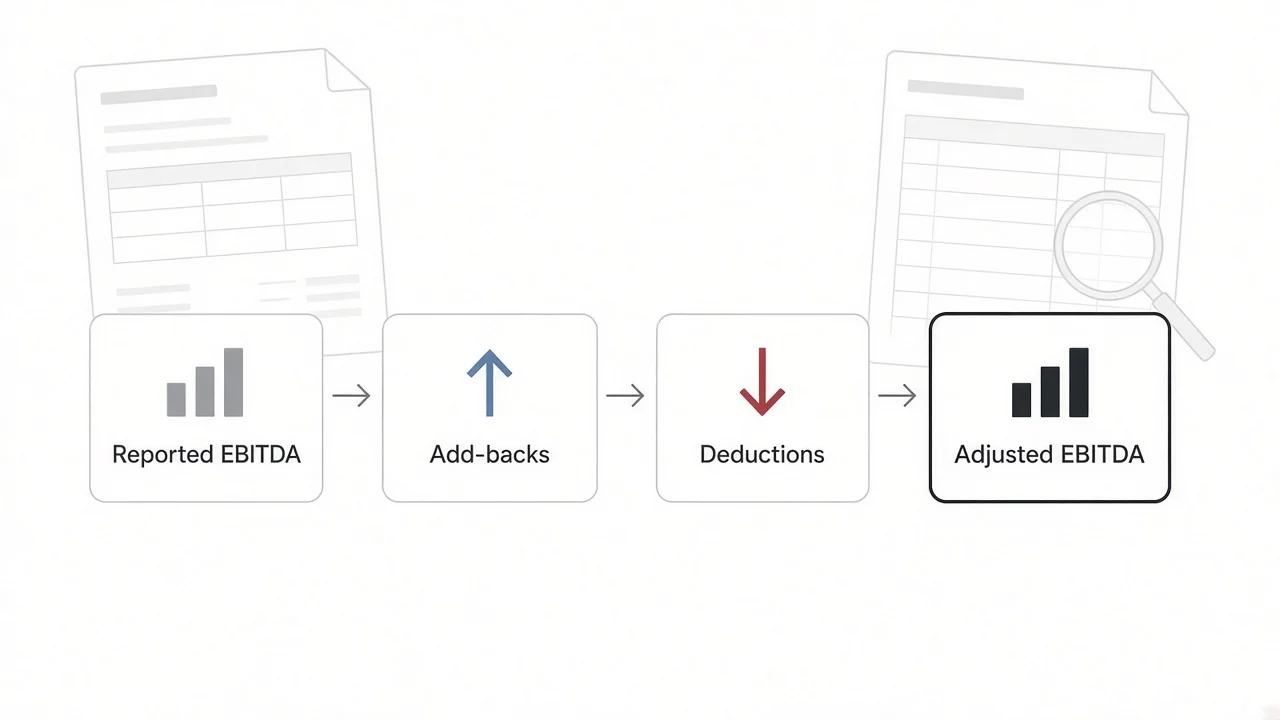
A quality of earnings report is an independent rebuild of a company's profit, usually prepared by accountants during the sale of a business, that tests whether the earnings a seller presents are real, recurring, and backed by cash. Buyers price most private companies as a multiple of earnings before interest, taxes, depreciation and amortization (EBITDA), and lenders size their loans on the same figure, so the report's adjusted EBITDA, together with its work on working capital and debt, tends to become the number the deal is built on. When the coffee company Farmer Bros. agreed in 2026 to sell itself to an affiliate of the investment firm Braemont Capital, its merger proxy statement recorded that a rival that later joined the buying group would not begin talks until it had seen the company's quality of earnings analysis, and the price fell from $2.00 a share at the letter of intent to $1.29 at signing, first on diligence findings about cost cuts that would not last, a larger pension deficit, and rising debt, then on deductions for deal expenses and bonuses.
What quality of earnings means
The phrase has two uses. Investors and accounting researchers use quality of earnings to describe how well a company's reported profit reflects its economic performance and predicts its future cash flow. Earnings are high quality when they come from repeat sales at stable margins and turn into cash, and low quality when they lean on one-time gains, aggressive estimates, or revenue booked before it is earned. Net income measures how much a company earned in a period under accounting rules. Earnings quality is a judgment about how much of that figure will still be there next year.
In mergers and acquisitions (M&A), quality of earnings, often shortened to QoE or QofE, means a specific piece of financial due diligence. An accounting or advisory firm takes the target's ledgers, bank statements, tax returns, payroll, and contracts and produces a report that walks from reported EBITDA to an adjusted figure the firm believes a new owner can expect. The private equity glossary defines it as the test of whether the EBITDA a buyer is paying a multiple on is solid.
The quality of earnings ratio
Public-market analysts measure earnings quality from published statements, and the common shortcut is the quality of earnings ratio, which divides cash flow from operating activities by net income. A ratio above 1.0 means the company turned more than its reported profit into operating cash. A ratio persistently below 1.0 means profit is running ahead of cash, often because receivables, inventory, or capitalized costs are growing faster than sales.
A company that reports net income of $50m and operating cash flow of $65m has a ratio of 1.3. If the next year shows the same $50m of profit but $30m of operating cash, the ratio drops to 0.6, and the analyst turns to the balance sheet to see whether customers are paying more slowly, inventory is piling up, or costs once expensed are now capitalized.
A related screen, the Sloan ratio, takes net income minus operating and investing cash flow and divides the result by total assets, so a high reading means more of the profit is accruals rather than cash. It is named for the accounting researcher Richard Sloan, whose 1996 study in The Accounting Review found that the accrual part of earnings persists less than the cash part and that companies with high accruals went on to earn lower stock returns.
Both ratios work only as a first screen. Fast-growing companies consume working capital legitimately, and neither ratio can see an owner's personal expenses in the cost base or a customer about to leave. That needs the records, which is why private buyers commission a report.
What a quality of earnings report contains
No standard format exists, and the client sets the scope. Most reports cover the same core analyses in a written report with an executive summary and an Excel databook that traces every adjusted number to the ledger, which the buyer's deal team loads into its model.
The adjusted EBITDA bridge
The center of the report is a table that starts at net income, adds back interest, taxes, depreciation and amortization to reach reported EBITDA, then lists every adjustment needed to reach adjusted EBITDA, each with an amount by period and a note on the evidence. Good reports show management's proposed adjustments beside the accountant's view, so a reader can see which add-backs were accepted, reduced, or rejected. The periods are usually the last two or three fiscal years plus the trailing twelve months, because buyers price and lenders underwrite on the most recent year.
Proof of cash and proof of revenue
A proof of cash reconciles bank statements to the income statement period by period: deposits against revenue, disbursements against expenses. It catches revenue that never arrived as cash, expenses paid outside the books, and owner draws recorded as costs. A proof of revenue ties invoices and contracts to deposits for a sample of customers. The Small Business Administration (SBA) lending rules now require a cash proof covering the trailing twelve months and the last two fiscal years.
Net working capital and the peg
Net working capital in a deal is usually receivables plus inventory plus prepaid expenses, minus payables and accrued liabilities, with cash and debt left out. The report computes it month by month for twelve to twenty-four months, strips out unusual items, and proposes a normal level. That level becomes the target, or peg, in the purchase agreement. If the business delivers less working capital at closing than the peg, the price falls dollar for dollar, and if it delivers more, the price rises. The monthly series also shows whether a seller has stretched payables before the sale.
Net debt and debt-like items
Most private company deals are priced on a cash-free, debt-free basis. The buyer agrees to an enterprise value, and the seller receives that value minus debt plus cash. The report lists the obvious debt, such as bank loans, leases, and shareholder loans, and the items a buyer will argue are debt even though they sit elsewhere on the balance sheet: unpaid taxes, deferred revenue for work not yet done, accrued bonuses, underfunded pensions, deferred compensation, unpaid capital spending, and litigation reserves. Every dollar classified as debt comes off the equity check, so this schedule can move the seller's proceeds as much as an EBITDA adjustment.
Revenue quality and customers
The report breaks revenue down by customer, product, channel, and region, separates recurring from one-time sales, and measures customer concentration. It tests whether large customers renew, flags contracts that expire soon after closing, and separates growth that comes from volume from growth that comes from price increases. Gross margin by product line, days sales outstanding, and days payable outstanding usually sit here.
Common quality of earnings adjustments
Adjustments run in both directions. Add-backs raise EBITDA by removing costs that will not recur. Deductions lower it by removing income that will not recur or by adding costs the books leave out. The adjusted EBITDA in a seller's confidential information memorandum often falls in the buyer's report, and add-backs without support are the usual reason.
Non-recurring items
A lawsuit settlement and its legal fees, a one-time consulting project, banker and legal fees for the sale itself, flood damage, a gain on the sale of equipment, or an insurance payout can be removed if it truly will not repeat. The test is the pattern. A company with a different "one-time" charge in each of the last three years has a recurring cost, and a careful accountant leaves it in.
Owner compensation and related parties
Private companies often pay owners above or below what a hired manager would cost, run personal expenses such as cars, travel, or family salaries through the business, and rent property from entities the owner controls. The report replaces owner pay with a market salary for the role, removes documented personal expenses, and restates related-party rent, supply, or service contracts at market rates. A below-market lease from the owner is a deduction, because the buyer will pay market rent after closing.
Pro forma and run-rate adjustments
Pro forma adjustments restate history as if a known change had been in place for the whole period: a price increase already in effect, a contract signed late in the year, a location closed, a cost program already carried out. The dividing line is evidence. A signed contract or a completed headcount reduction can support an adjustment, and a planned saving usually cannot. Lenders draw the same line. The January 2026 commitment letter for Warburg Pincus and Permira's purchase of Clearwater Analytics caps add-backs for savings "committed to be taken or planned to be taken" at 35% of EBITDA, while savings from actions already taken face no such cap.
Accounting method and timing
Many smaller companies keep books on a cash basis or close the year with large manual entries. The report converts results to accrual accounting so that revenue and costs land in the period they belong to. Typical fixes are bonuses paid in January for the prior year, inventory counted only at year-end, bad-debt reserves that were never set up, and routine repair or software spending capitalized as an asset.
Revenue recognition
Revenue booked before it is earned inflates the current year and borrows from the next. In the United States the rule is Accounting Standards Codification Topic 606 (ASC 606), which recognizes revenue as the company satisfies its obligations to the customer. A drop in deferred revenue in the year before a sale, or a jump in year-end shipments, is the signal the accountant chases. Rebates, discounts, and returns recorded in the wrong period distort results the same way.
Red flags a quality of earnings review turns up
Most findings fall into a short list, and each one lands on a specific line of the deal.
- Profit without cash. EBITDA rises while operating cash flow and the proof of cash do not. This hits adjusted EBITDA and, if receivables are aging, the working capital peg.
- Recurring "non-recurring" charges. Add-backs that appear every year go back into the cost base.
- Customer concentration and churn. A single customer with a large share of revenue, or a large contract ending soon after closing, can lower the price or move part of it into an earnout.
- Capitalized expenses. Costs moved onto the balance sheet keep EBITDA high and push the expense into depreciation.
- Inventory problems. Counts that do not reconcile, obsolete stock carried at cost, or missing purchase accruals change cost of goods sold.
- Cost cuts that will not hold. Deferred maintenance, frozen hiring, or reduced marketing in the year before a sale. Braemont cited "recent cost-cutting measures" it believed "were not sustainable long term" when it lowered its bid for Farmer Bros.
- Hidden liabilities. Sales tax owed in states where the company has nexus, unclaimed property, worker misclassification, underfunded pensions, or pending litigation. These usually become debt-like items or indemnity claims rather than EBITDA adjustments.
Quality of earnings report vs. audit
An audit and a quality of earnings report start from the same ledgers but answer different questions. An audit tests whether financial statements are fairly presented under generally accepted accounting principles (GAAP) and ends with an opinion. A quality of earnings review asks how much of the profit will continue and what that means for price, debt, and closing terms, and ends with findings and a number.
The American Institute of Certified Public Accountants (AICPA) draws the line in its Statement on Standards for Consulting Services, CS section 100. In an attest engagement such as an audit, the accountant expresses a conclusion about an assertion made by someone else. In a consulting engagement, "the practitioner develops the findings, conclusions, and recommendations presented," and the standard lists "analysis of a potential merger or acquisition" among its examples of transaction services. A quality of earnings report is a consulting engagement, with no required format and no defined materiality, and the firm that prepares it does not have to be the auditor.
| Audit | Quality of earnings report | |
|---|---|---|
| Question | Are the statements fairly presented under GAAP? | How much of the earnings will continue under a new owner? |
| Output | Opinion on the financial statements | Adjusted EBITDA, net working capital, net debt, findings |
| Periods | Fiscal year end | Monthly, usually two or three years plus the trailing twelve months |
| Focus | Balance sheet and compliance | Income statement, cash conversion, working capital, debt-like items |
| Adjustments | Corrects misstatements against GAAP | Normalizes one-time, owner, and pro forma items that GAAP allows |
| Standard | Auditing standards; attest | AICPA consulting standards; no set format |
| Who relies on it | Shareholders, lenders, regulators | Buyer, seller, lenders, insurers |
The two are complements. An audited company still gets a quality of earnings review in a sale, because a statement can be correct under GAAP and still include a one-time gain or a cost the buyer will add back. Some lenders accept either one for an acquisition, as Limbach Holdings' 2026 credit agreement with PNC Bank does for larger targets.
A quality of earnings report has limits that follow from its consulting status. It gives no opinion or assurance, relies heavily on records and explanations from management, tests samples rather than every transaction, and is not designed to detect fraud. Its numbers describe the periods reviewed, which is why a deal that runs long needs the report rolled forward. Tax exposure, IT systems, and the commercial outlook fall outside the core scope unless the client adds them.
Buy-side vs. sell-side quality of earnings
A buy-side report is commissioned and paid for by the buyer, usually after a letter of intent is signed and the seller has granted exclusivity, since few buyers spend the fee before they know they have the deal. The buyer's accountants look hardest for items that lower EBITDA, raise debt, or justify protections in the purchase agreement.
A sell-side report, sometimes called vendor due diligence, is commissioned by the seller before the company goes to market. It lets the seller find and fix problems, document add-backs, defend a working capital level, and give bidders a verified starting point. Private equity buyers still commission their own report, but a seller's report narrows the arguments and speeds the process. A problem the seller discloses while several bidders compete costs less than one a single buyer finds during exclusivity.
The Farmer Bros. sale shows the seller's version in a public filing. On April 3, 2025, the company engaged Alvarez & Marsal for a quality of earnings analysis "intended to facilitate diligence and provide interested parties with a more comprehensive and verified picture" of its financial performance. In June, the chief executive of Royal Cup, a rival coffee company that later became the buyer as a Braemont affiliate, said Royal Cup "would need to see the company's quality of earnings analysis before engaging in discussions." Alvarez & Marsal finished in July 2025, covering results through May, and the board then announced its review publicly. Braemont later brought its own "independent quality-of-earnings advisors" to confirmatory diligence.
A seller's report also helps a board compare bids. In the 2025 sale of SigmaTron International, the company's Schedule 14D-9, filed June 26, 2025, records that its banker, Lincoln International, pointed out that one bidder had accepted the results of the company's quality of earnings analysis, while the higher bidder, the private equity firm Transom Capital, still wanted to do further quality of earnings diligence, which "presented a material risk of a potential purchase price reduction."
Some lenders limit the seller's role. Under the SBA's rules, the report for an SBA-guaranteed acquisition loan "must not be prepared by or for the seller."
Who prepares a quality of earnings report
The work is done by the transaction services or financial due diligence groups of accounting and advisory firms: the Big Four, national and regional accounting firms, and advisory firms such as Alvarez & Marsal. Teams mix accountants who came from audit with analysts who have deal experience, led by a partner who signs the report and takes calls from the buyer, the lenders, and the insurers.
Buyers choose providers partly on whom the lenders will accept. The lenders on TPG's buyout of AvidXchange, in a May 2025 commitment letter, accepted adjustments from a report "conducted by financial advisors (which are either nationally recognized or reasonably acceptable" to the lenders' agent) and added that "any of the 'Big Four' accounting firms are acceptable." Sponsors on large deals therefore tend to use the Big Four or a few national firms, while lower middle-market deals use regional firms whose fees fit the deal. Firms generally do not prepare reports for both sides of one deal. When a separate Alvarez & Marsal group did synergy work for Braemont after the firm's quality of earnings engagement for Farmer Bros. had ended, Farmer Bros.' management reviewed the arrangement and found no conflict.
Transaction services is also a route into deal jobs. Private equity firms hire from these teams because the private equity associate spends much of a live deal reconciling the accountants' findings with the model. Accountants who break into private equity from these teams still sit the same modeling tests as bankers, and Private Equity Jobs lists deal and diligence openings at funds.
The quality of earnings process and timeline
The work follows the same sequence at most firms.
- Scope. Client and provider agree on periods, entities, and depth, with or without tax, IT, or proof of revenue.
- Data request. Monthly trial balances and financial statements, general ledger detail, bank statements, tax returns, payroll, receivable and payable agings, customer and vendor lists, contracts, debt agreements, and support for every proposed adjustment.
- Management meetings. Interviews with the CFO and controller, from a couple of hours to a couple of days, on revenue recognition, accruals, unusual items, and the add-backs.
- Analysis. Proof of cash, revenue and margins, the EBITDA bridge, monthly working capital, debt and debt-like items, and follow-up requests as findings appear.
- Draft findings and final report. The provider walks the client through the draft, then finalizes the report and databook, shares it with lenders and insurers if required, and rolls it forward if the deal runs long.
Providers quote anywhere from three to eight weeks, and four to six weeks is the most common range. Cash-basis books, several entities, or slow answers lengthen it. Sellers who plan ahead start six to twelve months before going to market so they have time to fix what the review finds. Owners also commission one when the event is a refinancing, a recapitalization, or a partial sale rather than a full exit.
Private equity buyers build that time into their bids. In the 2026 sale of Varex Imaging, the company's merger proxy statement records that a private equity bidder told the company's banker it could not update its offer on the accelerated timeline without "a discussion with their investment committee and at least 30 days of confirmatory due diligence, including preparation of a quality of earnings report." Varex signed with Teledyne Technologies instead.
How much a quality of earnings report costs
Fees depend on scope more than on deal size. The main drivers are the volume of transactions to test, the number of legal entities and locations, the condition of the books (cash-basis records and late reconciliations add hours), the number of periods, and add-ons such as tax diligence, proof of revenue, or IT review.
Published ranges give a sense of scale. Mowery & Schoenfeld, an Illinois accounting firm, puts a typical report at $20,000 to $30,000. Morgan & Westfield, an M&A advisory firm, cites $5,000 for a minimal report on a small company to more than $100,000 for a complete report on a mid-sized one, and $10,000 to $20,000 for a local firm reviewing a company with less than $10m of revenue.
Who pays follows who commissions. A buyer pays for its own report and counts the fee among deal costs in its sources and uses table. A seller pays for a sell-side report and may see the fee come off its proceeds: the Farmer Bros. board's list of transaction expenses to be deducted from the price included "fees related to the quality of earnings review." Under the SBA rules, a lender may rely on a report the buyer commissioned before applying for the loan only after one of the lender's approved vendors reviews it, a step the agency says is meant "to help mitigate costs."
How a quality of earnings report changes the price
Because the price is a multiple of EBITDA, each dollar the report removes from EBITDA comes off the enterprise value at that multiple. Debt does not shrink with it, so the whole reduction falls on the equity.
SigmaTron's filing allows the arithmetic on real numbers. Transom's first proposal in March 2025 assumed adjusted EBITDA of $12.4m for the fiscal year and an enterprise value of about $74.5m, an implied multiple of 6.0 times. It offered $1.80 a share, about $11.0m of equity on 6,119,288 fully diluted shares, so roughly $63.5m of the enterprise value went to debt and other claims. At that multiple, a $1.0m add-back rejected by the buyer's accountants would cut the enterprise value by about $6.0m. The equity would fall from $11.0m to about $5.0m, or from $1.80 to about $0.82 a share. A cut of about 8% in EBITDA would remove more than half of the shareholders' proceeds.
The re-trade that happened came through the balance sheet instead. Transom later raised its offer to $4.53 a share, about $27.7m of equity. Its final bid cut the implied equity value from $27.7m to $22.9m. The filing gives three reasons: secured debt had risen since the earlier bid, the buyer wanted $1.0m of cash left at closing "to mitigate certain unquantified debt-like items identified by Transom in its financial due diligence, in a total amount of approximately $13.7 million," and estimated transaction expenses had risen from $5.0m to $5.4m. Transom's tender offer was made at $3.02 a share, a figure that also spreads the equity over shares issuable to warrant holders, about 17.5% of the outstanding stock.
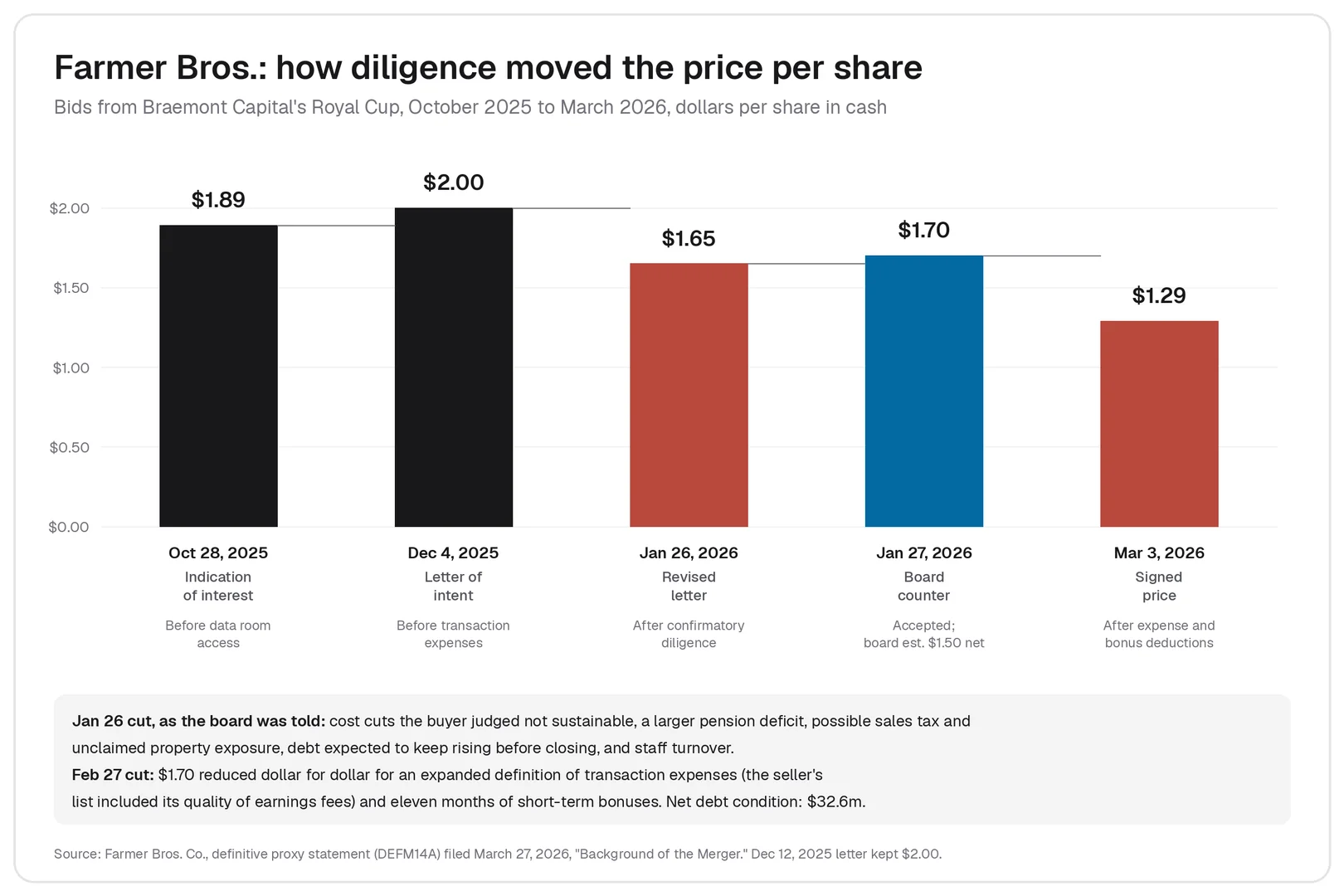
Farmer Bros. shows both routes in one deal. Braemont's indication of interest in October 2025 was $1.89 a share, and its December letter of intent was $2.00, about $73.9m of enterprise value. In mid-December it refused to go higher, "largely because" its analysis showed net debt at closing "would likely be higher than previously estimated." In January 2026, after confirmatory diligence, it cut the bid to $1.65, citing the cost cuts, the pension deficit, possible sales tax and unclaimed property exposure, rising debt, and staff turnover. The board countered at $1.70, and Braemont accepted. In late February, Braemont reduced $1.70 dollar for dollar for an expanded definition of transaction expenses and eleven months of short-term bonuses to reach $1.29, its best and final price, and the draft agreement made closing conditional on net debt, including transaction expenses and net of cash, of no more than $32.6m.
The report does not always lower the price. A seller's report can support add-backs, and a buyer that wants to win can give up the right to re-price. Transom's March 30 proposal stated that its price was "not conditioned on confirmation of the Company's calculation of adjusted EBITDA," a point the banker highlighted to the board.
How private equity firms use a quality of earnings report
For a private equity firm, the report feeds four documents at once: the debt package, the purchase agreement, the model, and the investment committee memo.
Debt sizing and the credit agreement
In a leveraged buyout (LBO), lenders set the loan as a multiple of EBITDA and test covenants against it for years, and the quality of earnings report is often written into the definition of that EBITDA. The AvidXchange commitment letter, from lenders including Ares, Blue Owl, Cliffwater, MUFG, New Mountain, and PIMCO for a $60m revolving facility and a $440m term loan, defines Consolidated EBITDA to include "adjustments, exclusions and add-backs set forth in" the "'Quality of Earnings' report, dated April 26, 2025," or in the sponsor's model, and caps add-backs for future savings and synergies at 35.0% of pro forma EBITDA. The same definition adds back the "effects of purchase accounting," such as the inventory write-up from a purchase price allocation, so that an accounting entry made at closing does not shrink the EBITDA the covenants test. The Clearwater letter, from a group including Goldman Sachs Asset Management, Ares, Blue Owl, Antares, Golub, KKR, Apollo, and HPS, allows adjustments "of the type contained in a quality of earnings report." The add-backs the accountants accept therefore become borrowing capacity and covenant headroom for the life of the loan.
Add-on acquisitions
Credit agreements also require reports for later acquisitions. Limbach's 2026 agreement with PNC counts adjustments "specifically reflected in" quality of earnings reports for two acquisitions in Consolidated EBITDA, and for any target with annual revenue above $15m requires two years of audited statements or a quality of earnings report. Sponsor-backed companies that grow through add-on acquisitions commission one report after another for the same reason.
Small buyers and the SBA rule
Search funds and individual buyers who finance acquisitions with SBA-guaranteed loans face a formal rule. Under the SBA's SOP 50 10 technical updates, effective October 1, 2026, a lender must obtain a quality of earnings report for a business acquisition or expansion with a purchase price of $3m or more, measured before buyer equity and seller debt. Owner buyouts and employee stock ownership plan or cooperative transactions are exempt. The report must be prepared by an independent professional for the lender's benefit, include the cash proof, document add-backs such as non-recurring items, owner compensation, related-party transactions, deferred maintenance, and cash-to-accrual differences, and assess customer concentration and contract continuity. The lender must use the report's earnings to calculate debt service coverage.
The purchase agreement
The report's numbers become definitions in the purchase agreement. The working capital analysis sets the peg. The debt and debt-like schedule becomes the definition of indebtedness deducted from the price. Findings that cannot be priced, such as a sales tax exposure, become specific indemnities, escrows, or closing conditions, and a concentration risk can turn part of the price into an earnout. When the buyer uses representations and warranties insurance, the insurer reads the diligence reports, and known issues are generally excluded from cover.
The model and the memo
Inside the fund, the analyst or associate replaces management's adjusted EBITDA in the LBO model with the report's figure, reruns returns, and resizes the debt. The deal team decides which findings change the price, which go into the purchase agreement, and which become part of the plan after closing, and the investment committee memo records those decisions, because the committee approves a price on a specific EBITDA. Buyers also cite the report to their own investors. When Perimeter Solutions agreed in December 2025 to buy Medical Manufacturing Technologies from the private equity firm Arcline for about $685m, its announcement said the target's expected $50m of 2025 Adjusted EBITDA "reflects the Company's internal estimate based on the quality of earnings report received by the Company."
Quality of earnings report example
The table below is an illustrative summary bridge for a hypothetical company, not taken from a filing. It sets management's view beside the accountant's for the trailing twelve months, in $ millions.
| Line | Management | Quality of earnings | Basis for the QoE view |
|---|---|---|---|
| Net income | 4.1 | 4.1 | Ledger, tied to tax return |
| Interest, taxes, depreciation and amortization | 4.4 | 4.4 | Ledger |
| Reported EBITDA | 8.5 | 8.5 | |
| Owner salary above market | 0.6 | 0.4 | A hired CEO costs more than the owner assumed |
| Lawsuit settlement and legal fees | 0.5 | 0.5 | Single case, settled, invoices support |
| Planned headcount reduction | 0.9 | 0.0 | Not yet carried out |
| Below-market rent from owner's property company | 0.0 | (0.2) | Buyer will pay market rent |
| Revenue recognized ahead of delivery | 0.0 | (0.3) | Shipped after year end; ASC 606 |
| Year-end bonuses on cash basis | 0.0 | (0.2) | Accrued to the year earned |
| Adjusted EBITDA | 10.5 | 8.7 |
The gap is $1.8m. At the 6.0 times multiple in Transom's first bid for SigmaTron, it is worth about $10.8m of enterprise value, all of it from the seller's equity unless the seller can support its add-backs.
Quality of earnings FAQs
How long does a quality of earnings report take?
Most providers quote four to six weeks from the data request to the draft, with a range of about three to eight. Clean monthly closes and a ready data room shorten it.
Do private equity firms require a quality of earnings report?
In practice, yes. Private equity buyers usually commission their own report, even when the seller provides one, because their lenders and investment committees rely on it. Sponsors also make bids subject to it: Transom's March 24, 2025 proposal for SigmaTron "remained subject to completion of due diligence, including a quality of earnings analysis."
Is a quality of earnings report required for an SBA loan?
For SBA-guaranteed loans that finance a business acquisition or expansion with a purchase price of $3m or more, yes, under the technical updates effective October 1, 2026. Owner buyouts and employee stock ownership plan or cooperative transactions are exempt.
Sources
Farmer Bros. Co., definitive merger proxy statement (DEFM14A), filed March 27, 2026: Background of the Merger. GT Silver BidCo (Warburg Pincus and Permira), amended and restated commitment letter dated January 21, 2026, Exhibit (b)(ix) to Clearwater Analytics' Schedule 13E-3, filed February 24, 2026: Consolidated EBITDA definition. American Institute of Certified Public Accountants, Statement on Standards for Consulting Services, CS section 100. Limbach Holdings, credit agreement with PNC Bank, exhibit to Form 8-K filed September 9, 2026: Consolidated EBITDA and permitted acquisitions. SigmaTron International, Schedule 14D-9, filed June 26, 2025: Background of the Offer. Arrow Borrower 2025 (TPG), amended and restated commitment letter dated May 23, 2025, Exhibit (b)(3) to AvidXchange's Schedule 13E-3, filed June 18, 2025. Varex Imaging, definitive merger proxy statement (DEFM14A), filed September 21, 2026: Background of the Merger. US Small Business Administration, SOP 50 10 with technical policy updates, effective October 1, 2026: quality of earnings requirement. Perimeter Solutions, press release on the acquisition of MMT, Exhibit 99.1 to Form 8-K, December 10, 2025.
Related posts
Related posts
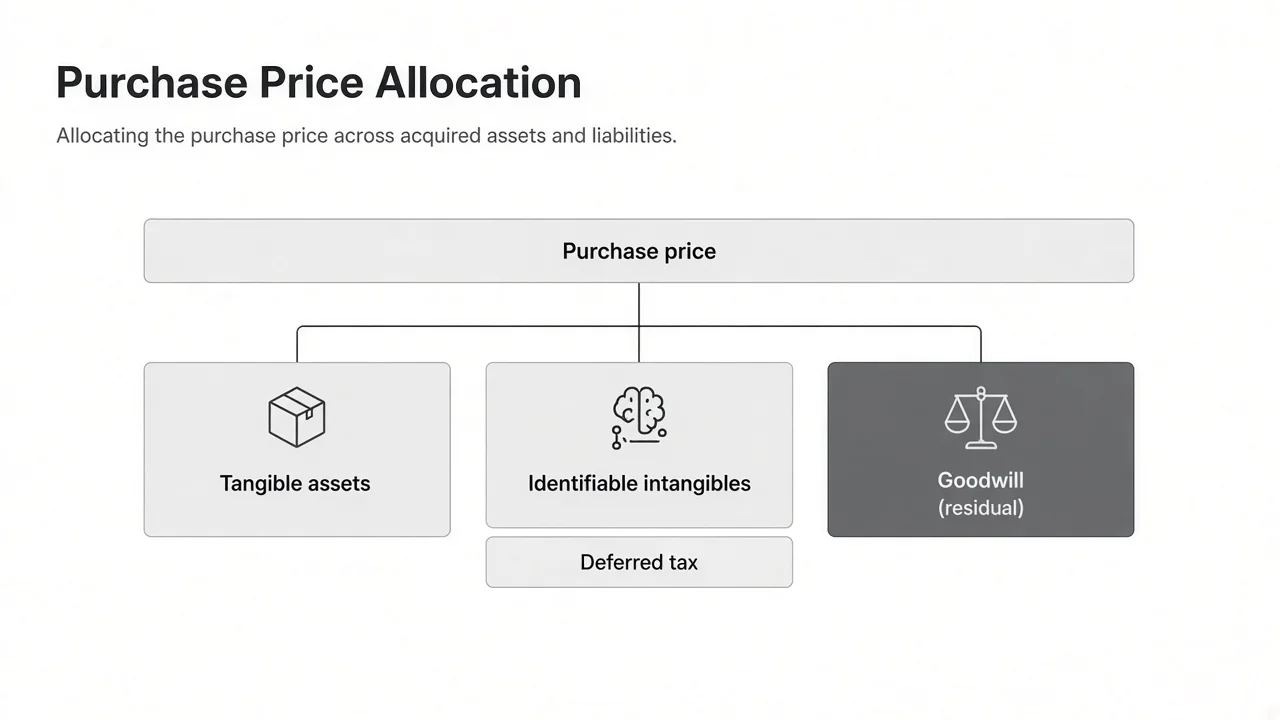
Purchase price allocation assigns a deal's price to every asset and liability at fair value and leaves goodwill as the remainder. The steps, the deferred tax math, and the tax-return version, with Kimberly-Clark's Kenvue filing.
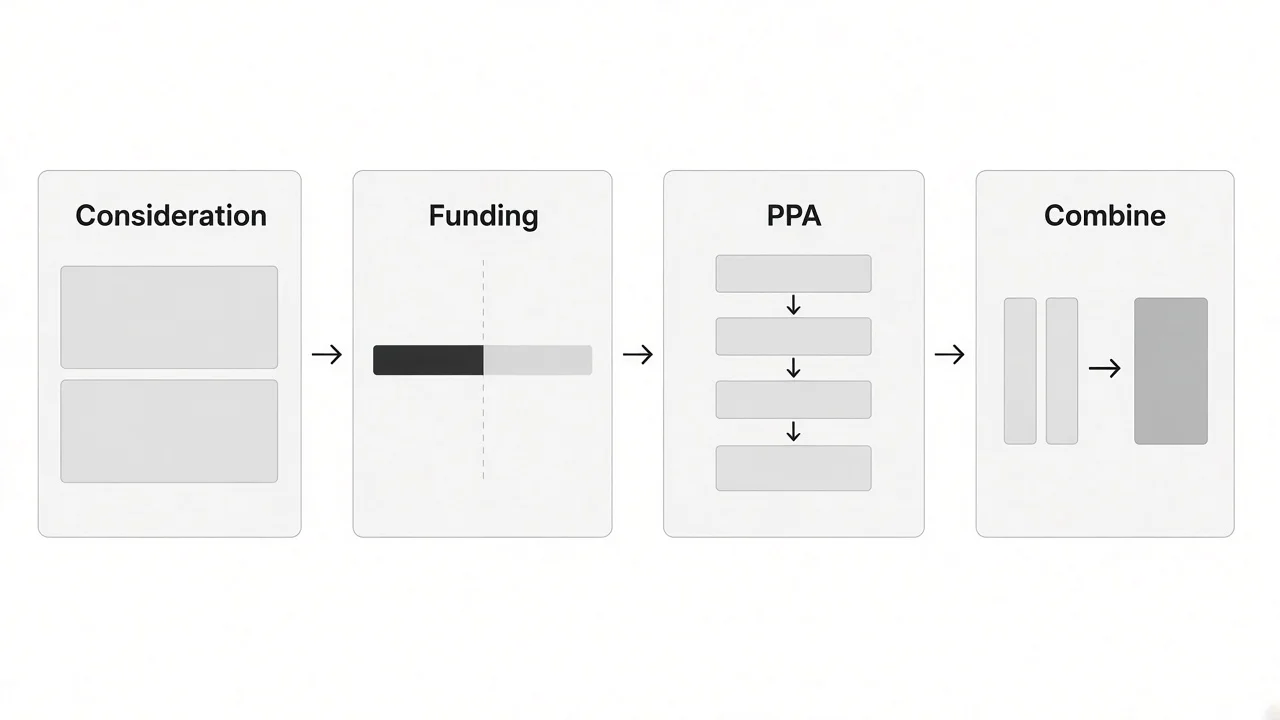
A merger model combines two companies under a stated offer: consideration mix, funding, purchase price accounting, combined statements, and synergies. Build order, walk-through, and Kimberly-Clark's filed Kenvue consideration and preliminary PPA.

Sum-of-the-parts valuation values each business segment on its own, then bridges to equity. When to use it, how to build it, conglomerate discount, and Walgreens' filed Centerview and Morgan Stanley ranges.