

Venture capital is money that investment funds put into young, fast-growing private companies in exchange for part ownership. Most of the companies fail or return little, so a venture fund relies on a few large winners to pay for everything else. The investors are venture capital firms, which raise each fund from pension plans, endowments, foundations, family offices, and wealthy individuals and then pick the companies. In 2025 American venture investors put $320bn into 15,352 deals, according to the 2026 Yearbook of the National Venture Capital Association (NVCA), and 2,984 firms managed $1.38trn. Through the third quarter of 2026 they had already invested $515.8bn, more than in any full year on record.
What venture capital is
Venture capital is equity, not a loan. A bank lends against cash flow or collateral and expects to be repaid with interest; a venture investor buys shares and is paid only if the company becomes worth more and is later sold or listed. That suits companies that burn cash for years before they earn any, such as software, biotech, and hardware startups, because they have nothing a lender could underwrite.
Venture investors usually buy a minority stake, often a fifth of the company or less in a single round, and they take preferred stock rather than the common stock held by founders and employees. The preferred shares come with rights to be repaid first in a sale and with a say over major decisions. Venture investors also accept far more risk than other investors. Industry research on angel and early-stage portfolios that NVCA summarizes in its Yearbook found that about 34 percent of investments return nothing at all.
US securities law has its own definition. Under Rule 203(l)-1 of the Securities and Exchange Commission (SEC), a venture capital fund is a private fund that tells investors it pursues a venture capital strategy, puts no more than 20 percent of its capital into anything other than cash and shares bought directly from private companies, borrows no more than 15 percent of its capital and only for up to 120 days at a time, and does not let investors redeem their stakes except in extraordinary circumstances. A manager that runs only funds meeting that test can skip full registration with the SEC, although it still files a short report. The rule is the line between a venture fund and a hedge fund or a lending fund.
Venture capital is one branch of private equity, the broad family of funds that buy stakes in private companies. Venture funds back companies early and take minority stakes; buyout funds take control of mature, profitable companies and often borrow to do it. Growth equity, one of the other types of private equity, sits between them and buys minority stakes in companies that are already growing fast and often already profitable.
How a venture capital fund works
A venture capital firm is the manager. Each fund it raises is a separate limited partnership in which the firm acts as the general partner, making the decisions and carrying the legal liability, and outside investors are the limited partners. The firm usually also invests some of its own partners' money alongside them. The terms of the deal between them sit in the limited partnership agreement.
Limited partners do not hand over their money on day one. They sign a commitment for a fixed amount, and the general partner draws it down through capital calls as it finds companies to back. Money committed but not yet called is the fund's dry powder. US venture funds held $299.3bn of it at the end of 2025, NVCA reports, alongside $1.08trn in the value of companies they already owned.
Most funds make new investments for the first three to five years, the investment period. They hold back a large share of the fund, often half or more, for follow-on checks in the companies that do well, because a venture investor who does not keep buying in later rounds sees its stake shrink. The rest of the fund's life is spent helping the companies grow and waiting for them to be sold or listed. Funds are written to last 10 years, with optional extensions of one to two years. In practice many run much longer. NVCA quotes Adam Grosher of the J. Paul Getty Trust saying in November 2025 that his portfolio holds funds that are "15, 18, even 20 years old." The year a fund first draws capital is its vintage year, and funds are compared with others of the same vintage.
The limited partners are mostly institutions with long horizons. Pension funds had an average of 13.7 percent of their assets in private market equity in 2024, up from 3.6 percent two decades earlier, NVCA reports. University endowments, foundations, sovereign wealth funds, insurers, family offices, and funds of funds fill out the list. Individuals can invest only if they meet the SEC's accredited investor test in Rule 501: net worth above $1m excluding a primary home, or income above $200,000 a year ($300,000 with a spouse or spousal equivalent) in each of the past two years. Since 2020 holders of the Series 7, Series 65, or Series 82 securities licenses also qualify. Funds sell their interests privately under the SEC's Regulation D, either under Rule 506(b), which bars public advertising, or under Rule 506(c), which allows it as long as the fund verifies that every buyer is accredited. Many larger funds go further and accept only qualified purchasers, a higher bar set in the Investment Company Act, which lets the fund take more than 100 investors.
Stages of venture capital
Companies raise venture capital in rounds, and each round is named for how far along the company is. The labels are loose, and the dollar amounts at each stage have grown sharply over the past decade.
Pre-seed and seed. The first outside money, often from angel investors, small seed funds, and accelerators, used to build a product and hire the first engineers. NVCA describes these rounds as historically $1m to $3m and often structured as a SAFE (simple agreement for future equity) or a convertible note, which turn into shares at the next priced round, typically at a discount or under a valuation cap. In 2025, 4,778 US companies received their first venture financing.
Series A. The first large priced round, usually led by an institutional venture firm that sets the price and takes a board seat. NVCA calls it the point where "institutional venture capital truly begins." The company has a product in the market and early evidence that customers want it.
Series B and C. Money to scale a business that works: more sales staff, new markets, more product lines. Investors at this stage look at revenue growth and unit economics more than at the founding team's promise.
Late stage and venture growth. Series D and later rounds for companies that may be years from a sale or listing. PitchBook classifies rounds from Series E onward as venture growth. In 2025 these rounds took about 40 percent of all US venture dollars, much of it in a handful of artificial intelligence companies.
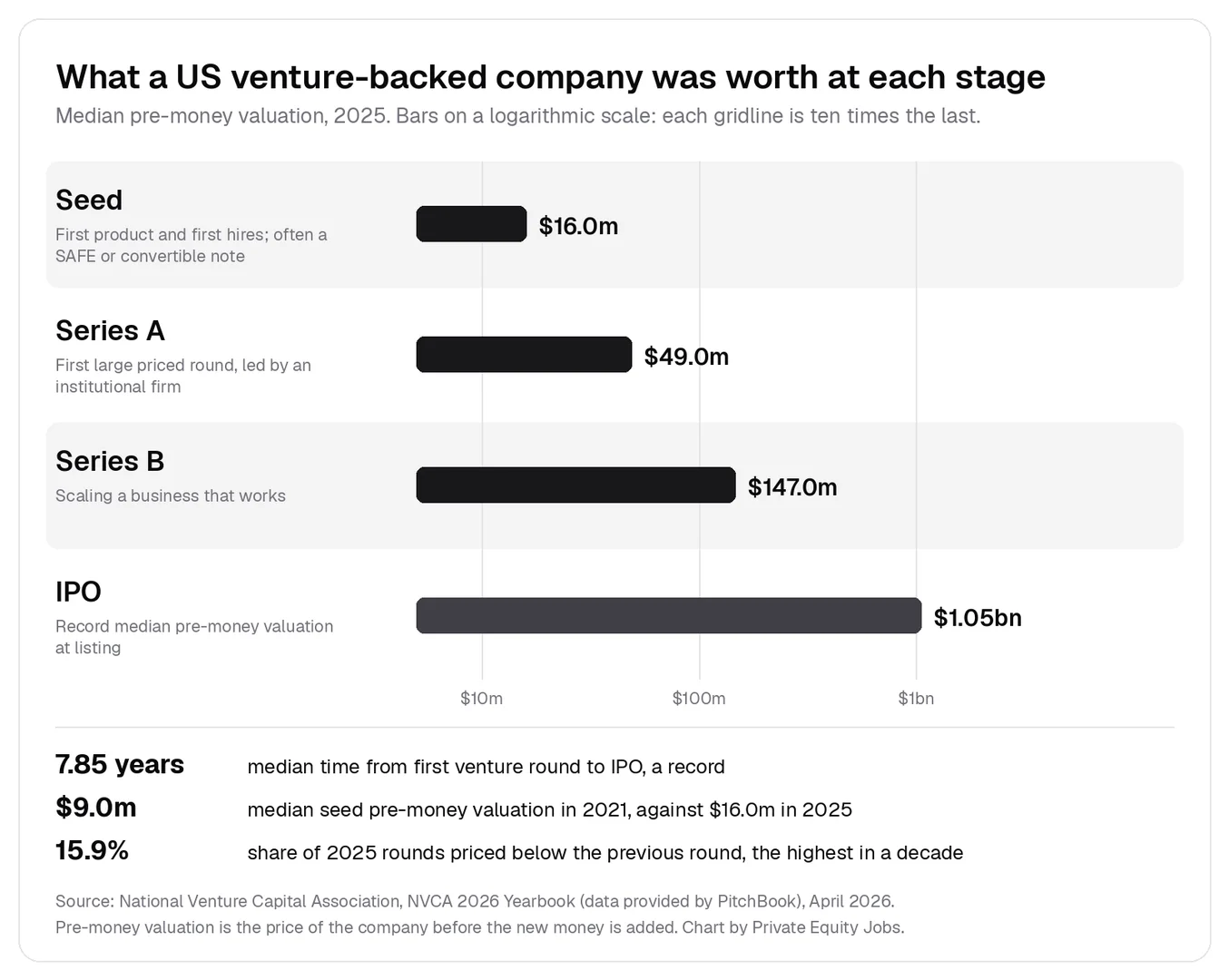
Valuations rise at each step. The median US seed round in 2025 valued the company at $16.0m before the new money came in, up from $9.0m in 2021, NVCA reports; the median was $49.0m at Series A and $147.0m at Series B. The median time from first venture round to an initial public offering (IPO) hit a record 7.85 years in 2025, and the median company that listed was valued at a record $1.05bn before the offering.
How a venture deal is structured
Founders raise a round by meeting many investors, usually through introductions from other founders, angels, or lawyers, with a pitch deck and early numbers. A firm meets far more companies than it backs, and a deal typically passes a first meeting, a deeper review by one partner, and a pitch to the full partnership before an offer. The offer arrives as a term sheet, a short and mostly nonbinding document that sets the price and the investor's rights. The lead investor negotiates it, usually puts in the largest check, and often takes the board seat; other firms join on the same terms. That sharing of a round, called syndication, lets each fund back more companies with the same money. Before signing, the lead runs due diligence on the team, the market, the technology, and the early traction, which can take anywhere from days at seed to months later on. The signed term sheet then becomes a set of closing documents. The model set that NVCA publishes has five core agreements: the company's amended certificate of incorporation, which creates the preferred stock and its rights; a stock purchase agreement; an investors' rights agreement; a voting agreement, which fixes who sits on the board; and a right of first refusal and co-sale agreement, which governs later sales of founders' shares.
Price is set as a pre-money valuation, what the company is worth before the new money arrives. Add the new money and the result is the post-money valuation. NVCA's own example: a $10m investment at a $40m pre-money valuation gives a $50m post-money valuation, and the investor owns 20 percent ($10m divided by $50m). Every new round dilutes the existing holders. In NVCA's illustration a founder who owns 100 percent at incorporation might hold 70 percent after the seed round, 50 percent after Series A, and 35 percent after Series B. Investors often ask the company to enlarge its option pool, the shares set aside for future employees, before the round, which puts that dilution on the founders rather than the new investor.
The preferred stock carries the terms that matter most in a sale:
- Liquidation preference. Preferred holders get their money back before common holders. With a 1x preference on the $10m above, if the company later sells for $30m, the investor takes $10m first, rather than the $6m its 20 percent stake would earn, and founders and employees split the remaining $20m. If the company sells for $200m, the investor converts to common and takes its 20 percent, or $40m.
- Participation. Participating preferred takes its preference and then shares in what is left. In the $30m sale, a participating investor would take $10m plus 20 percent of the remaining $20m, or $14m.
- Anti-dilution. If the company later raises money at a lower price, a down round, the investor's conversion price is adjusted so that it ends up with more shares, which dilutes common holders further. NVCA counted 15.9 percent of 2025 deals as down rounds, the highest share in a decade.
- Conversion and dividends. Preferred shares convert into common at the holder's choice, usually one for one, and convert automatically at an IPO. Venture preferred often carries a dividend right, but it is usually noncumulative and rarely paid; the value of the shares lies in the preference and the conversion right.
- Board seats and protective provisions. Preferred holders usually get board representation and veto rights over new fundraising, a sale of the company, and changes to the charter.
- Milestones. Some rounds are paid in tranches, with later money released only when the company hits agreed targets such as a product launch or a revenue level.
These terms are why a headline valuation can mislead. Finance professors Will Gornall and Ilya Strebulaev found that post-money valuations overstate fair value by about 50 percent, NVCA notes, because the price of the newest preferred share, with all its protections, is applied to every share in the company, including common stock that has none of them.
How venture capitalists make money
Venture firms earn two kinds of income. The first is a management fee, typically 2 percent of committed capital a year during the investment period, which pays salaries, offices, travel, and legal costs. NVCA's arithmetic: a $1bn fund at 2 percent produces $20m a year regardless of how the investments perform. Many agreements reduce the fee after the investment period ends, and some large funds charge it on invested rather than committed capital. Funds may also recycle early exit proceeds into new investments instead of paying them out, so that more of the committed money ends up in companies rather than in fees.
The second is carried interest, usually 20 percent of the fund's profits once limited partners have their money back, and sometimes only after they have also earned a hurdle rate, often 8 percent a year. NVCA notes that top-performing firms increasingly negotiate 25 to 30 percent. The order in which cash is paid out is the distribution waterfall. In NVCA's example, a fund that returns $300m on $100m of limited partners' capital pays the general partner about $40m in carried interest, and the limited partners receive about $260m, made up of their $100m back and $160m of profit.
Profits in a venture fund come from very few companies. The NVCA Yearbook breaks down angel and early-stage portfolios this way:
| Outcome | Share of deals | Share of total returns |
|---|---|---|
| 10x or more | 5% | 54% |
| 5x to 10x | 8% | 20% |
| 2x to 5x | 15% | 15% |
| 1x to 2x | 20% | 8% |
| Partial loss | 18% | 3% |
| Total loss | 34% | 0% |
One deal in 20 produced more than half of the money. Venture investors call this pattern the power law, and it shapes how funds invest. A firm has to back enough companies to have a chance at an outlier, own enough of each one for an outlier to matter, and keep money aside to defend that ownership in later rounds.
Fund size sets how large the outlier has to be. "Returning the fund" means one investment pays back the whole fund on its own. Suppose a fund owns 8 percent of a company when it is sold, after the dilution of later rounds. For a $50m seed fund, a $625m sale returns the fund. For a $1bn fund holding the same 8 percent, it takes a $12.5bn sale. Wyatt Lonergan, a general partner at VanEck Ventures, worked the same problem in October 2026 for a $50m fund backing about 35 companies with half its money held back for follow-ons, and put the multiple one position must reach at about 35 times the money put into it, counting the first check and the follow-ons. Nikunj Kothari, a partner at FPV Ventures, made the same point about the largest funds in an August 2026 post, writing that when a fund is that big, "each investment needs to be underwritten to an outcome that big," so missing a winner costs it more than backing a loser.
Venture capital returns and the 2026 market
Over 15 and 20 years venture funds as a group have roughly matched a tech-heavy stock index, and over 10 and 25 years they have trailed it, with a wide gap between the best and worst managers. Cambridge Associates' US Venture Capital Index, which pools 2,836 funds formed since 1981, returned a net 15.99 percent a year over the 10 years to 31 March 2026. The same cash flows invested in the Nasdaq would have earned 17.22 percent a year by the firm's modified public market equivalent method. Over 15 years the index returned 15.57 percent against 15.76 percent for the Nasdaq comparison, and over 20 years 13.00 percent against 12.96 percent. Over 25 years it returned 8.96 percent a year, against 12.06 percent. The most recent year was strong. In calendar 2025 the index returned 21.1 percent, compared with 8.7 percent for Cambridge Associates' US private equity index. Those are internal rates of return, which reward early cash and can look different from a simple multiple of the money invested.
Reported returns rely heavily on paper values. A venture fund usually shows losses in its first years, as fees and write-downs come before any exits, and recovers only if the winners are sold, the pattern known as the J-curve. Limited partners track two multiples: total value to paid-in capital (TVPI), which counts unsold holdings at their marked value, and distributions to paid-in capital (DPI), which counts only cash returned. The gap between them is wide right now. AngelList's mid-2026 benchmark update for funds on its platform, using data to 1 July 2026, put the median 2021 fund at a TVPI of 1.12x after five years, while the median 2019 fund had a DPI of only 0.15x and the median 2017 fund 0.34x.
Limited partners have paid more into venture funds than they received back in each of the past four years. In 2025 managers called $61bn from limited partners and returned $42bn, Cambridge Associates reports, and since 2021, the last year that distributions exceeded calls, limited partners have paid in $1.60 for every $1.00 they received. Exits are the bottleneck. NVCA counted $217.1bn of venture-backed exits in 2025 across 1,463 deals; 1,396 were acquisitions and only 49 were IPOs. With so few listings, more holders now sell stakes in funds or companies to other investors in secondaries, or roll companies into continuation funds, to get cash before an exit.
New investment, by contrast, is at a record. The $515.8bn invested through the third quarter of 2026 compares with $357.9bn in all of 2021, the previous peak, and artificial intelligence companies took 82.7 percent of it, according to the Q3 2026 PitchBook-NVCA Venture Monitor. Fundraising is concentrated too. US venture firms raised $108.5bn across 699 funds through September; funds of $500m or more made up 6 percent of the funds closed and 78.1 percent of the money, and Andreessen Horowitz alone closed $23.8bn, more than a fifth of the total. First-time funds raised $4.9bn across 81 vehicles, and the number of emerging firms closing any fund fell from 927 in 2022 to 211 through the third quarter of 2026. PitchBook counted a record 992 private US unicorns, companies valued at $1bn or more, worth $5.7trn.
Who provides venture capital
Venture capital firms. Independent partnerships that raise funds from limited partners and invest them, from seed funds of a few million dollars to multibillion-dollar firms that back companies from the first round to the last.
Angel investors. Individuals who invest their own money, usually at pre-seed and seed and usually in smaller checks. Many are former founders or executives. Because they answer to no outside investors, they decide faster and ask for fewer rights, and they often invest alongside seed funds. Groups of angels pool deals through angel networks and syndicates.
Corporate venture capital. Companies that invest from their own balance sheet or through a dedicated arm, such as Alphabet's GV or Salesforce Ventures, often in startups whose products relate to their own. Deals with corporate investors made up 57.7 percent of US venture deal value in 2025, NVCA reports.
Government programs. The Small Business Administration still licenses small business investment companies, private funds that can add government-guaranteed borrowing to their own capital, and many states and cities run their own venture funds.
Accelerators. Programs such as Y Combinator that invest a small fixed amount in batches of very early companies in exchange for equity, then run a few months of training that ends in an investor demo day.
Crossover and sovereign investors. Mutual fund managers and hedge funds that hold public stocks also buy into late-stage private rounds, and sovereign wealth funds from the Gulf and Singapore now write large checks directly. NVCA counted sovereign wealth participation in seven of the ten largest US venture deals of 2025.
Banks. Banks lend to startups through venture debt and serve them as clients, but their lending desks are not venture investors. Some run investment arms: J.P. Morgan Growth Equity Partners, part of J.P. Morgan Asset Management, closed its first growth fund with more than $1bn in commitments in April 2023 to back companies from Series B to pre-IPO in software, fintech, real estate, and consumer technology.
Pros and cons of venture capital for a company
Venture capital lets a company spend ahead of revenue without monthly loan payments or personal guarantees, and if the company fails, the founders owe the investors nothing. The investors usually bring more than money. Lead investors who take a board seat spend about 80 hours a year on site with each company, according to research by Michael Gorman and William Sahlman that NVCA cites, mostly on strategy, recruiting senior hires, and raising the next round. A well-known firm's backing also helps a company hire, sign customers, and raise again.
Each round dilutes the founders, and the liquidation preferences ahead of them mean common shareholders can receive little from a modest sale even when the headline price looks good. Raising also takes time: pitch meetings, diligence, and term-sheet negotiation can occupy the founders for months. Preferred holders gain board seats and veto rights, so founders give up some control over when to raise, when to sell, and at what price. The fund's timeline also becomes the company's. A fund that needs outsized exits within its 10-year life will push for fast growth and a large outcome, and will lose interest in a company that settles into steady, modest profits. In a remark quoted in the NVCA Yearbook, Rohit Mittal, founder of Stilt and an investor at Helium Ventures, described many venture-backed companies as stuck after a $3m to $4m seed round and a few hundred thousand dollars of annual revenue, unable to raise more, sell, or shut down cleanly because of the preferences stacked above the founders.
For companies that do not fit the power law, other money is available. Founders can bootstrap from revenue, borrow from a bank or through a Small Business Administration loan, take revenue-based financing repaid as a share of sales, raise venture debt alongside an equity round, apply for government research grants, or sell small stakes to the public through regulated crowdfunding.
A short history of venture capital
The modern industry dates to 1946, when Harvard Business School professor Georges Doriot helped found American Research and Development Corporation (ARD), a publicly traded company set up to back new businesses. Eleven years later ARD invested $70,000 in Digital Equipment Corporation; NVCA puts the eventual return at about $355m. The Small Business Investment Act of 1958 created government-licensed small business investment companies that could borrow from the federal government to invest in young companies.
The partnership model took over in the 1960s and 1970s. Kleiner Perkins and Sequoia Capital were both founded in 1972, and NVCA was formed in 1973. The turning point came in 1979, when the Department of Labor clarified that pension managers could judge risk across a whole portfolio under the Employee Retirement Income Security Act's prudent man rule. Pension money followed, and venture fundraising tripled within five years, NVCA notes.
The internet boom of the late 1990s brought record fundraising and nine-figure valuations for companies without revenue. When it ended, the Nasdaq lost 78 percent of its value and many funds lost money. The industry rebuilt through the 2000s on companies such as Google and Facebook, reached a peak of $357.9bn invested in 2021, cooled in 2022 and 2023, recovered in 2025, and set a new record in 2026 on the strength of artificial intelligence.
Working in venture capital
A venture firm is small. NVCA counts 2,984 active US firms, and the median firm managed $37.9m in 2025, though the average was $295.9m because a few firms are enormous. At 2 percent, a $37.9m firm earns roughly $760,000 a year in fees to pay everyone, which is why many firms have only two or three investing partners and no junior staff at all. Larger firms hire in a ladder:
- Analyst and associate. Find companies, run first meetings, research markets, and help with diligence and portfolio support. Many associate seats last two to three years.
- Senior associate, vice president, or principal. Lead deals with a partner's support and sit on some boards as observers.
- Partner or general partner. Make investment decisions, take board seats, and share in carried interest. Senior partners also raise the next fund from limited partners.
- Venture partner, operating partner, and entrepreneur in residence. Experienced operators or former founders who work with the firm part-time or between companies.
- Platform roles. Recruiting, marketing, and go-to-market staff who help portfolio companies rather than pick them.
Seats are scarce and rarely posted, so most hires come through networks. Common routes in are startup operating roles in product, engineering, or sales; investment banking or consulting followed by a growth-stage associate program; a founder's exit; or deep expertise in a field such as biotech or semiconductors. Pay leans on carried interest, which may take a decade to turn into cash, more than on salary, and that weighting is one of the larger career differences between private equity and venture capital. Private Equity Jobs lists open investing roles at venture and private equity firms, and its companies directory shows the firms behind them.
Common questions
How does a venture capitalist make money?
From a management fee, typically 2 percent of committed capital a year, and from carried interest, usually 20 percent of the fund's profits after limited partners get their money back. A $1bn fund pays about $20m a year in fees. The carried interest is paid only when portfolio companies are sold or listed for more than the fund paid.
Why is venture capital so hard to get into?
Firms are small and few. The median US firm managed $37.9m in 2025, too little to support a junior team, and the number of emerging firms closing a fund fell from 927 in 2022 to 211 through the third quarter of 2026. Most hiring happens through networks rather than postings, and firms favor candidates who have built or sold products or who know a technical field well.
Is Shark Tank venture capital?
Not in the fund sense. The investors on the show put in their own money ("It's our money, it's all real," Mark Cuban told Yahoo Finance in 2019), which makes them angel investors. Many of the companies are also consumer product businesses that grow steadily rather than the very fast-growing companies venture funds target.
Is J.P. Morgan a venture capital firm?
No. J.P. Morgan is a bank. It lends to startups and advises them, and its asset management arm runs J.P. Morgan Growth Equity Partners, which raised more than $1bn for its first growth fund in 2023. That makes the bank a growth investor through one unit, not a venture capital firm.
Is venture capital private equity?
Yes, in the broad sense. Venture capital is the branch of private equity that backs young companies with minority stakes, while buyout funds take control of mature companies. Both use the same limited partnership structure, management fees, and carried interest.
How long does a venture capital fund last?
Funds are written for 10 years, with optional extensions of one to two years. Many run longer because companies take a record 7.85 years to reach an IPO, and some limited partners now hold funds 15 to 20 years old.
Sources
- National Venture Capital Association, NVCA 2026 Yearbook (data provided by PitchBook), April 2026.
- PitchBook and National Venture Capital Association, Q3 2026 PitchBook-NVCA Venture Monitor, October 2026.
- Cambridge Associates, US Venture Capital Index and Selected Benchmark Statistics, 31 March 2026.
- Cambridge Associates, US Private Equity & Venture Capital Benchmark Commentary: Calendar Year 2025, published 30 July 2026.
- AngelList, "Fund Benchmarks: A Mid-Year 2026 Refresh," Abe Othman, 4 September 2026.
- US Securities and Exchange Commission, 17 CFR 275.203(l)-1, venture capital fund defined.
- US Securities and Exchange Commission, 17 CFR 230.501, accredited investor; press release 2020-191, 26 August 2020.
- National Venture Capital Association, NVCA Model Legal Documents (financing documents).
- J.P. Morgan Asset Management, J.P. Morgan Growth Equity Partners fund close announcement, 20 April 2023.
- CNBC, Mark Cuban on Shark Tank, 24 May 2019.
- Wyatt Lonergan, VanEck Ventures, post on X, 13 October 2026; Nikunj Kothari, FPV Ventures, post on X, 20 August 2026.
Related posts
Related posts

The investment banking ladder runs from analyst to associate, vice president, director, and managing director. What each level does, how long promotions take, posted pay at every rung, hours, and when people leave.

Middle-market investment banks sell and finance companies worth tens of millions to about $2bn, many of them owned by private equity firms. The firms, the 2026 league table, how they get paid, posted pay, and where the seat leads.

Equity research covers public companies, publishes ratings, and sits between management and investors. How the seat differs from IBD on hours, conflicts, pay shape, AI pressure, and exits to AM, hedge funds, IR, and corporate finance.