

Investment banking and management consulting both sell advice to large companies, which makes them easy to confuse. An investment banker advises on transactions: selling a company, buying one, or raising debt or equity, and the bank earns most of its fee when the deal closes. A management consultant advises on how a business runs, such as which markets to enter, which costs to cut, or how to reorganize, and the firm is paid for the project whether or not the client acts on the advice. That difference in what the client pays for explains most of the gaps in hours, skills, pay, and where each job leads. At the Wharton School they are the two most common first jobs. Of the 423 graduates in its 2025 undergraduate class who reported a full-time job function, 156 went into investment banking and 86 into consulting; the next largest group, investment management, had 33.
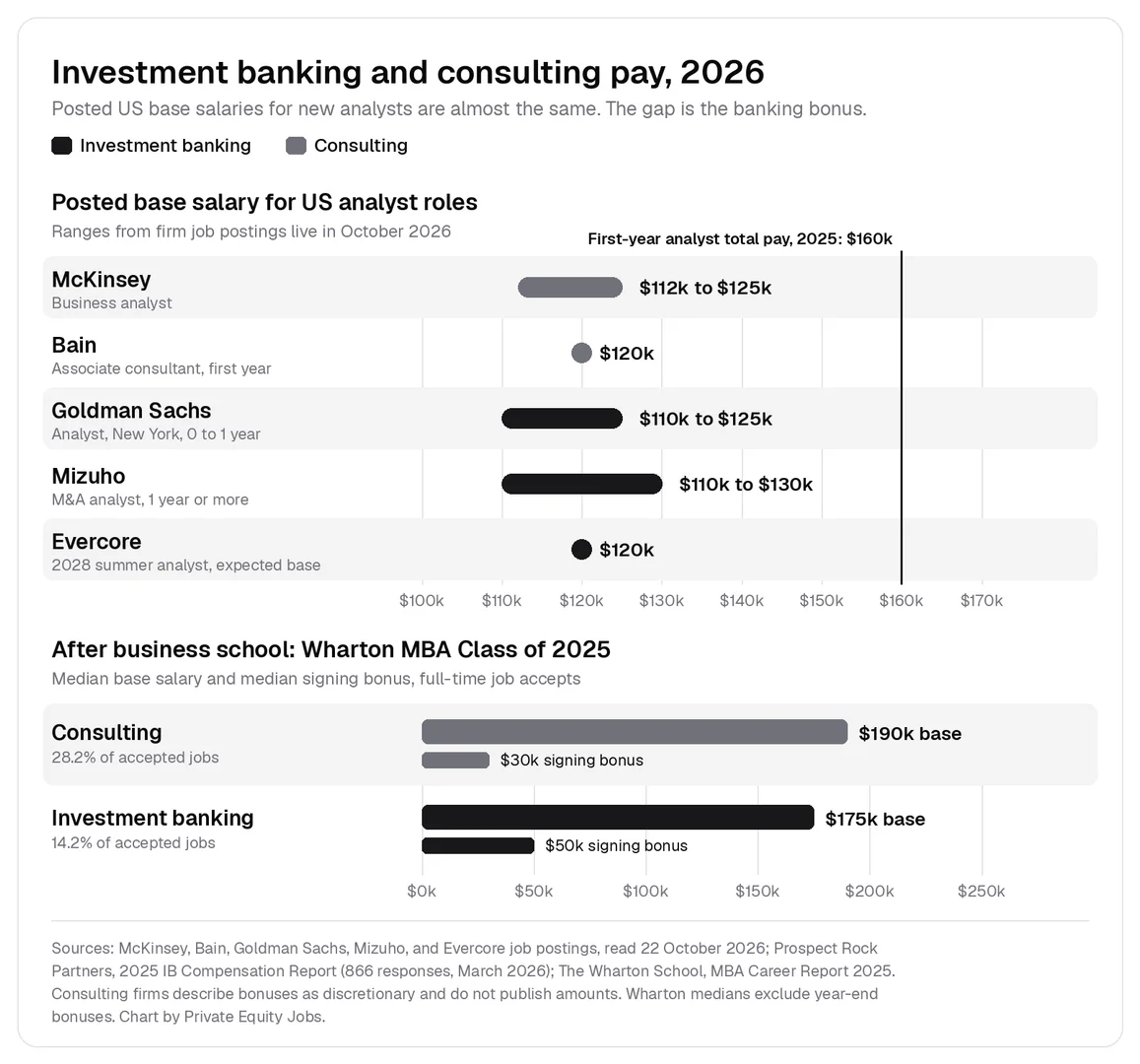
The two jobs now start at almost the same base salary. In October 2026 McKinsey & Company posted a range of $112,000 to $125,000 on its careers site for new US business analysts, Bain & Company posted a $120,000 first-year base for associate consultants, and Evercore listed $120,000 as the expected base salary for its 2028 summer analysts. Banking pays more once the year-end bonus is counted. After business school, consulting pays the higher base salary. Wharton's Class of 2025 MBA graduates took a median $190,000 in consulting and $175,000 in investment banking.
What investment bankers and consultants do
Investment banks advise companies, governments, and investors on mergers and acquisitions, raise money for them by underwriting stock and bond sales, and help troubled companies restructure their debts. Banks sit on the sell side of finance. They earn fees for arranging transactions rather than investing their own capital in them. The junior work shows up in job postings. Mizuho's posting for an M&A analyst at its Greenhill advisory arm lists drafting pitch books, running due diligence, and building discounted cash flow, comparable company, precedent transaction, leveraged buyout, and merger models. The employers range from the global bulge bracket banks such as Goldman Sachs and JPMorgan to elite boutique advisers such as Evercore and to middle-market banks that advise on smaller deals.
Management consultants, whom the Bureau of Labor Statistics (BLS) counts as management analysts, study how an organization works and recommend how to make it more efficient or more profitable. The work is organized as projects, called engagements, each with a defined question, a team, and an end date. McKinsey tells new business analysts that they will join a client service team and "take ownership of a workstream," which might be a market-sizing model, a cost analysis, or a set of interviews with the client's managers and customers. The best known firms are McKinsey, the Boston Consulting Group (BCG), and Bain, together called MBB, followed by the consulting arms of the large accounting firms and by smaller specialist firms.
One legal difference follows from the transactions. Investment bankers who work on securities deals must register with the Financial Industry Regulatory Authority (FINRA) and pass its licensing exams; Mizuho's analyst posting lists the Series 79 and Series 63. Consultants need no license to give strategic advice.
Key differences
| Investment banking | Management consulting | |
|---|---|---|
| What the client buys | Advice and execution on a transaction | A recommendation on how to run the business |
| How the firm is paid | Mostly success fees when a deal is announced or closes, plus retainers | Fees for a scoped project, agreed in a proposal |
| Core junior work | Financial models, valuation, pitch books, due diligence | Data analysis, client interviews, slide decks, workstream ownership |
| Posted US analyst base, 2026 | $110,000 to $125,000 (Goldman Sachs, Evercore); $110,000 to $130,000 at Mizuho for analysts with a year of experience | $112,000 to $125,000 (McKinsey, Bain) |
| Year-end bonus | Large; first-year analysts reported $160,000 in total pay for 2025 | Discretionary; amounts not published by the major firms |
| Median MBA base, Wharton Class of 2025 | $175,000, with a $50,000 median signing bonus | $190,000, with a $30,000 median signing bonus |
| Staffing | Several deals at once | Usually one project at a time |
| Hours and travel | Long and unpredictable around live deals; mostly office-based | Long during project peaks; frequent travel to client sites |
| Licensing | FINRA exams such as the Series 79 and Series 63 | None |
| Undergraduate recruiting | Applications 17 to 21 months before the internship (Piper Sandler, Evercore) | Deadlines about 15 months before the internship (McKinsey) |
| Route into large buyout funds | About 90 percent of megafund associates in a 2026 sample | Under 3 percent of the same sample |
How banks and consulting firms get paid
A bank's fee depends on the outcome. Evercore's annual report for 2025 says the revenue of its investment banking business is "primarily a function of closing client transactions and earning success fees, the timing and realization of which is irregular." Evercore may also collect retainer fees under the engagement letter and an announcement fee when a deal is made public, in addition to the success fee paid at closing. Moelis & Company's annual report describes what happens when a deal falls apart. In that case the firm "often does not receive advisory fees that would have been received if the transaction had been completed, despite the fact that we may have devoted considerable time and resources to the transaction."
That structure shapes the job. Bankers pitch for mandates they may not win, and once a deal is live the timetable belongs to the buyer, the seller, and the financing markets, so the team works when the deal needs it. Evercore's report says the same revenue funds its annual bonus payments, so bonuses depend on how many deals close. Prospect Rock Partners, a recruiting firm that surveys banker pay, found that pay bottomed out in 2023 and then recovered through 2024 and 2025.
A consulting firm sells its time and expertise for a set scope. The BLS describes how a client typically asks several firms for proposals that spell out how the work will be done, the schedule, and the cost, and then picks one. The firm is paid for delivering the analysis and recommendation. A consulting team's calendar is set by the project plan and its steering-committee meetings, and the firm's revenue depends on keeping consultants staffed on paying projects. Consultants at consulting firms are usually paid "a base salary in addition to a year-end bonus," the BLS says.
The work and the skills each job builds
A junior banker's day revolves around numbers and documents. Evercore's summer analysts are told to expect "preparing for and attending client meetings, financial modeling, resolving complex accounting issues, industry analysis, due diligence and new business development." Goldman Sachs's posting for a New York capital solutions analyst adds debt-sizing models and leveraged buyout frameworks. After two years an analyst can value a company several ways, read a credit agreement, and explain how a deal will be financed. Those are the skills that private equity firms test, which is why the analyst program feeds the investment banking career path and the buy side.
A junior consultant's day revolves around a question the client is paying to answer. A typical workstream combines spreadsheet analysis with interviews and site visits, then turns the findings into slides for a client presentation. McKinsey's posting warns that business analysts may need to travel to and work in "factories, hospitals, mines." Consultants come out of their first years able to break a vague business problem into parts, gather data quickly in an industry they did not know, and present a recommendation to senior executives. They also see more industries; a consultant might work on a retailer, a hospital system, and a utility in the same year, while a banker usually stays in one industry or product group.
The two jobs are staffed differently. Evercore asks its summer analysts to be able to "work on several projects concurrently," and a junior banker typically splits time across a few live deals and pitches, assigned by a staffer, often a vice president, who sees the group's whole workload. A consultant is usually staffed on one engagement at a time and, between engagements, may spend time unstaffed on internal work or proposals. Client contact differs as well. Junior consultants often work alongside client staff and run parts of client meetings within their first year or two, while junior bankers spend most of their time with their own deal team and see client executives mainly in meetings that senior bankers lead.
The jobs also build different networks. A banker's working contacts are company executives, private equity investors, and the lawyers and lenders on each deal, and some of those investors later hire bankers. A consultant's contacts are managers inside client companies across several industries, plus a firm alumni network spread through corporate leadership roles.
The standards differ too. A banker's model goes into a transaction document, so it has to tie out to the decimal and the balance sheet has to balance. Consulting questions often have no exact answer, and the team aims for an estimate good enough to support a decision. Bankers on a deal usually work most closely with a company's chief financial officer; consultants more often report to the head of strategy or the chief executive.
The skills overlap at the edges. Bankers learn a company's strategy when they write the investment case for a sale, and consultants build financial models when they size a market or test a cost program. Banking goes deeper on valuation, accounting, and financing, and consulting goes deeper on operations, strategy, and working with client teams.
Recruiting timelines and how hard each is to get
Both industries fill much of each analyst class from the previous summer's interns, and both recruit early. Piper Sandler calls its summer program "a direct pipeline to our full-time analyst positions." Of Wharton's undergraduate Class of 2025, 79 percent of graduates working full time had accepted their offers before January of senior year, "primarily those working in early recruiting industries like Financial Services and Consulting," and 81 percent said a summer internship or previous employer helped them get the job.
Both recruit most heavily at a short list of universities, which recruiters call target schools, and look for strong grades and earlier internships. Evercore encourages all majors to apply but asks for a "strong academic record" and "demonstrated knowledge in investment banking and global markets," which applicants usually show through a finance internship or coursework. Consulting firms test problem solving rather than finance knowledge, so their analyst classes draw on a wider range of majors.
Banking recruits earlier. Evercore opened applications for its 2028 summer analyst program on 9 September 2026 and will close them on 15 November 2026, for students graduating between December 2028 and June 2029. Those applicants are in the fall of their second year, about 20 months before the internship begins. Piper Sandler opened its 2027 summer analyst program to sophomores in the class of 2028 and kept applications open through January 2026.
Consulting recruits the same class a little later. McKinsey's deadline for its 2027 business analyst internship was 29 March 2026, in the spring of sophomore year. By 22 October 2026, BCG's US campus page said applications for its 2027 summer internship and full-time roles had closed. If consulting deadlines for the next class follow the same pattern, a student who wants to try both will need banking technical questions ready in the fall of sophomore year and consulting cases by the spring.
Neither industry publishes acceptance rates. Class sizes at one school that both recruit from give a sense of scale. Wharton's 2025 undergraduates sent 22 graduates to McKinsey, 19 to BCG, and 16 to Bain, against 26 to Goldman Sachs, 23 to Morgan Stanley, and 17 to JPMorgan.
Technical interviews and case interviews
Consulting firms test problem solving. McKinsey's interviewing page on its careers site describes Solve, a gamified online assessment used for most consulting roles, and two kinds of interviews: the Personal Experience Interview, about a past accomplishment or challenge, and the Problem Solving Interview, a business case drawn from a typical client situation. McKinsey has also added an "AI interview" in select US final rounds, in which candidates work through consulting tasks with its internal AI tool, Lilli, The Guardian reported in January 2026, citing the interview-preparation company CaseBasix. BCG asks US applicants to complete its Consultant Career Assessment, which allows 48 hours, and invites selected candidates to an online case of about 35 minutes roughly two weeks after the deadline.
Bank interviews test the work in the job postings. Large banks often screen with an online assessment or a pre-recorded video interview, then bring finalists in for a superday of back-to-back interviews with bankers. Candidates are asked how the three financial statements connect, how to value a company with a discounted cash flow analysis or with comparable companies and precedent transactions, and what drives a leveraged buyout, along with questions about recent deals and why they want banking. A case interview is scored on how the candidate structures an unfamiliar problem and reasons through it aloud, which takes practice with a partner. A technical interview is scored on accounting and valuation answers that can be studied from a textbook in advance.
Pay at entry and after business school
At the undergraduate level the posted base salaries now overlap almost completely. McKinsey posts $112,000 to $125,000 for US business analysts, and Bain posts $120,000 for first-year associate consultants. On the banking side, Goldman Sachs posts $110,000 to $125,000 for a New York analyst with up to a year of experience, Mizuho posts $110,000 to $130,000 for an M&A analyst with at least a year of experience, and Evercore lists $120,000 for its summer analysts. Wharton's undergraduates reported a median starting salary of $110,000 across all jobs.
The difference comes from the bonus. First-year analysts reported total pay of $160,000 for 2025, up from $148,000 for 2023, in Prospect Rock's 2025 compensation report, based on 866 responses collected in early 2026. Against the posted base ranges, that implies a first-year bonus of roughly $35,000 to $50,000. Within a class, banks pay the same base and spread bonuses by performance tier. McKinsey and Bain both describe their US bonuses as discretionary and do not publish amounts, so there is no comparable figure for consultants.
After business school the order on base pay flips. In Wharton's MBA employment report for the Class of 2025, consulting took 28.2 percent of accepted jobs, more than any single part of financial services, at a median base salary of $190,000, against $185,000 for the class as a whole. Investment banking had 14.2 percent at a median base of $175,000. Banks paid more up front. The median signing bonus was $50,000 in investment banking and $30,000 in consulting. The same pattern held for interns. Wharton's Class of 2026 summer interns earned a median $15,750 a month in consulting and $14,583 in investment banking. Wharton's medians exclude year-end bonuses, where banking's advantage returns. Prospect Rock's survey put total pay for a first-year associate at a bulge bracket bank at $280,000.
Outside the elite firms, the two occupations pay about the same. The BLS put the median annual wage of management analysts at $101,860 in May 2025, and of financial and investment analysts at $102,740. The elite banks and consulting firms employ a small part of either field. Management analysts held about 1.1 million US jobs in 2025, and financial and investment analysts about 377,200.
Hours, travel, and lifestyle
Banking hours are longer and harder to predict. In September 2024 JPMorgan said it would limit junior bankers to 80 hours a week in most cases, with live deals exempt, after a Bank of America banker died while working more than 100 hours a week on a deal. The policy sits alongside a "pencils down" period from 6 p.m. Friday to noon Saturday and one guaranteed weekend off every three months, and Bank of America already capped junior hours at 80, a limit that was reportedly often ignored. Because the deal sets the schedule, a quiet week can turn into an all-night one when a buyer sends a markup or a financing window opens.
Consulting hours are long but follow the project plan. The BLS says management analysts "travel frequently" because they spend much of their time with clients, and that some work more than 40 hours a week. McKinsey's posting asks business analysts to be able to work "outside of traditional business hours or take on projects with limited or no notice at times," and Bain asks for a "willingness to travel and work onsite with clients." The heavy weeks come before steering-committee meetings and final presentations, which are on the calendar from the start. Consultants on travel-heavy projects usually fly out early in the week and return for a Friday in the office or at home, and the firm pays for flights, hotels, and meals on the road. Banks pay for dinner and a car home when analysts work late. Because a consulting project has an end date, consultants can usually plan vacations around it, while a banker on a live deal can lose evenings, weekends, and planned time off with little warning.
The cultures differ as well. Banking teams are hierarchical. Work passes down from the managing director to the analyst, who waits for comments on each draft and turns them quickly. Consulting teams are flatter, junior staff are expected to offer ideas and disagree in team discussions, and firms keep research and knowledge staff who help consultants learn an unfamiliar industry quickly.
Promotions and career path
Banking has a fixed ladder: analyst, associate, vice president, director, and managing director. The analyst program is getting shorter as banks try to hold on to analysts whom private equity firms recruit early. Citi cut its program from three years to two in October 2026, Fortune reported, and JPMorgan moved to two and a half years in 2025. Pay grows fastest at the top. Prospect Rock found that first-year analyst pay rose 8 percent between 2023 and 2025, while managing director pay rose 30 to 35 percent.
Consulting has a similar ladder, with titles that vary by firm: analyst, consultant or associate (the usual entry title after an MBA), engagement manager or project leader, principal or associate partner, and partner. Both industries run an up-or-out system, in which people who are not promoted on schedule are usually asked to leave. The bigger difference is the second hiring door. Consulting firms hire heavily at the MBA level, which is why consulting accounted for about twice the share of Wharton's 2025 MBA job acceptances that investment banking did. Many undergraduate hires leave for business school and come back at the post-MBA level.
Job security and hiring in 2026
Consulting firms are still adding junior staff while they adopt AI. McKinsey plans to hire 12 percent more people in North America in 2026, and more entry-level workers, Eric Kutcher, chair of McKinsey North America, told Business Insider in September 2025. McKinsey's chief executive, Bob Sternfels, told Harvard Business Review's IdeaCast that the firm has a "workforce" of 20,000 AI agents alongside its 40,000 staff, The Guardian reported. The BLS projects employment of management analysts to grow 10 percent from 2025 to 2035 and of financial analysts to grow 7 percent.
Banking jobs depend on deal volume, and a banker who specializes in one industry or product is exposed to that market's cycle. Evercore's annual report says its liquidity is "highly dependent" on its revenue stream, which comes mainly from closing transactions whose timing is outside its control. Banks are also automating some entry-level work. Fortune's report on Citi noted that banks are using AI tools for tasks such as document review.
Exit opportunities, including private equity
For private equity, banking is the stronger route. 10X EBITDA, a recruiting-preparation firm, reviewed about 300 LinkedIn profiles of associates hired since 2020 at seven megafunds (Apollo, Blackstone, Carlyle, CD&R, KKR, Thoma Bravo, and TPG) and published the results in March 2026. About 90 percent came from bulge bracket and elite boutique banks. Consultants from MBB made up less than 3 percent, and at Apollo, Blackstone, and KKR about 1 percent. The sample is small and drawn from public profiles, but it matches how funds recruit. The associate interview includes a modeling test, and the analyst program is the training for it. The few large funds that do hire former consultants as associates usually look for MBB experience, so a consultant at a smaller firm has a harder route than a banker at a middle-market bank. A banker who joins a fund moves from advising on a deal to owning the decision and the result, the central difference between private equity and investment banking.
Consultants reach private equity by other routes. Some join after business school; at Wharton, private equity, buyout, and related firms accounted for 13.4 percent of the 2025 MBA class's accepted jobs, at a median base of $200,000. Others join a fund's operating or value-creation team, which works with portfolio companies after a deal, or start in a consulting firm's private equity practice, which runs commercial due diligence for funds. In that work the consultant informs the fund's decision and the fund's investment team makes it, one of the basic differences between private equity and consulting.
Outside private equity, former consultants often move into corporate strategy, operating roles, and general management across industries. Bankers' other exit opportunities include hedge funds, growth equity, corporate development, and company finance teams, where the job involves valuing or financing a business. Private Equity Jobs lists open roles at private equity firms and investment banks, and its companies directory shows the firms behind them.
Switching between consulting and banking
Moving from consulting to banking is easiest through business school. Banks hire MBA graduates as associates, and investment banking accounted for 14.2 percent of the jobs Wharton's 2025 MBA class accepted. Moving directly into an analyst seat is harder, because lateral postings ask for banking experience; Mizuho's M&A analyst posting requires at least a year at a "top tier investment bank."
Moving from banking to consulting is common at the MBA level and possible without it. McKinsey says it hires problem solvers "from a wide range of disciplines," including law, medicine, engineering, and the military, and every candidate takes the same case interviews. A banker's financial skills help in the case, but the format has to be learned like any other.
Which to choose
A student who wants to work at a large buyout fund should choose banking. The data on where associates come from is lopsided, and the on-cycle process that most candidates use to break into private equity tests the modeling that bankers do every day. A student who already knows they want to manage a business, work across industries, or keep options open for an MBA should look hard at consulting, which pays a higher base after business school and offers more ways out.
The rest of the choice is about the work. Someone who enjoys accounting, valuation, and the mechanics of a transaction, and who can tolerate losing evenings and weekends to a deal, will do better in banking. Someone who prefers open-ended problems, presenting to executives, and seeing many industries, and who does not mind frequent travel, will do better in consulting.
Common questions
Is consulting harder to get into than investment banking?
Neither industry publishes acceptance rates. At Wharton in 2025, MBB together hired 57 undergraduates and the three largest banking employers hired 66. Consulting interviews are also harder to prepare for alone, while banking technical questions can be studied.
Does consulting pay better than investment banking?
Not for undergraduates. Base salaries are almost identical, at about $110,000 to $130,000 in 2026 postings, and banking adds a larger bonus, with first-year analysts reporting $160,000 in total pay for 2025. After business school, consulting pays a higher median base ($190,000 against $175,000 at Wharton in 2025), while banking pays a larger signing bonus and year-end bonus.
Are investment bankers considered consultants?
No. Both give advice, but investment bankers work on securities transactions and must hold FINRA licenses such as the Series 79, and their fees depend mostly on deals closing. Consultants advise on strategy and operations, need no license, and are paid for the project.
Which is better for private equity, consulting or investment banking?
Investment banking. In a 10X EBITDA review of associates hired at seven megafunds since 2020, about 90 percent came from bulge bracket and elite boutique banks and less than 3 percent from MBB consulting firms. Consultants reach private equity more often through business school or a fund's operating team.
Can you switch from consulting to investment banking?
Yes, most often through an MBA and an associate role. Direct moves into an analyst seat are rare because lateral analyst postings ask for prior banking experience.
Sources
- McKinsey & Company, Business Analyst posting (US and Canada pay range) and Interviewing page, read 22 October 2026.
- Bain & Company, Associate Consultant posting, job ID 10397, read 22 October 2026.
- Boston Consulting Group, United States on-campus associate opportunities page, read 22 October 2026.
- Evercore, 2028 Strategic Advisory M&A Summer Analyst Program listing, Harvard Mignone Center for Career Success, read 22 October 2026; Evercore Inc., Form 10-K for 2025.
- Moelis & Company, Form 10-K for 2025.
- Goldman Sachs, Capital Solutions Analyst posting, role 186685; Mizuho Americas, Mizuho | Greenhill M&A Analyst posting, R7139.
- Piper Sandler, 2027 Investment Banking Summer Analyst announcement, January 2026; Villanova University Career Connections, McKinsey 2027 internship deadline, 2 March 2026.
- Prospect Rock Partners, 2025 IB Compensation Report, 14 March 2026.
- The Wharton School, MBA Career Report 2025 and Full-Time Industry Choices; University of Pennsylvania Career Services, Wharton Undergraduate Class of 2025 Career Plans Survey.
- US Bureau of Labor Statistics, Occupational Outlook Handbook: Management Analysts and Financial Analysts (May 2025 wages, 2025 to 2035 projections).
- Fortune, JPMorgan junior banker hours cap, 12 September 2024; JPMorgan analyst program length, 9 June 2025; Citi analyst program, 7 October 2026.
- Business Insider, McKinsey entry-level hiring, September 2025; The Guardian, McKinsey AI interview, 14 January 2026.
- 10X EBITDA, Which investment banks do top PE megafunds hire from, March 2026.
Related posts
Related posts

Venture capital is equity money that funds put into young, fast-growing private companies. How a VC fund works, the stages, deal terms, fees and carry, returns, and who provides it.

The investment banking ladder runs from analyst to associate, vice president, director, and managing director. What each level does, how long promotions take, posted pay at every rung, hours, and when people leave.

Middle-market investment banks sell and finance companies worth tens of millions to about $2bn, many of them owned by private equity firms. The firms, the 2026 league table, how they get paid, posted pay, and where the seat leads.