
A search fund is a small pool of money that investors give to one or two entrepreneurs so they can spend about two years looking for a single private company to buy and run as its chief executive. The investors pay the searcher's salary and expenses during the search. If the searcher finds a company, the same investors get the first right to put up the much larger sum needed to buy it, and the searcher earns a stake of up to 25 to 30 percent of the company over time. Stanford Graduate School of Business, where the model started in 1984, counts 862 of these funds in the United States and Canada. Of those that have finished searching, 58 percent bought a company.
A search fund is a form of private equity in the plain sense that outside investors buy a stake in a private company. It works differently from a buyout fund. There is one company instead of a portfolio, the person who finds the deal becomes the chief executive, the investors decide deal by deal, and there is no fund life that forces a sale.
What a search fund is
H. Irving Grousbeck, a lecturer at Stanford, devised the model in 1984 as a way for business school graduates without capital to own and run a company. "It's the most direct route to owning a company that you yourself manage," he said in Stanford's A Primer on Search Funds (2026 edition). Stanford's first study of the model, published 30 years ago, covered 13 funds. Its 2026 Search Fund Study (Peter Kelly, Stefanos Zenios and Dom Ng, June 2026, revised October 2026) covers 862 funds launched from 1984 to the end of 2025, which it estimates is 99 percent of those known in the two countries. New launches peaked in 2023 and stayed near that level in 2024 and 2025, when the study added 181 funds.
The study counts a fund as a "core" search fund when a first-time searcher leads it and several investors fund the search, with the aim of buying one company for the searcher to run. The wider practice is called entrepreneurship through acquisition, which also covers people who buy a company with their own money and bank loans, and newer vehicles that raise a larger pool up front to buy several companies. When people in the field say "search fund" without a qualifier, they mean the core model.
The money comes in two rounds. Search capital is a few hundred thousand dollars that pays the searcher's salary, travel, legal and diligence costs while they look. Acquisition capital is the equity for the purchase itself, usually several million dollars, raised once there is a signed deal. Investors who funded the search have the right, but not the obligation, to invest in the acquisition. A searcher who finds nothing returns what is left of the search capital and the fund closes. Investors lose most of what they put in, and the searcher has spent two years on a salary.
How a search fund works
A search fund moves through five stages: raising the search capital, searching, buying the company, running it and, eventually, selling it or holding it for the long term.
Raising search capital
The searcher writes a private placement memorandum that sets out their background, the industries or kinds of company they will look for, the budget and the proposed terms, then pitches it to investors. Most search funds are set up as limited liability companies, and a handful of law firms that specialize in the model draft the documents. Searchers who started in 2024 and 2025 took a median of three months to raise a median of $550,000 per principal from a median of 13 investors, according to the 2026 study. The median fund raised $600,000 in total, and just over a third of funds had two partners.
Search capital is sold in units. The primer puts a typical unit at $35,000 to $50,000 and tells searchers to choose investors who could also put $100,000 to $1m into the eventual deal, because an investor stretching to afford the unit adds pressure rather than help. Some investors back search funds regularly, as individuals or through firms that specialize in the model. Others are wealthy individuals, family offices, and executives and business owners the searcher knows, many of whom invest partly to advise a younger entrepreneur.
Searching
Searchers either pick a few industries and work through every company in them, or look across industries for any owner ready to sell. Most blend the two, for example spending 75 percent of their time on a few industries and 25 percent on deals from brokers, and the primer says searchers increasingly report success from focusing on narrow segments of an industry. Because the search follows industries rather than a map, the primer warns searchers to be willing to move to wherever the company is, although 52 percent of searchers have bought a company in the same state or region where they searched. Most of the work is finding owners who have not hired a broker, by letters, calls and visits, alongside deals that brokers and bankers bring. Stanford reports that the median search fund that bought a company since 2020 did so after 20 months. Searchers who bought in 2024 and 2025 signed an average of 2.5 letters of intent, the first about seven months into the search. When a letter of intent fell through, 79 percent of searchers blamed something discovered in due diligence, 45 percent a disagreement with the seller over price and 40 percent a lack of investor support.
Buying the company
Once the searcher has a signed letter of intent and has finished due diligence, they go back to their investors for the acquisition equity and arrange debt. Equity comes from the investors and often from the seller, who keeps a minority stake. Debt can come from banks, private credit funds, a note owed to the seller and loans from investors. Pacific Lake Partners, a firm that invests in search funds, says seller or bank debt typically makes up 20 to 40 percent of the price. Part of the price can also depend on later results through an earn-out. Search capital converts into the same shares as the acquisition equity, at a premium known as the step-up.
Among companies bought in 2024 and 2025, the median search fund paid $16.0m for a company with $8.1m of revenue, $2.5m of earnings before interest, taxes, depreciation and amortization (EBITDA), a 25 percent EBITDA margin and 30 employees. The median price was 6.2 times EBITDA, down from about seven times in the two previous cohorts. Across every deal in the study the median price was $13.5m and the largest was $152.5m.
Running the company
The searcher becomes chief executive, and the investors, or a few of them, form the board. The primer says the first 100 days, and often the first six to 12 months, should go to learning the business: interviewing employees, customers and suppliers and working in sales and operations. Barring a crisis, it advises no substantive changes early on. The board usually meets within a few weeks of closing and once or twice more in the first 100 days. Stanford's data show new chief executives in 2024 and 2025 earned a median base salary of $208,000.
Selling or holding
There is no fixed date for an exit, although Stanford puts the planned life of a core search fund at five to seven years. INSEAD Knowledge, in "Search Funds: A Rising Asset Class Outperforming PE and VC" (June 2025), puts a typical hold at four to six years. The Yale School of Management note "Exploring Various Search Fund Structures" (Nicholas Rice and A. J. Wasserstein, 2021) puts the chief executive's tenure at five to ten years. Exits take the same forms as other private equity exits: a sale to a buyout firm or a corporate buyer, a recapitalization that pays investors from new debt, or a sale of some investors' shares to new ones.
What searchers look for in a company
Search funds buy companies small enough that buyout firms and large buyers are not bidding against them, and stable enough that a first-time chief executive is unlikely to break them. The primer says lenders and investors prefer companies with at least $10m of annual sales and $1.5m of EBITDA, and that searchers have had the most success with companies earning $1.5m to $5m of EBITDA. Below $1m of EBITDA or a 10 percent margin, the primer says the margin for error is thin. Above about $30m of sales and $7m of EBITDA, a company may be too complex for an inexperienced manager.
The criteria searchers and their investors use come from the same logic:
- A history of profit and growth. Lenders lend against cash flow, and a growing business leaves room for mistakes.
- Recurring revenue. Stanford finds that companies with high recurring revenue produced higher returns than those without it, probably because steady cash flow gives a new chief executive time to improve the business.
- A fragmented industry. With no dominant competitor, a small company can set its own prices and grow by adding services or regions. The primer warns against "being the best house in a bad neighborhood," a good company in a declining industry.
- Low risk of sudden change. Searchers avoid technological obsolescence, heavy regulation, commodity exposure that cannot be hedged and sharp cyclicality.
- No dependence on one customer. The primer flags any customer above 30 percent of sales.
- An owner with a reason to sell. The typical seller is a founder approaching retirement with no family successor.
- A business that does not depend on the owner. A company whose customer relationships and decisions all run through the founder is hard for a newcomer to take over.
The primer advises against turnarounds, which need a specific skill and leave little room for error, and against taking a public company private, which costs far more in legal fees. Services businesses have been the most common purchase, followed by software, and education, especially credentialing and vocational training, had its highest number of acquisitions in 2024 and 2025.
How search fund economics work
Three terms decide how a search fund's value is divided: the step-up on search capital, the preferred equity investors hold, and the searcher's equity, which vests in three tranches.
The step-up
When the fund buys a company, the search capital converts into shares at a premium to reward investors for funding the riskiest stage. The primer says the step-up is "often 150 percent of what was originally invested." At that rate, a $50,000 unit counts as $75,000 of acquisition equity, and a fund with the 2024 to 2025 median of $600,000 of search capital credits investors with $900,000. A larger search budget means a larger step-up claim on the company, which is one reason the primer says many searchers keep their salaries low and their budgets lean.
Preferred equity and the coupon
Investors usually receive participating preferred equity, and the searcher receives common equity. In a sale, investors first get back what they invested plus an annual return, which the primer calls a coupon and puts at 6 to 8 percent in the most common structure. They then share in what remains in proportion to their ownership, which is why the equity is called participating. Debt is repaid before either. The preference protects investors in a weak outcome and costs the searcher most in a middling one.
The searcher's three tranches
The primer says a solo searcher typically earns up to 25 percent of the common equity and a pair up to 30 percent, in three equal tranches:
- At closing. The first third vests when the company is bought.
- Over time. The second third vests over about four years as long as the searcher stays.
- On performance. The last third vests if investors reach return targets at exit. These usually start when investors earn a 20 percent net internal rate of return and reach full vesting at 35 percent, though some deals use a multiple of invested capital, especially for holds longer than five years.
If the searcher is fired for cause, all of their shares are usually cancelled. If they leave for other reasons, unvested shares are cancelled and the company may buy back vested ones at fair value. In larger deals, with equity above about $15m, investors often cut the searcher's percentage or move more of it into the performance tranche. Some agreements add a "catch-up," which lets the searcher take a larger share of later profit until the split returns to the agreed percentages, or a "super carry" for very high returns.
Worked example: one company, three sale prices
The primer gives a simplified example. Investors put $1m into a company for 70 percent of the equity, as participating preferred with an 8 percent annual return. Two searchers hold the other 30 percent. There is no debt, and the company is sold after four years for $5m. Investors first take their preference, $1m compounded at 8 percent for four years, or $1.36m. The remaining $3.64m is split 70/30, so investors receive $3.91m in total, an internal rate of return of 41 percent, and the searchers receive $1.09m. The 70/30 split on paper becomes about 78/22 in cash.
The primer's example assumes the searchers' equity has fully vested. Private Equity Jobs reran it with the vesting described above, at three sale prices, assuming the time tranche had vested by year four and the performance tranche vests in a straight line between a 20 and a 35 percent internal rate of return for investors. That ladder is one of the forms the primer describes, not a standard.
| Sale price after four years | Performance tranche vested | Searchers' share of the equity | Searchers receive | Investors receive | Investors' internal rate of return |
|---|---|---|---|---|---|
| $2m | 0% | 20.0% | $0.13m | $1.87m | 17.0% |
| $3m | 46% | 24.6% | $0.40m | $2.60m | 26.9% |
| $5m | 100% | 30.0% | $1.09m | $3.91m | 40.6% |
Private Equity Jobs arithmetic on the terms in Stanford's 2026 Primer on Search Funds. Investors invest $1m; 8 percent compounding preference; searchers' equity 10 percent at closing, 10 percent time-vested and up to 10 percent on performance.
Raising the sale price from $2m to $5m raises the searchers' payout from $0.13m to $1.09m, more than eight times as much. At $2m the preference absorbs $1.36m, the performance tranche does not vest because investors earn 17 percent, and the searchers' 20 percent applies only to the $0.64m left. The structure pays investors first and pays the searcher for outperformance. It also explains why Stanford finds a U-shaped distribution of chief executives' equity: among chief executives whose companies had been sold, 22 percent received $10m or more and 22 percent received nothing.
The primer also describes a second structure in which half of the investors' preferred shares carry a 15 percent return and are redeemed after the first year, and the other half carry no fixed return. In its example that raises investors' internal rate of return to 51 percent and the searchers' payout by about 8 percent, but it needs strong cash flow in the first year. The primer says searchers have recently preferred the first structure.
Taxes and deal form
Two tax points shape the deal. The primer says the qualified small business stock rule in the U.S. tax code can eliminate federal capital gains tax at exit on up to $15m, or ten times the investment, per person if the company and the holding period qualify, so searchers should check it with tax advisers before closing. Searchers have also traditionally preferred to buy assets rather than shares, to choose which liabilities to take on and to raise the tax basis of the assets, although share purchases have become more common as more targets are C corporations whose owners would be taxed twice on an asset sale.
How often search funds succeed
Search funds have produced high returns for investors as a group, from a minority of companies, after a long and uncertain search.
The odds of buying a company
Stanford's latest count, as of December 31, 2025, has 197 funds still searching, 274 that ended without buying anything and 382 that bought a company. That puts the acquisition rate for concluded searches at 58 percent. For funds launched from 2021 to 2024 it was 48 percent, although only 42 percent of the 2023 to 2024 searches had concluded, so that figure will change. The 2024 study had put the overall rate at 63 percent.
Stanford attributes the decline to less favorable market conditions, including more competition for deals, and to a wider range of preparation among searchers as the model became popular. Comparing searchers from the two business schools that have produced the most searchers with everyone else, it estimates that market conditions explain about half of the decline. Searchers who launched from 2007 to 2010, during the financial crisis, bought a company 86 percent of the time. Among searchers who launched from 2021 to 2024:
- Partners bought a company 58 percent of the time and solo searchers 43 percent.
- Searchers with more than two years of experience after graduate school bought 55 percent of the time, against 40 percent for those with one year or less.
- Searchers who signed a letter of intent within six months bought 74 percent of the time, and within 12 months 65 percent.
Returns to investors
All U.S. and Canadian search funds together produced an aggregate internal rate of return of 33.9 percent and a return on investment of 4.75 times the money invested, as of December 31, 2025. Stanford calculates them from the combined cash flows of all investors across all funds, not as an average of each fund's return, and includes funds that never bought a company, companies still operating and exits at a gain or a loss. The internal rate of return dipped from 35.1 percent in the 2024 study while the multiple rose from 4.5 times, because chief executives held their companies longer. Search funds that bought and sold a company returned 39.3 percent a year and 5.98 times the money, or 35.3 percent and 5.61 times once failed searches are included. Stanford also compares the cash flows with the S&P 500 using a public market equivalent, where 1.0 matches the index. Search funds scored 2.88 overall and 3.59 for exited companies.
The difference between the internal rate of return and the multiple matters here because holds are long. A company held for nine years can return ten times the money at a lower annual rate than a sale at twice the money after one year.
A few funds carry the returns
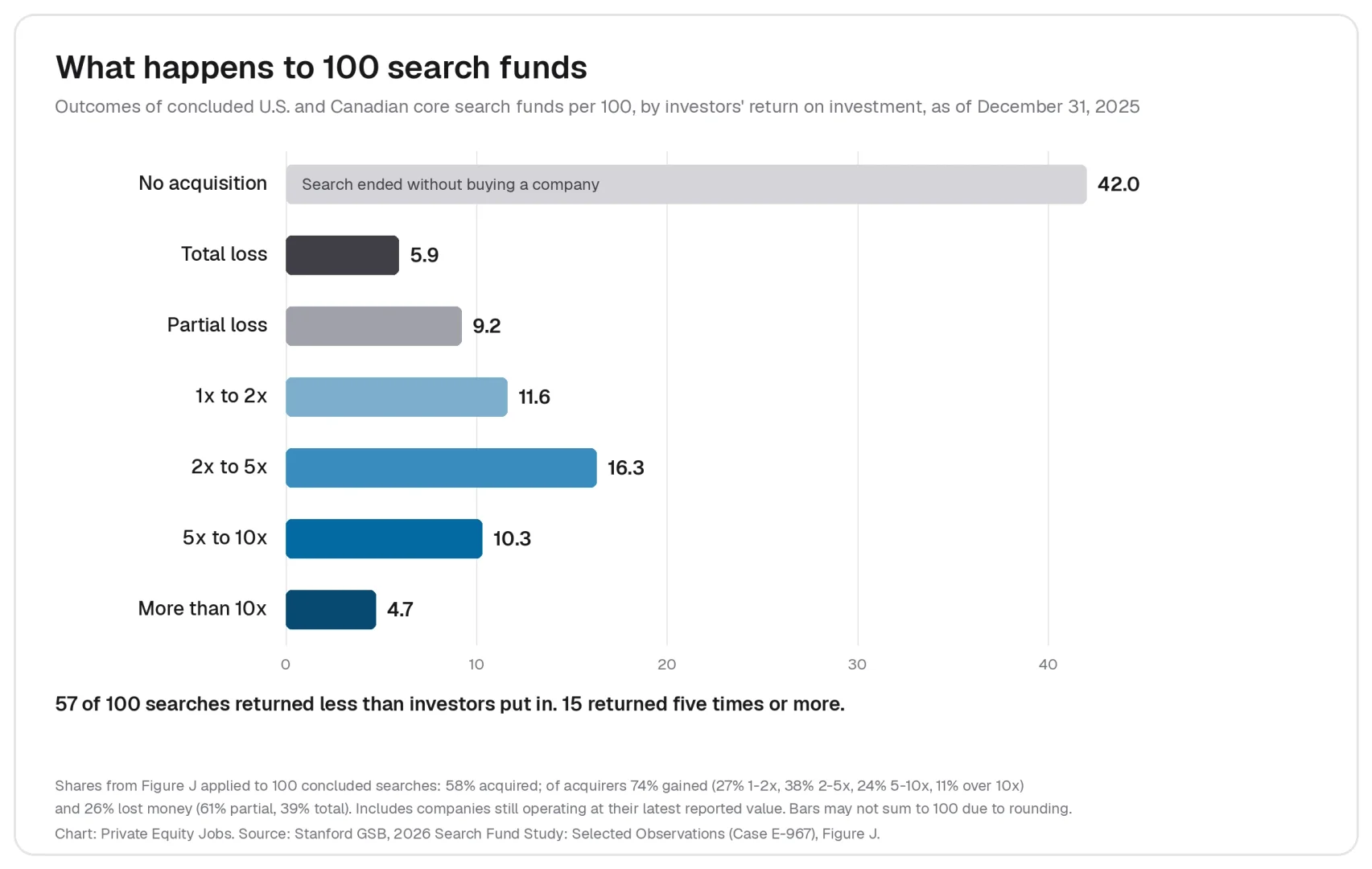
The average hides how unevenly the returns are spread. Applying the shares in the study's outcome chart to 100 concluded searches gives the picture in the chart above: 42 made no acquisition, about 15 bought a company and lost money (9 lost part of it and 6 all of it), and about 43 produced a gain. About 16 returned two to five times the money, 10 returned five to ten times and fewer than 5 returned more than ten times.
Those last few funds carry the asset class. Excluding funds that returned ten times or more cuts the aggregate return to 2.8 times and 27 percent a year. Excluding the top tenth by multiple cuts it to 2.1 times and 20 percent. The ten-times funds were usually older, with a median acquisition year of 2012 against 2018 for the rest, and bought smaller companies, at a median of $4.0m against $6.7m. Time matters too. In the study's outcome chart, companies that returned more than ten times had been held for 8.8 years if still operating and 9.8 years if sold, against 3.5 and 6.0 years for those that returned one to two times. Stanford warns that a portfolio with younger funds or larger deals may not match the study's averages. Because the top funds are rare, Stanford notes, it is hard to match the overall result within any single investor's portfolio.
Stanford also found higher returns for companies with high recurring revenue, for deals that used debt at acquisition, for services businesses and for partnered searches.
Outside the United States and Canada
IESE Business School in Barcelona tracks search funds elsewhere. Its International Search Funds 2026: Selected Observations (Juan Naranjo, Ann-Sophie Kowalewski, Peter Kelly and Jan Simon) covers 492 funds in 48 countries and reports an aggregate return of 2.8 times and 30 percent a year, up from 2.0 times and 18 percent two years earlier. Of the 296 international searches that had concluded, 216, or 73 percent, bought a company, a higher rate than in the United States and Canada. The median international deal cost $12m at 5.7 times EBITDA.
Search fund vs private equity
A search fund and a buyout fund both buy private companies with outside money and some debt, aim to grow them and sell them later. The structure of the money and the role of the person who finds the deal are different.
| Search fund | Buyout private equity fund | |
|---|---|---|
| Companies owned | One | A portfolio, often 10 to 20 |
| Who runs the company | The searcher, as chief executive | Hired or existing management, overseen by the firm |
| Capital | Search capital, then acquisition equity raised deal by deal | Committed fund capital, called as deals close |
| Size of the vehicle | Median search capital of $600,000 (2024 to 2025), then several million dollars of acquisition equity for one deal | Commitments of hundreds of millions or billions of dollars |
| Investors' choice | Right but not obligation to invest in each deal | Committed in advance; the firm picks deals |
| Investors' risk | Concentrated in one company; most of the search capital is lost if there is no deal | Spread across a portfolio of companies |
| Investors' involvement | Many advise the searcher, and some sit on the board | Limited partners are usually passive |
| Pay for the person who finds deals | Salary from search capital, then up to 25 to 30 percent of one company, vesting in three tranches | Management fee and carried interest, a share of profit across the fund |
| Typical company | $1.5m to $5m of EBITDA; 2024 to 2025 median price $16.0m | Larger; middle-market and large funds buy companies worth hundreds of millions or billions |
| Timing | No fixed exit date; best results from long holds | Fund life of about ten years sets the hold period |
| Deal sourcing | Searcher contacts owners directly | Deal team plus banks and brokers |
| Board | Searcher's investors | The fund's partners |
The fund-size and company-size row compares typical cases. A small buyout fund can buy a company as small as a large search fund deal, and some search fund companies have been sold to buyout firms. INSEAD Knowledge reports buyout firms in Spain buying companies that searchers had built.
The difference that matters most to investors is the commitment. A limited partner in a buyout fund commits money for years and lets the general partner choose the deals. A search investor commits a small amount to a person, then decides whether to back the specific company, which is closer to how investors back an independent sponsor deal by deal. The difference that matters most to the searcher is that they own a large piece of one company and run it, rather than a small share of profits across many.
The economics also differ in who pays for the search. In a buyout fund the management fee pays the deal team's salaries. In a search fund the investors pay the searcher's salary out of search capital and recover that money, with a step-up, only if there is a deal.
Search fund vs private equity as a career
For someone working in private equity, a search fund means giving up a salaried seat on a deal team for a two-year attempt to find, buy and run one company. Private equity is the second most common background among searchers who launched in 2024 and 2025, at 18 percent, behind management consulting at 19 percent and ahead of investment banking and finance at 15 percent. The median searcher in that group was 32 years old, and 80 percent had an MBA, most of them starting the search a year after graduating. Sixty-one percent had taken a course on entrepreneurship through acquisition.
What carries over from a private equity associate role is the deal work: screening companies, building a leveraged buyout model, negotiating a letter of intent, running diligence and arranging debt. What does not carry over is the rest of the job. A searcher spends most of two years persuading owners who have never thought about selling, works without a team, and then has to manage 30 or so employees. Stanford finds that partnered searchers and those with more work experience after graduate school buy companies more often.
The pay is also shaped differently. Searchers active in 2024 and 2025 earned an average of $148,000 while searching. New chief executives earned a median of $256,000 in salary and bonus, and those with more than five years in the job a median of $325,000. The money that makes the path worthwhile is the equity, and its distribution is wide. Among chief executives of companies still operating, 19 percent reported equity worth $10m or more and 24 percent reported none, either because they had just started or because the company had lost value. A private equity professional who stays on the career path earns more cash in the early years and builds carried interest across a fund. A searcher gives that up for a 42 percent chance of finding nothing (52 percent for searchers who launched from 2021 to 2024) and, if the search succeeds, a concentrated stake in one company.
Search fund investing is also a job in its own right. Some investment firms specialize in search funds and hire associates and former searchers, and some buyout firms back searchers directly. Students often work for a searcher as interns, and Searchfunder, the main online community for searchers, runs a job board for those roles.
Other kinds of search
The core model is the most studied form of buying a small company to run, but not the only one. The Yale note on search fund structures describes several others.
- Self-funded search. The searcher pays for the search themselves, draws no salary and may own up to 100 percent of the company. Deals are smaller, often $500,000 to $1.5m of EBITDA, and are financed with bank debt, often Small Business Administration 7(a) loans that the buyer personally guarantees, plus seller debt and a small amount of personal or outside equity. SearchFund.org, a community site for searchers, puts senior bank debt at 50 to 90 percent of a typical self-funded deal and a seller note at 10 to 30 percent. Lenders' rules then apply, including the SBA requirement for a quality of earnings report on larger purchases. The searcher keeps control but carries the risk and the costs of failed deals.
- Accelerators. A sponsor organization trains searchers, pays a salary during the search, provides diligence experts, lenders and mentors, and supplies equity alongside the debt the searcher arranges. The searcher keeps control of the deal and typically receives a significant share of the equity at exit.
- Single-sponsor search. One investor, often a family office, funds the search instead of a group, which gives the searcher one source of capital and advice.
- Narrower variants. The Yale note also describes accelerators for self-funded searchers and for mid-career professionals, searches concentrated on one industry, one region or a handful of investors, impact vehicles that add social goals such as employee ownership, searches in emerging markets, and programs in which the searcher can earn a majority of the equity by meeting growth targets.
- Long duration enterprises. Also called holding companies or committed-capital vehicles, these raise $10m to $25m of preferred equity up front on a specific thesis, plan to own companies for ten years or more and buy several businesses. Two-thirds of founders run their first acquisition for a median of two years, then move to the parent company to make more acquisitions. Stanford counted 67 in the United States and Canada, 63 percent launched in 2024 or later. Their founders raised a median of $20m from 17 investors, and 96 percent of those launched by 2023 had bought at least one company.
The Stanford and IESE return figures cover only core search funds. Self-funded searches and the other models carry different risk and pay, and their results are not in those numbers.
Selling to a search fund
For a business owner, a searcher is a buyer who will run the company personally, which matters to owners who care what happens to employees and customers after they leave. EdgePoint, a mergers and acquisitions adviser to sellers, lists the situations where a search fund fits: the owner wants to retire or cut back, there is no successor in the company or family, the industry knowledge the business needs can be learned quickly and the business has low risk.
The trade-offs are certainty and price. A searcher does not have the money in hand at signing, because investors decide after the deal is agreed, and is often doing a first deal. EdgePoint says in a 2020 note to sellers that this makes closing less certain and slower than with a buyout firm or a corporate buyer, and that search funds may not offer the highest price in an auction. The primer agrees that buyout firms and corporate buyers usually have the advantage in a competitive sale. Sellers often keep some equity or lend part of the price through a seller note, and many stay on for a short transition. EdgePoint advises sellers to judge a searcher on their professional background, search history, investors, lender support and character, which in its experience decide whether a deal closes. It also notes that some searchers later refinance their original investors and stay on as the sole owner.
How to start a search fund
- Decide whether the role fits. The primer lists traits that successful searchers share, including attention to detail and perseverance, and notes that a searcher may contact thousands of companies, visit 50, submit 10 letters of intent and run diligence on one to three before buying one.
- Choose solo or a partner. Partnered searches buy companies more often and have produced higher returns, but split the equity.
- Write the private placement memorandum. It sets out the searcher's background, search strategy, target criteria, budget and terms.
- Raise the search capital. Recent searchers raised about $550,000 each from about 13 investors in three months.
- Search. Pick industries or an opportunistic approach, build a list of owners, and aim to sign a first letter of intent within a year.
- Close and run the company. Raise the acquisition equity and debt, form the board, and plan the first year as a period of learning.
Business schools now teach the model, and Stanford, IESE, Yale and INSEAD publish free material. Searchfunder charges $6 a month for a basic membership and $19 for a professional one.
Frequently asked questions
Is a search fund private equity?
In the broad sense, yes. Outside investors buy equity in a private company. In the way people in the industry use the term, private equity usually means a firm that raises a fund and buys several companies, and a search fund is a separate path.
How successful are search funds?
About 58 percent of concluded U.S. and Canadian searches have bought a company, and 48 percent for funds launched from 2021 to 2024. Of those that bought, 74 percent reported a gain. Investors as a group earned 33.9 percent a year and 4.75 times their money, but most of that came from a small number of very successful companies.
How much do search fund CEOs make?
New chief executives earned a median of $256,000 in salary and bonus in Stanford's 2026 study, and those with more than five years in the job $325,000. Equity is the larger part of the reward and varies widely, from nothing to more than $10m.
How long does a search take?
The median searcher who bought a company since 2020 took 20 months. Search capital is usually budgeted for about two years, and the primer notes that some searches take three years or more.
What is the difference between a search fund and venture capital?
Venture capital funds young companies that are usually losing money and need to grow fast. A search fund buys an established, profitable company and expects returns from steady improvement and debt repayment.
Do you have to pay for Searchfunder?
Yes. Searchfunder is a subscription community, at $6 a month for basic membership and $19 for professional, according to its site.
Sources
Stanford Graduate School of Business, 2026 Search Fund Study: Selected Observations (Case E-967, June 30, 2026, revised October 29, 2026). Stanford Graduate School of Business, A Primer on Search Funds (Case E-958, 2026 edition). IESE Business School, International Search Funds 2026: Selected Observations (ST-689-E, 2026). Yale School of Management, Exploring Various Search Fund Structures (2021). The outcomes chart and the vesting table are Private Equity Jobs arithmetic on the Stanford figures and primer terms.
Related posts
What a debt schedule is, the inputs and formulas for each line, how to handle interest circularity, what a real excess cash flow sweep requires, and a debt schedule built from the 3G Capital buyout of Skechers.
What unlevered free cash flow is, how to calculate it line by line, how it differs from levered free cash flow, and how Olo's 2025 merger proxy used two versions of it.

The income statement, balance sheet and cash flow statement explained, every link between them traced through Sealed Air's 2025 10-K, and how to answer "walk me through the three financial statements" and its follow-ups.